Jiji Beyond the Little Train: The Solitude and Vastness of Riding to the Jiji Mountain Relay Station
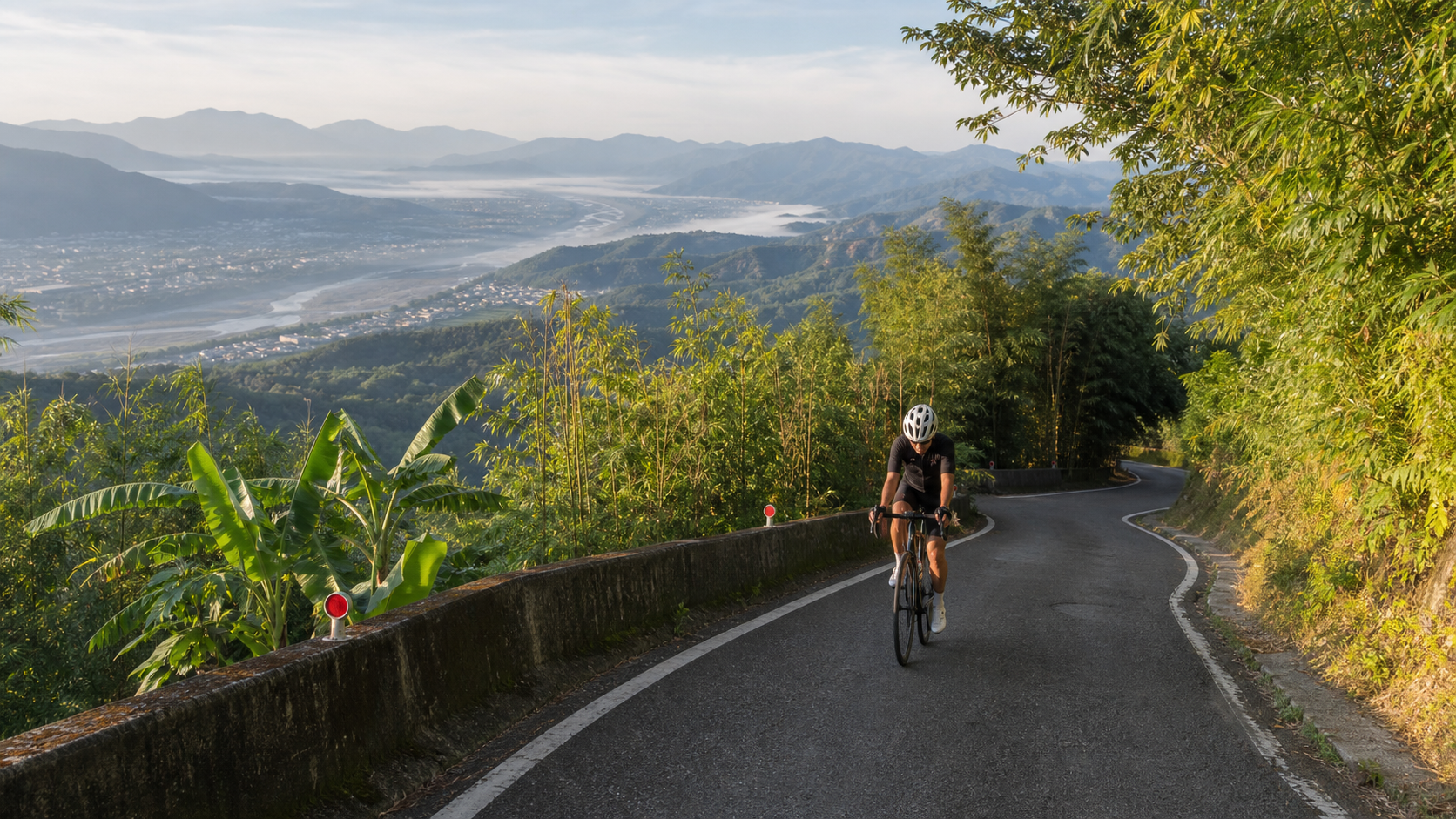
The Jiji most people know is the green tunnel lined with camphor trees, the slow-moving blue little train, and the sun-dappled railway scenery on postcards. But Jiji actually has another face—one hidden in the mountain forests behind the town, a face belonging to climbers.
Following the industrial road upward, passing through a green tunnel of bamboo groves and banana trees, you climb over a thousand meters until you reach the Jiji Mountain television relay station at an elevation of about 1,392 meters. This 14.39-kilometer road with an average gradient of 7% is Jiji’s quietest and most storied side. This article wants to take you into this mountain forest forgotten by tourists.
Jiji: A Town with Memories
To understand Jiji Mountain, you first have to understand Jiji.
Jiji is a charming town in Nantou, famous for the Jiji Line railway, the Green Tunnel, and the scenery of the Zhuoshui River. What’s most moving here is the traces left by time. The Jiji Town Loop Bicycle Path is about 17.52 kilometers long, lined with camphor trees, where you can see Japanese-style buildings, Qing Dynasty relics, the scars left by the 921 Earthquake, and the grandeur of the Zhuoshui River Gorge. And on County Road 152 between Mingjian Township and Jiji Township, that Green Tunnel of about 4.5 kilometers planted with roughly five hundred camphor trees is Jiji’s signature—at night, small lights are strung up in the trees, turning the entire road into a golden tunnel.
The 921 Earthquake once devastated this town, and Jiji Station briefly collapsed. But the people of Jiji turned their scars into memories and stood the town back up. When you ride through here, every stretch of road beneath your wheels carries the resilience of this town.
From Green Tunnel to Green Tunnel
Interestingly, this climbing road up Jiji Mountain also has its own “Green Tunnel”—it’s just not on the tourist map.
Starting from the industrial road trailhead behind Jiji’s town center, you climb up the winding road, flanked by greenery woven from bamboo groves, mixed woods, and banana trees. Sunlight filters through layers of leaves, dancing across the asphalt in patches of light. This “hidden Green Tunnel” has no little train, no tourists—just you, your bike, and the breathing of the mountain forest.
The higher you ride, the farther the town’s clamor fades, and the clearer the birdsong and cicada calls become. Occasionally, around a bend, the view suddenly opens up—the Jiji town and the Zhuoshui River valley spread out below your feet, with mountain ranges stacked in the distance. This kind of “exclusive scenery earned through sweat” is something tourists on the little train will never see.
First Person: The Solitude and Vastness of the Road to the Relay Station
I chose a slightly cool early morning to head up the mountain. Jiji’s town center hadn’t fully woken up yet, and the air carried the scent of dew. Turning onto the industrial road, the gradient wasn’t brutal, but it stretched on endlessly—this kind of road that’s “not too steep, but always climbing” is the true test of mental fortitude.
I barely encountered anyone along the way. Only the bamboo groves rustling in the wind, and banana leaves gently swaying overhead. I kept my pace very slow, letting my breath and pedaling fall into sync. This solitude isn’t frightening—it’s calming. The world shrinks to just the road ahead, and stray thoughts are gradually wrung out by the climb, leaving only pure focus.
When I reached the relay station at about 1,392 meters, the transmission tower stood there in lonely isolation. I parked my bike and walked to the spot with the best view—the entire central valley spread out before me. Jiji, the Zhuoshui River, distant Mingjian and Zhushan, even the plains further beyond, all captured in a single glance. In that moment, the vastness made the 14-kilometer climb all worth it. There was no celebratory archway, no cheering crowd—just the wind and me. But I knew this was my own personal summit.
Flavors and Hospitality Along the Way
The Jiji Mountain industrial road itself has scarce supplies, but the town of Jiji at the foot of the mountain is the warmest supply station for this journey.
Jiji’s town center has all kinds of snacks and shops—the last source of energy before heading up, and the place to reward yourself after coming down. Around Jiji Station and along the Green Tunnel, there are always vendors selling traditional snacks and local produce. After the climb, descending into town, buying a bowl of hot food, sipping a cold drink, and sitting in front of the old station watching the little train pull in—this contrast between “mountain solitude” and “town’s lively烟火” is exactly what makes the road up Jiji Mountain so captivating.
What This Road Means to Riders
The Jiji Mountain relay station is a road you ride “not for fame.”
It doesn’t have Wuling’s elevation, no photo-op spots of trendy routes, and doesn’t even have a proper landmark. Those willing to ride it are mostly doing it for themselves—for that solid climb of over a thousand meters, for that undisturbed focus, for that feeling when you gaze into the distance from the summit: the grounded sense of “I made it up here on my own.”
What it teaches you is “how to endure solitude.” On this long, quiet industrial road, there are no spectators, no applause—just you and your own rhythm. When you learn to enjoy this solitude, you’ll discover that the deepest joy of cycling isn’t in results, but in the process of being alone with yourself. Jiji Mountain is exactly that kind of silent yet honest teacher.
Seasonal Scenery
- Spring: The mountain forests turn fresh green, bamboo groves are tender and verdant—the most comfortable riding season.
- Summer: Low elevations are muggy, but the Green Tunnel offers cool shade; an early morning ascent is most pleasant.
- Autumn: Clear skies and crisp air, the best visibility—the view of the Zhuoshui River Valley from the summit is especially sharp.
- Winter: Mornings are cold but dry; the summit is often wrapped in clouds and mist, offering a uniquely bleak beauty.
Suggested Itinerary
You can fit Jiji Mountain into a one-day trip like this:
- Early morning: Depart from Jiji’s town center, challenge the Jiji Mountain relay station while it’s still cool, and enjoy the empty Green Tunnel.
- Late morning: Descend back to Jiji’s town center, visit Jiji Station and the Green Tunnel, and soak in the town’s charm.
- Afternoon: Ride the Jiji Town Loop Bicycle Path, see Japanese-style buildings, Qing Dynasty relics, and the Zhuoshui River Gorge, and stop by the 921 Earthquake Museum of Taiwan.
- Evening: Enjoy local cuisine in town with a cold drink, slowly wrapping up this journey of “one mountain, one town.”
Jiji Mountain doesn’t make a fuss, yet it leaves a deep impression on those willing to ride upward. It reminds us: the most precious scenery often isn’t on the bustling map, but in those places where you’re willing to sweat alone and arrive alone. Next time you come to Jiji, besides taking the little train, try riding up that mountain—you’ll encounter a quieter, and vaster, Jiji.
The Scars and Rebirth of 921: Jiji’s Resilience
To understand Jiji, you can’t leave out the 921 Earthquake. That catastrophic quake of 1999 devastated this town—Jiji Station briefly collapsed, many buildings toppled, and the town lay in ruins. But the people of Jiji weren’t defeated. They turned their scars into memories, rebuilt their homes brick by brick, and stood the town back up.
Today, riding through Jiji, you can still see the traces left by the 921 Earthquake along the Jiji Town Loop Bicycle Path—testimony to this town’s resilient vitality. When you ride past these places, every stretch of road beneath your wheels carries the sweat and will of the people of Jiji rebuilding their homes. This resilience echoes the spirit of climbing in a curious way—both are about standing back up after falling, about not giving up in the face of difficulty. Perhaps that’s why this town of Jiji can especially touch the hearts of every rider striving upward. It reminds us: whether it’s a mountain or a low point in life, as long as you don’t give up, there’s always a day you’ll stand back up and reach the summit.
Two Faces of the Green Tunnel
Jiji’s most famous landmark is that Green Tunnel lined with camphor trees. Located on County Road 152 between Mingjian Township and Jiji Township, the tunnel is about 4.5 kilometers long, with roughly five hundred camphor trees on both sides, their dense branches and leaves weaving a verdant passage overhead. By day, sunlight filters through the gaps in the leaves, casting dreamlike light and shadow; by night, small lights are strung up in the trees, turning the entire road into a golden tunnel.
Interestingly, the climbing industrial road up Jiji Mountain also has its own Green Tunnel—it’s just not on the tourist map. Starting from the trailhead behind Jiji’s town center, the roadside is woven with greenery of bamboo groves, mixed woods, and banana trees, with sunlight dappling the asphalt. This hidden Green Tunnel has no little train, no tourists—just you, your bike, and the breathing of the mountain forest. Both are green tunnels—one bustling and crowded with tourists, the other quiet and solitary, belonging only to those willing to ride upward. This contrast is exactly what makes the road up Jiji Mountain so captivating—it lets you see a quieter Jiji that tourists will never see.
The Zhuoshui River and the Jiji Line Railway: The Lifeblood of the Land
The land of Jiji is nourished by two lifelines—one is the Zhuoshui River, and the other is the Jiji Line Railway. The Zhuoshui River is Taiwan’s longest river, named for the heavy sediment carried in its waters. This river has carved out magnificent gorges while nurturing fertile land and abundant produce along its banks. When you ride up Jiji Mountain and gaze out from the relay station, the valley spreading beneath your feet is a masterpiece shaped by the Zhuoshui River over thousands of years.
The Jiji Line Railway, meanwhile, is the other lifeline of this land. This branch railway line has carried generation after generation of people and goods through the mountains and waters of Jiji. The image of a small blue train slowly passing through a green tunnel is the impression of Jiji etched into countless Taiwanese memories. When you ride past Jiji Station and watch the small train pull in, you feel a beauty of time interweaving—the old railway and the modern bicycle, on the same land, each writing their own stories of people and this landscape. Once you understand the Zhuoshui River and the Jiji Line, you’ll see Jiji Mountain not merely as a climb, but as a journey deeply rooted in the lifeblood of this land.
First Person: The Solitude and Vastness of the Road to the Relay Station
I chose a slightly cool early morning to head up the mountain. The Jiji town center hadn’t fully awakened yet, and the air carried the scent of dew. Turning onto the industrial road, the gradient wasn’t brutal, yet it stretched on endlessly—this kind of road, never too steep but always climbing, tests your resolve the most.
I encountered almost no one along the way. Only bamboo groves rustling in the wind, banana leaves swaying gently overhead. I kept a very slow pace, letting my breathing and pedaling fall into sync. This solitude wasn’t frightening; it was calming—the world shrank to just the road ahead, distractions gradually wrung out by the climb, leaving only pure focus. When I reached the relay station, at an elevation of approximately 1,392 meters, the transmission tower stood there in isolation. I parked my bike and walked to the spot with the best view—the entire central valley unfolded before me. Jiji, the Zhuoshui River, distant Mingjian and Zhushan, even the plains further beyond, all captured in a single glance. In that moment, the vastness made the 14 kilometers of climbing entirely worth it. No celebratory archway, no cheers—just the wind and me. But I knew this summit belonged to me alone.
What This Road Means to Riders: Enduring the Solitude
Jiji Mountain Relay Station is a road ridden not for fame. It lacks the elevation of Wuling, has no check-in points for social-media-worthy routes, and doesn’t even have a proper landmark. Those willing to ride it are mostly doing so for themselves—for the solid climb exceeding a thousand meters, for the undisturbed focus, for that feeling of “I made it up here on my own” when gazing out from the summit.
What it teaches you is to endure solitude. On this long, quiet industrial road, there are no spectators, no applause—only you and your own rhythm. When you learn to embrace this solitude, you discover that the deepest joy of cycling lies not in results, but in the process of being alone with yourself. In this era where everything demands sharing and likes, to have a stretch of road, a stretch of time, purely spent with yourself, not for anyone else to see, riding only for yourself—this in itself is a luxurious form of happiness. Jiji Mountain is exactly such a silent yet honest teacher. It teaches you that the most precious scenery often isn’t found on crowded maps, but in those places you’re willing to reach alone, sweating on your own.
Seasons and Side Trips: One Mountain, One Town
Jiji Mountain has its own character in every season: in spring, the mountains are freshly green with tender bamboo shoots; in summer, the lower elevations are muggy, but the Green Tunnel offers cool shade, making early morning rides most pleasant; in autumn, the weather is crisp with the best visibility, and the view of the Zhuoshui River valley from the summit is especially clear; in winter, early mornings are cold but dry, and the summit is often wrapped in clouds and mist, carrying a distinct bleak beauty.
To fit Jiji Mountain into a day trip, here’s how you might arrange it: set out from Jiji town center in the early morning, take on the Jiji Mountain Relay Station while it’s still cool, and enjoy the empty Green Tunnel; after descending in the late morning, return to Jiji town center to visit Jiji Station and the Green Tunnel, soaking in the town’s charm; in the afternoon, ride the Jiji Loop Bicycle Path to see Japanese-era architecture, Qing Dynasty relics, and the Zhuoshui River gorge, stopping by the 921 Earthquake Museum of Taiwan along the way; in the evening, enjoy local cuisine in town with a cold drink, slowly wrapping up this journey of one mountain and one town. Jiji Mountain doesn’t make a fuss, yet it leaves a deep impression on those willing to ride upward. It reminds us: the most precious scenery often isn’t found on crowded maps, but in those places you’re willing to reach alone, sweating on your own. Next time you visit Jiji, beyond taking the small train, try riding up that mountain—you’ll encounter a quieter, and more expansive, Jiji.
Jiji: A Town with Memories
Jiji is a charming town in Nantou, known for the Jiji Line Railway, the Green Tunnel, and the scenery of the Zhuoshui River. What’s most moving here is the traces left by time. The Jiji Loop Bicycle Path spans approximately 17.52 kilometers, lined with camphor trees, offering views of Japanese-era architecture, Qing Dynasty relics, and the grandeur of the Zhuoshui River gorge. And on County Road 152 between Mingjian Township and Jiji Township, the Green Tunnel—about 4.5 kilometers long with roughly five hundred camphor trees—is Jiji’s signature attraction: at night, small lights are strung through the trees, turning the entire road into a golden tunnel.
But Jiji actually has another face—one hidden in the mountains behind the town, belonging to climbers. Following the industrial road upward, passing through a green tunnel of bamboo groves and banana trees, you climb over a thousand meters until you reach the Jiji Mountain Television Relay Station at approximately 1,392 meters. This road, 14.39 kilometers with an average gradient of 7%, is Jiji’s quietest and most storied side. Most people know Jiji for the camphor-lined Green Tunnel, the slowly passing blue train, the sun-dappled railway scenery on postcards. Only those willing to ride up the mountain encounter the more expansive, more solitary, and more authentic Jiji.
Flavors and Warmth Along the Way
The Jiji Mountain industrial road itself has scarce supplies, but the town of Jiji below is the warmest resupply point for this journey. The Jiji town center offers a variety of snacks and shops—the last source of energy before heading up, and the place to reward yourself after descending. Around Jiji Station and along the Green Tunnel, vendors sell traditional snacks and local produce. After climbing the mountain and descending to town, buy a bowl of hot food, grab a cold drink, and sit in front of the old station watching the small train pull in—this contrast between the solitude of the mountains and the lively bustle of the town is precisely what makes the Jiji Mountain road so captivating.
This stark contrast makes every Jiji Mountain trip feel like an emotional journey. You can face the long climb and the silent emptiness alone on the mountain, then return to the bustling town below. One moment you’re gazing at the vast valley beneath the transmission tower; the next, you’re sitting before the old station, surrounded by the train’s whistle and tourists’ laughter. This shift from solitude to liveliness, from mountain forest to town streets, makes Jiji Mountain more than just a climb—it’s a complete experience combining challenge and healing. No wonder those who ride it keep coming back—they return not just for the thousand-meter climb, but for the warmth of that bowl of hot food, that cold drink, and that town with memories, waiting below.
From Green Tunnel to Green Tunnel
Interestingly, this climb up Jiji Mountain has its own green tunnel—it’s just not on any tourist map. Starting from the industrial road trailhead behind Jiji town center, winding upward along the curving road, you’re flanked by greenery woven from bamboo groves, mixed hardwoods, and banana trees. Sunlight filters through layers of leaves, dancing across the asphalt in patches of light. This hidden green tunnel has no small train, no tourists—just you, your bike, and the breathing of the mountain forest.
The higher you climb, the farther the town’s clamor recedes, and the clearer the birdsong and cicada calls become. Occasionally, a turn opens up the view suddenly—the town of Jiji and the Zhuoshui River valley spread out below, with layered mountain ridges in the distance. This exclusive scenery, earned through sweat, is something train-riding tourists will never see. Both are green tunnels—one bustling and crowded with sightseers, the other serene and solitary, belonging only to those willing to ride upward. This contrast is precisely what makes the Jiji Mountain road so captivating—it shows you a quieter Jiji that tourists never see. When you ride alone on this empty industrial road, you suddenly understand why some beauty can only be earned with your own legs and your own sweat; and precisely because it’s hard-won, that beauty is all the more profound and unforgettable.
The Jhuoshuei River and the Jiji Line: The Lifeblood of the Land
The land of Jiji is nourished by two lifelines—one is the Jhuoshuei River, and the other is the Jiji Line railway. The Jhuoshuei River is Taiwan’s longest river, its name derived from the vast amounts of sediment carried in its waters. This river has carved out magnificent gorges while also nurturing the fertile plains and abundant produce along its banks. When you climb Jiji Mountain and gaze out from the relay station, the valley spreading beneath your feet is a masterpiece shaped by the Jhuoshuei River over thousands of years.
The Jiji Line railway, meanwhile, is another lifeline of this land. This branch line has carried generation after generation of people and goods through the mountains and waters of Jiji. The image of a small blue train slowly gliding through the green tunnel is how countless Taiwanese people remember Jiji. When you ride past Jiji Station and watch the little train pull in, you feel a beauty of time interweaving—the old railway and the modern bicycle, on the same land, each writing their own stories of people and this landscape. Once you understand the Jhuoshuei River and the Jiji Line, Jiji Mountain becomes more than just a climb—it becomes a journey deeply rooted in the lifeblood of this land. And that is precisely why riding Jiji Mountain is something that calls for emotion—you are not merely challenging a mountain, but drawing close to a land nourished by rivers and railways for a hundred years.
What This Road Means to Riders: Enduring the Solitude
The Jiji Mountain relay station is a climb you ride not for fame. It lacks the elevation of Wuling, has none of the check-in spots of scenic Instagram routes, and doesn’t even have a proper landmark. Those who come to ride it do so mostly for themselves—for the solid climb of over a thousand meters, for the undisturbed focus, and for that feeling of looking out from the summit and knowing, with quiet certainty, that you made it up on your own.
What it teaches you is to endure solitude. On this long, quiet industrial road, there are no spectators, no applause—only you and your own rhythm. When you learn to embrace that loneliness, you discover that the deepest joy of cycling lies not in results, but in the process of being alone with yourself. In an age where everything demands sharing and likes, to have a stretch of road, a stretch of time, purely for yourself—not to show anyone, riding only for yourself—is itself a luxury of happiness. Jiji Mountain is exactly such a silent yet honest teacher. It teaches you that the most precious scenery is often not on the crowded map, but in those places you are willing to reach alone, sweating alone.
Related Reading
- Jiji Mountain Relay Station Guide: Pacing Tips for the 1,000-Meter Hard Climb Hidden Behind the Green Tunnel
- Nantou Jiji Line Bike Path: A Family Route of the Little Train and the Green Tunnel
- The Sacred Steep Climbs of a Hakka Hill Town: Riding into Shitan, Encountering Xianshan
- The Secret Steep Climb to the Sacred Tree: Route 56, An Encounter with Ancient Giants in the Deep Shade
觀霧 變好騎了! | 北高車友爆笑大會師 | 公路車 | 單車旅遊 Taiwan Cycling Route GuanWu
6 年前
台北闊瀨陡坡 騎旅 / 日本單車雜誌編輯車友臨時加入!/ 髮香才是最強的 / feat. 北迴歸線小隊 / 公路車 CT Yeh
6 個月前
一定要騎一次!阿里山最深處:里佳部落!單車旅行 | 2800m爬升 | 深度部落體驗:嗨翻晚會、螢火蟲、銀河 | feat. JJSC & 廢物伙伴 | 公路車 CT Yeh
9 個月前
新竹白蘭部落! 爬陡坡還能講笑話...? 廢物伙伴の約騎 | 公路車 | CT Yeh
4 年前
大武山後門26%歡樂陡坡!JJSC南台灣單車行Day2 / 被颱風追著跑 / 公路車 / CT Yeh
2 年前
一日北高 2022 廢物伙伴年度大戲 | 我們跨越濁水溪了 | 尖叫雞變滴雞精 | 公路車 | CT Yeh
3 年前
新竹羅平 x 天湖部落 大禹嶺級變態陡坡! 4K超高畫質 空拍 | 公路車
5 年前
高雄綠園道鐵路自行車道 / 外地人能輕鬆駕馭 還是整路崩潰? / 2025 全線開通 春節實地探索一次!(附GPS連結)/ 公路車 / CT Yeh
1 年前