Between Tea Aroma and a Sea of Clouds: Riding Tou 101 into the Hidden Ginkgo Forest of Dalun Mountain in Lugu
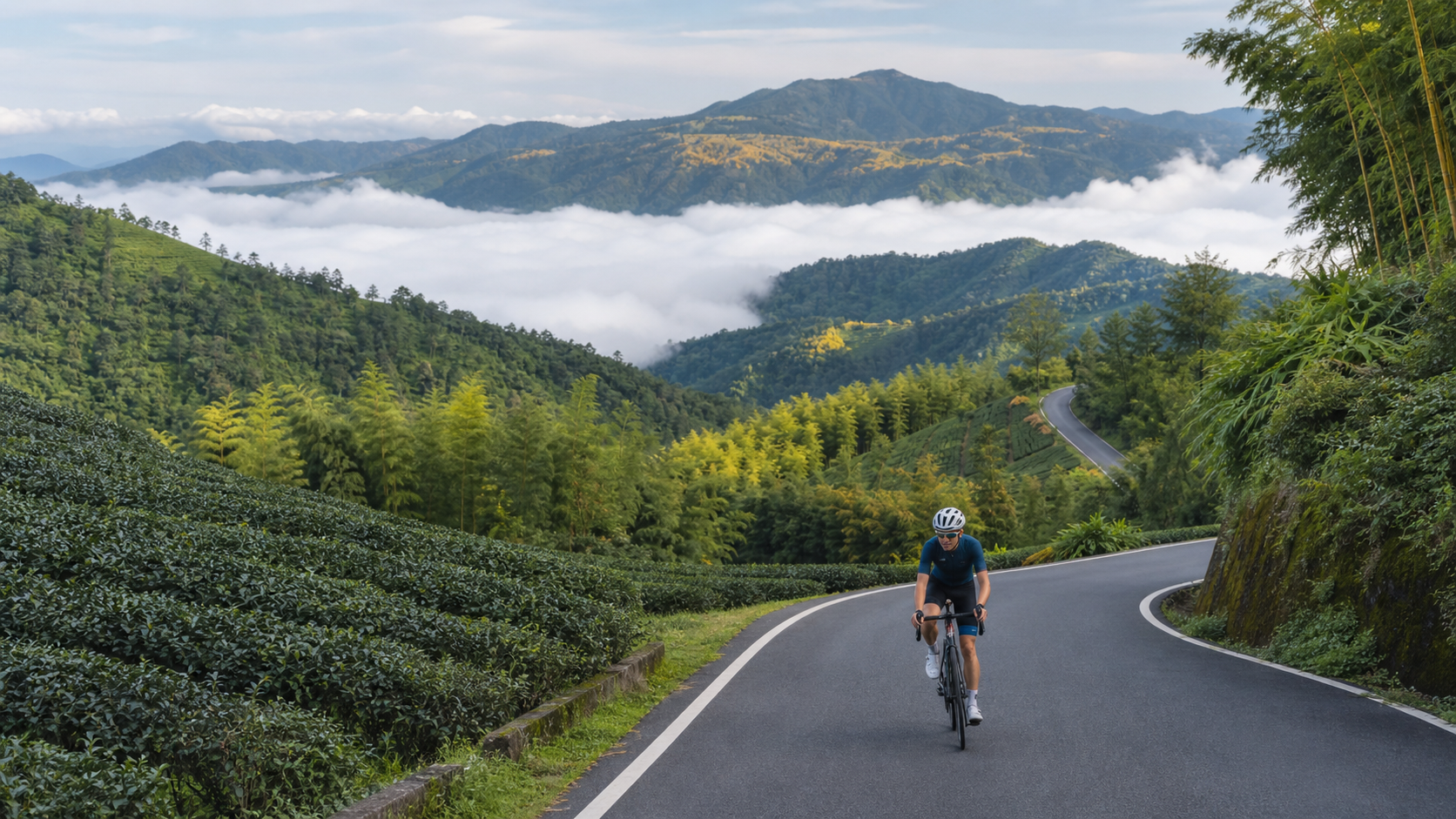
In Lugu, Nantou, a faint aroma of tea always lingers in the air. This is the birthplace of Dongding Oolong tea, where terraced tea gardens on the hillsides gleam with a glossy green under the sun. And Route Tou 101 is a gentle climbing road through this tea country—7.61 kilometers, 537 meters of elevation gain, with an average gradient of 4.3%. It doesn’t push you or torment you; it simply carries you quietly upward, into that hidden realm of bamboo groves, tea gardens, and ginkgo forests.
This article isn’t about pacing. It just wants to let you smell the tea of Lugu, see the sea of clouds over Dalun Mountain, and hear the stories this road slowly tells.
Lugu: A Mountain Town Wreathed in Tea Aroma
Lugu, located in Nantou, is one of Taiwan’s most renowned tea towns. The fame of Dongding Oolong tea has spread the name of this small mountain village far and wide. Its terrain is dominated by hills and mountains, with elevation rising gradually. Tea gardens blanket the hillsides, and the misty climate nurtures the tea leaves’ unique aroma and character.
Route Tou 101 winds upward from downtown Lugu toward Xitou and Dalun Mountain. Riding along this road, you’ll be surrounded by neat rows of tea gardens, bamboo groves rustling in the wind, and the occasional scent of tea farmers roasting leaves. This feeling of riding embraced by tea aroma and bamboo groves is Lugu’s unique gentleness. It’s not as dramatic as high mountains; instead, it’s like a warm cup of Oolong tea—sweet on the finish, and the more you savor it, the more flavor it reveals.
Xitou: The Gateway to the Forest
Continuing up Route Tou 101, you’ll arrive at Xitou. This is Lugu’s most famous forest recreation area, renowned for its towering cedar and Japanese cedar groves and crisp, clean air. The forest trails, the University Pond, and the sacred tree of Xitou are part of countless Taiwanese people’s travel memories.
For cyclists, Xitou is an important rest and supply stop along this road. After climbing a stretch, riding into the Xitou area, the coolness of the forest washes over you, and every breath feels sweeter. You can stop here, have a cup of tea, grab a bite, and let your body and mind recover in the embrace of the forest before deciding whether to push on toward the higher Dalun Mountain.
Dalun Mountain: Southeast Asia’s Largest Ginkgo Forest
If you’re willing to ride a bit higher, Route Tou 101 will lead you to a breathtaking hidden gem—the Dalun Mountain Ginkgo Forest.
Dalun Mountain sits at an elevation of roughly 1,250 to 1,600 meters, with ginkgo trees covering more than 80 hectares—the largest ginkgo forest in all of Southeast Asia. From the Dalun Mountain observation deck at about 1,500 meters, you can look down over layers of verdant ridges and, in a single glance, take in several counties across central Taiwan. If you’re lucky and the weather cooperates, you can witness an endless sea of clouds rolling beneath your feet like ocean waves.
Every late autumn and early winter, the ginkgo trees across the mountain shift from green to gold, painting the entire hillside in a dreamy shade of yellow. It’s a temperate-zone landscape rarely seen in Taiwan, drawing countless visitors on a pilgrimage to the summit. For cyclists, riding into this golden expanse under your own power is an especially romantic experience—others drive up to see the ginkgo trees, but you pedal, sweat, and climb your way inch by inch to bring this golden forest into view.
First Person: A Journey of Tea Aroma and a Sea of Clouds
I chose a clear autumn morning to set out from downtown Lugu. The morning mist hadn’t yet lifted, a thin layer of moisture clung to the tea gardens, and the air carried a cool, fragrant scent of tea. The gradient of Route Tou 101 was gentle, unhurried, letting me ride slowly and take in the scenery.
Along the way, tea gardens and bamboo groves slipped quietly past. Every so often, a turn would suddenly open up the valley view, with distant ridges appearing and disappearing through the mist. This rhythm was relaxing—no need to fight the gradient, no need to stare at the cyclocomputer, just follow your breath and pedal upward, stroke by stroke.
Riding into Xitou, the coolness of the forest made me stop. I took a sip of the hot tea I’d brought, watched the cedar trees soar into the sky, and listened to the wind threading through the treetops. After resting, I decided to push on toward Dalun Mountain. The higher I climbed, the steeper the road and the higher the altitude, with afternoon fog beginning to gather. When I finally reached the Dalun Mountain observation deck, the scene before me stole my breath—layers of green ridges spread out below, a sea of clouds surged like waves in the distance, and the ginkgo trees across the mountain were just turning from green to gold. In that moment, every drop of sweat became worth it.
A Taste Along the Way: A Cup of Dongding Oolong
On this road through Lugu, the flavor memory is always tea.
Dongding Oolong is Lugu’s pride. Along the way, there are many tea gardens and tea shops where you can stop and savor a cup of local tea. When you’re tired from climbing, sit by a tea garden, brew a pot of warm Oolong, and gaze at the valley below—this is Lugu’s version of leisure. Beyond tea, the Xitou and Dalun Mountain areas also offer local mountain produce and hot pot dining. Meals near the Dalun Mountain observation deck taste especially good with a sea of clouds as the backdrop.
What This Road Means to Cyclists
For many riders, Route Tou 101 is “the gentleness of getting started.” With its relatively approachable gradient, it lets beginners experience for the first time the sense of accomplishment that comes from “climbing a mountain on your own strength,” without being scared off by steep slopes. For many, it’s the starting point of falling in love with climbing.
For seasoned riders, Route Tou 101 is a road that can be “as deep or as shallow as you want”—if you want to train, it’s a great aerobic workout; if you want to relax, it’s a leisurely path to tea aroma and a sea of clouds. What it teaches us is that cycling doesn’t always have to be about pushing yourself to the limit. Sometimes, slowing down, smelling the tea, and watching the sea of clouds is the most authentic joy of riding.
Seasonal Scenery
- Spring: Tea gardens are lush green, spring tea fills the air with fragrance—a great season for tea tasting and riding.
- Summer: Lower elevations are muggy, but Dalun Mountain’s high altitude and cool climate make it a great place to escape the heat.
- Late Autumn to Early Winter: The ginkgo trees on Dalun Mountain turn from green to gold, blanketing the mountain in yellow—the most dreamlike season on this road.
- Winter: Winter fog wraps the tea country in a uniquely cool, serene beauty, but temperatures on Dalun Mountain are low, so warm clothing is essential.
Suggested Itinerary
You can fit Route Tou 101 into a day trip like this:
- Early morning: Set out from downtown Lugu, ride along Route Tou 101 toward Xitou while it’s still cool, and enjoy the tea garden scenery along the way.
- Late morning: Arrive at Xitou, stroll the forest trails and University Pond, and breathe in the fresh forest air.
- Afternoon: Extend your ride to Dalun Mountain, climb to the observation deck, and gaze out over the sea of clouds and green ridges (or golden ginkgo trees in autumn and winter).
- Evening: Return to Lugu, savor a pot of Dongding Oolong, enjoy a meal of local mountain produce, and slowly bring this tea-scented journey to a close.
Route Tou 101 is a road that makes you fall in love with “slow riding.” It reminds us that cycling isn’t just about chasing numbers and mileage—it’s also about rediscovering that carefree, contented feeling between tea aroma and a sea of clouds. Next time you’re in Lugu, don’t just buy tea in town—ride up Route Tou 101 and head into that hidden realm of bamboo groves, forests, and ginkgo trees. What you’ll bring back isn’t just a ride, but a whole mountain’s worth of tea aroma and sea of clouds.
Lugu: A Mountain Town Wreathed in Tea Aroma
Lugu, located in Nantou, is one of Taiwan’s most renowned tea towns. The fame of Dongding Oolong tea has spread the name of this small mountain village far and wide. Its terrain is dominated by hills and mountains, with elevation rising gradually. Tea gardens blanket the hillsides, and the misty climate nurtures the tea leaves’ unique aroma and character. Route Tou 101 winds upward from downtown Lugu toward Xitou and Dalun Mountain. Riding along this road, you’ll be surrounded by neat rows of tea gardens, bamboo groves rustling in the wind, and the occasional scent of tea farmers roasting leaves.
This feeling of riding embraced by tea aroma and bamboo groves is Lugu’s unique gentleness. It’s not as dramatic as high mountains; instead, it’s like a warm cup of Oolong tea—sweet on the finish, and the more you savor it, the more flavor it reveals. Continuing up Route Tou 101, you’ll arrive at Xitou—Lugu’s most famous forest recreation area, renowned for its towering cedar and Japanese cedar groves and crisp, clean air. For cyclists, Xitou is an important rest and supply stop along this road. After climbing a stretch, riding into the Xitou area, the coolness of the forest washes over you, and every breath feels sweeter. You can stop here, have a cup of tea, grab a bite, and let your body and mind recover in the embrace of the forest before deciding whether to push on toward the higher Dalun Mountain.
Dalun Mountain: Southeast Asia’s Largest Ginkgo Forest
If you’re willing to pedal a bit further uphill, Route Tou 101 will lead you to a breathtaking hidden gem—the Dalun Mountain Ginkgo Forest. Dalun Mountain sits at an elevation of roughly 1,250 to 1,600 meters, with ginkgo trees covering over 80 hectares, making it the largest ginkgo forest in all of Southeast Asia. From the Dalun Mountain Observation Deck at about 1,500 meters, you can gaze down over layers of verdant mountain ridges and take in several counties across central Taiwan in a single sweep. If you’re lucky and the weather cooperates, you might even witness an endless sea of clouds rolling beneath your feet.
Every late autumn and early winter, the ginkgo trees across the mountain shift from green to gold, painting the entire slope in a dreamlike golden hue. It’s a temperate-zone landscape rarely seen in Taiwan, drawing countless visitors on a pilgrimage to witness it. For cyclists, being able to ride into this golden expanse on your own legs is an especially romantic experience—others drive up to see the ginkgo trees, but you’re turning the pedals, breaking a sweat, and climbing inch by inch until this golden forest unfolds before your eyes. Dongding Oolong tea is Lugu’s pride, and along the way you’ll pass numerous tea gardens and tea shops where you can stop for a cup of local excellence. When the climbing wears you out, sit by a tea garden, brew a pot of warm oolong, and gaze blankly at the valley—this is the leisurely pace that belongs to Lugu. For many riders, Route Tou 101 is a gentle introduction. With its relatively forgiving gradients, it lets beginners experience for the first time the sense of accomplishment that comes from climbing a mountain on their own strength, without being scared off by steep slopes. It’s where many people’s cycling journey of falling in love with climbing begins, and it’s a road that will make you fall in love with slow riding, with savoring the moments between tea fragrance and seas of clouds.
Xitou: The Gateway to the Forest
Continuing up Route Tou 101, you’ll arrive at Xitou. This is Lugu’s most famous forest recreation area, renowned for its towering cedar and Japanese cedar forests and crisp, clean air. Xitou’s forest trails, University Pond, and sacred tree are part of countless Taiwanese people’s travel memories. For cyclists, Xitou is an important rest and resupply point along this road. After climbing a stretch, riding into the Xitou area, the coolness of the forest washes over you, and every breath tastes sweet and fresh.
You can stop here, have a cup of tea, grab a bite to eat, and let your body and mind recover in the embrace of the forest before deciding whether to push on toward the higher Dalun Mountain. What makes Xitou so enchanting is that it transforms the fatigue of climbing into the healing power of a forest bath in an instant. One moment you’re gasping for breath on the slope, the next you’re standing among towering cedar trees, drawing in a deep breath of air rich with phytoncides—that sense of physical and mental ease is a reward unique to this road. For many riders, being able to catch their breath and sip a hot cup of tea in Xitou’s forest is itself one of the biggest reasons to ride Route Tou 101. It makes cycling about more than just sweat and challenge—it becomes a journey of intimate communion with the forest and nature.
First Person: A Journey of Tea Fragrance and Seas of Clouds
I chose a clear autumn morning and set out from downtown Lugu. The morning mist had yet to lift, a thin layer of moisture clinging to the tea gardens, the air carrying the cool, crisp scent of tea. The gradients on Route Tou 101 are gentle, unhurried, letting me ride slowly and take in the views at my own pace. Along the way, tea gardens and bamboo groves drifted slowly past me. Every so often, a turn would suddenly open up the valley vista, distant ridges appearing and disappearing through the clouds and mist. This rhythm is relaxing—no need to battle the gradient, no need to stare at the bike computer, just follow your breathing and pedal upward, stroke by stroke.
Riding into Xitou, the coolness of the forest made me stop. I took a sip of the hot tea I’d brought along, watched the cedar trees soar into the sky, and listened to the wind threading through the treetops. After resting, I decided to push on toward Dalun Mountain. The higher I climbed, the steeper the road and the higher the elevation, with afternoon fog beginning to gather. When I finally rode up to the Dalun Mountain Observation Deck, the sight before me stole my breath—layers of emerald ridges spread out beneath my feet, a sea of clouds rolling like waves in the distance, and the ginkgo trees across the mountain just beginning to turn from green to gold. In that moment, every drop of sweat became worth it. For me, Route Tou 101 has long ceased to be just a climbing road—it’s a road that leads to beauty: to tea fragrance, to forests, to seas of clouds and golden ginkgo hidden realms. It taught me that the best part of cycling isn’t necessarily conquering the highest mountain, but in the slow riding, encountering these breathtaking landscapes—and encountering the version of yourself willing to slow down and truly savor the moment.
What This Road Means to Cyclists
For many riders, Route Tou 101 is a gentle introduction. With its relatively forgiving gradients, it lets beginners experience for the first time the sense of accomplishment that comes from climbing a mountain on their own strength, without being scared off by steep slopes. It’s where many people’s cycling journey of falling in love with climbing begins. And for seasoned riders, Route Tou 101 is a road that can be as challenging or as easy as you make it—if you want a workout, it’s a great aerobic training route; if you want to relax, it’s a leisurely path leading to tea fragrance and seas of clouds.
What it teaches us is that cycling doesn’t have to be about pushing yourself to the limit. Sometimes, slowing down, smelling the tea, and watching the sea of clouds is where the truest joy of riding lies. In a cycling world that’s always chasing faster, farther, and higher, Route Tou 101 is like a breath of fresh air, reminding us that riding can also be leisurely and healing. It makes us remember the reason we first fell in love with cycling—not for results, not for showing off, but for that sense of freedom and unbridled joy found among the mountains, in the tea gardens, and beside the seas of clouds. With its gentleness, Route Tou 101 gives that original joy back to every rider willing to slow down.
Seasonal Scenery and Suggested Itinerary
Route Tou 101 and the Dalun Mountain area offer distinct charms in every season. In spring, the tea gardens are lush green and the spring tea harvest fills the air with fragrance—a great season for tea tasting and riding; in summer, the lower elevations are hot and humid, but Dalun Mountain’s high altitude keeps the climate cool, making it an ideal summer retreat; in late autumn and early winter, the ginkgo trees on Dalun Mountain shift from green to gold, covering the mountain in gold—the most dreamlike season on this road; in winter, the tea country is wrapped in misty fog, offering a different kind of cool, serene beauty, though temperatures on Dalun Mountain drop low and warm clothing is needed.
To fit Route Tou 101 into a day trip, here’s how you might arrange it: set out from downtown Lugu in the early morning, take advantage of the cool weather and ride slowly along Route Tou 101 toward Xitou, enjoying the tea garden scenery along the way; arrive at Xitou in the morning, stroll the forest trails and University Pond, breathing in the forest’s fresh air; in the afternoon, push on toward Dalun Mountain, climb to the observation deck and gaze out over the sea of clouds and emerald ridges (or golden ginkgo trees in autumn and winter); return to Lugu in the evening, brew a pot of Dongding Oolong, enjoy a meal of local mountain produce, and slowly bring this tea-fragrant journey to a close. Route Tou 101 is a road that will make you fall in love with slow riding. It reminds us that cycling isn’t just about chasing numbers and mileage—it’s also about rediscovering that carefree state of mind between tea fragrance and seas of clouds. Next time you’re in Lugu, don’t just buy tea in town—ride up Route Tou 101 and head into that hidden realm of bamboo groves, forests, and ginkgo trees. What you’ll bring back isn’t just a ride, but an entire mountain’s worth of tea fragrance and seas of clouds.
The Taste of a Cup of Dongding Oolong
On this road through Lugu, the taste memory is always tea. Dongding Oolong tea is Lugu’s pride, and along the way you’ll pass numerous tea gardens and tea shops where you can stop for a cup of local excellence. When the climbing wears you out, sit by a tea garden, brew a pot of warm oolong, and gaze blankly at the valley—this is the leisurely pace that belongs to Lugu. Dongding Oolong is renowned for its distinctive throat feel and floral-fruity aroma, a fragrance nurtured by the misty high-mountain climate of Lugu. When you ride along Route Tou 101, surrounded by row after row of tea gardens, you’re actually riding through the very source of this fine tea.
Beyond tea, the Xitou and Dalun Mountain area also offers local mountain produce, hot pot, and other dining options. Meals near the Dalun Mountain Observation Deck taste especially good with the sea of clouds as a backdrop. This experience of blending riding, tea tasting, scenery, and food into one is a richness unique to Route Tou 101. It makes cycling more than just exercise—it becomes a complete journey engaging sight, taste, and smell. Stop, brew a cup of Dongding Oolong, let the tea’s sweetness linger on your palate, let the sea of clouds roll before your eyes—in that moment, you’ll understand that the best part of cycling has never been just reaching the destination, but the flavors and scenery along the way that make you want to linger. This is Lugu, this is Route Tou 101, writing a slow song for every rider with its tea fragrance and seas of clouds.
Dalun Mountain: A Golden Hidden Realm Reached on Your Own Legs
What makes Dalun Mountain most alluring is its ginkgo forest—the largest in all of Southeast Asia. At an elevation of roughly 1,250 to 1,600 meters, the ginkgo trees cover over 80 hectares. Every late autumn and early winter, the ginkgo trees across the mountain shift from green to gold, painting the entire slope in a dreamlike golden hue—a temperate-zone landscape rarely seen in Taiwan. From the Dalun Mountain Observation Deck at about 1,500 meters, you can gaze down over layers of verdant mountain ridges and take in several counties across central Taiwan in a single sweep; if you’re lucky and the weather cooperates, you might even witness an endless sea of clouds rolling beneath your feet.
For cyclists, being able to ride into this golden expanse on your own legs is an especially romantic experience. Others drive up to see the ginkgo trees, but you’re turning the pedals, breaking a sweat, and climbing inch by inch until this golden forest unfolds before your eyes. Scenery earned through effort is always more profound, more moving. When you stand at the Dalun Mountain Observation Deck, looking at the golden ginkgo trees covering the mountain, the sea of clouds rolling at your feet, and the layered ridges in the distance, you’ll forget the fatigue of the climb—everything before you will simply seem too beautiful to be real. In that moment, every effort invested on Route Tou 101 becomes worth it. No wonder so many riders make a special trip up Dalun Mountain during ginkgo season—just for a romantic encounter with this golden hidden realm that can only be reached on your own two legs.
The Philosophy of Slow Riding: Cycling Doesn’t Always Have to Be a Battle Against Yourself
In the world of cycling, we’re constantly encouraged to go faster, farther, and higher—to set new PBs, conquer big climbs, and chase rankings. These pursuits are certainly exhilarating, but Route 101 reminds us that cycling has another side: slow riding. Slow riding isn’t laziness; it’s an active choice—a choice to ease off the pace, to feel the wind, to smell the tea, to watch the sea of clouds, and to enjoy the act of riding itself, not just the destination.
The gentle gradients of Route 101 are the perfect stage for slow riding. You can ignore the bike computer, forget about pacing, and simply follow your breath, pedal stroke by pedal stroke, letting the tea plantations, bamboo groves, and forests drift slowly past you. This kind of slowness lets you rediscover the scenery you’d normally rush past, and it lets you reconnect with the pure, original joy of riding. In an era that prizes efficiency and results above all, being able to slow down is itself a luxury—and a form of wisdom. With its tea fragrance and sea of clouds, Route 101 gently teaches the philosophy of slow riding to every rider willing to ease off the pace. It shows us that cycling doesn’t always have to be a battle against yourself—sometimes, going a little slower and loosening up can actually let you ride farther, longer, and with more joy.
Conclusion: Toward the Hidden Gem
Route 101 is a road that makes you fall in love with slow riding, and a road that leads to something beautiful. It carries you through the fragrance of Dongding oolong tea, through Xitou’s cedar forests, and finally to Dalun Mountain’s ginkgo forest—the largest of its kind in Southeast Asia. The scenery along the way unfolds layer by layer, growing more beautiful with each turn, like a song that gradually hits its stride.
It reminds us that the most precious part of cycling is often not how high a mountain you’ve conquered, but the breathtaking scenery you encounter along the way—and the version of yourself who’s willing to slow down and truly take it all in. Next time you visit Lugu, don’t just buy tea in town—ride up Route 101 and head into that hidden realm of bamboo groves, forests, and ginkgo trees. The tea plantations in the morning mist, the coolness of the forest, the sea of clouds from the observation deck, and the golden ginkgo leaves in autumn all await you at the end of that gentle climb. What you’ll bring back isn’t just a ride, but an entire mountain’s worth of tea fragrance and sea of clouds, along with a sense of ease and contentment rediscovered through slow riding. This is the most tender love letter that Route 101 and Dalun Mountain have written to every rider willing to slow down.
Related Reading
- Lugu Route 101 Guide: A 4.3% Beginner-Friendly Route to the Gateway of Dalun Mountain
- Xitou to Shanlinxi: A Cloudy Journey Through Cedar Forests, Monster Village, and Songlongyan Waterfall
- Route 162甲 Ruifeng: Riding into the Sea of Clouds in Alishan’s Tea Region, a Long Climb Dancing with Morning Mist
- Songbailing Cycling Route: A Stunning Tea Plantation Climb in Nantou
嘉義大埔、阿婆灣挑戰賽,美到以為在日本!ft. 環騎5 Cool 西拉雅188 / 公路車 / CT Yeh
7 個月前
一定要騎一次!阿里山最深處:里佳部落!單車旅行 | 2800m爬升 | 深度部落體驗:嗨翻晚會、螢火蟲、銀河 | feat. JJSC & 廢物伙伴 | 公路車 CT Yeh
9 個月前
觀霧 變好騎了! | 北高車友爆笑大會師 | 公路車 | 單車旅遊 Taiwan Cycling Route GuanWu
6 年前
新竹羅平 x 天湖部落 大禹嶺級變態陡坡! 4K超高畫質 空拍 | 公路車
5 年前
嘉義單車路線推薦:碧湖山茶園超陡坡挑戰!里佳部落-奮起湖-瑞峰 (附路線)
7 個月前
[4K空拍] 三灣落羽松 秘境 與 神仙谷
7 年前
里佳部落 阿里山單車深度旅遊! | 竹山/草嶺/來吉/奮起湖 | 無敵銀河絕景 全新路線探索! 驚險狀況百出! | 4K沉浸式畫質 | 公路車 | CT Yeh
3 年前
台北闊瀨陡坡 騎旅 / 日本單車雜誌編輯車友臨時加入!/ 髮香才是最強的 / feat. 北迴歸線小隊 / 公路車 CT Yeh
6 個月前