Taichung Blue Highway Guide: Huanan Road's Steep Climb Hiding a 19% Short Wall Behind a 3.2% Average
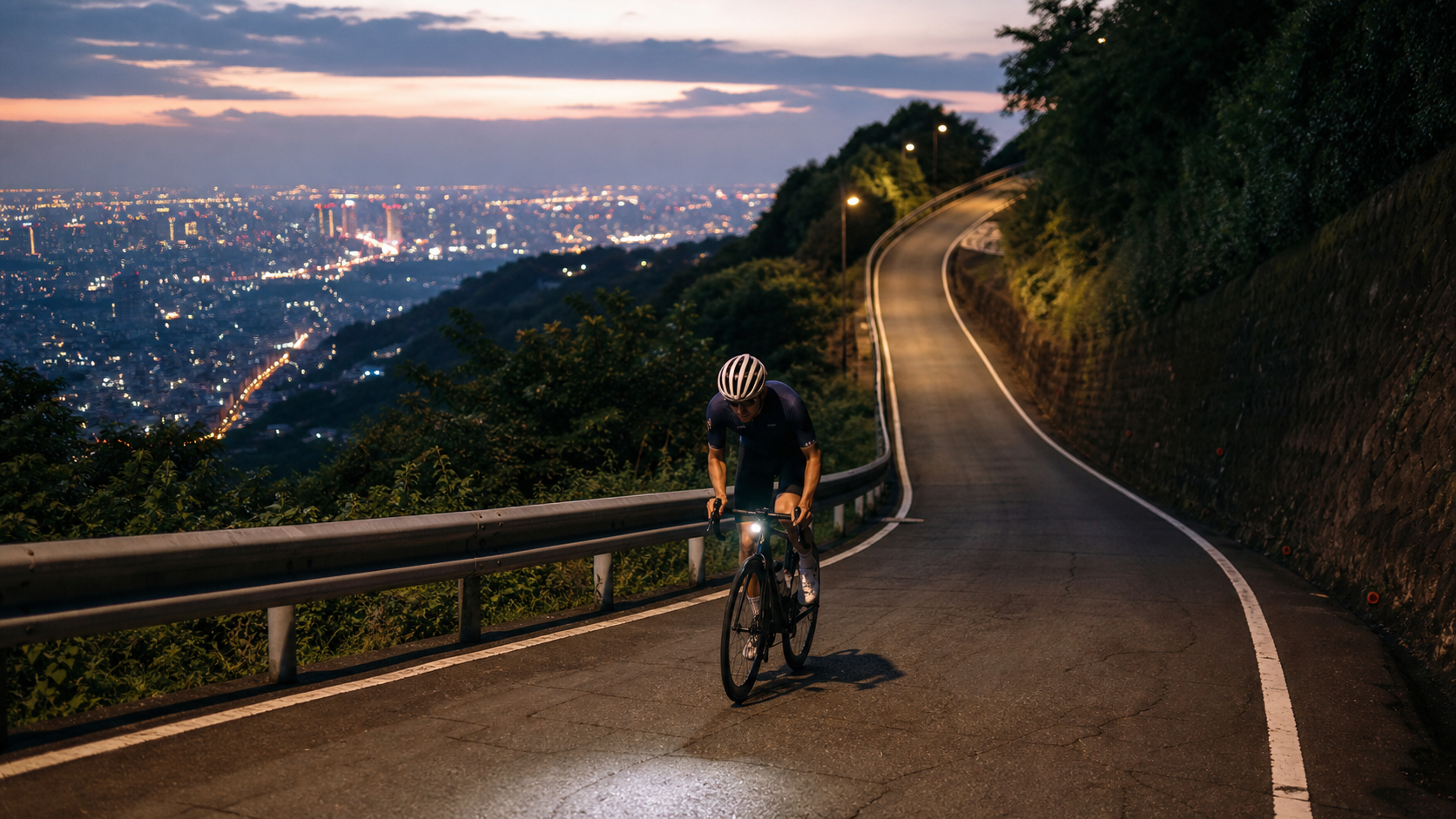
On Dadu Mountain in Taichung, there’s a road cyclists affectionately call the “Blue Highway.” Its official name is actually “Huanan Road,” known for its steepness and night views, making it one of the most convenient and fiercest short climbing training grounds in the Taichung metropolitan area. Want a quick hill workout after work? For Taichung cyclists, this is often the answer.
Let’s look at the real numbers: Taichung Blue Highway (Strava segment 15796748) is approximately 9.43 km long with 358.8 meters of total elevation gain and an average gradient of 3.2%, rated Category 2 on Strava. That 3.2% average is dragged down by the gentler sections and the approach segment—the core steep section of the Blue Highway actually averages a punishing 7%, with the steepest pitch approaching 19%. This gap between “mild on average, brutal in spots” is exactly why it needs to be broken down with an engineering approach.
Route Overview: A Steep Night-View Climb on Dadu Mountain
| Item | Data |
|---|---|
| Segment Distance | 9,430 meters (approx. 9.43 km) |
| Total Elevation Gain | 358.8 meters |
| Average Gradient | 3.2% (entire segment); core steep section approx. 7% |
| Strava Rating | Category 2 |
| Location | Dadu Mountain area, Taichung City |
| Official Road Name | Huanan Road |
| Characteristics | Short, steep, with extremely steep sections (up to nearly 19%) |
The heart of the Blue Highway is a direct steep climb connecting Wanggaoliao toward the Dadu direction. The Huanan Road steep section truly known as the “Blue Highway” is about 3.8 km long with a 7% average gradient and roughly 247 meters of elevation gain. The full 9.43 km Strava segment includes the approach and extension, which pulls the average down to 3.2%, but what you’ll actually face is that fierce 7% straight climb hidden within.
This steep section can be divided into two parts: the first section runs from the foot of Dadu Mountain to the bridge in the middle, about 2 km long; the second section continues past the bridge up to the traffic light at the top, about 1.7 km long. Its “intimidating opener” road design ensures every attempt is anything but easy.
Why the “3.2% Average” Is Deceptive
The Blue Highway is a classic lesson in the “average gradient trap.” The 3.2% overall average includes the gentle approach section; once you hit the core steep section, the gradient immediately jumps to a 7% average, with localized 10% and 19% short walls.
If you ride in with a “it’s only 3.2%” mindset, you’ll be brought back to reality the moment you enter the steep section. This is also the Blue Highway’s value as a training ground—it delivers high-intensity climbing stimulus in an extremely short distance, perfect for efficient post-work training sessions.
Section Strategy 1: Approach and Warm-Up
The approach section before the core steep climb has a gentle gradient, making it an ideal warm-up zone.
- Pacing Principle: Bring your heart rate into the aerobic zone, keep power at 65%–70% of FTP, and let your body prepare for the steep climb ahead.
- Equipment Check: Before entering the steep section, make sure your gearing is already shifted to a climbing-friendly ratio—don’t fumble with shifting mid-climb.
Section Strategy 2: First Steep Section (approx. 2 km)
The moment you enter the core steep section, the Blue Highway hits you with an “intimidating opener”—an immediate climb of about 400 meters with a maximum gradient of 10%.
- Pacing Core: Don’t let the opener rattle your rhythm, and don’t try to muscle through it. Use a sustainable intensity (near but not exceeding FTP) to get through, keeping your heart rate under control.
- Gear Usage: Have 34×28 and 34×30 ready; when you hit the 10% pitches, shift down decisively to maintain your cadence.
- Pedaling: Maintain 70–80 rpm, keep your upper body relaxed, and focus power through your legs.
Section Strategy 3: Second Steep Section (approx. 1.7 km, including the 19% extreme wall)
Past the bridge, you enter the second section—this is the Blue Highway’s true boss. The steepest point of the second section reaches 19%.
- Gearing Is Your Lifeline: Facing a short wall approaching 19%, 34×32 or even lighter gearing is never too much. Err on the side of lighter, or both your knees and heart rate will blow up.
- Pacing Strategy: Accept that your speed will drop dramatically; falling to single-digit km/h is normal. The mission is to “keep the pedals turning without putting a foot down.”
- Standing Climb Usage: On the 19% short wall, you can briefly stand and sprint for 5–10 seconds to power over, but calculate carefully—standing climbs burn oxygen fast.
- Mindset: The second section is short; grit your teeth through it and you’ll reach the traffic light at the top with its wide-open night views.
Section Strategy 4: Finishing at the Top
Reaching the traffic light at the top completes the Blue Highway’s core steep climb. This is the Wanggaoliao direction, famous for Taichung’s night views.
- Pacing: If doing repeat intervals, this is the endpoint of one rep; descend, refill fluids, then go again.
- Recovery: Short climbs at high intensity demand proper hydration and stretching.
Gearing and Equipment Recommendations
Facing a short wall of nearly 19%, gearing strategy is critical:
| Rider Level | Recommended Chainring | Recommended Cassette | Notes |
|---|---|---|---|
| General Cyclist | 50/34T compact crank | 11-34T | Lifesaver gearing for the 19% short wall |
| Advanced | 50/34T | 11-32T | For those with steep-climb experience |
| Competitive | 52/36T | 11-30T | For those with high power-to-weight ratios |
Other key points:
- Tires: 25c–28c, slightly lower tire pressure for more grip—slipping on steep climbs is a leading cause of putting a foot down.
- Bike Weight: On short, steep climbs, “light” equals “fast.”
- Lighting: Many people ride the Blue Highway after work to enjoy the night views; front and rear lights plus reflective gear are essential—watch out for urban traffic.
Nutrition and Hydration Strategy
The Blue Highway is short, but with high intensity and its suburban location, refueling is relatively convenient.
- Before Climbing: Convenience stores near the foot of Dadu Mountain allow you to stock up on water and food beforehand.
- Repeat Training: Many cyclists use the Blue Highway for repeat climb workouts; be sure to rehydrate after every descent to avoid cumulative dehydration.
- Night Riding: For evening rides to enjoy the views, pay attention to balancing hydration and warmth as temperatures drop.
Weather and Seasons
- Rideable Year-Round: With its low elevation, it can be ridden all year, making it one of the few season-friendly climbs near the Taichung metropolitan area.
- Summer: Dadu Mountain has strong sun and muggy heat; start in the early morning or evening.
- Evening: This is the golden hour for Taichung’s night views, but be mindful of urban traffic and visibility.
- After Rain: Steep sections become slippery, and the 19% short wall is extremely dangerous on wet pavement—avoid it.
Common Mistakes and DNF Risks
- Misled by the 3.2% average: Overlooking the true ferocity of the 7% core average and the 19% short wall.
- Gearing too heavy: Using insufficiently light gearing on the 19%—a leading cause of putting a foot down and knee injuries.
- Losing rhythm to the opener: Panicking on the initial 10% steep pitch makes the rest even harder.
- Slipping on steep sections: Tire pressure too high or wet pavement causes loss of grip on steep climbs.
- Ignoring traffic: Heavy suburban traffic and low visibility at night create significant safety risks.
Target Times by Rider Level
Based on the core steep section (approx. 3.8 km, 247 meters of gain, 7% average):
| Rider Level | Reference Time | Notes |
|---|---|---|
| Competitive Racer | 10–13 min | All-out effort |
| Advanced Cyclist | 14–18 min | Has steep-climb foundation |
| General Cyclist | 19–25 min | Steady completion |
| Recreational Challenger | 26+ min / just finish | Goal is no foot down |
The Blue Highway is the “quick charging station” for Taichung’s urban cyclists—short distance, high intensity, and night views. One lap after work delivers climbing stimulation instantly. But its “mild on average, brutal in spots” character reminds us to never judge a climb by its average gradient alone. Only when you understand the 19% short wall hidden beneath the numbers can you truly know this Blue Highway on Huanan Road.
Practical Guide to Breaking the Average Gradient Trap
The Blue Highway is a classic lesson in the average gradient trap. The 3.2% overall average includes the gentle approach section; once you enter the core steep section, the gradient immediately jumps to a 7% average, with localized 10% and 19% short walls. If you ride in with a “it’s only 3.2%” mindset, you’ll be brought back to reality the moment you enter the steep section. The way to break it is to break the entire route into clear stages.
The approach section before the core steep climb has a gentle gradient, making it an ideal warm-up—bring your heart rate into the aerobic zone, keep power at 65% to 70% of FTP, and confirm your gearing is already in a climbing-friendly ratio. The first steep section is about 2 km, and the Blue Highway hits you with an intimidating opener right away—about 400 meters of climbing with a maximum gradient of 10%. Don’t let it rattle your rhythm; use a sustainable intensity to get through, with 34×28 and 34×30 ready. Past the bridge, the second section is about 1.7 km—this is the true boss, with the steepest point reaching 19%. Facing this kind of short wall, 34×32 or even lighter gearing is never too much; err on the side of lighter. Accept that your speed will drop dramatically; falling to single-digit km/h is normal. The mission is to keep the pedals turning without putting a foot down. On the 19% short wall, you can briefly stand and sprint for 5 to 10 seconds to power over, but calculate carefully—standing climbs burn oxygen fast. Grit through it, and you’ll reach the traffic light at the top with its wide-open night views.
Making the Most of Suburban Training
The Blue Highway’s greatest value lies in being the quick charging station for Taichung’s urban cyclists. It’s short and intense, making it perfect for time-poor office workers to train efficiently. One lap after work delivers high-intensity climbing stimulus—this is its unique advantage as a training ground. Many cyclists treat it as a repeat-climb workout, going up and down again and again, squeezing maximum training benefit from limited time.
Based on the core steep section of about 3.8 km, 247 meters of gain, and a 7% average, competitive racers finish in about 10 to 13 minutes, advanced cyclists in about 14 to 18 minutes, and general cyclists in about 19 to 25 minutes. Facing the short wall of nearly 19%, gearing strategy is critical—general cyclists are advised to use 50/34T with an 11-34T cassette, tires from 25c to 28c with slightly lower pressure for more grip, as slipping on steep climbs is a leading cause of putting a foot down. Many people ride the Blue Highway after work to enjoy the night views; front and rear lights plus reflective gear are essential—watch out for urban traffic. One key reminder: never judge a climb by its average gradient alone. The Blue Highway’s mild-on-average, brutal-in-spots character is its most important lesson—only when you understand the 19% short wall hidden beneath the numbers can you truly know this Blue Highway on Huanan Road, and safely and efficiently turn it into your training weapon.
Route Overview: A Steep Night-View Climb on Dadu Mountain
Taichung Blue Highway (Strava segment 15796748) is approximately 9.43 km long with 358.8 meters of total elevation gain and an average gradient of 3.2%, rated Category 2 on Strava. Located in the Dadu Mountain area of Taichung City, its official road name is Huanan Road. It’s known for its steepness and night views, making it one of the most convenient and fiercest short climbing training grounds in the Taichung metropolitan area. That 3.2% average is dragged down by the gentler sections and the approach segment—the core steep section of the Blue Highway actually averages a punishing 7%, with the steepest pitch approaching 19%.
The Huanan Road steep section truly known as the Blue Highway is about 3.8 km long with a 7% average gradient and roughly 247 meters of elevation gain. The full 9.43 km Strava segment includes the approach and extension, which pulls the average down to 3.2%, but what you’ll actually face is that fierce 7% straight climb hidden within. This steep section can be divided into two parts: the first section runs from the foot of Dadu Mountain to the bridge in the middle, about 2 km long; the second section continues past the bridge up to the traffic light at the top, about 1.7 km long. This gap between mild on average and brutal in spots is exactly why the Blue Highway needs to be broken down with an engineering approach, and it’s also its most unique value as a training ground.
Section-by-Section Steep Climb Strategy and Gearing
The approach section before the core steep climb has a gentle gradient, making it an ideal warm-up—bring your heart rate into the aerobic zone, keep power at 65% to 70% of FTP, and confirm your gearing is already in a climbing-friendly ratio before entering the steep section, so you don’t fumble with shifting mid-climb. The first steep section is about 2 km, and the Blue Highway hits you with an intimidating opener right away—an immediate climb of about 400 meters with a maximum gradient of 10%. Don’t let the opener rattle your rhythm, and don’t try to muscle through it; use a sustainable intensity to get through, with 34×28 and 34×30 ready, maintaining 70 to 80 rpm with your upper body relaxed.
Past the bridge, the second section is about 1.7 km—this is the Blue Highway’s true boss, with the steepest point reaching 19%. Facing a short wall approaching 19%, 34×32 or even lighter gearing is never too much; err on the side of lighter, or both your knees and heart rate will blow up. Accept that your speed will drop dramatically; falling to single-digit km/h is normal. The mission is to keep the pedals turning without putting a foot down. On the 19% short wall, you can briefly stand and sprint for 5 to 10 seconds to power over, but calculate carefully—standing climbs burn oxygen fast. Grit your teeth through it, and you’ll reach the traffic light at the top with its wide-open night views. Choose tires from 25c to 28c with slightly lower pressure for more grip, as slipping on steep climbs is a leading cause of putting a foot down; shed bike weight where possible—on short, steep climbs, light equals fast. Many people ride the Blue Highway after work to enjoy the night views; front and rear lights plus reflective gear are essential—watch out for urban traffic.
Training Value, Weather, and Conclusion
The Blue Highway is the quick charging station for Taichung’s urban cyclists—short distance, high intensity, and night views. One lap after work delivers climbing stimulation instantly. Many cyclists treat it as a repeat-climb workout, going up and down again and again, squeezing maximum training benefit from limited time. Based on the core steep section of about 3.8 km, 247 meters of gain, and a 7% average, competitive racers finish in about 10 to 13 minutes, advanced cyclists in about 14 to 18 minutes, and general cyclists in about 19 to 25 minutes.
As for weather, the Blue Highway’s low elevation makes it rideable year-round, one of the few season-friendly climbs near the Taichung metropolitan area. In summer, Dadu Mountain has strong sun and muggy heat; start in the early morning or evening. Evening is the golden hour for Taichung’s night views, but be mindful of urban traffic and visibility. After rain, steep sections become slippery, and the 19% short wall is extremely dangerous on wet pavement—avoid it. The Blue Highway’s mild-on-average, brutal-in-spots character reminds us to never judge a climb by its average gradient alone. Only when you understand the 19% short wall hidden beneath the numbers can you truly know this Blue Highway on Huanan Road and turn it into your efficient training weapon. With the shortest distance, the steepest gradient, and the most beautiful night views, it has become the fastest and most therapeutic climbing haven in the busy lives of countless Taichung cyclists.
Designing an Efficient Repeat-Climb Workout
Because the Blue Highway’s core steep section is short and intense, it’s an excellent venue for repeat-climb training. A sample workout: after a thorough warm-up, climb the Blue Highway’s core steep section at full (or near-full) effort and record your time; descend back to the start, spin easy for 5 to 8 minutes to let your heart rate recover; then climb a second and third rep. Beginners start with 2 to 3 reps; advanced riders can do 4 to 5. This type of training efficiently builds your climbing strength, anaerobic capacity, and lactate tolerance.
The Blue Highway’s greatest advantage as a suburban training ground is its time efficiency. You don’t need to spend half a day driving to the mountains—you can arrive within half an hour after work, knock out several high-intensity repeat climbs, and head home. For office-worker cyclists who never have enough time, this kind of high-return training ground is a lifesaver for maintaining form. Of course, high-intensity training also carries a higher risk of injury—be sure to warm up thoroughly, ride within your limits, and allow adequate recovery between reps. If your speed drops too much in later reps, it means insufficient recovery or too many reps; better to cut volume than to grind out junk reps. Treat the Blue Highway as your urban climbing gym; make the most of its short, steep, intense character, and your climbing ability will improve steadily and efficiently within your limited training time.
Common Mistakes and Safety Reminders
Although the Blue Highway is short, it has several traps that can trip people up. First is being misled by the 3.2% average, overlooking the true ferocity of the 7% core average and the 19% short wall. Second is gearing too heavy—using insufficiently light gearing on the 19% is a leading cause of putting a foot down and knee injuries. Third is losing rhythm to the opener—panicking on the initial 10% steep pitch makes the rest even harder. Fourth is slipping on steep sections—tire pressure too high or wet pavement causes loss of grip on steep climbs. Fifth is ignoring traffic—heavy suburban traffic and low visibility at night create significant safety risks.
Avoiding these risks comes down to three things: bring light enough gearing, control tire pressure and grip, and always stay alert to urban traffic and lighting safety. Especially since many people choose to climb the Blue Highway in the evening for the night views, when light fades and traffic remains heavy, front and rear lights plus reflective gear are essential, and be sure to watch for vehicles behind you when cornering or changing lanes. With these safety preparations in place, you can fully enjoy the climbing thrill and night scenery while making it home safely. The Blue Highway’s appeal lies in combining high-intensity training with stunning night views in the urban suburbs, letting busy cyclists efficiently balance fitness and spirit. With the right mindset and thorough preparation, it becomes your most convenient, most efficient, and most therapeutic climbing companion.
Target Times, Equipment Checklist, and Rider Levels
Based on the core steep section of about 3.8 km, 247 meters of gain, and a 7% average, competitive racers finish in about 10 to 13 minutes of all-out effort, advanced cyclists in about 14 to 18 minutes, general cyclists in about 19 to 25 minutes of steady riding, and recreational challengers in 26 minutes or more with the goal of not putting a foot down. These numbers help you gauge where you stand on the Blue Highway.
For the equipment checklist, facing a short wall of nearly 19%, gearing is paramount—general cyclists are advised to use a 50/34T compact crank with an 11-34T cassette, advanced cyclists can use 11-32T, and competitive cyclists with high power-to-weight ratios can use 52/36T with an 11-30T cassette. Choose tires from 25c to 28c with slightly lower pressure for more grip, as slipping on steep climbs is a leading cause of putting a foot down; shed bike weight where possible—on short, steep climbs, light equals fast. If riding in the evening for night views, front and rear lights and reflective gear are essential, and carry basic repair tools. With proper equipment, especially light gearing, you can confidently handle the Blue Highway’s ferocious short wall hidden beneath its mild average. Remember the Blue Highway’s most important lesson: never judge a climb by its average gradient alone—understand that 19% short wall, bring the right gearing, and you’ll truly know this Blue Highway on Huanan Road.
Conclusion: The Urban Quick Charging Station
The Blue Highway is the quick charging station for Taichung’s urban cyclists. It’s short, intense, and offers night views—one lap after work delivers climbing stimulation instantly, with a chance to enjoy Taichung’s most beautiful night scenery along the way. For urban cyclists who never have enough time, this kind of high-return training ground is the most convenient choice for maintaining form and refreshing the mind and body.
But the Blue Highway’s value goes beyond training efficiency. Its unique mild-on-average, brutal-in-spots character is a profound lesson in “not being fooled by appearances”—beneath the 3.2% average lies a 7% core average and a short wall of nearly 19%. This reminds us that whether cycling or in life, we can’t just look at averages or surfaces; we must understand the real difficulty and challenges hidden beneath the numbers. When you conquer that 19% short wall on the Blue Highway and stand at Wanggaoliao looking back at the sea of lights below, you’ll understand: the shortest road sometimes holds the hardest test, and after the hardest test often comes the most beautiful scenery. This is the Blue Highway—that short, steep, beautiful Huanan Road in Taichung’s urban area, both painful and beloved, offering every rider who climbs it the most concentrated and profound gift.
Why Every Taichung Cyclist Should Ride the Blue Highway at Least Once
The Blue Highway may not be Taichung’s most spectacular or famous climb, but it’s a road nearly every Taichung cyclist should ride at least once. The reason is that it condenses the essence of climbing training—within just a few kilometers, you experience the full challenge from gentle slopes to steep pitches, from 10% to nearly 19%. This high-density training stimulus is something many longer climbs can’t provide.
More importantly, the Blue Highway teaches you a lifelong lesson: don’t be deceived by average gradients. Beneath the mild 3.2% average lies a 7% core average and a short wall of nearly 19%. Learning to read the real difficulty hidden beneath the numbers allows you to make smarter judgments and preparations when facing any unfamiliar route. Add to that its suburban location, year-round rideability, and night views, and the Blue Highway is almost a training ground tailor-made for busy urban cyclists. Whether you want efficient training, to test your fitness, or to relax and enjoy the scenery in the evening, the Blue Highway has you covered. This is why it deserves at least one ride from every Taichung cyclist—to feel the ferocity of that 19% short wall, to admire the sea of lights at Wanggaoliao, and to experience the unique charm of short, steep, and beautiful woven together on this Huanan Road.
Related Reading
- Dadu Wanggaoliao Climb Guide: A 3.5 km Urban Short Hard Climb at Nearly 6% and the “Blue Highway’s” 12% Test
- The Night-View Steep Climb on Dadu Mountain: The Blue Highway, a Post-Work Ritual for Taichung Cyclists
- Wanggaoliao’s Night and Cliffs: Riding Up Dadu Mountain for a Taiwanese Version of Hakodate’s Lights
- Shenkeng Shennan Road Practical Guide: 2.6 km, 220 Meters of Climbing, a Brutal Short-Distance High-Intensity Test
台北闊瀨陡坡 騎旅 / 日本單車雜誌編輯車友臨時加入!/ 髮香才是最強的 / feat. 北迴歸線小隊 / 公路車 CT Yeh
6 個月前
爬坡ITT實境)台中 魔王 松鼠坡 首航 6:12 大肚山 大三元 科福路
8 年前
2015/11/28 - 大肚溪夕陽自行車道 與 藍色公路 輕鬆騎
10 年前
大武山20%魔王陡坡【JJSC南台灣遊騎Day2】!屁股真的要裂開了...凡士林抹滿也沒用?神秘金教堂還有超便宜夜市
3 個月前
大武山後門26%歡樂陡坡!JJSC南台灣單車行Day2 / 被颱風追著跑 / 公路車 / CT Yeh
2 年前
2015/11/28 - 華南路 (藍色公路) 單車試騎 (登山車+沒上卡)
10 年前
新竹羅平 x 天湖部落 大禹嶺級變態陡坡! 4K超高畫質 空拍 | 公路車
5 年前
萬年峽谷! 30% 超激陡坡 里佳部落DAY2 還是很硬! | 公路車 | CT Yeh
3 年前