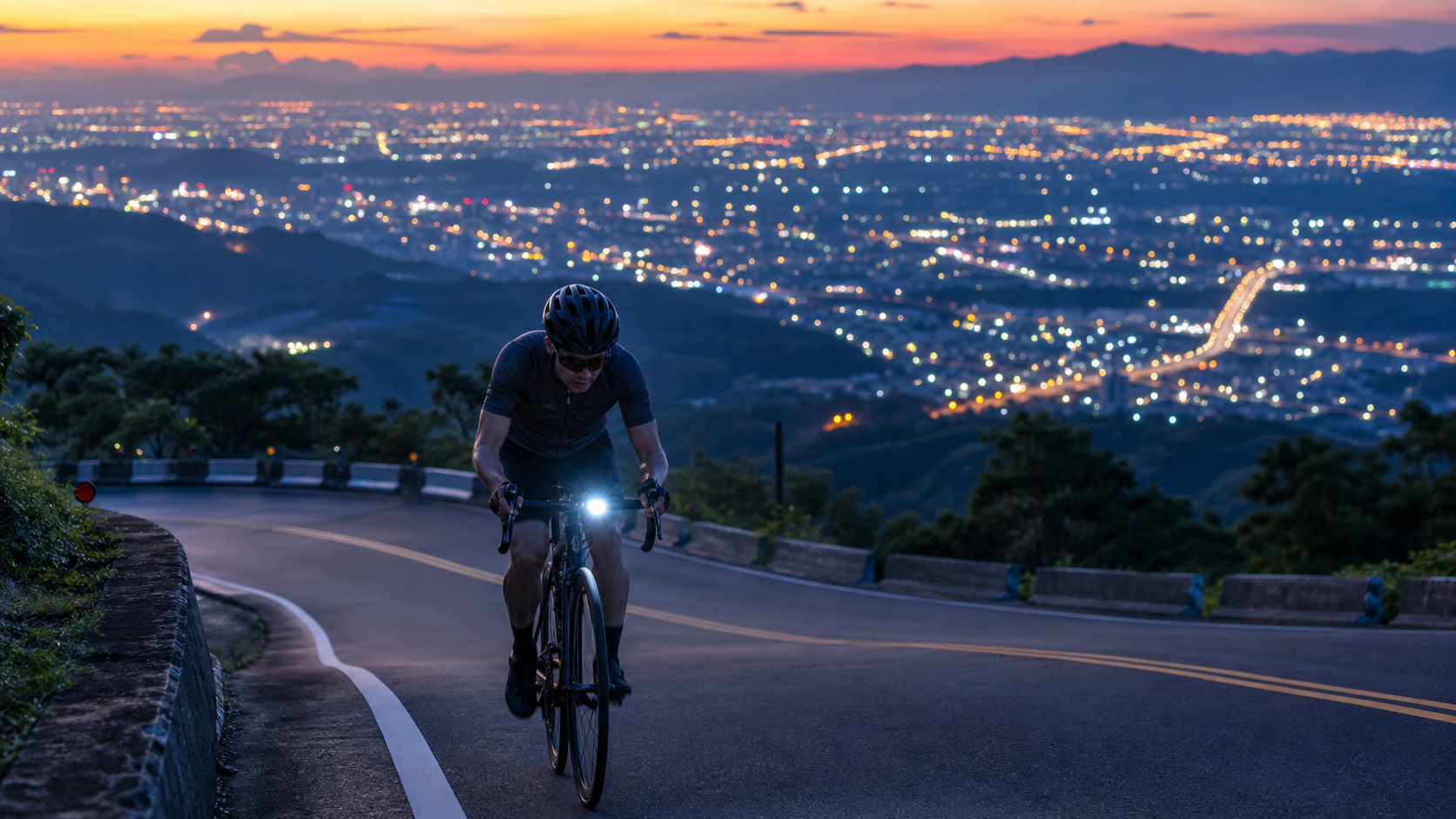
Taichung’s nightscape is at its most beautiful when viewed from Dadu Mountain.
As the sun sinks into the Taiwan Strait, the lights of the entire Taichung Basin flicker on one by one, like a spilled sea of stars spread beneath your feet. And one of the most classic ways to take in this view is with your own legs—pedaling a bike, following the road cyclists affectionately call “Blue Highway” (Huanan Road), climbing breathlessly up to Wanggaoliao. 9.43 kilometers, 358 meters of elevation gain, with a short wall near 19% at its steepest—all in exchange for Taichung’s most moving sea of lights.
This article isn’t about pacing. It’s about how this steep climb on Dadu Mountain became a “daily ritual” for countless Taichung cyclists after work, and why it leaves people both exhausted and in love.
Dadu Mountain: Taichung’s Balcony
Dadu Mountain is a tableland stretching between the Taichung Basin and the Taiwan Strait. Standing on the ridge, you have the vast sea on one side and a bustling city on the other—a view that takes in “mountain, sea, and city” all at once, making Dadu Mountain Taichung’s natural balcony.
Blue Highway—also known as Huanan Road—clings to the slope of this tableland. It connects Wanggaoliao toward the Dadu direction, a straight and steep climbing road. By day, it’s a training ground where cyclists hone their leg strength; by dusk, it transforms into a romantic road leading to the night view. This dual character of “training” and “romance” is the most captivating thing about Blue Highway.
Wanggaoliao: Taking in Taichung’s Sea of Lights
The top of Blue Highway leads to the famous Wanggaoliao. It’s one of the most expansive viewpoints on Dadu Mountain and a sacred spot for night views in the hearts of Taichung residents.
When you’ve exhausted every ounce of effort to reach the top and turn back before your breath has settled, the entire sea of Taichung’s lights spreads out beneath your feet. High-rises, streets, and traffic merge into flowing rivers of light; in the distance, the horizon of the Taiwan Strait fades into the night. In that moment, the pain of the climb suddenly feels meaningful—you didn’t arrive by car; you earned this view inch by inch with your own effort. That sense of accomplishment makes the night view at Wanggaoliao more beautiful in a rider’s eyes than in anyone else’s.
First Person: A Post-Work Ritual
For many office-worker cyclists in Taichung, Blue Highway is a “post-work ritual.”
I’m one of them. Work ends, the sky darkens, I change into my cycling kit and ride toward the foot of Dadu Mountain. The approach is gentle enough, letting me slowly pedal away the day’s fatigue and clutter. Then Blue Highway delivers its signature “reality check”—just as you enter the steep section, there’s a sharp climb with gradients approaching 10%. My heart rate spikes instantly, my legs start to burn, and the office irritations are swept away by this sudden intensity.
Past the bridge, the second steep section is the real test. A short wall nearing 19% stands before me; I drop to my lowest gear, yet my cadence keeps falling, the front wheel feeling like it might lift off. For those few dozen seconds, the world shrinks to just three meters of asphalt ahead and my own heavy breathing. It’s this near-“zeroing out” focus that gets you hooked—all the stress and anxiety are wrung dry by that steep wall.
Push through the short wall, reach the traffic light at the top, and turn back—Taichung’s sea of lights is glowing below. I stop, gasping for air, gazing at that brilliant city, feeling completely emptied out and recharged at the same time. This is the healing Blue Highway gives me.
What This Road Means to Riders
The significance of Blue Highway to Taichung cyclists lies in two words: “convenience” and “efficiency.”
It sits right on the urban fringe—no long drive needed. Any evening or early morning, you can get there quickly and hammer out a high-intensity climb. For office workers with limited time, this kind of “short, steep, intense” training ground is a lifesaver for maintaining form. Many treat it as a repeat-climb workout, going up and down again and again, squeezing maximum training benefit out of limited time.
But its meaning goes beyond training. Blue Highway teaches us how to carve out a small stretch of “time that’s purely our own” amid a busy daily life. The pain of the climb, the night view at the top—it’s the most lucid and most relaxed moment of the day. It reminds us: cycling doesn’t always require an expedition to distant mountains. Sometimes, a steep climb at your doorstep and a familiar night view are enough to help you find yourself again.
Flavors Along the Way and the City’s Hustle
Blue Highway sits close to the Taichung metropolitan area, which means “supplies” and “wrap-up” are especially convenient. The Dadu area at the foot of the mountain has convenience stores—great for refilling water before the climb and quenching your thirst after the descent. And once you finish Blue Highway, coasting down the Dadu slope back into the city, Taichung’s entire food scene is yours to choose from—a steaming bowl of noodles, a hand-shaken drink, a late-night snack, all perfect rewards for that steep climb.
This seamless switch between “solitary climbing in the mountains” and “urban bustle at the foot” is Blue Highway’s unique rhythm. You can be battling a 19% wall one moment, and sitting in a night market snacking and watching the crowd fifteen minutes later. This stark contrast makes every Blue Highway ride feel like a concentrated adventure.
Seasonal Scenery
- Spring: Pleasant weather, clear views from Dadu Mountain—a great season for riding and sightseeing.
- Summer: Strong sun and muggy heat, but the evening sunset and night views are at their most spectacular, ideal for a dusk departure.
- Autumn: Crisp, clear skies with the best visibility; Wanggaoliao’s night view is luminous and brilliant.
- Winter: Low elevation means it’s rideable year-round; the dry, cold winter air actually makes the night view even sharper.
Suggested Itinerary
To build a ride around Blue Highway, here’s how you could arrange it:
- Dusk: Start from Dadu at the foot of the mountain, climb Blue Highway against the sunset, and enjoy the magical transition from sunset to night view at Wanggaoliao.
- Nightfall: Pause around Wanggaoliao to watch Taichung’s lights flicker on one by one.
- Descent: Coast down the Dadu slope back into the city, staying alert to urban traffic and lighting safety.
- Late-night snack: Find a small eatery or night market in downtown Taichung, and reward this “steep climb + night view” journey with a hot meal.
Blue Highway isn’t Taiwan’s highest or longest road, but it may be the climbing route closest to the daily lives of Taichung residents. With the shortest distance, the steepest grades, and the most beautiful night view, it has become a breathing space in countless cyclists’ busy lives. Next time you’re in Taichung, if you want to reclaim a bit of time for yourself, ride up Dadu Mountain in the evening—break a sweat on the 19% wall, then, before the sea of lights at Wanggaoliao, hand the day’s fatigue back to the night.
Dadu Mountain: Taichung’s Balcony
Dadu Mountain is a tableland stretching between the Taichung Basin and the Taiwan Strait. Standing on the ridge, you have the vast sea on one side and a bustling city on the other—a view that takes in mountain, sea, and city all at once, making Dadu Mountain Taichung’s natural balcony. Blue Highway—also known as Huanan Road—clings to the slope of this tableland. It connects Wanggaoliao toward the Dadu direction, a straight and steep climbing road. By day, it’s a training ground where cyclists hone their leg strength; by dusk, it transforms into a romantic road leading to the night view.
The top of Blue Highway leads to the famous Wanggaoliao. It’s one of the most expansive viewpoints on Dadu Mountain and a sacred spot for night views in the hearts of Taichung residents. When you’ve exhausted every ounce of effort to reach the top and turn back before your breath has settled, the entire sea of Taichung’s lights spreads out beneath your feet. High-rises, streets, and traffic merge into flowing rivers of light; in the distance, the horizon of the Taiwan Strait fades into the night. In that moment, the pain of the climb suddenly feels meaningful—you didn’t arrive by car; you earned this view inch by inch with your own effort. That sense of accomplishment makes the night view at Wanggaoliao more beautiful in a rider’s eyes than in anyone else’s. This dual character of training and romance is the most captivating thing about Blue Highway.
An After-Work Ritual
For many office-worker cyclists in Taichung, Blue Road is an after-work ritual. When work ends and the sky begins to darken, they change into their cycling jerseys and ride toward the foot of Dadu Mountain. The approach section is relatively gentle, letting you slowly pedal away the fatigue and stray thoughts of the day. Then Blue Road delivers its signature wake-up call—just as you enter the climb, there’s a steep ramp with a maximum gradient approaching 10%. Your heart rate spikes instantly, your legs start to burn, and all the office frustrations are swept away by this sudden intensity.
After the bridge, the second steep section is the real test. A short wall approaching 19% stands before you; even with the gears dropped to the lowest, your cadence keeps falling, and the front wheel feels like it might lift off the ground. For those few dozen seconds, the world shrinks to just the three meters of asphalt ahead and your own heavy breathing. It’s this near-total focus that gets you hooked—all the stress and anxiety are wrung dry by that steep wall. Push through the short wall, reach the traffic light at the top, and look back—Taichung’s sea of lights is flickering on below. Stop, gasp for air, and gaze at that dazzling city, feeling completely emptied out and then recharged. This is the healing Blue Road offers. What it teaches us is how to carve out a small stretch of time that is purely our own amid a busy daily life. The pain of that climb and the night view at the top are the most lucid and most relaxing moments of the day. It reminds us: cycling doesn’t always require an expedition to the high mountains; sometimes, a steep slope at your doorstep and a familiar night view are enough to help you find yourself again. Descend Dadu Mountain back into the city, mind the urban traffic and lighting safety, and find a snack stand or night market—rewarding this journey of steep climbs and night views with a hot meal is the most complete everyday adventure for Taichung cyclists.
Wanggaoliao: Taking in Taichung’s Sea of Lights
The top of Blue Road leads to the famous Wanggaoliao. It’s one of the most expansive viewpoints on Dadu Mountain and a sacred spot for night views in the hearts of Taichung residents. When you’ve fought your way to the top and turn back while still catching your breath, the entire expanse of Taichung’s lights unfolds beneath your feet. High-rises, streets, and traffic merge into flowing rivers of light; in the distance, the horizon of the Taiwan Strait fades into the night. At that moment, the pain of the climb seems to gain meaning—you didn’t arrive by car; you climbed every inch of that night view on your own.
This sense of achievement makes the night view at Wanggaoliao more beautiful in a cyclist’s eyes than in anyone else’s. When it comes to viewing the night scene, those who drive up see a landscape; those who ride up see the crystallization of their own effort. Every light corresponds to every drop of sweat you just shed. This beauty earned through pain is especially profound and moving. No wonder so many Taichung cyclists are willing to climb Blue Road in the evening—what they’re pursuing isn’t just that dazzling sea of lights, but also the grounded satisfaction of “arriving on my own.” The night view at Wanggaoliao is the gentlest yet most magnificent reward Dadu Mountain gives to every rider who pedals upward with effort.
Urban Fireworks and the Meaning of This Road
Blue Road sits right next to the Taichung metropolitan area, which makes resupply and finishing up especially convenient. The Dadu area at the foot of the mountain has convenience stores—great for refilling water before the climb and quenching your thirst after the descent. And after finishing Blue Road, as you descend Dadu Mountain back into the city, the entire culinary map of Taichung is yours to choose from—a steaming bowl of noodles, a hand-shaken drink, a late-night snack, all serve as the perfect reward for that steep climb. This seamless switch between solitary climbing on the mountain and urban fireworks at the foot is the unique rhythm of Blue Road. You can be battling the 19% short wall one moment, and just over ten minutes later, be sitting in a night market eating snacks and watching the crowd go by.
The significance of Blue Road to Taichung cyclists lies in the two words: convenience and efficiency. It’s right on the urban fringe—no long drives needed. Any evening or early morning, you can get there quickly and knock out a high-intensity climb. For office workers with limited time, this short, steep, intense training ground is a lifesaver for maintaining form. But its meaning goes beyond training. Blue Road teaches us how to reserve a small stretch of time that is purely our own amid a busy daily life. The pain of that climb and the night view at the top are the most lucid and most relaxing moments of the day. It reminds us: cycling doesn’t always require an expedition to the high mountains; sometimes, a steep slope at your doorstep and a familiar night view are enough to help you find yourself again. Blue Road isn’t the highest or the longest road in Taiwan, but it may be the climb closest to the daily lives of Taichung residents—with the shortest distance, the steepest gradient, and the most beautiful night view, it has become a breathing space in the busy lives of countless cyclists.
An After-Work Ritual
For many office-worker cyclists in Taichung, Blue Road is an after-work ritual. When work ends and the sky begins to darken, they change into their cycling jerseys and ride toward the foot of Dadu Mountain. The approach section is relatively gentle, letting you slowly pedal away the fatigue and stray thoughts of the day. Then Blue Road delivers its signature wake-up call—just as you enter the climb, there’s a steep ramp with a maximum gradient approaching 10%. Your heart rate spikes instantly, your legs start to burn, and all the office frustrations are swept away by this sudden intensity.
After the bridge, the second steep section is the real test. A short wall approaching 19% stands before you; even with the gears dropped to the lowest, your cadence keeps falling, and the front wheel feels like it might lift off the ground. For those few dozen seconds, the world shrinks to just the three meters of asphalt ahead and your own heavy breathing. It’s this near-total focus that gets you hooked—all the stress and anxiety are wrung dry by that steep wall. Push through the short wall, reach the traffic light at the top, and turn back—Taichung’s sea of lights is flickering on below. Stop, gasp for air, and gaze at that dazzling city, feeling completely emptied out and then recharged. This is the healing Blue Road offers—it lets you reset yourself to zero with a steep climb after a day of fatigue, then relight yourself with a night view.
Seasons, Side Trips, and the Everyday Life of Taichung Residents
Blue Road has its own character in every season: in spring, the weather is pleasant and the views from Dadu Mountain are clear; in summer, the sun is strong and it’s muggy, but the evening sunset and night views are at their most magnificent, making dusk the ideal time to set out; in autumn, the sky is high and the air is crisp, visibility is at its best, and the night view at Wanggaoliao is crystal clear and dazzling; in winter, the low elevation means it’s rideable year-round, and the dry, cool winter air actually makes the night view even sharper. No matter the season, Dadu Mountain awaits every rider who climbs up with its night view.
To fit Blue Road into an itinerary, here’s how you can arrange it: set out from Dadu at the foot of the mountain at dusk, climb Blue Road as the sun sets, and enjoy the magical moment of sunset turning into night view at Wanggaoliao; after dark, linger around Wanggaoliao for a while and watch Taichung’s lights come on one by one; descend Dadu Mountain back into the city, minding urban traffic and lighting safety; finally, find a snack stand or night market in downtown Taichung and reward this journey of steep climbs and night views with a hot meal. Blue Road isn’t the highest or the longest road in Taiwan, but it may be the climb closest to the daily lives of Taichung residents. With the shortest distance, the steepest gradient, and the most beautiful night view, it has become a breathing space in the busy lives of countless cyclists. Next time you’re in Taichung, if you want to reclaim a bit of time that’s your own, why not ride up Dadu Mountain in the evening—work up a sweat in front of the 19% short wall, and then, before the sea of lights at Wanggaoliao, return the day’s fatigue to the night.
Dadu Mountain: Taichung’s Natural Balcony
Dadu Mountain is a plateau stretching between the Taichung Basin and the Taiwan Strait. Standing on the ridge, you have the vast sea on one side and the bustling city on the other—this view that takes in mountain, sea, and city all at once makes Dadu Mountain Taichung’s natural balcony. Blue Road—also known as Huanan Road—clings to the slopes of this plateau. It connects Wanggaoliao with the Dadu direction and is a straight, steep climbing road.
By day, it’s a training ground where cyclists hone their leg strength; by evening, it transforms into a romantic road leading to a night view. This dual character of training and romance is the most charming thing about Blue Road. It allows a single climb to be a serious workout in the early morning or a romantic date at dusk. The same road takes on completely different faces depending on the time of day—this versatility and inclusiveness make Blue Road a special presence in the lives of Taichung cyclists, serving as both a training partner and an emotional outlet. Whether you want to train seriously or simply relax and enjoy the view, this steep slope on Dadu Mountain gives you exactly what you need.
The Sea of Lights at Wanggaoliao and the Cyclist’s Healing
At the top of Blue Road lies the renowned Wanggaoliao—one of the most expansive viewpoints on Dadu Mountain and a sacred spot for night views in the hearts of Taichung residents. When you’ve exhausted every ounce of effort to reach the summit, still catching your breath as you look back, the entire tapestry of Taichung’s lights unfolds beneath your feet. High-rises, streets, and traffic merge into rivers of flowing light; in the distance, the horizon of the Taiwan Strait fades into the night. In that moment, the pain of the climb suddenly seems to have meaning.
This sense of achievement makes the night view at Wanggaoliao more beautiful in a cyclist’s eyes than in anyone else’s. Those who drive up see a landscape; those who ride up see the fruit of their own effort—every light corresponds to every drop of sweat you just shed. This beauty earned through pain is the most healing aspect of Blue Road. It allows busy urban riders, after a day of fatigue, to reset themselves to zero with a steep climb, then reignite themselves with a sea of lights. Blue Road is neither the highest nor the longest road in Taiwan, but it may be the climbing route closest to the daily lives of Taichung residents. Next time you’re in Taichung and want to reclaim a bit of time for yourself, ride up Dadu Mountain in the evening—break a sweat before the 19% short wall, and then, before the sea of lights at Wanggaoliao, surrender the day’s exhaustion to the night. In that moment, you’ll understand why this steep slope at your doorstep brings so many Taichung riders back again and again.
Conclusion: The Mountain at Your Doorstep
We always assume that roads worth riding lie far away—Wuling, Taroko, the island loop. But Blue Road reminds us that the most precious roads are sometimes right at our doorstep. This short section of Huannan Road on Dadu Mountain, with its steep slopes and night views, has become the closest companion in the daily lives of countless Taichung riders.
It doesn’t require a long drive, nor does it require you to take leave for a distant expedition. All it takes is an evening or early morning when you put on your jersey and ride to the foot of the mountain. Then, with a 19% short wall, wring out the day’s fatigue; and with the sea of lights at Wanggaoliao, recharge yourself fully. This healing that lies within arm’s reach is Blue Road’s gentlest gift. Next time life feels too full and your mind too restless, don’t rush to plan some distant trip—ride up Dadu Mountain first. Before that familiar sea of lights, you’ll rediscover the version of yourself that is happy because of cycling, clear-headed because of sweat, and grounded because of arrival. The mountain at your doorstep has always been there, waiting for you with its steep slopes and night views. And perhaps that is the most moving meaning of Blue Road—the climbing route closest to the daily lives of Taichung residents.
Related Reading
- The Nightscape and Cliffs of Wanggaoliao: Riding Up Dadu Mountain for a Taiwanese Version of Hakodate’s Lights
- Dadu Wanggaoliao Climbing Guide: A 3.5km Urban Short Steep Climb at Nearly 6% and the 12% Test of “Blue Road”
- Taichung Blue Road Guide: Huannan Road’s Steep Slope with an Average of 3.2% Hiding a 19% Short Wall
- Dasyueshan 32km Long Climb Practical Guide: The Endurance Mountain Rising 1,557 Meters from Dongshi
2015/11/28 - 大肚溪夕陽自行車道 與 藍色公路 輕鬆騎
10 年前
台北闊瀨陡坡 騎旅 / 日本單車雜誌編輯車友臨時加入!/ 髮香才是最強的 / feat. 北迴歸線小隊 / 公路車 CT Yeh
6 個月前
爬坡ITT實境)台中 魔王 松鼠坡 首航 6:12 大肚山 大三元 科福路
8 年前
新竹羅平 x 天湖部落 大禹嶺級變態陡坡! 4K超高畫質 空拍 | 公路車
5 年前
大武山20%魔王陡坡【JJSC南台灣遊騎Day2】!屁股真的要裂開了...凡士林抹滿也沒用?神秘金教堂還有超便宜夜市
3 個月前
雙十節的溫腥感人約騎,升旗到升天一次滿足 | 公路車 | 鳳山寺 | 米粉坡
6 年前
大武山後門26%歡樂陡坡!JJSC南台灣單車行Day2 / 被颱風追著跑 / 公路車 / CT Yeh
2 年前
阿里山塔塔加 兩倍特濃版!全新隧道開通! 進喔!公路車 | CT Yeh
3 年前