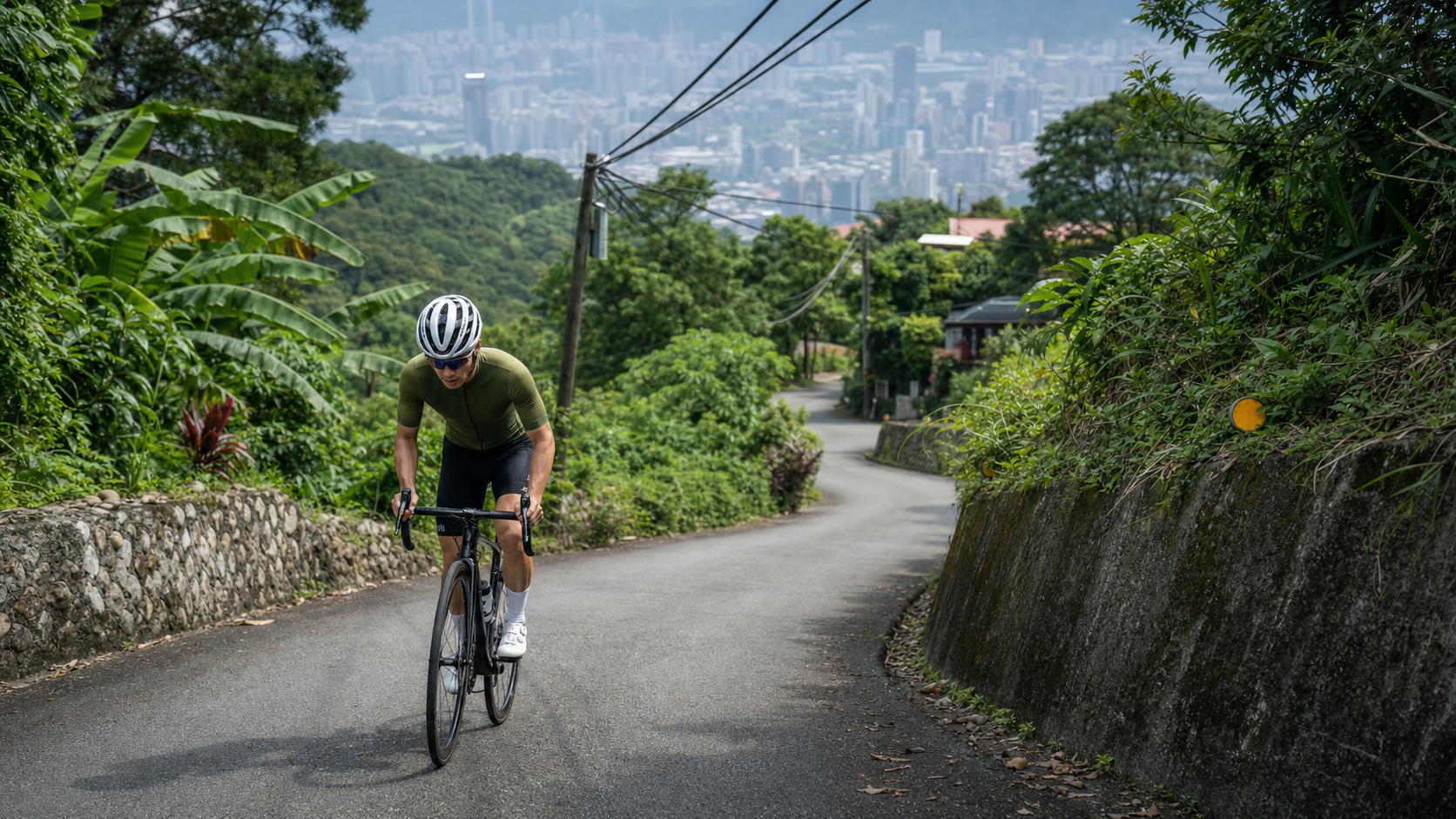
Route Basic Info: Starting and ending in Shilin District, Taipei City, total length 3944.22 meters, total elevation gain approximately 244.9 meters, average gradient 6.3%, officially rated as Category 2 (intermediate, slightly easy). The following data is cross-referenced from route database measurements and on-site riding experience; actual conditions are still subject to official announcements and on-site road conditions.
Route Overview: Why Zhongshe Road Is the “Graduation Exam” for Taipei Riders
If you’ve spent any time in Taipei cycling groups, you’ve definitely heard the phrase “go ride Zhongshe Road to practice first.” Located in the Waishuangxi area of Shilin District, right behind the mountain area adjacent to the National Palace Museum, Zhongshe Road is one of the most classic “entry-level advanced” climbing routes in Taipei’s northern district. Its status is subtle: for beginners just starting road cycling, this road is steep and long enough to make you question your life choices; but for true mountain veterans, Zhongshe Road is just a warm-up—ahead lie challenges like Fengguizui, Neishuangxi, and the Yangjin Highway.
Numbers speak the loudest. Zhongshe Road spans 3944.22 meters, less than 4 kilometers, which sounds like “not a big deal,” but the total elevation gain reaches 244.9 meters with an average gradient of 6.3%. Translating that into gut feeling: there are almost no flat sections to catch your breath—from start to finish it’s nearly all uphill, interspersed with several “attack zones” where the gradient clearly exceeds 10%. The difficulty rating falls at Category 2, which in the route database is intermediate-slightly easy, but anyone who has actually ridden it knows that “intermediate-slightly easy” doesn’t mean “easy”—it means “beginners can finish it, but they’ll definitely feel it.”
The reason this route is called “the必经之路 for Taipei riders to grow and thrive” lies in its highly educational gradient profile. Zhongshe Road doesn’t have the ultra-long gentle slopes of the Yangjin Highway that let you find a steady rhythm, nor does it have the short, brutal sections of some parts of Fengguizui—its gradient variation sits between the two: long enough for your lungs and legs to feel sustained pressure, yet not so long that you completely fall apart. As a result, many Taipei teams and coaches use Zhongshe Road as a “climbing ability assessment route”—a beginner’s first completion time often roughly reflects their potential for tackling more advanced mountain routes in the future.
Geographically, Zhongshe Road connects the Waishuangxi and National Palace Museum mountain road network, often linking with Zhishan Road and other mountain access roads near the museum to form the popular “Waishuangxi climbing loop” among Taipei riders. On holiday mornings, you’ll often see groups of road cyclists gathering around Waishuangxi to set off, with Zhongshe Road being a near-mandatory segment. For riders living in urban Taipei who haven’t yet scheduled a full Yangmingshan loop, Zhongshe Road’s advantages are high accessibility, short practice cycles, and a round trip completable within about an hour—perfect for short, high-intensity training after work on weekdays or on weekend mornings.
Section-by-Section Strategy: From Warm-Up at the Start to the Final Attack at the Summit
To efficiently conquer a 3.94 km climb with a 6.3% average gradient, a “section strategy” is key. Based on pacing patterns reported by riders, the full route is broken down into four phases below to explain pacing logic; actual landmarks and gradient transition points are still subject to on-site signage and official route maps.
Phase 1: Start Warm-Up Zone (approximately first 800 meters)
Most climbing routes arrange a relatively gentle lead-in near the start to let the body and cardiovascular system gradually enter a loaded state, and Zhongshe Road is no exception. The gradient here is typically below the route average, and riders should use this distance to warm up properly, including confirming cadence, adjusting breathing rhythm, and verifying the shifting system is working smoothly. The mistake many beginners make here is “going all out from the start,” thinking it’s only 4 kilometers anyway—only to find themselves out of gas when they hit the steeper middle section. The correct approach is to keep heart rate around 75-80% of your personal FTP (Functional Threshold Power), maintain cadence at 85-95 rpm, and let the body gradually warm up.
Phase 2: Middle Sustained Climb (approximately 800 meters to 2.5 km mark)
This is where Zhongshe Road truly shows what “6.3% average gradient” means. This section is long, the gradient is sustained, and there’s no obvious recovery platform—it’s the most endurance-pacing-demanding part of the entire route. The recommended approach here is “seated riding as primary, standing as secondary”—prolonged standing out-of-saddle efforts will spike heart rate quickly and accelerate lactate accumulation, making it easy to run out of steam for riders not yet fully adapted to climbing rhythm. Seated riding with a steady cadence (recommended 70-85 rpm), combined with a relaxed upper body and light grip on the handlebars, allows you to distribute energy evenly across the entire route. If pacing is correct through this section, heart rate should climb steadily to around 85% of your maximum heart rate and hold in that range rather than spiking near the limit and then struggling to hang on.
Phase 3: Rear Attack Zone (2.5 km to 3.5 km mark)
Most Taipei mountain training climbs have a “finishing blow” steep section before the end, and the rear section of Zhongshe Road is often described by riders as “thinking you’re almost there, but there’s still one more hard part.” Here the gradient may briefly exceed double digits, making it the most demanding area for instantaneous output and willpower. It’s recommended to take a deep breath adjustment before entering this section, slightly lower cadence while increasing force, and use a “short-interval standing sprint” approach to break through in segments—each standing effort should not exceed 15-20 seconds, then sit back down to recover rhythm, avoiding pushing heart rate to the brink of exhaustion in one go.
Phase 4: Finish and Summit (3.5 km to the end)
The final stretch typically eases slightly, giving riders a chance to adjust breathing, prepare for a sprint, or finish steadily. For riders training, it’s recommended not to sprint here but instead focus on recovering heart rate and doing a full pedal-stroke review, confirming whether your pacing strategy in the middle and rear sections was sound, serving as a reference baseline for the next attempt.
Gear Ratio and Equipment Recommendations: Don’t Let the Wrong Gearing Ruin Your Climbing Experience
With a 6.3% average gradient and local sections exceeding 10%, Zhongshe Road has clear requirements for gear ratio configuration. If you’re a road cycling beginner, a compact crankset (50-34T) paired with an 11-32T or 11-34T cassette is strongly recommended. This setup provides a low enough gear for the steep sections, avoiding the need to grind at extremely low cadence due to insufficient gearing, which can harm your knees.
For intermediate riders with a solid climbing foundation and an FTP-to-weight ratio (W/kg) of 3.5 or above, a standard crankset (53-39T) with an 11-28T cassette is also viable, but it’s recommended to shift to the small chainring early before entering the middle sustained climb and rear attack zone, avoiding the risk of chain skip or drop from shifting under load on steep sections.
For equipment, beyond confirming the drivetrain is in good condition beforehand, brake system checks are equally important—although Zhongshe Road is an uphill route, the descent back down equally requires good braking power and heat dissipation. It’s recommended to check brake pad wear and brake fluid/cable tension before riding. For tire pressure, general road bikes should maintain 90-110 psi (adjusted based on rider weight and tire width); overly high pressure on a route with dramatic gradient changes sacrifices grip and comfort.
For clothing, since Zhongshe Road is mostly in shaded forest areas with significant temperature differences between morning and afternoon, layered dressing is recommended, along with carrying a lightweight windbreaker to handle the sudden drop in perceived temperature on the descent.
Nutrition and Hydration Management: The Hidden Risk of a Short, High-Intensity Route
Many riders underestimate Zhongshe Road’s nutrition needs, reasoning “it’s only 4 kilometers, I’ll be there in no time.” But precisely because this route is steep and intensity is concentrated in a short burst, the body burns through glycogen and electrolytes faster than on longer, gentler climbs. It’s recommended to complete a full meal 1-2 hours before riding and consume an easily absorbable carbohydrate (such as a banana or energy gel) 15-20 minutes before departure.
For hydration, although the total riding time may only be 15-30 minutes (depending on individual level), under Taipei’s hot, humid summer conditions, sweat rates increase significantly. It’s recommended to carry at least a 500ml bottle and take small sips at the slightly flatter mid-route sections (if any), avoiding large gulps during full-power efforts on steep sections, which can cause choking or stomach discomfort.
If you’re arranging Zhongshe Road as part of a continuous training session (e.g., following up with other surrounding mountain routes), carrying electrolyte supplements and energy gels becomes even more important. It’s recommended to replenish every 45-60 minutes to maintain blood sugar and electrolyte balance, preventing cramps or a sudden cliff-like drop in energy.
Weather and Seasonal Recommendations: When Is the Best Time to Ride Zhongshe Road
Taipei Basin’s climate patterns significantly affect the Zhongshe Road riding experience. Spring and autumn (March-May, October-November) offer moderate temperatures and relatively lower humidity, making them the golden seasons for riding Zhongshe Road—comfortable, with less risk of overheating or heat exhaustion.
Summer (June-September) riding on Zhongshe Road requires special attention to the double threat of afternoon thunderstorms and high heat with high humidity. Since the route is mostly in shaded forest areas, the muggy feeling is more pronounced than on open roads. It’s recommended to start in the early morning (after sunrise and before 9 AM) to avoid the midday heat peak, while closely monitoring the Central Weather Administration’s real-time radar imagery. Mountain afternoon thunderstorms arrive quickly and violently; if you notice the sky changing dramatically mid-ride, you should retreat early to avoid heavy rain on steep sections causing slippery road surfaces.
Winter (December-February) under the influence of Taipei’s northeast monsoon, the mountain area is prone to cold, damp conditions and fog. Reduced visibility increases riding risk, so it’s recommended to enhance reflective gear and use lights, while paying attention to reduced grip from wet road surfaces. Overall, because Zhongshe Road is close to the city with concentrated elevation gain, it’s a route challengeable year-round, but equipment and departure times need to be adjusted according to the season.
Common Mistakes and DNF Risks: Where Beginners Most Often Fail
Based on practical experience shared by many riders, the most common failure mode on Zhongshe Road isn’t “insufficient fitness” but “incorrect pacing strategy.” Here are several common mistakes:
- Starting too fast: Misled by the relatively gentle gradient in the early section, riders go all out with a flat-road mentality. By the time they hit the middle sustained climb, heart rate is already near the limit, leaving them completely unable to pedal in the rear section and forced to dismount and walk.
- Insufficient gear ratio: Using a standard crankset with heavier gearing (e.g., 11-25T) forces riders to grind at extremely low cadence on steep sections, putting excessive stress on the knees with long-term injury risk.
- Ignoring nutrition timing: Assuming the short route needs no fueling, riders hit the rear attack zone with low blood sugar or cramping symptoms, forced to stop mid-ride and disrupting their rhythm.
- Letting guard down on the descent: Many riders focus all attention on the uphill challenge, then on the way back down, fatigue and reduced concentration increase accident risk. It’s recommended to maintain moderate braking to control speed on descents and avoid losing control in corners.
- Misjudging weather: Not watching for afternoon thunderstorm signs in summer, or failing to assess slippery road risks in winter, leading to safety concerns from riding recklessly.
By avoiding these mistakes and combining the section pacing strategy and gear ratio recommendations above, the vast majority of riders with basic riding ability can successfully complete the Zhongshe Road challenge without experiencing a DNF (Did Not Finish).
Target Time References for Different Rider Levels
The following times are for reference only; actual results will vary based on fitness, weather conditions, and equipment. Riders are advised to set goals based on their own past performance on similar gradient routes rather than directly applying others’ data.
| Rider Level | Characteristics | Reference Completion Time Range |
|---|---|---|
| Beginner | Just starting road cycling climbs, still accumulating mileage | 25-35 minutes |
| General Enthusiast | Regular riding habits, occasionally tackling mountain routes | 18-25 minutes |
| Intermediate Rider | FTP-to-weight ratio around 3.0-3.5 W/kg, regular climbing training | 13-18 minutes |
| Advanced Rider | FTP-to-weight ratio 3.5-4.5 W/kg, competitive experience | 9-13 minutes |
| Race Level | FTP-to-weight ratio above 4.5 W/kg | Under 9 minutes |
It’s worth noting that as a short-distance, high-average-gradient route, Zhongshe Road performance is more sensitive to instantaneous power output (especially explosive power in the rear attack zone), so it doesn’t fully equate to endurance-type performance on long climbs. Riders are advised to also reference their anaerobic threshold performance and interval training results when setting target times, rather than looking only at average climbing ability.
Training Cycle Planning: How to Fit Zhongshe Road into Your Climbing Program
For riders looking to systematically improve climbing ability, a single Zhongshe Road attempt has limited value. The truly effective approach is incorporating it into a regular training cycle. Below is a four-week progressive training framework suitable for most amateur riders, for those committed to continuous improvement.
Week 1: Baseline Test Week. Complete Zhongshe Road for the first time with a “not chasing speed, focusing on feel” mindset, recording your completion time, average heart rate, and maximum heart rate as baseline values for subsequent training. The focus this week isn’t riding fast but familiarizing yourself with the route’s gradient changes and building your body’s “map memory” of the road.
Week 2: Rhythm Strengthening Week. This week adds pacing control practice, attempting to maintain a steady cadence and heart rate zone through the middle sustained climb, avoiding erratic speed changes. You can use a power meter or heart rate monitor to set target zones (e.g., maintaining 80-85% of max heart rate), training your ability to sustain steady output under prolonged continuous effort.
Week 3: Interval Intensity Week. After familiarizing yourself with the overall rhythm, this week adds interval training elements—for example, deliberately increasing output intensity in the rear attack zone to simulate final sprint scenarios in races or challenges, training explosive power above the anaerobic threshold and recovery ability.
Week 4: Integration Test Week. Return to Week 1’s full challenge mode and compare completion times and physiological data before and after the four weeks. Most riders who seriously execute this training framework see significant improvement of over 10% in completion time within four weeks—this is the value of Zhongshe Road as a “benchmark test route”: its length and intensity are just right as a validation ground for short-cycle training effectiveness.
Heart Rate and Power Data Interpretation: Understanding Your Climbing Performance Scientifically
If your equipment setup includes a heart rate monitor or power meter, Zhongshe Road is an excellent route for analyzing personal climbing data. With concentrated intensity and relatively simple terrain, reviewing data after the ride clearly reveals performance gaps across different sections.
For heart rate data, an ideal climbing pace should show a curve of “gradual rise then stabilization”—heart rate climbs steadily in the opening section, holds in the target zone (typically 80-90% of max heart rate) through the middle sustained climb, and only in the rear attack zone is allowed to climb further toward the limit. If your heart rate curve spikes near maximum in the early section and then declines in the middle and rear sections, that indicates a clearly imbalanced pacing strategy—too aggressive at the start.
For power data, if using a power meter, observe the gap between Normalized Power and Average Power. The smaller the gap, the steadier your output; the larger the gap, the more erratic your power delivery, usually indicating poor rhythm control or overreacting to gradient changes (e.g., sprinting explosively on local steep sections, then immediately easing off on gentler slopes). Long-term, cultivating steady power output ability not only improves performance on short climbs like Zhongshe Road but also directly benefits future challenges on longer mountain routes.
Linking with Surrounding Routes: Building a Complete Waishuangxi Climbing Session
A solo Zhongshe Road challenge typically takes no more than an hour. For riders looking to arrange a more complete training session on holidays, consider linking Zhongshe Road with other routes around Waishuangxi to plan a full training day covering warm-up, main workout, and cool-down.
A suggested session structure: start from the city with a flat, easy ride as warm-up, connecting to the Waishuangxi road network; upon reaching the Zhongshe Road entrance, complete one to two formal climbing challenges (adjusting the number of reps and intensity based on personal fitness and training goals); after the challenge, optionally continue exploring other surrounding climbing routes or arrange a recovery ride as cool-down, allowing the body to gradually recover from high-intensity output.
This kind of session planning not only improves overall training effectiveness but also helps riders more comprehensively understand the rich cycling resources of the Waishuangxi area, rather than treating Zhongshe Road as an isolated single segment.
Handling Rain and Slippery Conditions: Don’t Let Weather Become an Excuse to Skip
Taipei Basin has a high probability of rainfall, and many riders develop the habit of “not riding when it rains.” But if you’ve put Zhongshe Road into a fixed training cycle, you’ll inevitably face situations requiring riding in slippery conditions. Here are some practical recommendations. First, tire selection: if rain is forecast, choose training tires with better grip and slightly reduce tire pressure (5-10 psi lower than usual) to increase the tire’s contact patch with the road and improve wet grip. Second, brake timing adjustment: braking distance lengthens noticeably on wet surfaces, especially on the descent back down. It’s recommended to brake earlier and use light, segmented deceleration rather than sudden hard braking that can cause wheel lock-up.
On sections with dramatic gradient changes, the most important things to watch for when riding in the rain are low-friction objects like drainage grates, manhole covers, and painted road markings. Wheels passing over these areas in wet conditions are highly prone to slipping. It’s recommended to anticipate ahead and steer around them or reduce speed when crossing. Additionally, visibility is typically poorer in wet weather, so it’s recommended to enhance reflective gear and front/rear lights. Even during daytime rain, consider running a flashing tail light to increase visibility and ensure your safety.
Of course, if there’s a severe thunderstorm warning or obvious dangerous conditions like deep standing water, it’s still recommended to decisively cancel that session—safety should always come before training progress.
Common Rider FAQ
Q1: Is Zhongshe Road suitable for bikes other than road bikes?
The road surface on Zhongshe Road is essentially well-paved asphalt access road, so road bikes, gravel bikes, and even some mountain bikes can complete the challenge successfully. However, due to the concentrated steep gradients, if using heavier city bikes or folding bikes with gearing oriented toward flat terrain, the difficulty increases significantly. It’s recommended to adjust expectations based on your bike’s characteristics.
Q2: Should beginners have someone ride with them on their first attempt at Zhongshe Road?
Strongly recommended. Although Zhongshe Road isn’t top-tier in difficulty, for beginners with no mountain riding experience, attempting it alone can easily lead to being stranded with no help due to poor energy distribution. Having an experienced rider accompany you not only provides pacing advice but also immediate assistance in emergencies, significantly reducing risk.
Q3: Are there aid stations or convenience stores on Zhongshe Road?
The area around Zhongshe Road is relatively simple mountain access road. It’s recommended to complete all supply preparations in the city or around Waishuangxi before riding, and not to expect convenient supply points along the way, to avoid insufficient supplies affecting riding performance and safety.
Q4: Can children or teenagers attempt Zhongshe Road?
If a teenager has a certain level of riding foundation and fitness, and rides within their limits under parental or coach supervision, Zhongshe Road can serve as an entry-level mountain riding experience route. However, it’s still recommended to assess based on individual circumstances; if necessary, start with just the front section (warm-up zone) rather than forcing a full completion.
Advice for Coaches and Team Ride Leaders
If you’re a team ride leader or coach planning group training activities, Zhongshe Road is an excellent group training venue, but it also requires attention to specific risks and leading techniques for group riding. Since the route is steep with limited road width, it’s recommended to use a “staggered departure” approach for group rides, dividing riders into different groups by fitness level to avoid forcing riders of vastly different abilities into the same group—a lose-lose situation where stronger riders wait and weaker riders feel excessive pressure.
Ride leaders should also confirm each rider’s equipment condition in advance, especially whether gear ratios are sufficient to handle the sustained 6.3% average gradient challenge, avoiding riders being forced to abandon mid-route due to inadequate equipment, which affects the completeness and morale of the group training. Additionally, it’s recommended to clearly communicate meeting points and emergency contact methods before departure, so that if any rider experiences fatigue or mechanical failure during the challenge, it can be handled promptly.
Conclusion: Make Zhongshe Road a Benchmark for Long-Term Progress
The significance of Zhongshe Road isn’t just “completing these 3.94 kilometers”—it’s that it provides a stable, repeatable gradient sample that lets riders regularly return to measure their progress. The combination of a 6.3% average gradient and 244.9 meters of elevation gain hits the difficulty sweet spot—challenging enough to constitute a real test, yet not so daunting that beginners are completely deterred. If you’re just starting to explore Taipei’s mountain routes, consider adding Zhongshe Road to your regular training list, recording your completion time and heart rate data each attempt, and combining the section pacing strategy, gear ratio recommendations, and four-week training framework provided in this article to continuously accumulate riding experience. You’ll find that this “必经之路 for Taipei riders to grow and thrive” truly lives up to its name—it will honestly reflect your progress and keep pushing you to become stronger.
Related Reading
- Zhongshe Road’s Gentle Slopes: Among Waishuangxi’s Mountain Scenery, the Reasons That Keep Bringing Me Back
- Dakeng to Xinshe Practical Guide: An 8.5 km Gentle Climb Connecting Zhongxingling, Taichung’s Main Training Artery
- Linkou Dake Road Practical Guide: A 5.13 km, 255 m Elevation Urban Climbing Introductory Course
- Dakeng Zhongzheng Campground Climb Practical Guide: A 5.8 km Gentle-with-Steep-Sections Taichung Entry-Level Training Stone
爬坡ITT實境)台中 魔王 松鼠坡 首航 6:12 大肚山 大三元 科福路
8 年前
中社路 12分 #Canyon #Aeroad 8.0 Di2 首航 [Checkpoint6]
9 年前
半日 小台灣 極限單車路線挑戰實錄
7 年前
台北闊瀨陡坡 騎旅 / 日本單車雜誌編輯車友臨時加入!/ 髮香才是最強的 / feat. 北迴歸線小隊 / 公路車 CT Yeh
6 個月前
單車 梅山36灣 坡度介紹 路段介紹 空拍 (相關遊記影片,請參考說明或我的頻道喔,歡迎訂閱)
6 年前
梅山36彎 奮起湖 #公路車 之旅 2400m
6 年前
藤枝二集團 單車行 Day1 | 南部小武嶺 | 爬坡爬到罵罵叫 | JJSC | 公路車 | CT Yeh
3 年前
2016/4/20 - 中社路 夜騎 半年甩肉14KG 後測
10 年前