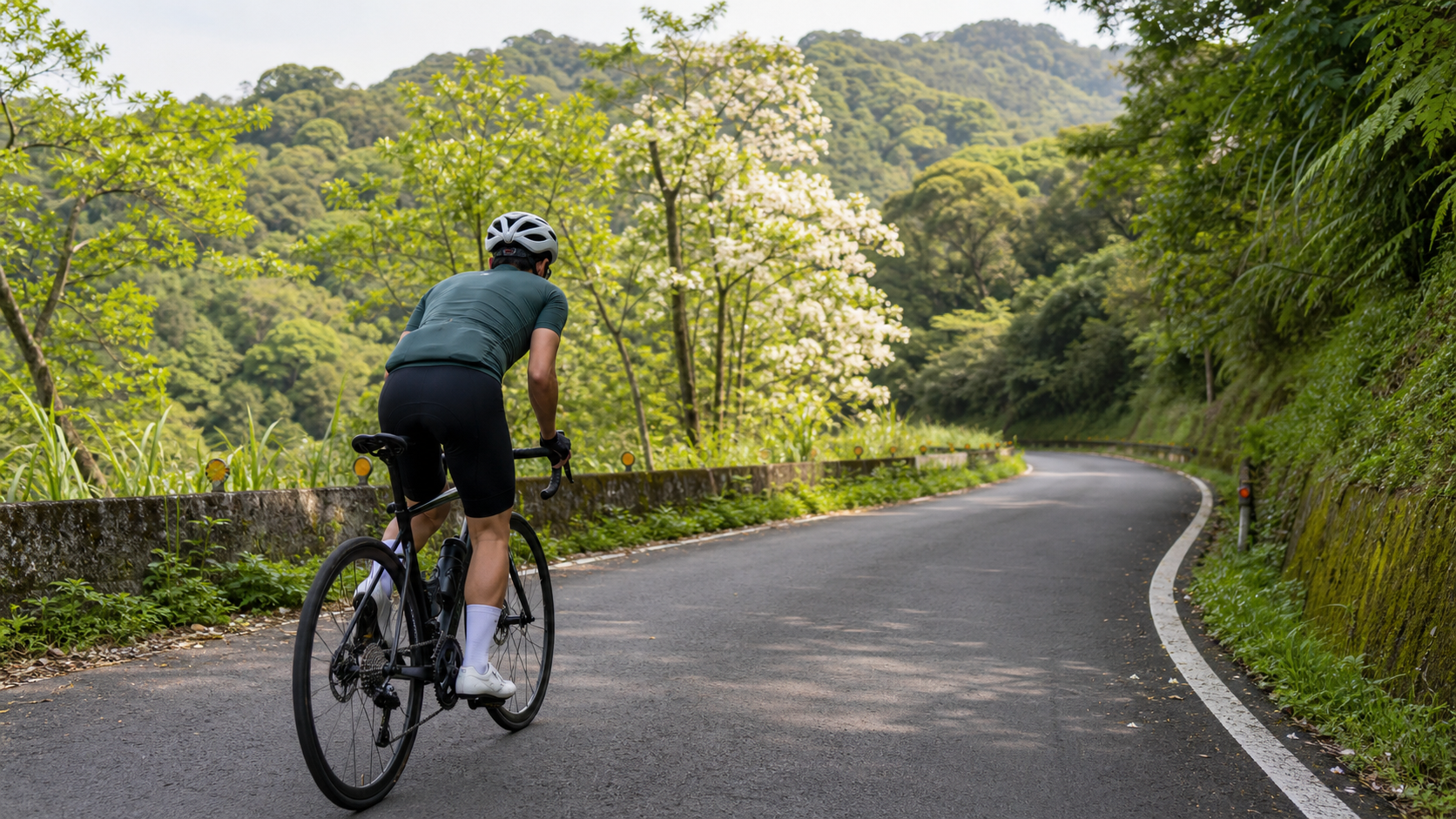
4.35 km in distance, 178 meters of elevation gain, 4.0% average gradient—Shiding Road (County Road 33, linking Nangang and the Xizhi hills, nicknamed “Tung Blossom Road” for the tung trees lining the route) is one of the few entry-level climbs on the eastern edge of the Taipei Basin with gentle gradients and straightforward road conditions. It won’t force you to blow up at the first corner, yet it lets you fully practice “steady-cadence pedaling.”
If you’re just stepping up from riverside bike paths into mountain training, or looking for a short climb you can repeatedly ride to quantify your progress, Shiding Road is practically a textbook choice. This article takes a data-driven approach, breaking the road into functional segments, explaining what gear ratio, cadence, and power output to maintain in each, reviewing common pacing mistakes, and finally offering target time references for riders of different levels—so every ride can be compared against your previous performance to reveal a true improvement curve.
1. Understanding the Numbers First: What a 4.0% Average Gradient Really Means
Before planning any pacing strategy, the baseline figures must be placed in the same frame of reference. Shiding Road spans 4.35 km with 178.4 meters of total elevation gain, translating to an average gradient of around 4.0%—by gradient classification, this falls in the “moderate climb” range, sitting between riverside flats and Yangmingshan’s brutal Hardman Slope. In terms of power profile, this gradient is best suited for practicing “sustained output without entering the anaerobic zone” rhythm riding (Tempo or Sweet Spot intensity), rather than short intervals.
Notably, 4.0% is the average gradient, meaning the actual gradient fluctuates between roughly 2% and 7% along the way—it’s not a uniformly graded asphalt slope. This is why many newcomers to mountain riding let their guard down in the early section, only to feel their legs suddenly get heavy later—because the average masks the true variation in gradient. For practical planning, it’s recommended to split the road into three functional zones: the warm-up start, the middle variable-gradient section, and the easing finish.
| Distance Range | Characteristics | Recommended Heart Rate Zone (based on personal LTHR) | Recommended Cadence |
|---|---|---|---|
| 0–1.5K | Gentle start, warm-up | Zone 2–3 (65%–80% LTHR) | 85–95rpm |
| 1.5–3K | Greatest gradient variation | Zone 3–4 (80%–95% LTHR) | 70–90rpm |
| 3–4.35K | Easing finish, room to pick up speed | Zone 3 (80%–88% LTHR) | 90–100rpm |
Using this table against your heart rate monitor or power meter helps you avoid the classic mistake of “surging early, fading late.” Additionally, if you have a power meter, it’s recommended to set your target power for the entire segment at 75%–90% of FTP, allowing brief surges to 95%–105% FTP on the middle rolling sections—but each surge should be followed by an immediate return to steady output, avoiding prolonged time in the anaerobic zone that depletes glycogen stores.
2. Segment-by-Segment Strategy: A Three-Part Breakdown of Gradient Changes and Cadence Rhythm
Segment 1 (0–1.5K): Warm-up start—don’t rush to raise your heart rate. The entrance to Shiding Road typically connects from the Nangang side, with smooth pavement and open visibility, with gradients mostly between 2% and 4%. The task here isn’t “speed” but smoothly transitioning your heart rate from Zone 1–2 flat-road cruising into Zone 3, while getting your leg muscles and core into climbing mode. Recommended cadence is 85–95rpm, starting in the middle chainring—avoid forcing a heavy gear from the outset, as that accelerates lactate buildup and leaves you unable to ride later. This section is also a good time to check your equipment—confirm the bottle cap is tightened, verify smooth shifting, and ensure your computer or power meter readings are displaying correctly—eliminating all variables during the low-intensity phase.
Segment 2 (1.5–3K): The critical section of the entire road, with the greatest gradient variation. This is where Shiding Road truly tests the rider. The middle section frequently features alternating short steep pitches and gentle rollers, with instantaneous gradients briefly spiking to 6%–8%—corresponding to the earlier 4% average, this is a concrete example of “the mean masking the variation.” The recommended strategy here is “micro-adjust on the climbs, settle back on the flats”: on steep sections, standing to sprint isn’t necessary—stay seated with a slightly reduced cadence (70–85rpm) and higher torque to handle most pitches; on gentler sections, quickly bring cadence back up to around 90rpm to redistribute the cardiovascular load back to the aerobic system. This “micro-adjustment” pacing mindset is essentially a microcosm of all long-distance climbing—rather than chasing perfectly even speed, learn to breathe with the terrain.
This section is also where rhythm disruption most commonly occurs. Many riders panic when they see the gradient number spike, reflexively standing and sprinting hard—only to have their heart rate blow past the anaerobic threshold thirty seconds later, forcing them to grind through the next kilometer at a crawl. The correct approach is to anticipate—using the gradient preview on your computer or prior route reconnaissance to know where short steep pitches appear, downshifting a corner in advance so your cadence drops before you hit the climb, rather than being forced into a reactive response by the steep pitch itself.
Segment 3 (3–4.35K): The finish—pick up speed based on feel. Entering the final kilometer-plus, the gradient typically falls back to around the average or even gentler—this is the moment to verify whether your earlier pacing was sound. If the first two segments were well managed, you should have enough in reserve to push output slightly higher and cross the line at near Zone 4 intensity; if your legs feel heavy and your heart rate is drifting near the anaerobic threshold while speed drops, that signals overly aggressive pacing earlier—a cue to correct on your next ride. It’s recommended to spend a minute after each ride reviewing your perceived exertion rating (RPE, on a 1–10 scale), combined with the actual data recorded on your computer—over time, this calibrates a pacing strategy that best suits you.
3. Gear Ratio and Equipment Recommendations
For a 4.0% average gradient with occasional 6%–8% short steep pitches in the middle, road riders using a standard crankset (53/39T) with an 11-28T cassette should generally manage fine; riders with average fitness or those wanting to preserve energy might consider a compact crankset (50/34T) with an 11-30T or 11-32T cassette, allowing smooth cadence on the middle steep sections without being forced to stand and grind. The increasingly popular 1x systems (single chainring with a wide-range cassette, e.g., 40T paired with 10-33T) also suit this gradient profile well, with simple and intuitive gear changes—ideal for riders who treat Shiding Road as a regular training base.
Regarding tire choice, Shiding Road’s surface is generally in good condition, primarily asphalt, so standard road tires (25c–28c) are sufficient—no need to switch to higher-grip models. Tire pressure should be adjusted by rider weight; a rider around 70kg might set approximately 90psi front and 95–100psi rear—excessively high pressure on the slightly coarse asphalt actually sacrifices grip and comfort.
For braking systems, given the generally moderate gradients and no particularly steep descents, both hydraulic disc brakes and traditional rim brakes handle the route safely—but on descents, it’s still advisable to brake early and progressively to avoid heat fade on longer downhills. If using disc brakes, regularly check pad wear, especially for riders who schedule this route into high-frequency training plans, as brake component wear will be faster than for weekend recreational riders.
4. Nutrition and Hydration Strategy
For a 4.35 km short climb with an average ascent time of roughly 15–25 minutes (depending on rider ability), a single lap itself requires no additional nutrition—just ensure your bottle is topped up before departure. However, Shiding Road is often incorporated into longer loop routes (e.g., connecting to Jiangziliao, Wufen Mountain, or the Beiyi direction), and if it’s part of a larger ride, it’s recommended to pause for 3–5 minutes at the summit or after the segment for small sips of water and electrolyte replenishment, reducing the risk of cramping from short-duration high-intensity output.
Taiwan’s summer mountain conditions are hot and humid, and Shiding Road offers limited shade along its route—at midday, reflected heat from the pavement can spike perceived temperatures significantly. It’s recommended to ride in the early morning or evening, carrying at least one bottle of sports drink or electrolyte supplement, especially when the route is part of a longer training plan. If departing at midday in high summer, consider carrying an extra bottle of plain water for pouring over your head to cool down—a simple yet effective trick commonly used by experienced riders in Taiwan’s summer mountains.
5. Weather and Seasonal Recommendations
Because Xiding Road is near the Keelung River and the northeast monsoon corridor, winter (November to February of the following year) is prone to damp, cold drizzle under the influence of the northeast monsoon. When the road surface is wet, the aforementioned steep mid-section climbs require extra careful speed control. It is recommended to lower your overall pace target by 10%–15% during winter rides and ensure you wear a jersey with windproof and water-repellent properties. In spring (March–April), tung blossoms and various wildflowers commonly bloom along the route, making it the best season for rides with the dual purpose of “attacking the climb plus enjoying the culture.” Temperatures are also relatively comfortable, making it the most recommended training window of the year. In summer, afternoon convective showers are relatively common on mountainous sections, so it is advisable to monitor real-time radar returns to avoid encountering thunderstorms mid-ride. Autumn (September–October) typically offers the best air quality and visibility of the year, and is also suitable for arranging longer, combined rides.
6. Common Mistakes and DNF Risk Assessment
Although Xiding Road has a gentle gradient and is short in distance, so it does not carry the “cannot finish” DNF risk that most people perceive, several common execution errors are still worth noting:
- Pacing too hard at the start: Many riders see the gentle gradient and attack the initial climb at their flat-road cruising speed, only to run out of steam at the variable-gradient mid-section. This is the most common pacing mistake on all short climb routes.
- Shifting gears too slowly: The gradient changes quickly in the mid-section. If you misjudge the timing of your shifts, you can easily find yourself in the awkward situation of a jammed chain or a dropped chain at a sudden steep pitch. It is recommended to shift down one gear before the gradient change, allowing the drivetrain to complete the shift under low tension.
- Ignoring slippery road surfaces: After rain, fallen leaves or moss tend to accumulate on the inside of corners. Be sure to slow down when descending and cornering, especially on the drainage grates and pavement seams commonly found on mountainous roads, which can easily cause slides when wet.
- Neglecting refueling timing: When Xiding Road is part of a longer route network, it is easy to overlook overall refueling planning because this segment alone is short. It is recommended to plan refueling based on the “entire ride” rather than a “single segment.”
- Skipping warm-up: Because the total distance is short, it is tempting to skip the warm-up and start riding immediately. However, muscles that have not been warmed up are more prone to cramping or strain when facing the mid-section climbs. It is recommended to spend five to ten minutes warming up on flat ground before departing.
7. Reference Target Times for Riders of Different Levels
The following times are for reference only; actual performance will vary depending on the day’s wind conditions, physical condition, and equipment weight:
| Rider Level | Estimated Completion Time | Reference Average Power (70 kg rider) |
|---|---|---|
| Advanced / Race level | 10–13 minutes | 4.0–4.5 W/kg |
| Intermediate / Consistent trainer | 14–18 minutes | 3.0–3.5 W/kg |
| Beginner / Recreational rider | 19–25 minutes | 2.0–2.5 W/kg |
For riders who are just beginning climb training, it is recommended to treat Xiding Road as a “benchmark test segment.” Re-riding it periodically and recording your time and heart rate response is the most intuitive way to track the progress of your aerobic capacity. The value of this road lies not in how hard it is, but in its stability and repeatability—which are precisely the qualities every training plan needs most.
8. Suggestions for Incorporating Xiding Road into a Training Cycle
If you are planning a systematic climb training cycle, Xiding Road is well suited for the “base phase” and “recovery weeks” of your training menu. During the base phase, you can use it as a repeated climb segment at Tempo intensity, doing three to five round trips per session with flat cruising between each as recovery. During recovery weeks, you can lower the intensity and simply use it to maintain pedaling neuromuscular memory, without deliberately pushing your heart rate high.
For riders preparing to tackle longer and harder routes (such as Balaka Road or the Pinglin mountain network), Xiding Road is also an excellent “pre-race testing” venue—because it is short and easy to access for repeated attempts, you can repeatedly validate your newly adjusted gear ratios, saddle height, or refueling strategy within a single training session. By the time you actually hit the big mountains, these details will already be refined, and you will not need to spend time figuring things out on the spot. This training philosophy of “using the small road to prepare for the big road” is exactly why many experienced riders keep Xiding Road on their shortlist.
9. Road Conditions and Traffic Safety Reminders
Although County Road 北33 is a familiar route for climbing cyclists, it is still an open industrial road for cars and motorcycles, not a closed cycling-only path. Be sure to ride on the right side, and anticipate blind spots in oncoming traffic before corners. Especially on the mid-section with its greater gradient variations, there are many corners and some sections have poor sight distance. It is recommended to wear a reflective vest or install a rear warning light to increase your visibility. On weekends, motorcyclists and other cycling groups occasionally use the road at the same time. Maintain adequate longitudinal spacing and avoid riding in a large group that occupies the full lane width, which would make it difficult for vehicles behind to overtake.
Regarding road surface conditions, since Xiding Road is a mountainous road, some sections may have potholes or patches due to drainage or geological factors. If time permits before a ride, it is advisable to check recent road condition reports through local cycling community groups. Especially after typhoons or heavy rain, mountainous roads are more prone to rockfalls or loss of roadbed. For safety, you should avoid riding for one to two days after extreme weather has just passed.
10. Final Thoughts: Make Xiding Road Your Training Baseline
One of the most important principles in engineering thinking is establishing a “repeatable, measurable baseline.” Xiding Road is precisely such an ideal baseline route—short in distance, moderate in gradient, and stable in road conditions, making it suitable for repeated use to verify changes in your physical condition. It is recommended to schedule one “baseline test day” each month: use a fixed warm-up routine and fixed equipment setup, ride the full 4.35 km at full effort, and meticulously record your completion time, average heart rate, average power, and cadence data. Accumulated over the long term, this road will become more than just a training segment—it will become the most honest mirror for tracking your fitness curve.
11. Combined Training Suggestions with Nearby Routes
If you have already mastered the difficulty of Xiding Road and feel that this segment alone no longer constitutes a sufficient training load, consider linking it with the nearby mountain roads of Nangang and Xizhi to form a combined route covering dozens of kilometers and over a thousand meters of elevation gain. A common approach is to use Xiding Road as a warm-up climb, then connect to the road network toward Jiangziliao, and depending on your energy levels, decide whether to turn back or continue extending toward Wufen Mountain or Pingxi. This ride design logic of “short climb to open, long climb to close” allows the body to complete its warm-up and equipment checks in a low-risk environment before entering the long-distance challenge that truly demands endurance and willpower.
For athletes preparing for mountain cycling events across Taiwan (such as the Wuling series or other New Taipei City mountain races), Xiding Road is also well suited for the tapering weeks two to three weeks before the event, to maintain pedaling neuromuscular sensitivity while avoiding high-intensity training that could lead to fatigue accumulation before race day.
12. Some Mental Preparation for Beginners Tackling Their First Climb
Finally, a few words for beginners attempting a climbing route for the first time. Although the gradient of Xiding Road is gentle, if this is your first time seriously facing a section with “continuous climbing for more than ten minutes,” you may still experience unprecedented breathlessness and a burning sensation in your legs in the mid-section. This is a completely normal physiological response and does not mean you lack fitness or chose the wrong route. The key to climbing has never been “not breathing hard,” but rather “learning to coexist with the breathlessness”—focusing on your breathing rhythm rather than the speed numbers often helps you get through the toughest few minutes.
The reason Xiding Road is suitable as your first formal climbing route is precisely because its gradient and length provide a safe “margin for error”—even if your pacing completely falls apart and you have to stop mid-way to catch your breath, you only need less than half an hour to regroup and continue to the finish. This low-risk learning environment is far better for building confidence than tackling Wuling or the Beihuan, which involve dozens of kilometers of sustained climbing from the very start. Once you have Xiding Road dialed in, you will find that when you face harder gradients, your mental toughness has already been quietly forged to be more resilient.
13. Equipment Checklist: Final Confirmation Before Departure
Before closing out this guide, here’s a pre-ride equipment checklist for riders tackling this route for the first time: confirm tire pressure matches the day’s temperature and your body weight; confirm shifting and brake feel are normal, especially whether the rear derailleur skips gears under climbing load; confirm water bottles are topped off, and carry an extra energy gel or snack just in case; confirm headlight and taillight batteries are sufficient—even if departing in daylight, a longer ride may stretch into dimmer hours; confirm your phone is fully charged with offline maps downloaded, as signal can be unstable on some mountain sections.
These seemingly trivial checks are exactly what turns a “casual short climb” into a safe, solid ride. Xiding Road may not be technically demanding, but every mountain road carries inherent risks, and thorough preparation is always the first and most important line of defense for riding safety.
14. Data Recording Tools and Training Tracking Recommendations
If you want to truly turn Xiding Road into an effective training tool, pair it with a GPS cycling computer or sports watch to record detailed data from every ride, including segment pacing, heart rate curves, power output (if equipped with a power meter), and cadence variations. Common training platforms on the market can visualize all this data, letting you clearly see which gradient section you perform most consistently on and where you tend to lose speed. After accumulating this data over time, you can even reverse-engineer a personalized pacing formula for different gradients—far more precise than riding purely by feel.
Additionally, spend two or three minutes after each ride jotting down that day’s perceived exertion, weather conditions, and equipment setup in a note app or training log. These seemingly trivial supplementary details are often the most critical contextual clues when reviewing data later—for instance, a particularly poor pacing day might not be a fitness regression, but rather unusually strong winds or slick road surfaces. Recording all these variables is the only way to make truly objective training adjustments.
As a short route that can be repeated at high frequency, Xiding Road is especially well-suited for accumulating this kind of long-term data sample. Once you have ten or twenty complete datasets from the same stretch, your understanding of your own physical condition will be far more precise and convincing than relying on feel alone.
15. Summary: Xiding Road’s Position in the Overall Training Blueprint
Looking back across this entire guide, Xiding Road’s role is clear—it is not a route for pushing your limits, but a training cornerstone for honing fundamentals, validating equipment and strategy, and accumulating stable data samples. Whether you’re a beginner just starting out or a veteran who has conquered hard climbs like Wuling or Hehuan, this 4.35-kilometer climb with an average gradient of 4.0% has a place in your training blueprint: for beginners, it’s the starting point for building confidence and baseline aerobic capacity; for veterans, it’s a testing ground for maintaining technical details and quickly evaluating new equipment. Master this road, and you’ve laid a solid foundation for taking on harder routes ahead.
Related Reading
- Pingxi Highway Practical Guide: 8.3 km, 793 m of Climbing, the Most Solid Climb Test in New Taipei’s Suburbs
- White May on Tung Blossom Road: A Leisurely Ride Journal and Local Scenery of Xiding Road
- Pingxi County Road 47 Practical Guide: Full Analysis of Pacing on a Quiet 8.3 km, 376 m Long Gentle Climb
- Wuzhi Mountain Practical Guide: 10 km, 839 m of Climbing, Don’t Be Fooled by the “5.7% Average”
台北闊瀨陡坡 騎旅 / 日本單車雜誌編輯車友臨時加入!/ 髮香才是最強的 / feat. 北迴歸線小隊 / 公路車 CT Yeh
6 個月前
單車 梅山36灣 坡度介紹 路段介紹 空拍 (相關遊記影片,請參考說明或我的頻道喔,歡迎訂閱)
6 年前
梅山36彎 奮起湖 #公路車 之旅 2400m
6 年前
半日 小台灣 極限單車路線挑戰實錄
7 年前
大禹嶺 到 武嶺牌樓 全程前後實況錄影 | 北進武嶺 | 東進武嶺 | KOM | 訓練台 | 坡度分析 | Taiwan KOM Last 10 km HARD | 公路車
6 年前
2020 戀戀197 全程4K雙錄影 訓練台實境 市民競賽組 M30 M40 #公路車
6 年前
西進武嶺 免費訓練分析服務 Intervals | 練不夠還是練過頭?你哪一種類型選手?AI模型告訴你! | 備戰神器 | 公路車 訓練 | CT Yeh
4 年前
4K單車實境) 舊陽金P字道 第1P 仰德大道至小油坑 誤跟武嶺神人們 被拉爆爽飛天 Taiwan Cycling Climb Route Recommend
7 年前