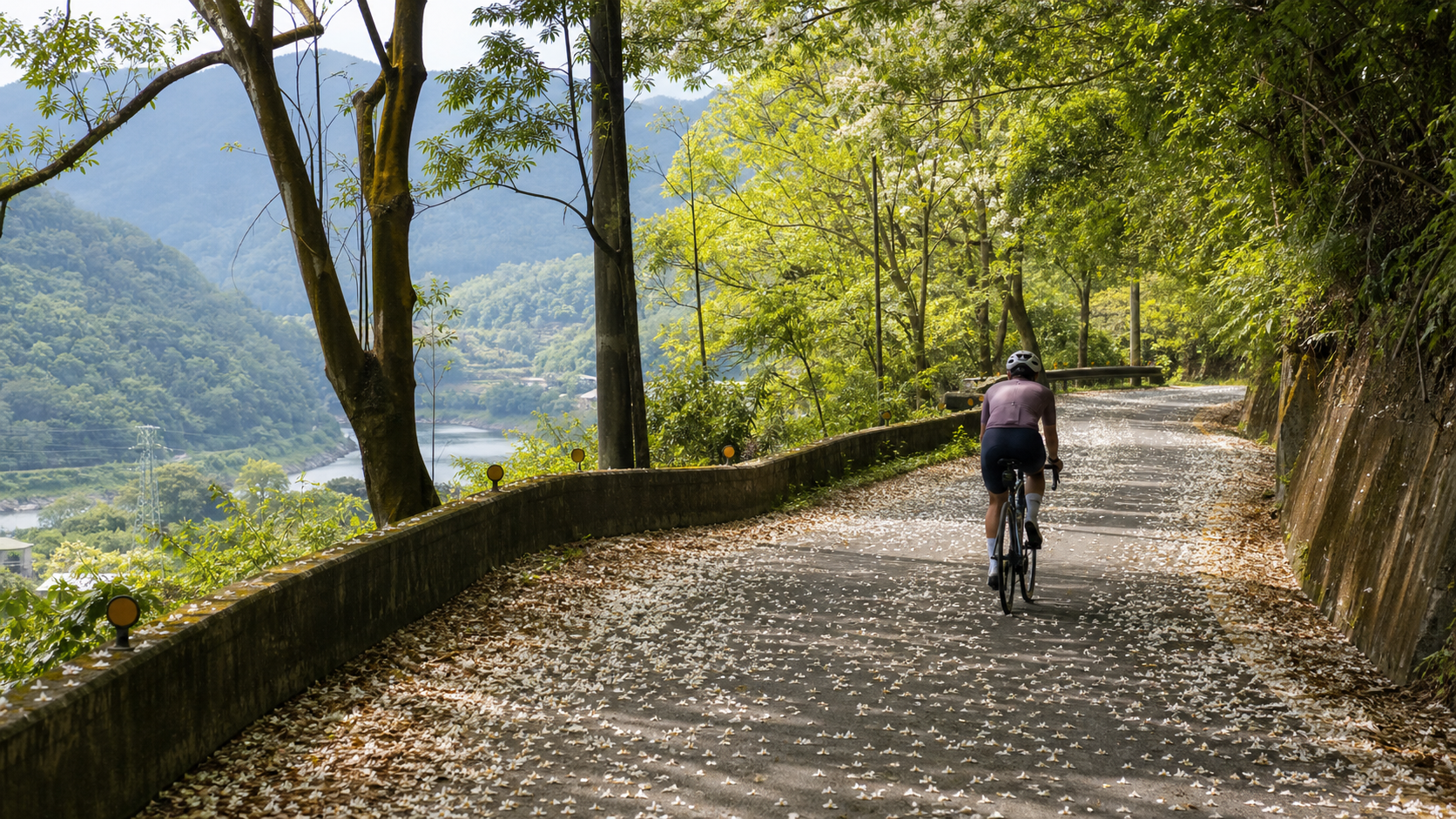
On the first weekend of May, I turned my handlebars toward Nangang and rode in the direction of Xididing Road. Not to chase a PR, not for some number on a training plan—just simply looking for a road where I could ride slowly and take in the scenery. Xididing Road—this County Road 33, a mere 4.35 kilometers long—turned out to be the best answer to that search that weekend.
1. A Quiet Lane on the Edge of the Keelung River Valley
To understand Xididing Road, you first have to understand the geography it sits in. Between Nangang and Xizhi, the Keelung River cuts a winding valley, flanked by the typical low hills on the edge of the Taipei Basin—not tall, but enough to give you that sense of ritual that comes with “entering the mountains.” Xididing Road climbs along the ridgeline of these hills, a local road connecting the Nangang mountain area with the Xizhi suburbs. In the past, it served mainly as a route for local residents and for transporting agricultural produce; today, it has become a beginner climbing route passed down by word of mouth among cyclists.
Compared to the classic big climbs like Wuling or Fengguizui, which require dedicated planning and a full day, the value of Xididing Road lies precisely in its “lightness.” Setting out from the city, you can connect to this road quickly and complete a ride with “both mountains and water” in less than half a day. This accessibility has made it the “first real mountain road” in many Taipei riders’ careers—not a gentle ramp on a riverside bikeway, but a true mountain road where you have to hold your breath and feel your heartbeat quicken.
Riding into the entrance of Xididing Road, the clamor of the city quickly falls behind you. The shade from the trees on both sides grows denser, and occasionally you catch glimpses of the Keelung River’s glimmering water hidden in the hollows of the hills. This instant shift of scene is one of the most captivating qualities of the climbing routes on the outskirts of Taipei—you never have to ride too far to find a slice of quiet. In recent years, the New Taipei City Government has also progressively completed the connection of riverside bikeways along the Keelung River, allowing the riverside paths between Nangang and Xizhi to link into a more complete network. This has also made the approach from the city to the entrance of Xididing Road smoother, with less time spent jostling with traffic.
2. Tung Blossom Season: Mountain Paths Covered in May Snow
The reason local riders affectionately call Xididing Road the “Tung Blossom Road” is the many tung trees planted along the route. Every year from late April to early May, when the tung blossoms bloom and fall, the road surface is often covered with a thin layer of white petals. When sunlight filters through the shade of the trees, it carries a particularly serene, poetic quality. This is also the famous “May Snow” imagery of Taiwan’s Hakka culture. Tung trees were originally introduced to Taiwan during the Japanese colonial period as a cash crop (for extracting tung oil); today, their economic value has long faded, and instead they have become one of the most iconic natural spectacles in Taiwan’s mountain areas every late spring. Hakka communities across northern Taiwan even hold Tung Blossom Festival events during the blooming season (please refer to official announcements for actual dates and locations).
Riding on a road like this, your speed naturally slows down. Not because the gradient is too steep to pedal, but because the sight of being surrounded by white petals makes you reluctant to rush past it too quickly. I remember reaching the middle section of the road that day when a gentle breeze happened to pass through, and tung blossoms came fluttering down from the trees, landing on the brim of my helmet and on my arms. Even thinking back on it now, that scene carries a softness that feels almost cinematic. The thin layer of white petals on the road surface left faint traces as tires rolled over them—that experience of “riding through a sea of flowers” is a romance that asphalt alone can never provide.
If you also want to capture such a scene, timing is crucial—the tung blossom season is typically concentrated within just two to three weeks, and it can come earlier or later depending on the year’s climate. It’s advisable to check the year’s blossom forecast before riding, or simply target the period from late April to mid-May and keep an eye on recent blossom reports from the mountain areas to avoid missing it.
3. Breathing and Thoughts on the Slope
Riding Xididing Road is, in fact, a very particular kind of mental transition. In the first half, the gradient is gentle, and your body can still spare attention to enjoy the scenery while pedaling; but as the elevation gradually rises and the road enters the middle section with more pronounced undulations, your breathing becomes focused, and your thoughts settle along with it. This experience of “the mind finding quiet because the body is busy” is perhaps the deeper reason so many people love climbing.
Compared to a flat riverside bikeway, a climbing route demands more complete focus—you have to watch the road surface, hold your breathing rhythm, and feel the signals from your body. This focus, in a way, is also a means of escaping the trivialities of daily life. When you’re fully absorbed in the act of pedaling, work worries and interpersonal entanglements are pushed to the edge of your consciousness. This is why many seasoned riders say that the meaning of climbing has never been merely physical training—it’s also a process of psychological healing.
While the gradient of Xididing Road isn’t enough to leave you gasping for breath, that sustained, steady sense of ascent provides exactly this intensity of “just enough focus”—not so easy that your mind wanders, not so painful that you can’t think at all. It’s a delicate balance. I often feel that a route of this intensity is actually better suited for “thinking things through” than an extreme hard climb, because when the body has room to operate, the mind has space to think. That day, riding halfway up, I remembered a decision at work that had been hanging unresolved, and slowly, in the rhythm of my pedaling, I sorted it out—that was probably the most unexpected reward of the ride.
4. Mountain Village Warmth and the Texture of Local Life
The area along Xididing Road isn’t particularly bustling—there are no dense clusters of shops or tourist attractions—but precisely because of that, it preserves a sense of mountain village life that is rare on the outskirts of Taipei. Occasionally you’ll see local residents tending vegetable gardens in front of their homes, drying freshly harvested crops, or groups of elders chatting under the arcades. For riders who have lived long years in the urban concrete jungle, these unpolished scenes of daily life are themselves a kind of scenery.
When riding through these settlements, slowing down and offering a gentle greeting is an unspoken understanding among local riders. The mountain roads are narrow, and residents and riders share the same road; the mutual respect and courtesy between them form the unique human warmth of this route. This riding etiquette may not be written in any route guide, but it’s a detail that everyone who truly comes to love this road will eventually come to appreciate. That day, as I passed by a house, an elderly man was tending his vegetable garden. Seeing me stop to photograph the tung blossoms, he smiled and said, “They’re blooming a bit later this year.” One simple sentence, yet it added a touch of human warmth to the entire ride.
5. Echoing the Larger Network: From Short Climbs to Long-Distance Possibilities
It’s worth noting that in the Nangang and Xizhi area where Xididing Road sits, the connection of riverside bikeways along the Keelung River has also been completed in recent years, allowing previously separate riverside paths to link into a more complete network. This means Xididing Road is no longer just an isolated mountain option—it can be incorporated into a more complete “riverside flat + mountain climb” combined route: ride the riverside bikeway to near the foot of the hills, cut into Xididing Road to experience the joy of climbing, and finally return via the same route or other parts of the network. For riders looking to progressively build climbing experience, this is an ideal route design.
For veterans familiar with the mountains in this area, Xididing Road is also often used as one segment connecting the network toward Jiangziliao, Wufenshan, and the Beiyi direction, serving as the opening move for longer multi-day itineraries. This logic of “opening with a short climb and closing with a long distance” ensures that even though Xididing Road’s gradient isn’t hard, it retains its presence and practical value within the regional network.
6. Xididing Road Through the Turning Seasons
Besides the spring tung blossoms, Xididing Road has its own charm in every other season. In summer, the greenery along the route is lush; shade is limited, but riding in the early morning or at dusk, the coolness of the evening breeze brushing your face is an excellent way to beat the heat. In autumn, air quality in the mountains is typically at its best for the year, with excellent visibility—ideal for a slow ride with a camera to capture the shifting light and shadow over the Keelung River valley. Winter brings a different kind of mood—the damp, cold drizzle carried by the northeast monsoon shrouds the entire road in a thin mist. While the riding difficulty increases, the image of a mountain path wrapped in clouds and fog has its own beauty, though you must be sure to take measures for warmth and traction.
7. For the Next Visit to Myself
After finishing the full length of Xididing Road that day, I looked back at the mountain path I had just climbed, and what surfaced in my mind wasn’t the sense of accomplishment of “completing a training target,” but a softer kind of satisfaction—as if I had spent an afternoon earnestly conversing with a road. This may be the most special thing about Xididing Road: it doesn’t aspire to become anyone’s “signature” route, yet with its gentle and honest gradient, it catches every person just beginning to learn climbing, or simply looking for a quiet place to ride.
Next time you find yourself riding through Nangang, consider setting aside a little time and turning your handlebars toward Xididing Road. No need to rush, no need to worry about pace—just let that quiet tung blossom road accompany you through an afternoon that needs no reason.
8. Two Landscapes: Riding Solo and Riding Together
I set out on that ride alone, which made me especially cherish the solitude that Xididing Road can offer. Riding alone carries a particular kind of freedom—no need to accommodate a companion’s pace, you can stop anytime to take photos, daydream, or simply plant your feet on the ground and listen to the wind rustling through the treetops. But I later revisited the road with a few friends and discovered that riding together offers another kind of scenery: the voices cheering each other on up the slope, the moments of high-fives at the end of the road—these are warmth that solo riding can never replicate.
The gradient of Xididing Road happens to suit this kind of “mixed-level” group ride—stronger riders can pull ahead and reach the top first, while less experienced riders won’t be dropped so far that they lose confidence. At the finish, everyone still has ample time to chat and wait, rather than suffering alone on a hopeless slope. This quality of being friendly to riders of different abilities is also why Xididing Road is frequently chosen by local teams as a practice route for new-rider group rides.
9. Road Conditions and Traffic Safety Reminders
Before or after riding Xididing Road, you can also arrange a visit to the Nangang Tea Manufacturing Demonstration Center, Nangang Park, or extend your exploration along the Keelung River bikeway to the local snacks around Xizhi Old Street (please refer to on-site information for actual shops and business hours). If time permits, you can also extend the itinerary to the nearby Jiangziliao or Beiyi direction network, stringing together a more complete tour of the northeastern foothills. The greatest advantage of this route is its flexibility—you can treat it as an independent afternoon excursion, or embed it into a longer training itinerary; either way, the road won’t let you down. For riders living in the Taipei urban area who want a suburban route they can “set out on after work,” Xididing Road is almost one of the most ideal answers—it makes “entering the mountains” feel no longer distant.
9. On the Meaning of “Small Roads”: Not Every Road Needs Conquering
Taiwan’s cycling culture is filled with the vocabulary of “conquest”—conquering Wuling, challenging Hehuan, completing a round-island tour. These are, of course, achievements worthy of pride, but over time, they also make many riders forget that riding can simply be an enjoyment in itself, without needing to carry the pressure of “accomplishing something.” For me, Xididing Road is precisely such a road that reminds me to “slow down.” It’s too short—too short to serve as anyone’s bragging material; it’s too gentle—too gentle to appear on any hardman ranking. But precisely because of this, it can be ridden so purely.
Whenever the pace of society leaves me breathless, I always think of the tung blossom petals on Xididing Road crushed under tires, of the elderly man who chatted with me about the blossoms, of the breeze that sent the petals scattering. These images form not a training achievement, but a memory worth savoring again and again. Perhaps this is the true meaning of riding—not every departure needs a clear purpose; sometimes, simply entrusting yourself to a familiar road is enough.
10. Afterword: For Every Rider Searching for “Their Own Road”
Every rider probably has a “comfort route” of their own in their heart—a road that requires no extensive preparation, no worry about getting lost or running out of energy, a road you can set out on whenever the urge strikes. For me, Xididing Road is gradually becoming exactly that. It may never appear on any “Top 10 Climbing Routes in Taiwan” list, but what it carries are those afternoon hours that need no reason—just pure pedaling and breathing fresh air.
If you don’t yet have your own “comfort route,” why not start your search on Xididing Road? It’s close enough to the city, gentle enough in gradient, and charming enough in scenery to become the first place you think of escaping to on countless future days of exhaustion.
11. For Travelers Beyond the Tung Blossom Season
Of course, not everyone can time their visit to Xididing Road precisely during the brief blooming season of late April and early May, but if you miss the tung blossoms, there’s no need to regret it. The beauty of this road doesn’t depend entirely on those white petals—even on days without flowers, the dense shade along the way, the clouds and mist that occasionally drift through the hollows, and that quiet far from the hustle and bustle are all worth a dedicated trip. I later revisited several times in high summer and deep autumn, and each time the light and scents were different, yet equally made me reluctant to finish the ride too quickly.
If you ask me whether Xididing Road is worth a dedicated trip, my answer is yes—but not because of any grand scenery or thrilling gradient. Rather, it’s because it taught me that the meaning of riding sometimes lies not in arriving, but in how the journey itself is felt and remembered. This quiet little road hidden between Nangang and Xizhi deserves every rider bustling through the city to experience it for themselves on a clear afternoon.
12. A Few Random Thoughts on Gear and Mindset
Writing this far, I’d like to talk about the gear I carried on that ride. In fact, that day I deliberately didn’t bring much—no professional power meter, no precise computer with pace targets, just a simple phone app to record the track, a bottle of water, and a camera. This “lightening” wasn’t just physical weight reduction; it felt more like a mental letting go. When you’re no longer chased by numbers, you can feel the texture of the road, the direction of the wind, and the angle of light and shadow more acutely.
Of course, I’m not saying data-driven training has no value—in fact, if your goal is to systematically improve your fitness, recording pace, heart rate, and power is an indispensable part of the process. But what Xididing Road taught me is that the same road can be approached with completely different mindsets. Sometimes it’s a training ground; sometimes it’s a sanctuary. This flexibility is perhaps the true reason a route remains enduringly appealing.
13. Conclusion: The Road Is Short, the Memories Are Long
4.35 kilometers—it might take less than twenty minutes to ride. But the scenery and state of mind I encountered on Xididing Road that afternoon became images I returned to again and again on many tired nights afterward, using them to soothe myself. This is probably why, even with its short distance and modest gradient, this road still deserves to be written into an article, recorded, and recommended to more people.
If you happen to live in Taipei and happen to be looking for a route that “needs no particular reason to set out,” I sincerely recommend you find an afternoon on a weekend and go meet Xididing Road. Perhaps, like me, you’ll encounter your own patch of tung blossom snow around some bend.
14. Appendix: On the Name of This Road
The name “Xididing Road” itself is quite interesting—“Xi” is taken from Xizhi, while “Ding” echoes the geographical connection toward Shiding. Two short characters condense the road’s geographical identity of connecting two administrative districts. Few may remember the official designation of County Road 33, but the poetic name “Xididing Road,” along with the nickname “Tung Blossom Road” derived from it, has gradually accumulated its own legend through word of mouth among riders. This is also one of the most charming aspects of many country roads in Taiwan—they often lack grand official tourism titles, yet in the shared memories of local residents and cycling communities, they possess their own soul and stories.
15. A Reminder for Travelers Visiting in Different Seasons
If you’re coming specifically for the tung blossoms, remember to keep an eye on the annual blossom announcements to avoid missing them; if you’re visiting in another season, it’s also worth bringing an open mind to appreciate the different faces this road presents under different weather. In summer, Xididing Road is lush with greenery, with cicadas singing from all directions—a great time to feel the vitality of the mountain forest in high summer; autumn air is clear and crisp, ideal for bringing a camera to capture the layered light and shadow over the distant Keelung River valley; the thin fog that occasionally shrouds the road in winter lends it a hazy poetry, though you must strengthen your warmth and traction preparations when riding, as the damp cold in the mountains often feels far lower than in the city.
No matter which season you come in, Xididing Road maintains its consistently gentle gradient and quiet atmosphere. This stability is perhaps the reason it continues to draw riders back again and again. It doesn’t need the blooming season to prove its worth—each season has its own scenery waiting to be discovered.
Writing to the end, I think the meaning of this article may not lie in persuading anyone that they must ride this road, but rather in leaving an honest record—a record of how an unremarkable country road, on an ordinary afternoon, with its gentle gradient and white petals scattered across the ground, caught a rider in need of room to breathe. If these words can also help you, the reader, recall or find your own “Xididing Road,” then this leisurely ride will have gained an additional layer of meaning. May every rider who reads this find, on roads familiar or unfamiliar, that pure joy of simply pedaling forward without needing a reason, and may we all, when the May snow season comes around again, ride this quiet tung blossom road once more.
Related Reading
- Xididing Road Practical Guide: A Gentle Warm-Up Climb on the 4.35km County Road 33 Tung Blossom Route, with Full Data and Pacing Analysis
- 793 Meters from Xizhi to Pingxi: A Timeless Little Path Hidden in the Valley
- Xiping Highway Practical Guide: 8.3km, 793m of Climbing, the Most Solid Climbing Test on the Outskirts of New Taipei
- A Secluded, Quiet Long Climb: Solitary Moments on County Road 47 and the Shiding-Pingxi Mountain Paths
台北闊瀨陡坡 騎旅 / 日本單車雜誌編輯車友臨時加入!/ 髮香才是最強的 / feat. 北迴歸線小隊 / 公路車 CT Yeh
6 個月前
虎豹潭!日本老師來台一日約騎 台灣車友熱情招待私房路線 / CT Yeh
21 天前
雙十節的溫腥感人約騎,升旗到升天一次滿足 | 公路車 | 鳳山寺 | 米粉坡
6 年前
梅山36彎 奮起湖 #公路車 之旅 2400m
6 年前
水金九不厭五分 10度寒流冷到不願停!feat. 卡卡 / 公路車 / CT Yeh
6 個月前
太平山單車員工旅遊 | 這樣玩CP值最高!| 公路車
5 年前
高雄綠園道鐵路自行車道 / 外地人能輕鬆駕馭 還是整路崩潰? / 2025 全線開通 春節實地探索一次!(附GPS連結)/ 公路車 / CT Yeh
1 年前
觀霧 變好騎了! | 北高車友爆笑大會師 | 公路車 | 單車旅遊 Taiwan Cycling Route GuanWu
6 年前