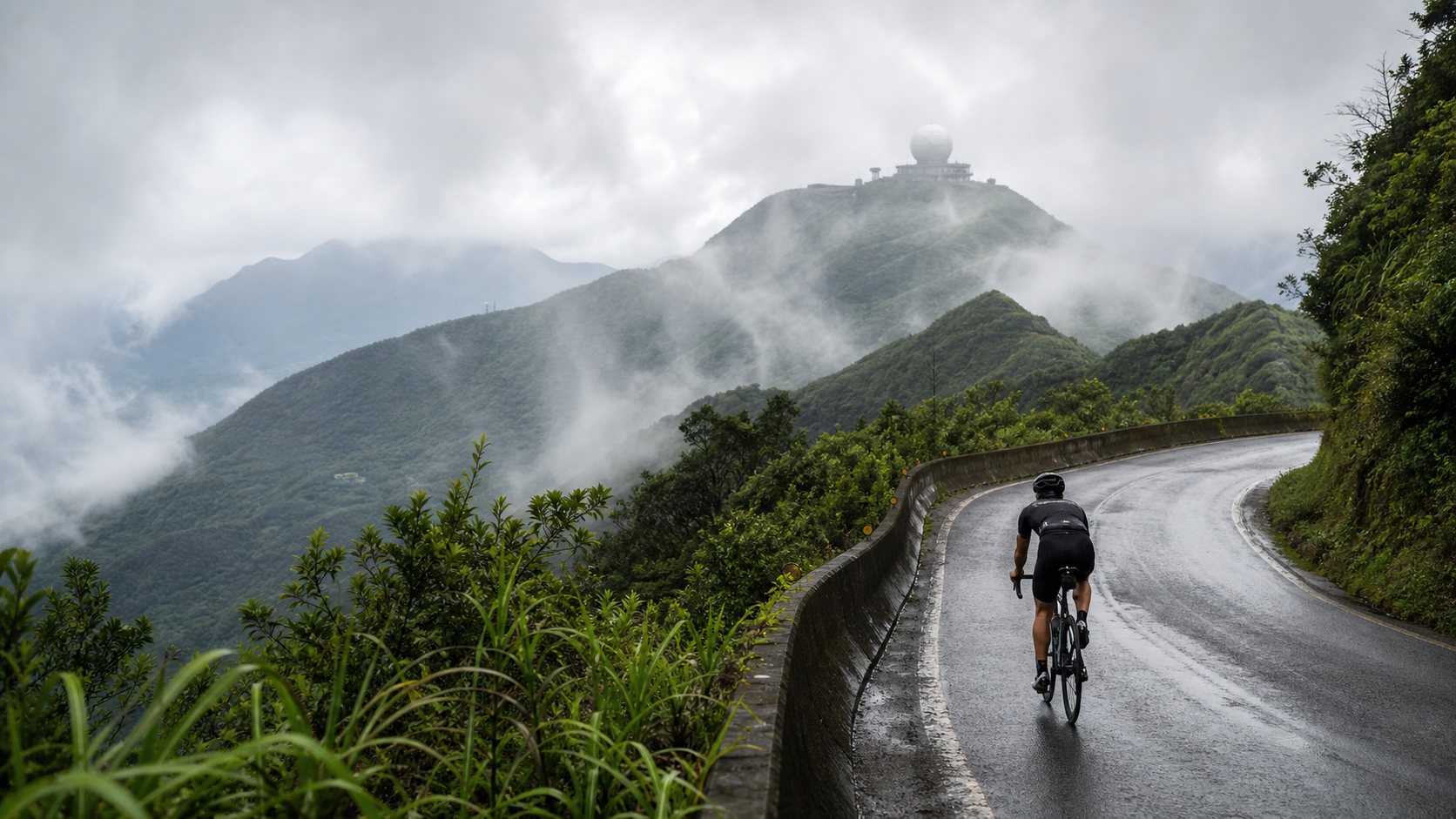
That day I set off from downtown Ruifang, my handlebars pointed straight into the mountains. Before I even reached the official climb, a light drizzle had already begun to fall. The weather in the Northeast Corner is always like this—changing on a whim. One moment the view ahead is reasonably clear, the next it’s quietly swallowed by a thin layer of fog. I knew the road I was about to ride was a mountain route toward Wufen Mountain in Pingxi—just over four kilometers, climbing more than two hundred meters, with a gradient that’s no pushover. But what I was truly looking forward to wasn’t the gradient number—it was the legendary “white sphere” hidden deep within the clouds and mist.
1. The Geographic Fabric of the Ruifang Hills
To understand this road, you first need to understand the geographic context it sits in. Ruifang District in New Taipei City lies on Taiwan’s Northeast Corner, right against the Pacific Ocean, and is one of the few mountainous areas in northern Taiwan directly exposed to the prevailing northeastern monsoon. Wufen Mountain itself is an important landmark in this hilly terrain, standing at roughly 757 meters above sea level, administratively straddling the border between Ruifang and Pingxi. As a result, this road—named after Pingxi but actually registered under Ruifang District—perfectly embodies the subtle overlap and ambiguity between administrative boundaries and geographic perception in this mountain area. Locals tend to name roads after peaks or settlements rather than strictly following administrative divisions.
This hilly region is an extension of the Xueshan Range’s foothills, with geology dominated by sandstone and shale. Years of rainfall erosion have carved out many steep but not particularly tall peaks. Combined with the orographic rain brought year-round by the northeastern monsoon, the entire area stays perpetually damp and densely vegetated—a classic subtropical mountain landscape of northern Taiwan. Riding through terrain like this, you can clearly feel the density of the elevation changes—unlike the Central Mountain Range’s long climbs that stretch for dozens of kilometers, the slopes here are short and tightly packed, one after another, like a hill-country version of stacked building blocks.
2. The White Sphere: A Landmark Presence
A large part of why Wufen Mountain enjoys considerable fame in the hiking and cycling communities comes from the striking white domed structure near the summit—the Central Weather Administration’s Wufen Mountain Weather Radar Station. This radar dome, resembling a giant white sphere, can be seen from far away on clear days, earning it the nickname “white sphere” among local hikers and riders, and serving as a key visual landmark for orienting yourself within these hills.
That said, I should be clear: this four-kilometer stretch I rode that day, climbing 257 meters, still leaves considerable elevation between its endpoint and the 757-meter main peak. So unless this road happens to be the endpoint itself, it’s likely just a core climbing segment on the way to the radar station at Wufen Mountain’s summit—the white sphere still stands higher up, a symbol of this mountain area’s prestige, but not necessarily the direct destination of this particular road. That day the fog was thick, and even as I neared the end of the segment, I could only catch occasional glimpses of a faint white outline on the distant peak through gaps in the clouds. That sense of “visible but untouchable” distance only added a layer of mystery to the landmark.
3. Riding Through the Mist: The Experience on a Fog-Shrouded Ridge
Once I entered the core climbing section, the fog grew noticeably thicker. Visibility dropped to maybe thirty or forty meters. The road ahead curved into the mist, its end hidden behind what looked like a grayish-white curtain. Riding uphill in dense fog like this, honestly, isn’t easy—once your vision is largely stripped away, your other senses become unusually sharp instead: your ears pick up the sound of your own breathing echoing inside your helmet, your skin feels the fine droplets of mist slowly dampening your cheeks and arms, and even your cadence seems to become more focused precisely because of the limited visibility.
This kind of weather naturally adds risk to riding—wet pavement, shortened sightlines—forcing me to slow down and handle every corner with extra caution. But the thick fog also brought a peculiar kind of beauty, as if wrapping the entire mountain road in a quiet, enclosed space. The clamor of the city and the clutter of daily thoughts were all shut out by this blanket of mist. Occasionally a gust of wind would blow through, briefly opening a gap in the fog and letting the silhouette of distant ridges flash into view. That momentary visual impact left a deeper impression than any wide-open view on a cloudless sunny day.
4. Echoes of an Old Mining Settlement: The Shared Memory of Pingxi and Ruifang
Although this road itself sits within Ruifang District and doesn’t directly pass through Pingxi’s famous sights, the broader Pingxi–Ruifang area historically belonged to one of northern Taiwan’s most important coal mining belts, sharing the same collective memory of the industry’s rise and fall. The Shifen and Jingtong old streets along the Pingxi Branch Railway Line, the sky lantern tradition that made Pingxi famous, and the nearby Houtong Cat Village in Ruifang—these attractions scattered across the region are all tied to the same industrial history of coal mining from the Japanese colonial era through the postwar period (for actual venues and exhibition details, please refer to on-site announcements).
While these well-known attractions may not sit directly along this climbing segment, riding through the area, you can still sense the lingering echoes of that history in the landscape’s subtle traces—the occasional old settlement buildings you pass, the remnants of industrial heritage—all silently telling of a time when these mountains flourished on black coal. Today the mining industry is long gone, and these hills have returned to their natural state, leaving only place names and a few preserved railway lines and old streets as witnesses to that history. Riding on roads like this, in a sense, feels like pedaling through a layer of industrial memory buried beneath time.
5. Another Face of Ruifang: The Distance from Jiufen
Mention Ruifang District, and many people immediately think of Jiufen Old Street—that hillside townscape built into the slopes, glowing with lights. But Jiufen and this climbing road hidden deep in the mountains are actually two completely different faces of Ruifang District—one is a tourist landmark teeming with visitors, the other a quiet industrial road remnant that almost only local residents and a handful of cycling enthusiasts ever set foot on. The fact that both are famous spots within the same district doesn’t mean they’re geographically close, and this road doesn’t directly pass through Jiufen. But this contrast—that such different atmospheres can exist within the same administrative area—is precisely what makes Ruifang so intriguing.
6. Breathing and Solitude on the Slope
The core steep section in the dense fog was the most mentally demanding part of the entire ride. The gradient fluctuated noticeably above the overall average, and with limited visibility and slippery pavement, every pedal stroke demanded full concentration. This state of intense focus paradoxically pushed me into a nearly meditative psychological rhythm—the world shrank to just a few meters of asphalt ahead, the sound of my own heavy breathing in my ears, and the gradually building burn in my thigh muscles. The usual mental chatter about work and relationships that occupies my mind during normal rides was almost completely pushed to the edge of consciousness under this high-intensity, visually restricted state.
I often feel that climbing alone in dense fog is a strange experience somewhere between challenge and meditation. No companions’ conversation to distract you, no open vistas to divert your attention to the scenery—only the most primal bodily sensations and breathing rhythm remain. This kind of solitude is hard to come by in the city, yet on a mountain road wrapped in clouds and mist, it unexpectedly becomes a precious moment of psychological settling.
7. The Turning Seasons: The Northeast Corner’s Damp Chill and Occasional Clarity
The Northeast Corner’s weather temperament leans damp and cold for most of the year, especially during the autumn and winter northeastern monsoon season, when thick fog and drizzle are practically routine—which is why I encountered this kind of weather on my ride. But this mountain area isn’t perpetually shrouded in clouds—in the transition between spring and summer, there are occasional stretches of several days with stable weather and excellent visibility. Riding the ridge during those windows, with layered mountain ranges in the distance and even glimpses of the coastline, creates a stark contrast to the fog-riding experience, making it feel almost like two completely different roads.
If you prefer clear views and photography conditions, I’d suggest scheduling your trip during the window before the autumn northeastern monsoon fully kicks in, or setting out in the early morning before afternoon convective clouds form. But if you happen to visit on a fog-shrouded day like I did, consider it a unique experience in its own right—after all, being able to personally experience this unpredictable yet poetic weather character of the Northeast Corner’s mountains is itself a memory you can only gain by visiting this region.
8. The Final Stretch Before the End: Anticipation and Restraint
As I neared the end of the road, the rain eased somewhat and the fog thinned slightly. I stopped the bike and looked back at the misty ridge I’d just climbed. That fatigue mixed with satisfaction from completing a solid climb welled up inside me. Looking up toward the higher elevations, I could faintly sense that the white sphere should be standing somewhere deeper in the clouds, but that day’s visibility ultimately never let me confirm its outline with my own eyes. This regret—knowing it was there but not being able to see it—has instead become my reason for wanting to return to these mountains.
I think this might be the very charm of mountain landmarks—they don’t need to reveal themselves fully on every visit. Sometimes the clouds obscure the view, and instead, that sense of unfinished anticipation is preserved all the more completely.
9. Notes for Future Visitors
If you’re planning to ride this climbing section in the Ruifang hills, I’d recommend checking the recent weather and visibility forecasts beforehand. Weather conditions in the Northeast Coast change far more rapidly than in the city—a clear sky when you set out is no guarantee it will still be clear when you reach the mountains. Carrying adequate cold-weather and waterproof gear is essential; even in summer, the mountain humidity and elevation changes can make the perceived temperature noticeably lower than in the city.
If your itinerary is flexible, consider working this stretch into a broader Ruifang–Pingxi area loop—you could also visit Houtong Cat Village, also in Ruifang District, or the old-street settlements along the Pingxi Branch Railway line, and experience how this mountain region has transformed from mining settlements into tourist towns (please refer to official announcements for current opening hours and transportation options). Such an arrangement adds a layer of cultural and historical depth to what would otherwise be a purely physical challenge.
10. Rethinking the Meaning of “the Finish”
This ride made me rethink what “the finish” really means. This four-kilometer stretch may not end at the summit of Wufen Mountain with a touch of the white sphere, but it is still a complete, solid, and worthy climbing experience. The road systems of many intermediate-altitude mountains in Taiwan are naturally composed of many such segments—not every stretch needs to reach the summit to count as a meaningful ride.
This realization—that a ride need not reach the highest point to be worth pedaling with full commitment—mirrors, in a way, many things in life worth investing in: not every effort needs to produce a final, visible result. The focus and dedication invested in the process itself is often what truly nourishes the spirit.
11. Settling After the Fog Lifts
On the descent, the rain stopped completely, and the sky revealed a few thin shafts of light that spilled through gaps in the clouds onto the wet asphalt, reflecting a texture almost metallic in sheen. These brief moments of clearing after rain are especially common in the Northeast Coast mountains, and especially beautiful—as if the entire forest had just taken a bath, with the air filled with the scent of damp soil and vegetation, remarkably fresh.
I stopped at a spot with a wider view, watching the residual fog slowly drift through the valley, and thought about how many stories like today’s—wrapped in clouds, then suddenly opening up—this region called the Northeast Coast must hold. This drama bestowed by the weather is perhaps the most captivating trait of the area.
12. For Riders Seeking “a Different Road”
If you’ve already ridden most of Taiwan’s famous long-distance classic climbs and are looking for a short, intense, and slightly mysterious route to diversify your training menu, this road hidden in the Ruifang hills, heading toward Wufen Mountain, might be worth adding to your shortlist. It doesn’t demand a full day like Wuling or the Northern Cross-Island Highway, yet within just four kilometers it condenses the Northeast Coast’s characteristic humid climate, rolling terrain, and elusive landmark scenery.
13. Afterword: The White Sphere Is Still There
On the way back that day, I thought to myself that even though I hadn’t been able to see the full outline of the white sphere this time, it still stood quietly in the deeper fog, day after day carrying out its duty as a weather radar station, watching over this Northeast Coast sky so often shrouded in clouds. Perhaps it is precisely this presence—“you can’t see it, but you know it’s always there”—that gives Wufen Mountain a low-key yet steadfast uniqueness among Taiwan’s many mountain landmarks.
If I have the chance to visit again, I hope to pick a day with better visibility and see with my own eyes what the white sphere truly looks like in the sunlight. But even if the weather doesn’t cooperate, I think I would still gladly ride back into the thick fog of these mountains—after all, some scenery simply isn’t meant to be seen clearly with ease.
14. Riding Alone Through Fog vs. Riding with Company
I set out on that ride alone, which made the solitude brought by the thick fog feel especially pure. Climbing alone in the fog, you rely entirely on your own judgment of road conditions and your body’s limits; there’s no companion to confirm directions with or share the tension with. This state is both slightly unsettling and yet brings a nearly pure form of focus. I later revisited this mountain area with friends on a day with more stable weather and found that riding together is a completely different experience—encouraging each other on the steep sections, exchanging observations about the weather and scenery at the end of the stretch. This kind of exchange is a warmth that solo riding never offers.
The gradient and length of this road are actually quite accommodating to both styles. Riding alone, you can set your own pace entirely and immerse yourself in that almost meditative focus within the fog; riding with others, even in poor weather, conversation and interaction can dilute the oppressive feeling the fog brings. I find it hard to say which way of riding is better—each offers a distinctly different yet equally precious experience. Perhaps it is precisely this flexibility that makes this mountain area worth returning to again and again.
15. Practical Pre-Ride Preparation Tips
Before riding in mountain areas prone to fog, I’d recommend making it a habit to check real-time weather and visibility forecasts, especially if you plan to go during the northeast monsoon season in autumn and winter. If conditions indicate a high probability of heavy fog or heavy rain, consider adjusting your ride date, or at least prepare complete waterproof and cold-weather gear—including a windproof and waterproof jacket, gloves, and anti-fog treatment for your eyewear. Fogged-up lenses in thick fog further compress an already limited field of vision, a small detail many riders overlook.
Lights and taillights are equally important. Even if you set out during the day, visibility in heavy fog can be comparable to riding at night, and a sufficiently bright taillight greatly increases the chance of being noticed by vehicles approaching from behind. I also recommend downloading offline maps and navigation apps in advance; signal can be unstable on some mountain sections, and thick fog can easily disorient your sense of direction. An extra layer of navigation backup can prevent unnecessary risk of getting lost. These preparations may seem trivial, but they are the key to completing a mountain ride full of variables safely and in full.
16. Light and Sound: Sensory Details Amplified in the Fog
Looking back on that ride, besides the greatly restricted vision, my other senses were unexpectedly heightened. The fine splashing sound of tires rolling over wet asphalt, the occasional calls of unidentified birds in the distance, the rustling of wind through treetops—these ambient sounds that are easily overlooked on ordinary rides became remarkably distinct in the fog, when visual cues were drastically reduced. The same went for smell—damp soil, rain-soaked vegetation, and the occasional waft of the region’s characteristic herbal scent interwove into a sensory memory that can only be understood through firsthand experience.
This experience of being forced to rely on other senses due to limited vision also made me rethink the definition of “viewing scenery.” We’re accustomed to “consuming” the beauty of a journey with our eyes, used to capturing expansive vistas and magnificent scenes with our cameras. But that day in the fog, I barely took a single photo that could be called “beautiful,” yet when I later recalled that ride, I felt a deeper impression than many of my sunny rides. Perhaps scenery has never existed solely in the visual realm; the memory a road leaves you with is often woven together from sounds, smells, perceived temperature, and breathing rhythm.
17. Conclusion: A Short but Profound Climbing Memory
4.045 kilometers, 257.4 meters of elevation gain—it might take less than half an hour to ride, but that fog-wrapped afternoon left an especially deep impression in the many moments I’ve since recalled that ride. This is perhaps the most captivating aspect of mountain riding—distance and time are never the only measures. Weather, atmosphere, and that sense of unfinished anticipation are often what truly make a stretch of road worth remembering.
If you’re also looking for a route that simultaneously builds fitness and carries a touch of the Northeast Coast’s characteristic damp poetry, find a day with changeable weather and take a trip into the Ruifang hills. Perhaps, like me, you’ll catch a distant glimpse of that legendary white sphere in a moment when the clouds part—or perhaps you’ll see nothing at all, left only with damp clothes and a pedaling memory worth savoring. Either way, this fog-blessed hill country is always there, waiting for the next rider willing to ride through the mist.
18. Postscript: The Multiple Identities Behind a Place Name
As I write this final section, I want to share a few thoughts about the name “Pingxi Wufen Mountain” itself. Although this route bears the name “Pingxi,” it is administratively registered under Ruifang, and the summit itself straddles the boundary between two administrative districts—this kind of mismatch between place names and administrative boundaries is actually quite common in Taiwan’s mountain roads. Local residents habitually identify a place by a mountain peak, a settlement, or the colloquial name of an old road, rather than strictly adhering to the invisible administrative lines on a map. Behind this naming logic lies a way of geographic cognition that is closer to lived experience—a mountain does not break apart in the middle just because an administrative boundary runs through it, and the shared living sphere of local people often predates administrative divisions and endures far longer.
This also reminds me that every road written into a route database, assigned precise mileage and gradient figures, carries a context far richer than those numbers—geological formation, climatic shaping, the rise and fall of industries, residents’ naming conventions—all these factors interweave to give an otherwise ordinary stretch of asphalt its own character and story. The next time you look up data on an unfamiliar route, perhaps you might also take a little extra time to understand what the land behind those numbers truly looks like.
19. Afterword: A Foreshadowing for the Next Visit
That day, after riding the full distance and returning to the city, my clothes were completely soaked through—I couldn’t tell whether it was rain or sweat. But I felt deeply satisfied—not because I had broken any records, but because I had fully experienced a journey genuinely shaped by the weather of the Northeast Coast. This feeling of being “taken seriously by the weather” somehow makes you feel the true character of this land more than a ride under clear, unbroken skies ever could.
I saved the photos and records of that ride into my phone’s album. Most of the images are shrouded in grayish-white mist, with blurred compositions and monotonous colors—by the standards of photographic aesthetics alone, they are hardly works worth showing off. But every time I flip through them, I can clearly recall the rhythm of my breathing while riding through the dense fog, the faintly visible tree shadows along the roadside, and the white giant sphere that never revealed itself yet still existed as a silhouette in my imagination. These images form a private memory belonging only to me and this mountain area, and they have become the most anticipated mystery to verify on my next visit.
Related Reading
- A White Sphere Ten Kilometers Away: A Ride Toward Clouds and Light at Wufen Mountain
- Wufen Mountain Guide: A Rhythm-Riding Masterclass on 10.28 Kilometers and 577 Meters of Climbing
- Pingxi Wufen Mountain Guide: A Complete Breakdown of Ruifang’s Tough Short Climb—4 Kilometers, 257 Meters of Elevation Gain, 6.4% Average Gradient
- Route 162A Ruifeng: Riding into the Sea of Clouds in Alishan’s Tea Country, a Long Climb Dancing with Morning Mist
騎單車去大屯山賞雪! 助航台滑冰 全記錄 | 台北R友大集合 | 下雪打雪仗囉 | 4K超高畫質
5 年前
水金九不厭五分 10度寒流冷到不願停!feat. 卡卡 / 公路車 / CT Yeh
6 個月前
觀霧 變好騎了! | 北高車友爆笑大會師 | 公路車 | 單車旅遊 Taiwan Cycling Route GuanWu
6 年前
台北大雁西飛 約騎挑戰 feat. Doris | 公路車 | CT Yeh
3 年前
嘉義大埔、阿婆灣挑戰賽,美到以為在日本!ft. 環騎5 Cool 西拉雅188 / 公路車 / CT Yeh
7 個月前
台北闊瀨陡坡 騎旅 / 日本單車雜誌編輯車友臨時加入!/ 髮香才是最強的 / feat. 北迴歸線小隊 / 公路車 CT Yeh
6 個月前
一定要騎一次!阿里山最深處:里佳部落!單車旅行 | 2800m爬升 | 深度部落體驗:嗨翻晚會、螢火蟲、銀河 | feat. JJSC & 廢物伙伴 | 公路車 CT Yeh
9 個月前
太平山單車員工旅遊 | 這樣玩CP值最高!| 公路車
5 年前