Mist and Railway Tracks in the Sky-Lantern Mountain Town: Riding to Shifen Waterfall, Encountering the Rain and Light of Pingxi
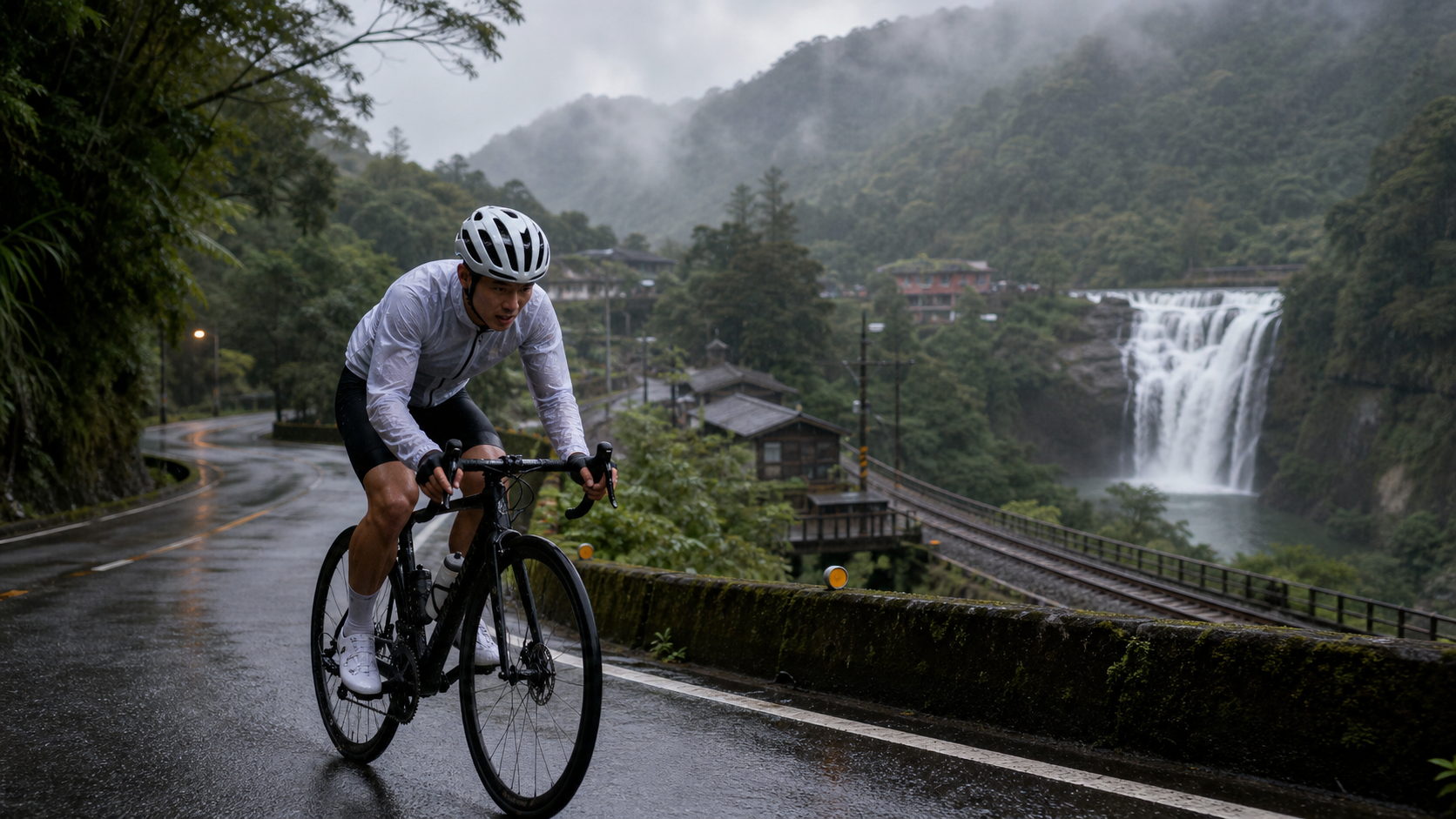
That day I turned my handlebars toward Pingxi, the mountain road winding upward as a fine rain drifted down—which, in Pingxi, is actually nothing out of the ordinary. This area is one of the rainiest mountain towns in all of Taiwan, its peaks wrapped in a thin layer of mist year-round. And the direction I was heading was Shifen, toward Shifen Waterfall, the site affectionately nicknamed “Taiwan’s Niagara Falls.”
1. A Mountain Town Transformed from Mining
Pingxi—the name itself carries a geographic poetry: a valley spreading out where the mountain terrain levels off, a quiet basin nestled in the northeastern corner of New Taipei City. But Pingxi’s history has not always been quiet. From the Japanese colonial era through several decades after the war, this was one of Taiwan’s important coal-mining regions. The black gold buried in the mountain’s belly propped up the economic lifeline of the entire settlement and sustained generation after generation of families who made their living in the mines. To haul the coal out of the mountains, a dedicated railway branch line was built back then—the Pingxi Line—winding along a tributary of the Keelung River and linking a string of small mountain stations: Houtong (Houdong), Wanggu, Lingjiao, Pingxi, Jingtong, and others. Shifen, among them, is the most iconic stop on the line.
As Taiwan’s mining industry gradually declined toward the end of the last century, Pingxi’s economic center of gravity slowly shifted from underground to above ground, from industry to tourism. The railway that once carried coal has become synonymous with what travelers call a “nostalgic mini-trip”; the mountain trails once marked by miners’ footsteps now attract riders like me, pedaling up the slopes one gear at a time. This transformation gives Pingxi’s air a contradictory yet captivating quality—both the serene simplicity of a mountain town and the weight of an entire generation’s industrial rise and fall.
2. On the Climb: Roads Woven with Rain and Mist
Pingxi’s terrain makes it a classic windward-slope, high-rainfall area—the mountains lift warm, moist air, and the moisture condenses into rain. This orographic effect keeps Pingxi damp year-round; even when downtown Taipei is bathed in sunshine, the Pingxi mountains may be under a steady drizzle. That day, riding the climb toward Shifen Waterfall, the gradient was sustained and solid, mountain wind mixed with moisture hitting my face, and the visor of my helmet quickly fogged over with a thin film of mist.
In weather like this, speed naturally drops. The asphalt glistened faintly in the rain, and I deliberately slowed my cornering rhythm, watching for fallen leaves and moss that might have accumulated on the road surface. But strangely enough, this riding experience wrapped in rain and fog gave the entire climb a nearly meditative focus—no dry, breezy ease under a bright sun, only breathing, cadence, and the faint patter of raindrops on my cycling jersey. Reaching the middle of the climb, I looked back toward the valley; clouds and mist were slowly drifting over the opposite ridgeline. That is a scene a sunny ride could never offer.
3. Shifen Waterfall: Imagination and Reality in a Folk Nickname
As the ride neared its end, the terrain toward Shifen Waterfall gradually opened up, and a faint, low rumble of distant water began to reach my ears. Shifen Waterfall—located within Shifen Waterfall Park and often called “Taiwan’s widest waterfall”—has long carried a widely circulated folk nickname: “Taiwan’s Niagara Falls,” or the “Taiwanese version of Niagara Falls.” The comparison, of course, only borrows the resemblance in form—a curtain-like, broad, gently cascading sheet of water—and in scale it is far removed from the real Niagara Falls. But this vivid colloquial name has, over the years, become the most memorable phrase used to introduce Shifen Waterfall, drawing countless domestic and international travelers to follow that nickname here.
I didn’t ride my bike all the way to the waterfall’s viewing platform itself—that section is more within the realm of pedestrian sightseeing. My route for this ride was on mountain roads heading in that direction, and along the way I could already feel the moisture thickening and the terrain tilting toward the valley where the waterfall lies. For riders who love cycling and also enjoy exploring local sights along the way, parking the bike at a suitable spot and walking into the waterfall park to feel the spray hitting your face up close is a worthwhile extension of the itinerary (for the actual trail routes and opening hours, it’s best to refer to on-site notices and official information).
4. Sky Lanterns and Railway Tracks: The Unique Scenery of Shifen Old Street
Besides the waterfall, the image most associated with Pingxi is probably the sky lantern. Every year around the Lunar New Year and the Lantern Festival, the Pingxi Sky Lantern Festival draws large crowds of visitors and photography enthusiasts into the mountain town, releasing lantern after lantern inscribed with wishes into the night sky. Orange-red points of light rise slowly and converge into a river—one of the few festival scenes in Taiwan with international recognition (exact session times and locations vary slightly each year; refer to official announcements). And Shifen Old Street is one of the most iconic spots for releasing sky lanterns—what makes this old street most distinctive is that it is built along both sides of the still-operating Pingxi Line railway tracks. Visitors stand right in the middle of the tracks to write on and release their lanterns, and when a train comes through, shopkeepers call out for everyone to clear the lanterns and make way. This scene of “old street and railway coexisting” has long become one of the most representative symbols in Taiwanese travel photography.
That day, as the rain briefly let up, I parked my bike at the roadside and looked toward the faint outline of the old street in the distance. In my mind surfaced those sky lantern scenes I had seen countless times in photos and videos. Even without actually walking into the old street, simply imagining the sight of those tracks lined with wishing lanterns on both sides was enough to understand why this mountain town, after its mining industry faded, managed to find its own second identity.
5. Breathing on the Slope and the Shadows of Miners
Riding up this sustained, solid climb, I couldn’t help but think of the mining history of this mountain area. The miners of those days traveled the same terrain up and down, except what they carried wasn’t water bottles and energy bars but heavy ore carts and tools, and they weren’t climbing for fitness or scenery but for the daily grind of making a living. That thought unconsciously slowed my pedaling rhythm—not because the gradient was too steep to turn the cranks, but because a kind of respect for this land’s past made me reluctant to rush past it at too hurried a pace.
Along the Pingxi Line, traces of the old mining settlements remain to this day—aging houses, abandoned mine entrance ruins—scattered quietly among green hills and clear streams, forming the town’s distinctive cultural texture. When riding past these places, if you slow down and take a closer look, you can often feel a weight deeper than mere scenery. This experience of “reading local history through exercise” is, to me, where cycling far surpasses driving or taking the train—the fatigue and focus of the body actually bring you closer to the breathing of the land itself.
6. The Four-Season Character of a Rainy Mountain Town
The rain of Pingxi is almost part of the town’s personality. In winter, the northeast monsoon blows straight in, and weeks of damp, cold drizzle are par for the course; the mountaintops are perpetually shrouded in mist, and both cycling and hiking require more complete rain gear and warm layers. Spring still sees frequent rainfall, but with temperatures warming and the festive atmosphere of the Sky Lantern Festival around the Lunar New Year, it is one of the seasons with the highest visitation from tourists and riders alike. Summer afternoon convective showers are common in mountainous terrain anyway, and Pingxi’s naturally rain-prone constitution amplifies that trait—be sure to check real-time weather information before heading out. Autumn, by contrast, sees relatively less rain and clearer air, and I consider it the best season for a full tour of the Pingxi mountain town—the waterfall’s volume may not be as abundant as in the rainy season, but visibility and views are often at their best all year.
No matter which season you visit, Pingxi retains that unique quality steeped in moisture—damp, quiet, carrying a touch of the melancholy left behind by the mining era, yet always brimming with a vibrant vitality thanks to the tourist appeal of sky lanterns and the waterfall.
7. A Suggestion to Slow Down Around Shifen Old Street
If you still have energy left after finishing this climb, it’s well worth parking the bike temporarily and switching to walking, slowly making your way into Shifen Old Street and the area around Shifen Waterfall Park. The old street itself isn’t long, lined with shops selling sky lanterns, local snacks, and souvenirs (actual shops and business conditions are subject to on-site conditions). Wandering through it to feel the atmosphere of railway tracks interwoven with old houses is another way to get to know Pingxi beyond cycling. The waterfall park features viewing trails that allow you to appreciate the magnificent sight of the water curtain cascading down from different angles; it’s advisable to arrange your停留時間 according to the on-site weather and trail availability.
8. Gear and Mindset for Riding in the Rain
That day’s ride was almost entirely enveloped in drizzle and moisture, and weather like this is quite a test of both equipment and mindset. A waterproof or water-repellent outer jersey is basic gear; if your glasses tend to fog up, lenses with an anti-fog coating are recommended, or simply remove the lenses for a clearer view. Mentally, riding in the rain requires letting go of attachments to speed and completion time, focusing instead on reading road conditions and cornering safely—this is a psychological state completely different from riding in clear weather, yet it offers its own kind of focus worth experiencing.
9. Echoes of a Larger Mountain Road Network
The northeastern mountain area where Pingxi sits is interconnected with neighboring mountain towns like Shuangxi, Ruifang, and Jingtong through its road network, and this climb toward Shifen Waterfall is often used by local riders as one segment in longer multi-day itineraries. For veterans familiar with the terrain, incorporating this stretch into a combined route covering Pingxi, Shifen, and Jingtong—experiencing mining settlement ruins, railway scenery, and waterfall views along the way—makes for a richly rewarding mountain mini-tour.
10. A Moment of Clearing After the Rain
As the ride neared its end, the rain suddenly stopped. A gap split the clouds, and sunlight slanted down onto the wet asphalt, sending up a faint wisp of vapor. That moment’s scenery left a deeper impression on me than any sun-drenched scene ever could—the damp air carried a fresh scent of greenery, and from afar came the faint, elusive sound of flowing water, as if the entire mountain town, after the rain, had taken a deep breath anew.
11. A Note to Myself for the Next Visit
What Pingxi taught me is a cycling philosophy of coexisting with the weather. The rain here is not an accident; it is an innate trait of this land. Rather than complaining about the uncooperative weather, it’s better to treat it as the mountain town’s way of welcoming travelers—using moisture to wash away the dust of the mundane, using mist to remind you to slow down. Next time I ride this climb, I’ll probably encounter rain again, but I already know that is precisely what Pingxi looks like at its most authentic.
12. A Romantic Imagination of “Rainbow Pool”
According to local lore, in the misty spray of Shifen Waterfall, when sunlight pierces through the moisture on a clear day, a faint rainbow halo occasionally refracts near the surface of the pool, leading some to use the poetic nickname “Rainbow Pool” to describe the mist-shrouded basin below the falls (this is a colloquial term passed down locally; whether you actually see a rainbow depends on the prevailing weather and light). In a way, this imagination echoes the overall impression Pingxi gives—damp, hazy, yet in the moment the clouds part, revealing a stunning radiance.
13. Conclusion: One Climb, a Century of a Mountain Town’s Heart
4.0 kilometers, 264.2 meters of elevation gain—it might take only about twenty minutes to ride, but what that stretch of road carries is a mountain town’s century-long transformation from coal production to tourism, from miners’ footsteps to sky lantern wishes. That day I rode this climb in the rain, never reaching the waterfall’s closest viewing platform, yet already feeling Pingxi’s truest character between the mountain wind and the moisture—rainy, quiet, carrying the heaviness left by the mining era, yet continuously drawing travelers from around the world through the fame of its lanterns and waterfall.
If you too are planning to ride this climb toward Shifen Waterfall, bring rain gear and a heart willing to slow down. This mountain town won’t flatter you with clear skies, but it will leave you with a memory worth revisiting again and again, through its clouds, its water sounds, and the sky lanterns on its railway tracks.
14. A Few Reminders for Travelers About to Depart
Whether you’re coming for the grand spectacle of the Sky Lantern Festival or simply to quietly ride this climb on an ordinary day, it’s advisable to check the day’s weather and mountain road conditions in advance, and to have rain gear and warm layers ready. Much of Pingxi’s beauty is built precisely upon its changeable and humid climate—rather than resisting it, learn to coexist peacefully with the moisture, and you’ll find that it is precisely this dampness that makes the town’s greenery and stories feel especially vivid. If you’re planning a combined itinerary of railway mini-trip and cycling, allow generous time flexibility—after all, the Pingxi Line has long intervals between trains, and mountain weather changes quickly; overly tight scheduling can easily make you miss scenery worth stopping for. What this mountain town truly wants to teach travelers is perhaps just those two words: “slow down.”
15. The Slow Philosophy of the Pingxi Line
The Pingxi Line remains one of the TRA’s still-operating branch lines. Trains are few, and intervals between them often stretch long—riders often joke that this is a “deliberate slowness.” The railway winds through the valley, and outside the windows alternate streams, cliff faces, old settlements, and the occasional small station platform peeking into view. Its sense of speed belongs to an entirely different world from the urban MRT or high-speed rail. While riding the climb, I could occasionally hear the rhythmic sound of a Pingxi Line train passing over rail joints in the distance—a rhythm that faintly echoed my own pedaling breath. Both are a sense of not rushing, of being willing to treat movement itself as the destination.
This “slowness” is, in fact, a microcosm of Pingxi’s overall character. Whether taking the train, strolling the old street, or riding a bike up the mountain like me, people who choose to come to Pingxi have, to some degree, chosen to temporarily set aside their obsession with efficiency. The stations this railway line links—Houtong, Wanggu, Lingjiao, Pingxi, Jingtong—each preserves its own distinct memories of mining settlements and tourist appeal. If time permits, combining a cycling route with a railway mini-trip is a more complete way to experience this mountain area.
16. Shifting Light and Shadow in the Mountain Town
That day the rain came and went in intensity, and the mountain light shifted unpredictably with it. Sometimes the clouds were thick, and the entire valley was bathed in a nearly monochromatic gray-blue; other times a beam of light slipped through a gap in the clouds, striking the wet cliff faces and leaves at an angle, instantly bringing the layering of the whole scene to life. This uncertainty of light and shadow is one of the most addictive aspects of riding in the Pingxi mountains—you can never predict what kind of sky you’ll encounter around the next bend; you can only focus on each turn of the pedals in the present.
Compared to a cloudless, flat-light riding day, this kind of mist-wrapped, shifting-light weather actually leaves far more vivid images in the mind. Later, flipping through the few photos I’d casually snapped with my phone that day, even with their less-than-professional quality, the mountain colors softened by moisture still carried more emotional impact than many crisp, sunny-day shots.
17. A Few Words from a Local
During the ride, I stopped to catch my breath at a slightly wider viewpoint by the roadside and happened to meet a local resident who ran a small business nearby. We chatted briefly. She said that outsiders often complain about Pingxi’s rain, but for people like them who have lived here for generations, the rain is simply the most natural part of daily life—there’s even a kind of familiarity in feeling that “if it’s not raining, it doesn’t feel like Pingxi.” She also mentioned that in recent years, with the growing fame of the Sky Lantern Festival and waterfall tourism, the town is far livelier than when she was a child. But as long as you leave the core area of the old street and walk a few minutes into the mountains, you can still find that quiet, simple pace of life—just like the climb I was riding.
That brief conversation added another layer to my understanding of Pingxi—it is not merely a tourist symbol of sky lanterns and waterfalls, but a real living space where countless local families go about their daily lives, coexisting with the rain.
18. Solo Riding and the Convergence of Collective Memory
I set out on that ride alone—no navigation voice, no companions’ chatter, only the rhythm of raindrops on my helmet and the sound of my own cadence and breathing interwoven. But strangely, even riding this mountain road by myself, I didn’t feel lonely—because every trace of mining heritage along the way, every sky lantern decoration swaying in the breeze, every stretch running parallel to the railway tracks, reminded me that this land carries the shared memories of so many people. The quiet of solo riding actually made it easier to receive those signals of collective memory; on a lively group ride, I might have missed those subtle yet profound moments.
I think this is one of the most precious things about cycling—it can be a purely physical challenge, or it can be a journey of dialogue with the land, depending on the mindset the rider chooses to bring to the road ahead. This climb in Pingxi happens to satisfy both needs at once: for those who want to challenge their numbers and pacing, it’s a solid mid-weight test; for those who want to slow down and absorb the local culture and scenery, it’s a window into a century-old mountain town’s story. The two mindsets are not mutually exclusive—often within a single ride, they naturally shift back and forth with the gradient and the weather.
19-1. Wishes in Sky Lanterns: A Ritual of Dialogue with Fate
The reason sky lanterns can transcend mere tourist gimmickry to become the spiritual symbol of an entire mountain town, I think, lies in what they carry: an extremely simple yet profound human longing—writing down wishes you can’t put into words, entrusting them to wind and fire, and sending them to an unseen distance. Whether praying for academic success, romance, safety, or simply writing a thought for someone who has left, the moment a lantern rises, it completes, in a sense, a quiet, personal confession. This faintly echoes how I felt riding alone on the mountain road—when climbing on a bike, the body bears a sustained and tangible load, while releasing a sky lantern releases the invisible but equally heavy weight in the heart. Both require a bit of courage: to hand something over, and then trust that it will reach where it needs to go.
According to stories passed down among older Pingxi residents, sky lanterns in earlier times were not purely a tool for prayer but a practical means of transmitting signals of safety between mountain settlements—in an era when mountains blocked communication and travel was inconvenient, raising a lantern was used to tell distant family members that “all is well here.” This is why, in the Taiwanese context, sky lanterns have always carried a warmth belonging to the land itself, beyond any tourist symbol (this is a folk account; different versions of their exact origins and early uses exist, and for the actual historical context, it’s best to refer to cultural-historical materials and official explanations). Today the tradition has transformed into a tourist celebration; the form may have changed, but the feeling of entrusting one’s wishes to the sky has never changed.
19-2. The Power of the Waterfall, and the Power of the Legs
After finishing the climb and hearing the low rumble of Shifen Waterfall in the distance, a thought struck me—what makes a waterfall awe-inspiring is that water, under gravity, pours and crashes down without pause; it is a display of relentless, day-after-day force. And the 4.0 kilometers and 264.2 meters of climbing I had just ridden—wasn’t that, in a sense, a similar kind of strength training? The legs continuously outputting against the gradient, resisting gravity—likewise an unbroken, day-after-day accumulation. The waterfall carves the valley terrain beneath it over centuries or millennia, while the rider, climb after climb, slowly carves out the endurance and willpower of their own body.
This analogy may be somewhat romanticized, but I do believe that when faced with nature’s enormous and sustained displays of power, it’s hard not to measure them against the fatigue and persistence of one’s own body at that moment. The waterfall doesn’t stop flowing because of rain or shine, just as the residents of this mountain town don’t stop living because of the rain; and a rider shouldn’t easily give up because the climb is hard—this is probably why this climb, originally intended merely as mileage accumulation, ended up leaving far more in my heart than the training data alone.
20. Afterword: At the End of the Road, Water Sounds and Stories
Writing to this point, I think what this article hopes to leave behind is not just a record of a climbing route, but a gaze into the life story of the mountain town of Pingxi. From mining settlement to tourist town, from coal-hauling railway to sky lantern wishes, from mountain drizzle to waterfall mist—this climb toward Shifen Waterfall links not only a difference in elevation but also a stretch of time that the land and its people have walked together. May you, the next time you ride this road, also hear Pingxi’s own story between the raindrops and the water sounds. And may you, at the moment you reach the top and look back at the road behind, feel the same sense of groundedness and tranquility, washed clean by the rain, that I felt that day—and carry that tranquility with you as you ride safely back down the mountain, quietly tucking this slice of mountain-town time into your own cycling memories.
Related Reading
- Pingxi, Jingtong, and Shifen Old Street Cycling Mini-Trip
- A White Sphere Ten Kilometers Away: A Ride into the Clouds and Light of Wufen Mountain
- Keelung Nuannuan to Pingxi: A Cycling Tour of Mountain-Town Coal-Mining Culture Near Taipei
- Pingxi Shifen Waterfall Direction Climb Practical Guide: Full Data Analysis of 4.0 km, 264 m Elevation Gain, 6.5% Gradient
水金九不厭五分 10度寒流冷到不願停!feat. 卡卡 / 公路車 / CT Yeh
6 個月前
太平山單車員工旅遊 | 這樣玩CP值最高!| 公路車
5 年前
5 ℃ 櫻花之旅 / 75萬單車直接雨中洗車.../ 平菁街 / 北迴歸小隊 / 公路車 / CT Yeh
5 個月前
嘉義大埔、阿婆灣挑戰賽,美到以為在日本!ft. 環騎5 Cool 西拉雅188 / 公路車 / CT Yeh
7 個月前
新竹羅平 x 天湖部落 大禹嶺級變態陡坡! 4K超高畫質 空拍 | 公路車
5 年前
Q老師約騎烏來瀑布 / 該買樂透了!?/ 公路車 / CT Yeh
11 個月前
阿里山塔塔加 兩倍特濃版!全新隧道開通! 進喔!公路車 | CT Yeh
3 年前
大武山20%魔王陡坡【JJSC南台灣遊騎Day2】!屁股真的要裂開了...凡士林抹滿也沒用?神秘金教堂還有超便宜夜市
3 個月前