Zhiben Sanhe Radio Station Practical Guide: The Hidden 8.5km, 5.7% Average Grade Challenge in the Taimali Mountains
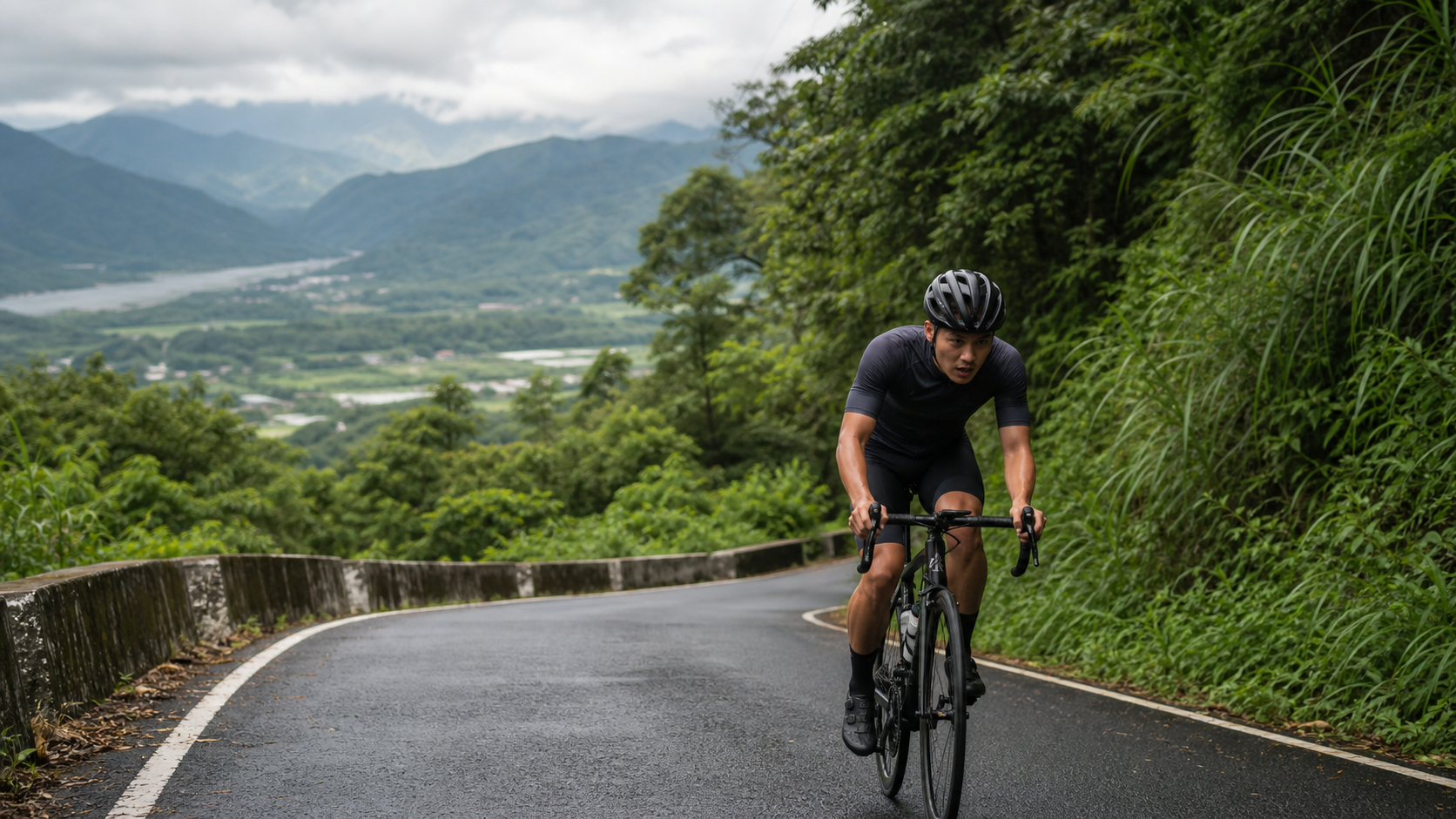
8.5 km, 5.7% average grade—the numbers look approachable, but the humid, hot climate of the Taimali mountain area combined with continuous climbing will push the route’s true difficulty beyond what many expect.
1. Let’s Lay Out the Data First
Before planning any climbing route, an engineer’s mindset always starts by confirming data consistency. For the Zhiben Sanhe Radio Station segment, Strava’s official data lists a total distance of 8,519.8 meters and an average grade of 5.7%, but the elevation gain field shows 0 meters—this is clearly a missing data point, not a route with no climbing.
Using distance and average grade to back-calculate gives a more reasonable elevation gain estimate: 8,519.8 meters × 5.7% ≈ 486 meters. This figure is quite close to the “approximately 488 meters of climbing, steepest section around 9.2%” recorded in this site’s existing route database, so this article uses a total climb of approximately 486 to 488 meters as the planning baseline. Riders should rely on actual GPS device measurements for real-world riding.
| Item | Data | Notes |
|---|---|---|
| Total Distance | 8.52 km | Short-to-medium distance climbing segment |
| Average Grade | 5.7% | Moderately hard, sustained climbing type |
| Estimated Total Climb | Approx. 486 m | Back-calculated from distance × grade, not an official direct figure |
| Steepest Section | Approx. 9.2% (site data) | Extra attention to gearing needed on local sections |
To be honest, the location shown on the Strava page is Taimali Township, Taitung County, not Taitung City, to which the Zhiben administrative district belongs. Although this route is named “Zhiben,” its actual location is closer to the mountain area between Zhiben and Taimali, near the Zhiben hot spring area. When writing about or planning this route, it’s best to understand it as “a climb in the Zhiben direction, Taimali mountain area,” rather than strictly within Zhiben city limits.
2. Route Characteristics: Medium-Distance, Sustained Climb
With an average grade of 5.7% and a total length of 8.5 km, this combination falls roughly into the “moderately hard” category in road bike climbing classifications—not like Wuling or Hehuan North Peak, which are long-distance challenges of 20 km or more, but far more demanding than the gentle slopes of riverside bike paths. This combination of distance and grade makes it very suitable as a weekend training climb, allowing you to complete a meaningful climbing intensity session within one to two hours.
Based on the route structure (per site data and grade distribution), this route is of the sustained climbing type, with little flat terrain for recovery. The steepest section may reach around 9.2%, meaning riders need sufficient low gears prepared for localized steep pitches, and should also be mentally prepared—this is not a route where you can fully relax and cruise midway.
3. Section-by-Section Strategy: Breaking the 8.5 km into Three Segments
Segment 1 (0–3 km) The Start: Find Your Climbing Rhythm
The first 3 km after departure are the most critical section for establishing your entire climbing rhythm. Many riders, driven by excitement or the urge to quickly shake off the initial discomfort, start with excessively high power output—this is the most common mistake on climbing routes. It’s recommended to keep target power for the first 3 km at around 80% to 85% of FTP, with cadence maintained at 75 to 85 rpm, giving your cardiovascular system and leg muscles enough time to adapt to the sustained climbing load pattern.
If the grade doesn’t vary much on this section, try to find a stable gear you can maintain for an extended period, avoiding frequent front and rear derailleur shifts due to minor grade fluctuations. Frequent shifting not only wastes energy but also increases the risk of chain drop during climbing.
Segment 2 (3–6 km) The Middle: The Trial of the Steepest Section
According to the site data, the steepest section is around 9.2%, and this grade range is likely located in the middle of the route. Before entering this area, it’s recommended to prepare both mentally and physically: check that the front derailleur has already shifted to the small chainring (if using a double-chainring system), and confirm the rear derailleur still has enough low gears to handle sudden grade increases.
When facing a steep section around 9.2%, the choice between seated and standing climbing varies by individual. Seated pedaling maintains a more stable heart rate and breathing rhythm, suitable for sustained efforts; standing pedaling leverages body weight for increased instantaneous torque, suitable for short steep bursts, but depletes more glycogen reserves. It’s recommended to primarily stay seated on the middle steep section, only briefly rising for moments when the grade spikes noticeably, then immediately returning to the saddle to restore rhythm, avoiding prolonged standing that causes heart rate to spike excessively.
Segment 3 (6–8.5 km) The Finish: Hold Steady for the Final Push
Entering the final 2.5 km, fatigue has accumulated to a certain level. The key on this section isn’t maintaining a high average speed, but avoiding form breakdown caused by exhaustion—cadence dropping too low, upper body starting to sway side to side, breathing becoming rapid and shallow—these are all signs of nearing physical limits. It’s recommended to refocus on breathing rhythm, using steady deep breaths to recalibrate your body’s state. Better to slow down than to sacrifice pedaling economy, avoiding cramps or muscle strains.
After reaching the summit, if you plan to descend the same way, be sure to let your heart rate drop to a safe range first and confirm the braking system is in good condition. Some sections of the Taimali mountain area may have fallen leaves, gravel, or slippery surfaces—control your speed on the descent, especially braking early before corners with poor visibility.
4. Gear Ratio and Equipment Recommendations
For this type of medium-distance, sustained, moderately hard climb, gear ratio recommendations:
- Front derailleur: 50/34 or 52/36 compact double chainrings are the most practical choice; for triple-chainring bikes, consider using the middle ring paired with a large cassette.
- Rear derailleur: At least an 11-28T cassette is recommended. If you have limited climbing experience or are still building fitness, an ultra-wide 11-32T or even 11-34T cassette provides greater safety margin, avoiding being forced to grind standing on the ~9% steep sections.
- Wheelset: This route has concentrated climbing and isn’t long, so there’s no need to chase lightweight time-trial wheelsets. Regular training wheelsets with reliable braking systems are sufficient, as braking stability on the descent is equally important.
- Tire pressure: If road conditions in the Taimali mountain area are uncertain, opt for slightly wider 25C to 28C tires. Tire pressure can be fine-tuned based on body weight and road conditions, balancing grip and rolling efficiency.
5. Nutrition and Hydration Strategy
Although the total length is only 8.5 km, the hot, humid climate of the Taimali area in Taitung, combined with the high-intensity output of sustained climbing, means fluid and electrolyte loss will be faster than expected. It’s recommended to ensure you’re well-hydrated before riding, consuming 300 to 500 ml of fluid 30 minutes before departure. If the single climb is expected to exceed 40 minutes, consider carrying a bottle of sports drink or energy gel, replenishing mid-climb to avoid low blood sugar affecting later output.
Since no clear roadside supply stations or shops are found along this route, it’s strongly recommended to carry sufficient supplies yourself, especially when riding during summer high-temperature hours—the risk of heatstroke and heat exhaustion should not be underestimated.
6. Weather and Seasonal Considerations
Summer temperatures in the Taimali area of Taitung frequently exceed 33°C, and with the climbing sections lacking shade, the perceived temperature will be even higher. It’s recommended to avoid the hottest hours around noon, choosing early morning or evening instead. Additionally, afternoon convective showers are common in mountain areas, especially in summer. Keep a close eye on weather forecasts—if dark clouds gather or barometric pressure drops noticeably, consider shortening the ride or turning back to avoid heavy rain on steep sections creating slippery conditions.
In autumn and winter, the Taimali mountain area is less affected by the northeast monsoon than coastal areas, but morning temperatures can still be low. Layered thermal clothing is recommended, and if temperatures drop sharply after summiting, prepare an insulating layer for the wind chill effect on the descent.
7. Common Mistakes and DNF Risks
- Starting too fast: Misled by the relatively gentle grade of the first 3 km, riders start at excessive intensity and have nothing left when hitting the 9.2% steep section mid-route.
- Gear ratio too heavy: Using a gear ratio unsuited to personal fitness (e.g., 50/34 with 11-25T), forced to grind standing on steep sections, easily causing knee discomfort.
- Insufficient fluid intake: Underestimating fluid loss on short-to-medium distance climbs, especially prone to dehydration in Taimali’s humid, hot climate.
- Ignoring descent risks: Eager to relax on the descent after summiting, without adequately checking road conditions and corner visibility, increasing crash risk.
- Misjudging afternoon convective showers: Failing to account for the rapidly changing mountain weather, recklessly departing during high-risk afternoon hours.
8. Target Time Reference for Riders of Different Levels
The following times are for training reference only; actual performance will vary with fitness, temperature, and wind conditions:
| Rider Level | Estimated Completion Time | Average Speed Reference |
|---|---|---|
| Advanced / Race Level | 20–28 minutes | 18–25 km/h |
| Intermediate / Trained | 28–40 minutes | 13–18 km/h |
| Recreational / Climbing Beginner | 40–60 minutes | 8–13 km/h |
The value of this route lies in its “medium distance, repeatable training” nature—unlike a century ride requiring a full day of planning, the 8.5 km distance makes it ideal for short, high-intensity weekday training or as a venue for multiple repeat climbs as interval training on weekends. As long as you prepare your gearing and supplies, this is a highly cost-effective practical training route.
9. Power Training Perspective: Using Sanhe Radio Station as an Interval Training Ground
For riders with a power meter, an 8.5 km climb at 5.7% average grade is perfect for structured training at “Sweet Spot” or “Threshold” levels. Sweet Spot training refers to holding power output between 84% and 97% of FTP—this range effectively stimulates lactate threshold improvement without causing the excessive fatigue of all-out efforts. Given this route’s length, one full climb lasts approximately 20 to 35 minutes (depending on rider level), which falls neatly within the recommended single-rep duration for Sweet Spot training.
To arrange higher-intensity interval training, consider splitting the route into 2 to 3 segments, each with 3 to 5 minutes of threshold-intensity surges (95% to 105% of FTP), using flatter sections or descents between segments for active recovery. This training approach is especially suited for riders preparing for time trials or climbing-oriented road races, as it simulates the common race pattern of “sustained high-intensity output, brief recovery, then pushing intensity again.”
Riders without a power meter can use heart rate as an alternative intensity indicator. It’s recommended to keep heart rate between 80% and 88% of maximum during the climb. If heart rate exceeds 90% and cannot be brought down within 30 seconds by adjusting cadence, the current intensity has exceeded the training target zone, and output should be reduced accordingly.
10. Route Maintenance Status and Road Surface Reminders
Industrial roads in Taitung’s mountain areas are often maintained less frequently than urban roads, and the Taimali mountain area where Sanhe Radio Station is located is no exception. Before riding, check for potholes, rockfalls, or landslide marks from recent rainfall, especially after typhoon season when mountain road conditions can change significantly. Avoid riding immediately after heavy rainfall, as the risk of loose soil and rocks increases markedly—safety should always take priority over training plans.
Additionally, while traffic on this type of industrial road is generally low, agricultural vehicles, scooters, or local residents’ transportation may still use it. Stay alert while riding, especially braking early and watching for oncoming traffic at corners with poor visibility.
11. Comparison with Other Taitung Climbing Routes
Placing Sanhe Radio Station within the broader coordinate system of Taitung’s climbing routes, its difficulty sits roughly between the gentle practice slopes around urban areas and long-distance, high-intensity challenges like Wuling or Taimali’s Golden Needle Mountain. Compared to classic long routes of 20 km or more with over 1,000 meters of climbing, Sanhe Radio Station’s 8.5 km is better suited as “entry-level advanced” climbing training—the distance isn’t long enough to intimidate beginners, yet the grade provides genuine training stimulus.
For riders preparing to tackle longer mountain routes (such as Wuling or the well-known long climbs of the Taimali mountain area), Sanhe Radio Station serves as an excellent preparatory training ground: first validate your gear ratio setup, nutrition pacing, and breathing control on this medium-distance climb. Once familiar with these fundamentals, you’ll approach higher-difficulty long climbs with greater confidence and safety.
12. Fine Points of Seated and Standing Technique
With an average grade of 5.7% and local sections reaching 9.2%, the technique of switching between seated and standing positions deserves deeper examination. When pedaling seated, shift your center of gravity slightly forward to avoid rear-wheel slippage or front-wheel lightness causing handling instability, while keeping your core muscles moderately engaged to reduce energy waste from upper-body sway. Hand position is best on the hoods or tops, as this posture keeps the airway relatively open, aiding oxygen supply during prolonged climbing.
For standing pedaling, attention must be paid to the coordination between body weight and pedal application point. The ideal standing position lets body weight naturally fall on the pedal of the pushing side, driving the bike forward through the rhythm of rocking side to side, rather than purely grinding with thigh strength. A common beginner mistake is leaning the upper body too far forward when standing, preventing the core from generating effective force—practice to find your own standing balance point. The middle steep section of Sanhe Radio Station is an excellent practice ground, where you can deliberately alternate between seated and standing to feel the differences in sensation and efficiency between the two positions.
13. Mental Toughness and Its Relationship with Climbing
Climbing is, to a large extent, a mental battle. When the grade keeps rising and breathing becomes increasingly labored, the brain easily generates thoughts of “giving up” or “getting off and walking to rest”—this is a normal response from the body’s self-protection mechanism, but it’s also a psychological hurdle that needs to be overcome through practice. When riding moderately difficult climbs like Sanhe Radio Station, practice shifting attention from “how much further” to “this current pedal stroke,” reducing psychological pressure by narrowing your focus.
Another effective mental technique is breaking the long climb into several psychological mini-goals, such as “ride to the next corner” or “get through this section that feels steepest right now,” rather than constantly thinking about remaining kilometers. This strategy of breaking the whole into parts, combined with the breathing control and posture adjustments mentioned earlier, effectively enhances a rider’s sustained output during mid-to-high intensity climbing—it’s also a practical battle-tested approach accumulated by many veteran climbing enthusiasts over the years.
14. For Riders Looking to Challenge Personal Records
If you’re already familiar with this route and want to push for a personal best, first do several warm-up rides to confirm how your actual performance varies under different weather and times of day—cooler morning temperatures generally favor better times, while midday heat noticeably slows pacing. When attempting a personal record, adopt a “negative split” strategy, meaning the second half should be faster than or at least equal to the first half. This requires deliberately suppressing the urge to push hard early, preserving ample energy reserves for an all-out final section.
Record power, heart rate, and split times for each attempt. Accumulated over time, this data clearly shows your improvement curve—another reason why Sanhe Radio Station, as a medium-distance, repeatable challenge route, is particularly suitable as a personal training benchmark.
15. Post-Ride Recovery and Muscle Relaxation
After completing a mid-to-high intensity climb like Sanhe Radio Station, the quadriceps and glutes typically feel noticeably sore and swollen. Within 15 minutes of finishing, perform light dynamic stretching, such as slow high-knee walking or a few minutes of easy cruising, to help metabolize lactate and prevent stiffness from sudden cessation of muscle activity. At home, use a foam roller to massage the front and back of the thighs, calves, and glutes—this significantly aids recovery for the next day’s training.
For nutrition, climbing training is a high-intensity mix of anaerobic and aerobic exercise. Within 30 minutes of finishing, consume a recovery meal with a carbohydrate-to-protein ratio of approximately 3:1, such as a banana with whey protein, or a simple chicken breast rice ball, to effectively accelerate muscle glycogen replenishment and micro-damage repair. If you plan to tackle climbing intensity training again the next day, adequate sleep and fluid intake are equally indispensable. These seemingly basic recovery details are often the key factors determining whether you can keep improving.
16. For Those Preparing for Your First Attempt
If Sanhe Radio Station is your first medium-distance climb with an average grade exceeding 5%, set aside any obsession with speed and time, and set your goal simply as “complete the ride safely.” The worst thing in climbing is overexertion—seeing a grade and wanting to power through, resulting in heart rate spiking too fast and muscles fatiguing prematurely, preventing you from experiencing the rhythm and sense of accomplishment climbing should offer.
Before your first attempt, confirm your bike’s gear ratio is suitable for climbing (especially whether the rear cassette has sufficiently wide low gears), and carry ample water and portable food. Once on the road, listen to your body’s signals at all times—if you feel significant discomfort, slow down or even stop briefly to rest rather than forcing a pace that doesn’t suit you. Everyone’s first climbing challenge eventually finds its own rhythm, and a moderately difficult, appropriately distanced route like Sanhe Radio Station is the most suitable starting point for practicing finding that rhythm.
17. Conclusion: A Training Climb Worth Returning to Again and Again
Taitung offers a wide variety of cycling routes, from long-distance county road loops to high-difficulty mountain challenges. Sanhe Radio Station may not be the most spectacular among them, but with its just-right combination of distance and grade, it has become a training ground many local riders consider worth revisiting. Whether you want to build climbing strength, practice power control, or simply find a route where you can honestly face yourself, Sanhe Radio Station deserves a place on your Taitung riding list—a fixed training segment you can challenge again and again, improving each time. The next time you plan a Taitung cycling itinerary, consider adding it in, using data and discipline to honestly face this 8.5 km moderate-difficulty test—you’ll find that this kind of solid training feedback is often more meaningful than chasing popular check-in spots, and builds a more substantial foundation for long-term progress.
18. Appendix: Pre-Ride Self-Checklist
To ensure every challenge is completed safely and smoothly, confirm the following items in order before departure: bike condition (brakes, shifting, tire pressure, chain lubrication), personal gear (helmet, gloves, jersey and bibs, sunglasses), supplies (water bottles, energy gels or portable food, electrolyte supplements), communication and navigation (phone battery, offline maps, emergency contact info shared with family or friends), and weather confirmation (recent rainfall, day’s temperature, and UV index). These seemingly tedious checks are the fundamental guarantee for every safe ride, especially for mountain routes like Sanhe Radio Station with sparse traffic and no roadside support—they are preparation steps that cannot be skipped. Internalizing this checklist as a fixed pre-ride ritual allows you to focus more fully on enjoying the challenge of the climb itself, without being distracted by unexpected equipment issues.
Related Reading
- Zhiben Sanhe Radio Station: A Quiet Yet Honest Climb Hidden in the Taimali Mountain Roads
- Taimali Golden Needle Mountain Practical Guide: A Complete Breakdown of the Category 5 Hard Climb—13.03 km, 1,250 m of Elevation Gain
- Wufen Mountain Guide: 10.28 km, 577 m Climb—A Textbook in Rhythmic Riding
- Tucheng Guanzizai Practical Guide: 3 km, 220 m Climb—Deconstructing This Hidden Steep Slope with Data
ThinkRider 智騎 XXPRO 訓練台,高階機種功能 只要 1/3價格!? 實測功率對比、噪音實測 / 公路車 / CT Yeh
1 年前
梅山36彎 奮起湖 #公路車 之旅 2400m
6 年前
台北闊瀨陡坡 騎旅 / 日本單車雜誌編輯車友臨時加入!/ 髮香才是最強的 / feat. 北迴歸線小隊 / 公路車 CT Yeh
6 個月前
爬坡ITT實境)台中 魔王 松鼠坡 首航 6:12 大肚山 大三元 科福路
8 年前
雨戰! 西進武嶺員工旅遊 加料 各路段大數據分析 | 同事端出5公斤的公路車來挑戰!? EP1
4 年前
單車 梅山36灣 坡度介紹 路段介紹 空拍 (相關遊記影片,請參考說明或我的頻道喔,歡迎訂閱)
6 年前
半日 小台灣 極限單車路線挑戰實錄
7 年前
2019 夏季KOM 5小 完賽心得 準備攻略 東進武嶺 夏季登山王之路 Taiwan KOM Challenge
7 年前