Luye Songlin Practical Guide: How to Ride This Short, Explosive 3.8km Climb with Steepest Sections Exceeding 20%
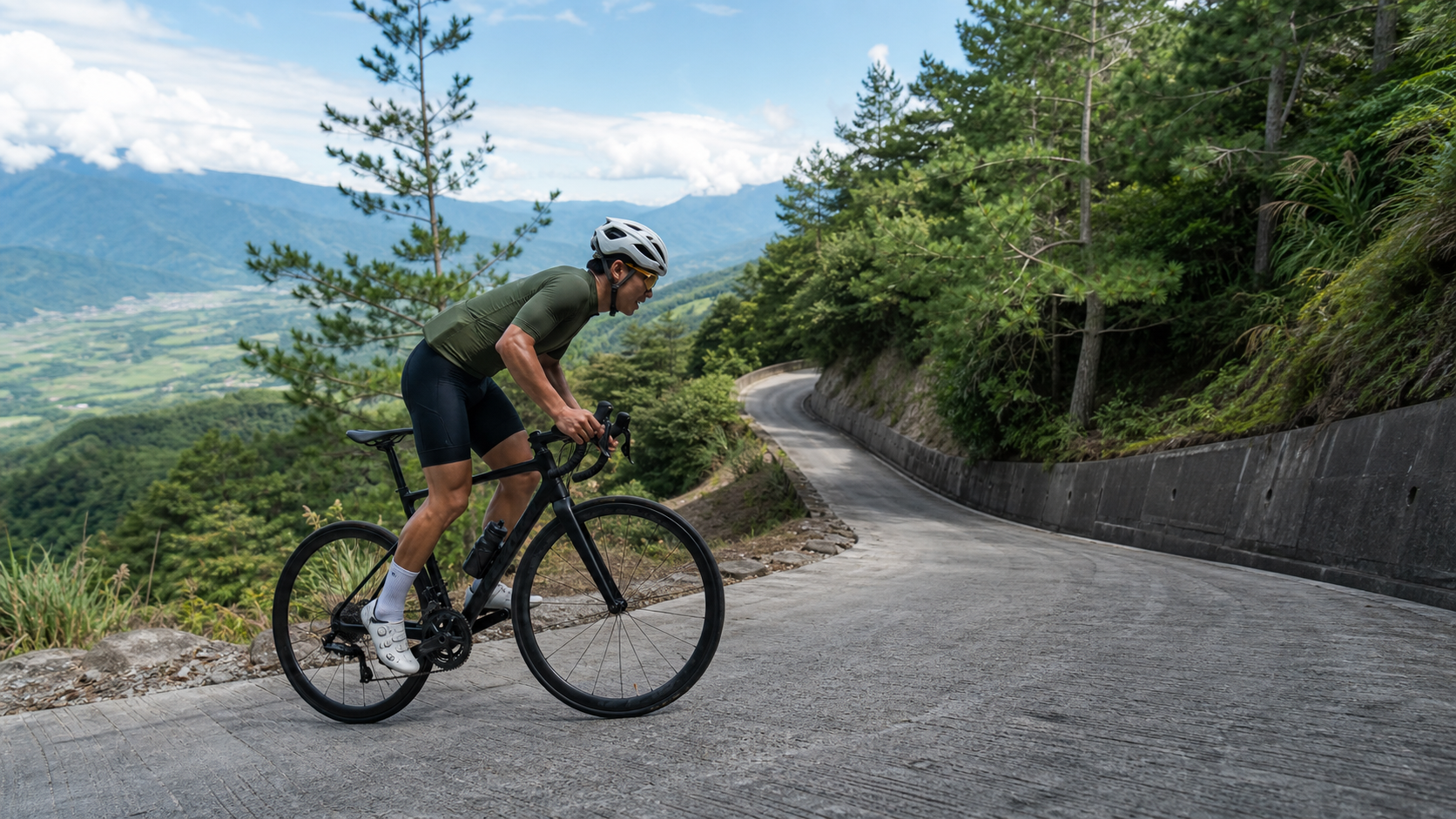
At just 3.8 kilometers long, yet hiding instantaneous gradients over 20%—Luye Songlin packs the most ferocious test among Taitung’s climbing routes into the shortest possible distance.
1. Let’s Start by Laying Out the Data
The official data for the Luye Songlin segment reads: total distance 3,805.26 meters, total elevation gain 324.342 meters, average gradient 7.9%. Cross-checking distance against gradient: 3,805.26 meters × 7.9% ≈ 300.6 meters, which is fairly close to the stated 324.3 meters of total elevation gain, confirming good internal consistency in the data.
| Item | Data | Engineering Perspective |
|---|---|---|
| Total Distance | 3.81 km | Short-distance explosive climb |
| Total Elevation Gain | 324.3 m | Completed within an extremely short distance |
| Average Gradient | 7.9% | Clearly above typical gentle-grade levels |
| Steepest Section | Possibly up to 25% (per site data) | Requires dedicated explosive-climb technique and mental preparation |
To be honest, the Strava page shows this segment’s geographic location as Yanping Township, Taitung County, rather than the commonly assumed Luye Township administrative area. Although the road bears the name “Luye,” its actual location is closer to the mountainous border zone between Luye and Yanping, near the well-known Luye Highlands scenic spot. Additionally, some sources indicate that the “Songlin Industrial Road” (also known as County Route 40 East) where this segment sits may extend up to 5.336 kilometers in total length, which differs from the 3.81 km Strava segment discussed here—presumably because the full road length and the actual segment range captured by Strava differ. This guide uses Strava’s official data of 3.81 km with 324.3 meters of total elevation gain as its baseline.
2. Route Characteristics: The Short-and-Fierce Explosive Climb Type
With an average gradient of 7.9% and a distance of just 3.8 km, this combination falls into the “short-distance, high-intensity” category of climbing classifications—a stark contrast to routes like the Shaoya Industrial Road introduced earlier (10.4 km, 6.4% average), which demands long-duration endurance management. Luye Songlin is closer to a sprint than a marathon-style endurance event—you don’t need to plan complex long-duration pacing strategies, but you do need to be prepared to承受 high-intensity muscular load within an extremely short time frame.
Real rider accounts corroborate the actual difficulty of this route. One rider shared in a community post about their first experience, mentioning that they “stalled” during the steep ascent—meaning the gradient was so severe and their technique not yet refined enough that they were forced to stop midway or dismount and walk. Another group-ride report mentioned that team members “complained bitterly” because they hadn’t anticipated how steep the mountain road would be. These first-hand accounts all confirm the difficulty presented by the official data: although the distance is short, the steepness of the gradient delivers a very direct physical impact on riders.
3. Section-by-Section Strategy: Breaking the 3.8 km into Three Segments
Segment 1 (0–1.2 km) The Start: Get into the Zone Immediately
Luye Songlin offers little room for warming up—you’ll hit noticeable climbing gradients shortly after setting off. It’s recommended to consciously control your breathing rhythm from the very beginning, avoiding the temptation to sprint at full effort just because the distance is short—while this route isn’t long overall, if you push your heart rate near maximum at the start, you’ll lack the reserve needed to handle the steeper sections ahead.
For this section, adopt a “progressive loading” strategy: start at moderate intensity, then as your body gradually settles into climbing mode, make slight upward adjustments to your output rather than going all-out from the first pedal stroke.
Segment 2 (1.2–2.5 km) The Core Steep Section: Facing the Possible 25% Instantaneous Gradient
According to site data, the steepest point on this route may reach 25%—a gradient that enters quite extreme territory, far beyond the common range for standard road bike climbing. When facing such instantaneous steep gradients, gear ratio configuration is absolutely critical—if your gearing isn’t light enough, you may well “stall” on the steep section like the rider mentioned in the earlier account, meaning your cadence drops to near-zero, the bike starts wobbling, and you’re even forced to dismount and walk.
Technically, it’s recommended to shift into your lightest gear combination before confirming you’re about to enter the extremely steep section, and employ a “standing burst” approach—using your body weight to instantly generate extra torque to power through the steepest short stretch, rather than trying to grind it out slowly in the saddle. This standing-burst technique requires practice, with the key being fore-aft weight distribution: lean slightly forward to maintain rear-wheel traction while simultaneously using your upper body to pull on the handlebars, coordinating with your lower-body pedaling to form a complete power chain.
Segment 3 (2.5–3.81 km) The Finish: A Brief Respite Before the Final Push
After passing the steepest section, the gradient typically eases somewhat—this is a rare breathing opportunity on the entire climb. Use this slightly gentler stretch to quickly regulate your breathing, let your heart rate drop a bit, and reserve some energy for the final push. Since the entire route is very short, you can usually choose to maintain a higher intensity toward the finish line, expending whatever energy reserves remain.
After reaching the summit (typically a spot with a more open view overlooking the surrounding scenery), remember to let your heart rate return to a safe range before deciding whether to continue your ride or head back down the same way.
4. Gear Ratio and Equipment Recommendations
Given that the steepest section may reach an extreme 25%, this is the most demanding route in terms of gearing among all routes covered in this guide:
- Front Derailleur: A compact crank of 50/34 or lighter is strongly recommended; if your bike allows, you could even consider a lighter climbing-oriented setup.
- Rear Derailleur: At minimum, an 11-32T cassette is recommended. If you’re less accustomed to ultra-steep climbs, an 11-34T or wider cassette provides greater safety margin, preventing you from being forced to walk before a 25% gradient due to insufficient gearing.
- Tire Pressure: Short, steep climbs demand more from traction. It’s advisable to slightly reduce tire pressure to increase the contact patch between tire and road, improving grip and handling stability while climbing.
- Mental and Technical Preparation: More than equipment, this route tests a rider’s on-the-spot explosive-climb technique and mental toughness. It’s recommended to practice standing-burst technique on other moderately steep climbs beforehand, building enough muscle memory before taking on Luye Songlin.
5. Nutrition and Hydration Strategy
Since the total length is only 3.8 km, this route typically doesn’t require complex mid-ride nutrition planning, but pre-ride preparation remains important:
| Time Point | Nutrition Recommendation |
|---|---|
| 15–20 minutes before departure | Consume 200–300 ml of fluid to ensure proper hydration |
| During the ride | If the single ascent takes under 20 minutes, no additional fueling is usually needed |
| After completion | Replenish fluids and electrolytes immediately; short-duration high-intensity output can cause noticeable dehydration |
Worth noting: although the single ascent time is short, the cardiorespiratory and muscular load from high-intensity output is not to be underestimated. If you plan multiple repeated attempts (e.g., as interval training), be sure to schedule adequate rest and hydration between each ascent.
6. Weather and Seasonal Considerations
The Luye Highlands area hosts a hot air balloon festival roughly from June to August each year, a major summer tourism event in Taitung. If your riding route overlaps with the festival venue traffic flow, vehicle and pedestrian congestion may be higher than usual during that season. It’s advisable to plan your riding time in advance, avoiding peak festival crowd hours.
Summer riding also requires special attention to Taitung’s high temperatures and intense UV radiation. In particular, if the climbing sections of this route lack shade, the perceived temperature will be even higher. It’s recommended to ride in the early morning or evening hours and to prepare adequate sun protection.
7. Common Mistakes and DNF Risks
- Insufficient Gear Ratio: This is the most common and most direct cause of failure. Facing gradients that may reach 25%, gearing that isn’t light enough will directly send your cadence to zero and force you to walk.
- Starting Too Fast: Misled by the short distance, you go all-out from the beginning, leaving no reserve when you hit the steepest section in the middle.
- Inadequate Mental Preparation: Underestimating the route’s actual difficulty and failing to mentally prepare for extreme gradients, leading to panic or even giving up when faced with the steep sections.
- Unfamiliarity with Standing Technique: When facing instantaneous extreme gradients, being unfamiliar with standing-burst technique can easily lead to falls from losing balance or front-wheel slippage.
- Underestimating Short-Distance Intensity: Letting your guard down because the total distance is short, failing to bring basic hydration or warm up properly, which compromises actual performance.
8. Target Time References for Riders of Different Levels
The following times are for training reference only; actual performance will vary significantly based on fitness level and gear ratio configuration:
| Rider Level | Estimated Completion Time | Average Speed Reference |
|---|---|---|
| Advanced / Race Level | 10–15 minutes | 15–23 km/h |
| Intermediate / Trained | 15–22 minutes | 10–15 km/h |
| Recreational / Climbing Novice | 22–35 minutes (including brief walking) | 6.5–10 km/h |
Luye Songlin is a textbook “short-and-fierce” explosive climb. The biggest challenge isn’t endurance management but whether your instantaneous explosive power and gear ratio configuration are up to the task. This route is excellent for practicing standing-burst technique on steep gradients and serves as an ideal short climb for interval training—as long as you’ve prepared your gearing and mental approach, even the challenge described in that rider’s account of “stalling” on the steep section can be progressively overcome through thorough preparation.
9. Power Training Perspective: Treating Songlin as an Anaerobic Power Training Ground
For riders with a power meter, Luye Songlin’s short-distance, high-gradient profile makes it ideal for anaerobic capacity and VO2max-level training. Since the entire route is only 3.8 km with the actual climbing concentrated in extremely short 1-to-2-minute bursts, power output on the steepest sections is likely to spike to 150% or even over 200% of FTP—exactly the intensity range ideal for training anaerobic explosive power.
It’s recommended to incorporate this route into a structured interval training plan, such as 3 to 5 repeated ascents, with adequate recovery between each ascent via gentle descents or flat cruising (recovery time should be at least 2 to 3 times the climbing time), thereby specifically improving your tolerance for short-duration high-intensity output. This training pattern is highly practical, targeted conditioning for riders preparing for King of the Mountain challenge races or those needing to handle sudden steep sections in competition.
Riders without a power meter can also use Rating of Perceived Exertion (RPE) to assess training intensity: the steepest section should reach an intensity level where you “can barely sustain it for more than 1 minute.” If it feels easy to sustain, it likely means your gear ratio is too heavy, which actually reduces the anaerobic training stimulus.
10. Practical Mindset Tips for Tackling Extreme Steep Climbs
Facing instantaneous gradients that may reach 25%, beyond the hardware preparation of gear ratios, mental and technical approaches are equally important. First, it’s recommended to “read the road” with your eyes in advance—before entering the steepest section, visually assess the upcoming gradient changes and decide in advance whether to respond seated or standing, rather than reacting on the spot once you’re already in the steep section.
Second, breath control is equally critical during extremely brief high-intensity efforts. A short, powerful breathing rhythm is recommended, synchronized with the explosive force of your pedaling, avoiding breath-holding that causes excessive core tension and actually limits lower-body power delivery efficiency. Finally, and most importantly: if you genuinely feel your gearing is insufficient and your speed is about to hit zero, rather than pushing through and risking a crash, decisively dismount and walk—as many real riders have shared in their accounts. This isn’t failure; it’s a wise, responsible choice for your own safety. Coming back next time with lighter gearing to try again is just as valid a way to prove your ability.
11. Road Surface Conditions and Descent Safety Reminders
As part of a local living road, the Songlin Industrial Road may not be maintained as frequently as urban roads. Before riding, it’s advisable to check for potholes, accumulated leaves, or loose gravel on the surface. Especially after consecutive rainfall, road surface friction in mountain areas can noticeably decrease, increasing the risk of slipping.
After completing the climb, if you plan to descend back the same way, exercise extra caution—sections that felt steep on the way up are equally critical tests of speed control on the way down. It’s recommended to keep both hands ready on the brake levers during the descent, using “intermittent braking” rather than “continuous heavy braking” to control speed, avoiding prolonged heavy braking that can overheat rims or cause brake system failure. Localized sections exceeding 20% gradient generate considerable acceleration when descending—be sure to anticipate corners and gradient changes well in advance. Better to ride conservatively than to show off speed on the descent.
12. Difficulty Comparison with Other Short Climbs in Taitung
Placing Luye Songlin within the coordinate system of Taitung’s overall short-distance explosive climbs, its 7.9% average gradient and potentially 25% maximum put it in a fairly hardcore tier, far above the average gradient level of typical suburban training climbs (usually between 3% and 5%). This combination of short distance and ultra-high intensity is uncommon among Taiwan’s cycling routes, which is why Luye Songlin has accumulated a reputation among seasoned climbing enthusiasts as “small but ferocious.”
If you’ve already conquered long mountain routes like Wuling or the Taimali mountain area but haven’t yet taken on a short-distance explosive climb like Luye Songlin, consider adding it to your training list—long-distance endurance and short-distance explosive power are two distinctly different yet equally important abilities in climbing, and Luye Songlin is one of the most ideal proving grounds for honing the latter.
13. Post-Ride Recovery and Muscle Soreness Management
Although the riding time at Luye Songlin is short, because the intensity is concentrated at anaerobic levels, post-ride muscle soreness is often more pronounced than expected. The quadriceps and calf muscle groups in particular may experience delayed onset muscle soreness (DOMS) within 24 to 48 hours after completing the challenge. It’s recommended to perform light dynamic stretching immediately after the ride and schedule a gentle low-intensity activity later that day (such as walking or easy cruising) to help blood circulation flush out metabolic waste and reduce soreness.
In terms of nutrition, short-duration high-intensity exercise primarily depletes the energy reserves of the anaerobic glycolytic system. It’s recommended to replenish carbohydrates soon after the ride to help restore muscle glycogen. If you plan to attempt the route again the next day or engage in other high-intensity training, adequate rest and sleep are indispensable for muscle recovery—it’s not advisable to rush into consecutive days of high-intensity explosive climbing while muscles are still recovering.
14. Technical Evolution Through Repeated Challenges
Luye Songlin’s short-distance, rapidly repeatable route characteristics make it an ideal proving ground for technical refinement. When fitness permits, it’s recommended to schedule 2 to 3 repeated attempts in a single ride, fine-tuning your standing-burst timing and gear-shifting rhythm with each attempt, while recording completion times and subjective feelings for each run. Through this iterative comparison process, you can more quickly find your optimal explosive-climb rhythm and clearly feel your technique maturing with each repetition.
This immediately visible feedback of technical improvement is also one reason short-distance explosive climbs deliver a greater sense of accomplishment compared to long-distance endurance routes—you don’t need to spend hours to get a complete training feedback cycle. Within just ten to twenty minutes, you can complete attempt after attempt of challenge and adjustment.
15. Appendix: Pre-Departure Equipment and Mental Double-Check
Facing a short-distance, high-intensity explosive climb like this, pre-departure preparation cannot be taken lightly. On the equipment front, be sure to confirm: whether the lowest gear on your rear cassette is sufficient to handle the 25% instantaneous gradient, whether your brake system is responsive and reliable (especially if you plan to descend back the same way), and whether tire pressure has been appropriately adjusted to increase traction. On the mental front, it’s advisable to accept in advance the fact that “this route is harder than you think,” avoiding a complacent mindset born of the short distance that leaves you caught off guard at the steep sections.
For group rides, it’s recommended to communicate clearly with teammates beforehand, allowing everyone to tackle this steep climb at their own pace—there’s no need to deliberately match others’ speed, and certainly no need to put excessive psychological pressure on yourself because you see teammates passing through easily. Everyone’s climbing ability and gear ratio configuration differ, and an extreme gradient like Luye Songlin naturally amplifies performance differences between individuals. Accepting and respecting each other’s pace will be a more important form of teamwork during the group ride.
16. Conclusion: Small and Beautiful, Yet Small and Ferocious
In just 3.8 short kilometers, Luye Songlin writes a strikingly vivid chapter among Taitung’s climbing routes. It requires no full-day planning, yet within just over ten minutes, it lets riders fully experience the physical and mental impact of high-intensity climbing. If you’re looking for a training route that can be quickly arranged yet remains full of challenge, Luye Songlin absolutely deserves a place on your Taitung riding map—an excellent battleground for honing explosive power and willpower.
17. Integrating Luye Songlin into Long-Term Training Planning
For riders aiming to take on higher-difficulty races, it’s recommended to incorporate short-distance explosive climbs like Luye Songlin into a fixed weekly or monthly training cycle. You could schedule a targeted power training session on a lighter endurance-training day of the week, using this route’s extreme steepness to fill the anaerobic capacity gap that long-distance endurance training rarely addresses. Accumulated over time, you’ll find yourself responding with greater composure and confidence when encountering occasional short steep sections on other routes—this is the tangible benefit that a compact yet potent training ground like Luye Songlin can deliver.
Whether your riding goal is to challenge classic long-distance races or simply to comprehensively improve your climbing ability, Luye Songlin is worth visiting in person at least once—to test your true performance against extreme gradients in the most direct way, and through challenge after challenge, to build climbing strength and confidence that are genuinely your own.
18. Conclusion: A Short Climb Can Write a Long Story
Luye Songlin spans less than 4 kilometers in total, yet it invites repeated reflection and retelling—that instantaneous 25% gradient, that genuine account of “stalling,” that whimsical contrast of coexisting under the same sky as hot air balloons. Pieced together, these fragments tell a story far longer and richer than its distance figure suggests. This is perhaps the most moving aspect of cycling: what truly determines the weight of a journey is never the number of kilometers, but how much you felt, how much you learned, and how many moments worth savoring you left behind along the way. Next time you plan a Taitung riding itinerary, don’t forget to include this short-but-fierce Luye Songlin—use just a few dozen minutes to write your own chapter of challenge worth revisiting, and let your climbing ability be most solidly tempered on this ferocious yet captivating short climb.
Related Reading
- Luye Songlin: Beside the Hot Air Balloon Festival, a Steep Surprise That Catches You Off Guard
- Luchang Steep Climb Practical Guide: Full Analysis of the 4.09 km, 9.6% Average Gradient Ultimate Challenge
- Koyasan Guide: Complete Endurance Pacing, Gear Ratio, and Nutrition Guide for the 17.4 km 4.4% Long Climb
- Lijia Forest Road Practical Guide: 8.33 km, 960.5 m Elevation Gain—Segment-by-Segment Breakdown of a Strava Hard-Rated Climb
台北闊瀨陡坡 騎旅 / 日本單車雜誌編輯車友臨時加入!/ 髮香才是最強的 / feat. 北迴歸線小隊 / 公路車 CT Yeh
6 個月前
萬年峽谷! 30% 超激陡坡 里佳部落DAY2 還是很硬! | 公路車 | CT Yeh
3 年前
大武山後門26%歡樂陡坡!JJSC南台灣單車行Day2 / 被颱風追著跑 / 公路車 / CT Yeh
2 年前
半日 小台灣 極限單車路線挑戰實錄
7 年前
新竹羅平 x 天湖部落 大禹嶺級變態陡坡! 4K超高畫質 空拍 | 公路車
5 年前
一定要騎一次!阿里山最深處:里佳部落!單車旅行 | 2800m爬升 | 深度部落體驗:嗨翻晚會、螢火蟲、銀河 | feat. JJSC & 廢物伙伴 | 公路車 CT Yeh
10 個月前
#北橫 + #北進武嶺 最硬的員工旅遊 EP1 | #公路車 #拉拉山 | 明池 | 武嶺 | 武陵農場 | 雲海 | Taiwan Cycling Route Wulin
6 年前
大武山20%魔王陡坡【JJSC南台灣遊騎Day2】!屁股真的要裂開了...凡士林抹滿也沒用?神秘金教堂還有超便宜夜市
3 個月前