Guangfu Bihe Pond Climbing Guide: A 4.4 km High-Intensity Test in the East Rift Valley with an Average Gradient of 5.8%
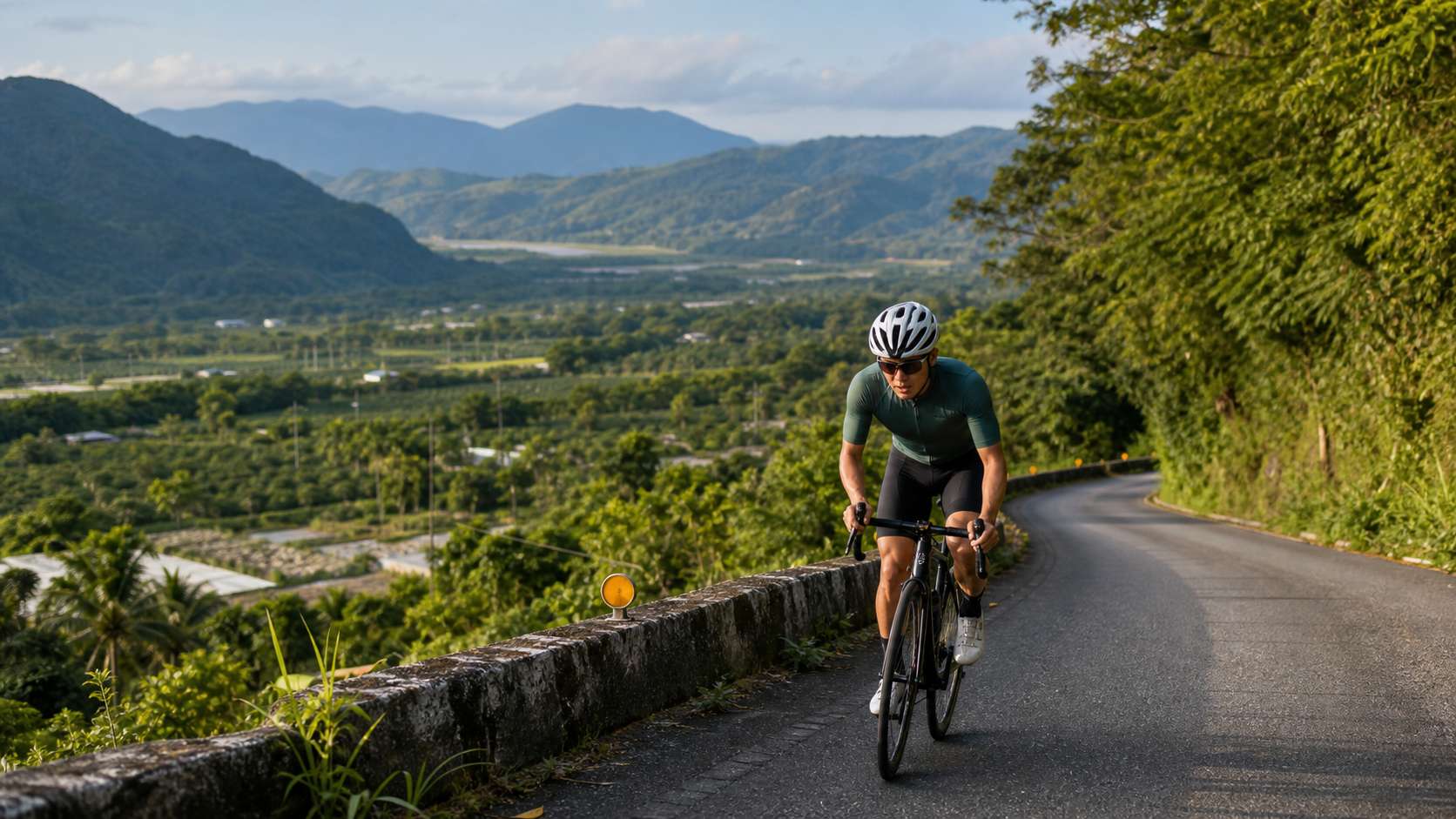
Route Overview and Data Analysis
The Guangfu Bihe Lake climb spans 4.39 km in total length with 252.6 meters of elevation gain and a 5.8% average grade, classified as a Category 2 (moderately hard) climb on Strava. Located in Guangfu Township, Hualien County, the route starts near the Matai’an Wetlands and the communities around Guangfu Sugar Factory, climbing toward Bihe Lake (also written as Bihe Lake or Bihai Lake in the mountain area). It is one of the few short-distance, high-intensity training routes in the East Rift Valley.
Let’s break down the numbers: 4.39 km with 252.6 meters of elevation gain at a 5.8% average grade. On Taiwan’s climbing map, this falls into the “short but solid” category—nowhere near the 10-to-20-kilometer endurance battles of Wuling or Hehuanshan, but definitely not a warm-up grade either. Cross-checking the math: 252.6 meters ÷ 4.39 km = 5.75%, which aligns almost perfectly with Strava’s 5.8% figure. This indicates a relatively even distribution of gradient with no extreme steep sections—a climb with stable grade variation, better suited for practicing “sustained output” rather than “sprint-and-corner” tactics.
In the context of the East Rift Valley’s topography, Guangfu Township sits on the valley plain between the Central Mountain Range and the Coastal Mountain Range. The climb toward Bihe Lake ascends from the valley floor toward the hilly terrain on the eastern side of the Central Mountain Range, passing orchards, betel nut plantations, and scattered indigenous tribal settlements (Guangfu is an important cultural hub for the Amis people, including the Dafugang and Tafalong tribes). These types of climbs typically feature good road surfaces and low traffic volume, making them popular testing grounds for local riders’ morning rides or weekend group rides, and are often used as short-intensity tune-ups before longer climbs like Hehuanshan or Taroko.
Key Data at a Glance
| Item | Data |
|---|---|
| Total Distance | 4.39 km |
| Total Elevation Gain | 252.6 m |
| Average Grade | 5.8% |
| Strava Category | Category 2 |
| Location | Guangfu Township, Hualien County |
| Recommended Direction | Valley plain → Bihe Lake mountain area |
Terrain Formation and Road Surface Characteristics
To truly master the Bihe Lake climb, understanding its geological origins—beyond just the distance and grade numbers—can help you craft a more precise pacing strategy. The East Rift Valley is a narrow, elongated valley sandwiched between the Central Mountain Range and the Coastal Mountain Range, geologically situated at the contact zone between the Philippine Sea Plate and the Eurasian Plate. Tributary streams on both sides of the valley (such as the Matai’an Creek within Guangfu Township) have eroded over millennia, creating steep but short alluvial fan slopes at the boundary between foothills and valley floor—this is the geological backdrop behind why the Bihe Lake route is “short and steep.”
This terrain also means the road surface and gradient won’t be perfectly uniform. Experienced riders know that even when Strava shows a 5.8% average grade, the actual feel often follows a three-phase pattern: “gentler at the start, steepest in the middle, slightly easing toward the end.” This is a classic signature of alluvial fan slope terrain—flatter near the foothills, with gradient concentrating as you approach the transition zone between valley and mountain. Therefore, before attempting a full-effort time trial, it’s advisable to do at least one “reconnaissance ride” at moderate intensity to feel the actual distribution of gradient changes, rather than relying solely on the average grade figure to plan your perceived-effort pacing.
Regarding road surface, these industrial-road-grade climbs are typically paved with asphalt, but due to low traffic volume and less frequent maintenance compared to major highways, some sections may have cracks, patches, or uneven drainage grate heights. After rain, fallen leaves and mud can accumulate on the road—stay extra vigilant when cornering and braking, and don’t let the pursuit of segment bests compromise awareness of road hazards.
Cycling Culture and Local Resources in Guangfu Township
Although Guangfu Township isn’t large in population, it serves as a key node in the East Rift Valley cycling network, with relatively well-developed cycling-friendly facilities nearby. The adjacent East Rift Valley Bikeway system connects attractions like the Guangfu Sugar Factory and the Matai’an Wetland Ecological Park, with flat sections suitable for warm-up and cool-down rides before and after climbing training. The Guangfu Sugar Factory itself is a well-known local rest stop, featuring parking and supply stations (ice cream, light meals, etc.). Many riders use the sugar factory as their assembly and departure point, then return after completing the Bihe Lake climb challenge to enjoy a refreshing popsicle as a reward—forming a complete riding ritual beloved by local cycling teams.
For riders traveling from other parts of Taiwan (such as Taipei, Taichung, or Kaohsiung) specifically to tackle East Rift Valley climbs, Guangfu’s location offers strategic advantages—bordering Fenglin and Shoufeng to the north, and Ruisui and Yuli to the south, it sits right in the middle of the East Rift Valley, making it convenient as a mid-point rest stop for multi-day riding itineraries. If planning a 2–3 day East Rift Valley climbing tour, scheduling Bihe Lake in the middle (as a “calibration route” for fitness and grade perception), followed by neighboring climbs like Chike Mountain or Liushishi Mountain, would be a well-reasoned plan with sensible energy allocation.
Section-by-Section Strategy: Pacing Control from Start to Midpoint
Although this route is only 4.39 km long, precisely because it’s short and steep, pacing strategy is actually more prone to error than on longer climbs—many riders push their heart rate near the anaerobic threshold in the first half, only to be forced into a significant slowdown in the final two kilometers, ending up slower overall than with steady pacing.
Section 1 (0–1.5 km): Leaving the Flat, Finding Your Climbing Rhythm
After departure, the road quickly transitions from the gentle valley plain to a noticeable ascent. In this section, ride at slightly below full effort (if using power, aim for around 85–90% of FTP), giving your cardiovascular system and legs a 1–2 minute adaptation period. A common mistake is charging off the line—especially when riders see the Strava segment start flag and adrenaline takes over. But short climbs like Bihe Lake are most vulnerable to “starting-line sprint syndrome”—the 10 seconds you save in the first kilometer often costs you 30+ seconds in the third and fourth kilometers due to lactic acid buildup in the legs.
Section 2 (1.5–3 km): The Core Gradient Zone, Sustained Output
This is the most gradient-concentrated core section of the entire route, with average grades potentially falling between 6–7% (adjusting slightly based on actual terrain undulations). Shift into a suitable low gear and maintain a cadence of around 75–85 rpm. Avoid grinding too heavy a gear, which stresses the knees, and avoid spinning too light a gear above 100 rpm, which causes unnecessary heart rate spikes. The key to this section is “breathing rhythm”—consider a 2-2 breathing pattern (two pedal strokes inhale, two strokes exhale, or adjusted to your cadence) to avoid unconsciously holding your breath as the grade steepens.
Section 3 (3–4.39 km): Final Sprint or Steady Finish
Entering the last kilometer-plus, if you’re targeting a time trial or Strava segment record, you can begin progressively increasing output here. If it’s just a training ride, maintain your current rhythm to the top, then coast for a cool-down. The views open up around Bihe Lake, and the latter part of the climb often offers layered vistas of the valley and Coastal Mountain Range—another reason many riders choose this route for “aerobic-with-anaerobic-intervals” training: the scenery distracts from the effort, making subjective fatigue feel lower than doing the same intensity on an indoor trainer.
Gear Ratio and Equipment Recommendations
For a short climb with a 5.8% average grade and maximum sections potentially reaching 8–10%, gear ratio recommendations are as follows:
- Standard Road Bike Setup: A 50/34T compact crankset paired with an 11-30T or 11-32T cassette is sufficient for this type of short but gradient-concentrated climb. If you don’t climb often in training and lack leg strength reserves, consider an 11-32T or even 11-34T wider-range cassette to retain low-speed spinning margin.
- Time Trial / Segment Hunters: If your goal is to set a new Strava segment record, consider a 52/36T semi-compact crankset with a tighter cassette, using the heavier gearing to maintain high-speed surges where the grade eases.
- Wheelset Choice: With only 4.39 km total, lightweight climbing wheels (rim depth 30mm or less front and rear) will outperform aero wheels. This is especially relevant given the frequent afternoon crosswinds in the East Rift Valley—the aero benefit of deep-section wheels on a short mountain climb is limited, while handling burden increases.
- Tire Pressure: With summer heat on the road surface and intense sun exposure in the Hualien area, consider dropping tire pressure by 3–5 psi (relative to flat-road riding) to improve grip and comfort, particularly if there are localized potholes or gravel.
Nutrition, Hydration, Weather, and Seasons
Although the Bihe Lake climb is short, Hualien summers (June–September) frequently bring afternoon thunderstorms, high heat, and humidity. Combined with Guangfu’s valley location and prolonged direct sunlight, even a 4.39 km ride carries significant perceived exertion. Recommendations:
- Before Departure: Consume 300–500ml of fluid at least 30 minutes prior to avoid starting dehydrated or on an empty stomach.
- During the Ride: Since the entire effort takes under 20 minutes (depending on ability, most riders finish in 12–25 minutes), no mid-ride food is needed, but carry at least one bottle of water; in summer, consider adding electrolyte supplementation.
- Seasonal Advice: Spring and autumn (March–May, October–November) offer the most pleasant temperatures and are the golden seasons for riding Bihe Lake and surrounding valley routes. In summer, avoid the high-heat window of 11 AM to 3 PM, opting for early morning or evening rides instead. During typhoon season (July–October), watch for rockfall or landslide warnings on mountain sections—some industrial roads around Guangfu may require time to repair after typhoons.
Common Mistakes and Risk Warnings
- Overly Aggressive Start: As noted earlier, short climbs are most susceptible to “seeing the flag and getting fired up,” leading to excessive output in the early section and a late-route collapse. Beginners attempting the route for the first time should ride the full distance at 80% effort, record the pacing, then plan a full-effort attempt next time.
- Insufficient Gear Range: If your training is mostly on flat roads and you haven’t brought a cassette with low enough gears, you may be forced to “stand and grind” through gradient-concentrated sections, increasing cramp risk.
- Ignoring Wet Road Surfaces: Mountain sections in the East Rift Valley occasionally have agricultural irrigation water overflow or afternoon showers making roads slippery. Anticipate cornering and braking well in advance to avoid high-speed crashes.
- Underestimating Short Climb Intensity: 4.39 km sounds short, but a 5.8% average grade is already at a level requiring serious pacing. Don’t let the short distance lull you into complacency—especially avoid charging at full effort before your cardiovascular system is properly warmed up.
Target Time References by Rider Level
| Rider Level | Suggested Target Time | Average Power Reference (70 kg Rider) |
|---|---|---|
| Beginner / Recreational | 20–28 minutes | 150–180W |
| Intermediate | 14–18 minutes | 200–250W |
| Competitive / Race Level | 10–13 minutes | 280–350W+ |
The above times are approximate reference values; actual results will vary based on individual body weight, wind conditions of the day, road surface, and warm-up status. If this is your first attempt at the route, aim for “finishing without injury and establishing a baseline time,” then progressively improve climbing power output through interval training. While Bihe Lake isn’t Hualien’s most famous climb, as a short high-intensity training venue, it’s an excellent choice for valley riders to practice “steep short-climb tolerance,” and also serves as a solid base fitness checkpoint before tackling longer climbs like Chike Mountain, Taroko, or Wuling.
Practical Application of Power and Heart Rate Data
If your equipment includes a power meter, Bihe Lake is an ideal route for calibrating your “short-duration maximal lactate steady state” (i.e., the power zone around your FTP). Since total completion time typically falls between 10–25 minutes, it closely matches the “20-minute all-out test” duration used in sports science to estimate FTP. Advanced riders can consider doing a full-effort Bihe Lake attempt every few training cycles and recording average power to track long-term climbing power progression—this reflects true fitness changes better than time alone (time is affected by wind and road wetness, while power data is relatively stable).
For riders without a power meter, heart rate can serve as the pacing guide instead. In the early section (0–1.5 km), keep heart rate at 80–85% of maximum; in the middle section (1.5–3 km, where gradient is most concentrated), progressively raise to 88–92%; in the final sprint section, decide based on how you feel whether to push toward near-maximum heart rate. This “progressive heart rate ramp” strategy effectively avoids the trap of blowing up early and being forced to slow dramatically later, and it aligns better with the physiological curve of heart rate naturally rising under sustained output.
Note that the East Rift Valley’s summer heat and humidity will cause the same power output to correspond to a higher heart rate response (a phenomenon known as heart rate drift due to thermal stress). Therefore, if challenging the route in peak summer, consider adjusting your target heart rate zones down by 3–5% to avoid overextending in pursuit of predetermined data targets and increasing heat exhaustion risk.
Training Planning: Fitting Bihe Lake into Your Periodization
For riders living in the East Rift Valley or frequently traveling to Hualien for training, a “short-distance, high-grade” route like Bihe Lake is actually a highly practical piece of the periodized training puzzle. Here are several common training structures:
Lactate Threshold Intervals: With only 4.39 km total and completion times mostly in the 10–25 minute range, it’s well-suited for “lactate threshold intervals”—climb at full effort, recover on the descent or flat, repeat 3–5 times. This training mode effectively builds the ability to repeatedly produce high power output in short bursts for riders preparing for long-distance climbing events (such as the Eastward Wuling or Hehuanshan series)—commonly known as “repeated climbing tolerance.”
Neuromuscular Power Training: If your goal is sprint-oriented short climbing time trials, the steep early section of Bihe Lake is ideal for “standing acceleration” practice—accelerate hard out of the saddle for 15–20 seconds at the climb entrance, simulating the scenario of dropping opponents or fighting for position in a race, then sit and settle into a steady pace to the summit.
Recovery Day Easy Ride: Bihe Lake can also be used in reverse as a “recovery day” route option—ride the full distance at far below full effort (heart rate at 60–70% of maximum), combined with deep breathing and relaxed shoulders and neck, promoting blood circulation through low-intensity activity and accelerating lactate clearance from the previous day’s training.
Beginner’s Checklist: Preparation Before the First Attempt
If this is your first time tackling an East Rift Valley climbing route, or you’re transitioning from flat-road riding to mountain training, here’s a preparation checklist before departing for Bihe Lake:
- Check Brakes and Drivetrain: Short, steep climbs demand immediate brake response. Before departure, confirm brake pad wear and shifting cable smoothness to avoid missing the optimal gear at gradient transition points due to shifting lag.
- Warm Up at Least 10 Minutes: Even though the destination route itself is only 4.39 km, do a 10–15 minute progressive warm-up on flat ground first, allowing your cardiovascular and muscular systems to adapt to exercise intensity and reducing the risk of pulls or cramps during the sudden climb.
- Carry Basic Puncture Repair Tools: Industrial-road-grade sections occasionally have gravel, nails, or other debris. Carry a spare tube, patch kit, and mini pump to avoid being stranded on mountain sections with poor cell signal due to a flat.
- Inform Someone of Your Route and Expected Time: As noted, cell signal may be unstable in some mountain sections. Telling a riding companion or family member your planned route and expected return time is a basic but often overlooked safety habit.
With the above preparation complete, Bihe Lake will be a route that delivers high satisfaction in a short time—no need to invest a full day, yet you’ll get a solid taste of East Rift Valley climbing terrain, and it’s an excellent touchstone for evaluating your recent training progress.
Route Combination Suggestions
Since Bihe Lake itself is short, most riders won’t end their ride after just this section—it’s typically incorporated into a larger East Rift Valley or Guangfu-area loop. Common combinations include:
- Guangfu Sugar Factory—Matai’an Wetlands—Bihe Lake Loop: Starting from Guangfu town center, first loop around the Matai’an Wetland Ecological Park (flat terrain, ideal for warming up), then cut into the Bihe Lake climb as the main intensity block of the workout, and finally return to the Guangfu Sugar Factory for ice cream as a cool-down reward—a classic weekend riding route for local cyclists.
- Provincial Highway 9 Valley Section Integration: Bihe Lake is adjacent to Provincial Highway 9, and riders often incorporate it into long north-south rides along the highway from Guangfu to Ruisui or Yuli, serving as an intensity variation point to break up long flat stretches and avoid single-muscle-group fatigue.
- Pairing with Chike Mountain and Liushishi Mountain: Riders familiar with East Rift Valley terrain also frequently pair Bihe Lake with Chike Mountain near Yuli in the same training week or the same Hualien cycling trip. Both are short-to-medium distance climbs with solid grades, suitable for a two-day riding plan to test how your body responds to different muscle groups and pacing strategies.
Safety and Precautions Summary
When riding industrial-road-grade climbs like Bihe Lake, beyond the pacing and gear ratio advice mentioned earlier, here are several practical reminders compiled by local riders:
- Watch for Agricultural and Work Vehicles: The area around Guangfu still has numerous orchards and farmland. You may encounter agricultural transport vehicles or trucks entering and exiting during the climb. Slow down and yield when passing, and don’t get so focused on pacing data that you overlook road conditions.
- Cell Signal Coverage: Signal may be unstable on some mountain sections. Before departure, inform riding partners or family of your planned route and return time, and confirm your navigation device (GPS watch or phone) has sufficient battery.
- Temperature Variation and Sun Protection: The East Rift Valley has intense sunlight. Even for a short climb, use sun protection (arm sleeves, sunglasses, sunscreen) and carry a lightweight rain jacket for the possibility of afternoon thunderstorms.
- Road Conditions Change Constantly: As an industrial-road-grade route, surface conditions, signage, and closure information change with the seasons (especially typhoon season). Before riding, check local cycling team communities or Hualien County government road authority announcements for the latest conditions, and defer to actual on-site signage.
In summary, Guangfu Bihe Lake is a “small but mighty” training route—no need to spend half a day, yet it delivers a solid grade challenge in just 4.39 km. Whether you’re preparing for long climbing events around the East Rift Valley or simply looking for a training ground to repeatedly test your improvement, Bihe Lake deserves a spot on your Hualien riding shortlist. From a data engineering perspective, the value of this route lies not in its length but in providing a relatively stable, repeatable grade sample—the combination of a 5.8% average grade and 252.6 meters of elevation gain falls precisely in the intensity range that most amateur riders find “challenging but not crushing.” It’s ideal for long-term tracking of your climbing ability growth curve, and also works well as a fixed test segment at the beginning and end of each seasonal training cycle—using the same route and similar weather conditions to control variables as much as possible, so you can truly compare improvements in power and time.
Related Reading
- Riding into the East Rift Valley’s Hidden Gem: Guangfu Bihe Lake and the Land Memory of the Amis Tribes
- Complete Guide to Biaoliu Jia Driveway: 4.7 km at 8.8% Average Grade—Segment Pacing, Gear Ratios, and Steep Wall Strategy
- Dongyan Mountain Practical Guide: 12.4 km, 501 Meters of Climbing, 4.0% Average Grade Intermediate Training Ground
- Beihong Baling to Mingchi Practical Guide: 18.5 km, 3.2% Average Grade, Approximately 592 Meters of Climbing Endurance Test
台北闊瀨陡坡 騎旅 / 日本單車雜誌編輯車友臨時加入!/ 髮香才是最強的 / feat. 北迴歸線小隊 / 公路車 CT Yeh
6 個月前
半日 小台灣 極限單車路線挑戰實錄
7 年前
花東縱谷單車遊 feat. Doris 景點五分鐘快速掃瞄 / 公路車 / CT Yeh
2 年前
單車 梅山36灣 坡度介紹 路段介紹 空拍 (相關遊記影片,請參考說明或我的頻道喔,歡迎訂閱)
6 年前
阿里山塔塔加 兩倍特濃版!全新隧道開通! 進喔!公路車 | CT Yeh
3 年前
2022 環花東挑戰賽 Day1 全記錄! 4K穿越機美景 x 髮香團 | 廢物伙伴軍團騎聚|花蓮-台東 |公路車 | CT Yeh
4 年前
2022 環花東挑戰賽 Day2 搭到特快車 高速真空吸引! 台東一路逆風殺回花蓮! 總排 ??| Feiyu Pocket 2s | 公路車 | CT Yeh
4 年前
#北橫 + #北進武嶺 最硬的員工旅遊 EP1 | #公路車 #拉拉山 | 明池 | 武嶺 | 武陵農場 | 雲海 | Taiwan Cycling Route Wulin
6 年前