Xianshan KOM Complete Guide: Practical Data Analysis of the 12.93 km Nanjhuang Climbing King with 3.9% Average Gradient
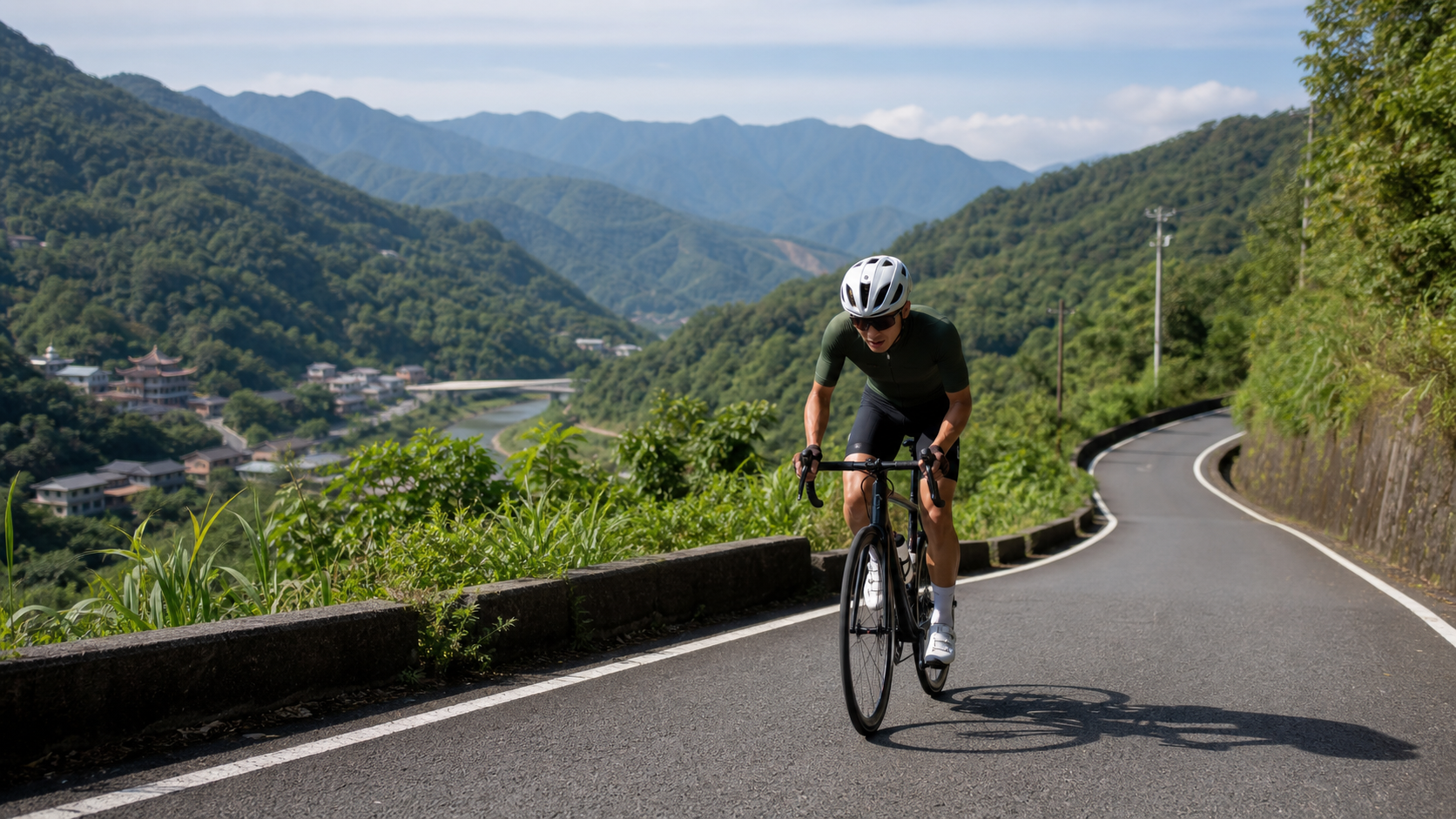
Route Overview: Dissecting the Data of the Xianshan KOM
Nanjhuang Township, a mountain town in Miaoli County renowned for its Hakka and Saisiyat indigenous culture, hides a timed segment affectionately nicknamed “Xianshan KOM” by local cyclists—officially designated as the “Nanjhuang Climbing King.” The segment stretches 12,930.9 meters, or 12.93 kilometers, with a total elevation gain of 507.8 meters and an average grade of 3.9%. Strava officially classifies it as a Category 3 climb. The tag field reads “Nanjhuang KOM,” while the description succinctly states “Nanjhuang Xianshan Climbing King Timed Segment.”
Let’s verify the numbers first: 12.93 kilometers multiplied by a 3.9% average grade yields a theoretical elevation gain of approximately 504 meters, which aligns almost perfectly with Strava’s stated 507.8 meters—a discrepancy of less than 1%. This indicates that the grade distribution across the entire segment is relatively uniform, with no extensive flat or even descending sections to “dilute” the average, nor any hidden extreme steep pitches that would inflate the total gain while making the average grade appear gentler. For riders looking to prepare in advance and simulate perceived exertion using data, this is good news—you can relatively confidently use the figures “3.9% average grade, 12.93 kilometers total length” to estimate your finish time and energy expenditure, without worrying too much about unexpected hidden steep sections catching you off guard.
The Category 3 classification sits in the mid-to-upper tier of Strava’s climb rating system, typically corresponding to long climbs with elevation gains between 300 and 600 meters and moderate grades. The Xianshan KOM falls right in the middle of this range—with 507.8 meters of climbing over 12.93 kilometers, it’s a timed segment that “won’t break beginners, but will definitely feel meaningful for experienced riders.” Compared to heavyweight climbs like Wuling or Hehuan Mountain, which often exceed 20 kilometers with average grades of 5% to 8%, the Xianshan KOM’s intensity is closer to a “mid-distance endurance test,” making it suitable as a benchmark for long-climb capability and as a training indicator segment before major hill-climb events.
From an engineering and sports science perspective, what does a 3.9% average grade mean? Estimating from a power-training standpoint, a rider weighing 70 kilograms on a 7-kilogram road bike (approximately 77 kilograms of system weight including gear) would need to sustain roughly 150 to 180 watts to maintain a climbing speed of about 12 to 14 kilometers per hour on a 3.9% grade. For a recreational rider with an FTP (Functional Threshold Power) around 200 watts, this corresponds to roughly 75% to 85% of FTP—a Zone 3 to Zone 4 intensity band that can be sustained for extended periods but still demands focused breathing and cadence management. This is why many cyclists who have completed the Xianshan KOM describe the route as “not painful enough to break you, but by the latter half you start questioning your life choices”—the biggest trap of a long climb with moderate grade often isn’t the grade itself, but rather the rider psychologically underestimating the fatigue accumulated from sustained output.
It’s worth noting that the Xianshan KOM is located in the mountainous area of Nanjhuang Township; the actual elevation of the start and finish points, the precise route alignment, and turn points should still be confirmed against Strava’s official map and GPX files. This article will provide an actionable strategy framework based on the three verified core data points—distance, elevation gain, and grade—combined with general tactical principles for long mountain climbs.
Segment-by-Segment Strategy: Pacing Management from the Start to Xianshan
When facing a 12.93-kilometer climb with a 3.9% average grade, the worst thing you can do is “go all out from the start.” The destructive power of a moderate-grade climb often doesn’t come from the momentary pain of steep pitches, but rather from riders misjudging intensity and burning through too much glycogen and neuromuscular energy in the early stages, leading to lactate accumulation, exacerbated cardiac drift, and ultimately forcing a significant slowdown or even risking time-cut elimination. Below, the entire route is broken down into four phases, with pacing and pedaling rhythm recommendations for each.
Phase 1 (0 to 3 km): Warm-Up Start, Keep Heart Rate Between Zone 2 and Zone 3
At the start of most Climbing King timed segments, riders’ adrenaline spikes, making it all too easy to unconsciously ride the first 3 kilometers as the fastest part of the entire segment. This is a fatal mistake. For the early section of the Xianshan KOM, it’s recommended to keep your heart rate between 75% and 80% of maximum (roughly the upper end of Zone 2 to the lower end of Zone 3), with power targeted at around 70% of FTP. In plain terms: this section should feel like “breathing is slightly heavier, but you can still speak in full sentences.” If you’re already gasping for air and can only manage single-word responses to companions, you’ve overdrawn your reserves for the later stages. Cadence should be maintained between 85 and 95 rpm, avoiding grinding a heavy gear, to preserve muscle glycogen in the quadriceps and glutes for sustained output in the middle and later sections.
Phase 2 (3 to 7 km): Entering the Core of the Segment, Steady Output Is Key
This is the section of the entire timed segment that best reflects your true climbing ability, with grades holding near or slightly above the average. Riders are advised to adopt a “constant power” strategy here—regardless of minor fluctuations in road grade, aim to keep power output within a stable range (78% to 85% of FTP) rather than using speed as the pacing metric. The reason is simple: when the grade steepens slightly, insisting on maintaining the same speed will cause power output to spike suddenly beyond sustainable limits; conversely, when the grade eases, sticking to the same speed wastes opportunities to recover. Using a power meter, or at least a heart rate monitor paired with Rate of Perceived Exertion (RPE, recommended at 6 to 7 on a 10-point scale), ensures you ride this section fast without overextending. This phase is also where the mind is most prone to wavering—past halfway but the finish still out of sight. Riders are advised to focus on short-term visual targets like “the next utility pole” or “the next corner,” avoiding psychological collapse from dwelling on “5 kilometers to go.”
Phase 3 (7 to 10 km): Fatigue Begins to Accumulate, Cadence and Seated Position Adjustments Are the Solution
By this point, most riders’ quadriceps will start showing noticeable soreness and swelling—a typical physiological response to a long, moderate-grade climb: muscle glycogen is gradually depleting, and lactate clearance begins to lag behind production. At this stage, it’s advisable to moderately adjust your cadence strategy: if you’ve been seated with a high cadence throughout the earlier sections, consider intermittent out-of-saddle surges of 10 to 15 seconds here, using different muscle groups (especially the glutes and gastrocnemius) to share the load from the quadriceps, while also redistributing blood flow in the hips to alleviate discomfort from localized ischemia. However, note that out-of-saddle efforts cause heart rate to spike instantly and shouldn’t be sustained for long; return to a seated position immediately after surging to recover your breathing rhythm. This section also calls for psychological self-talk—reminding yourself “the finish is near Xianshan, push through this and it’s the final sprint”—using a sense of purpose to counter physical fatigue.
Phase 4 (10 to 12.93 km): Final Sprint, Finish Within Your Limits
Entering the final stretch of less than 3 kilometers, if you’ve paced correctly up to this point, you should still have some energy reserves to gradually ramp up the intensity. It’s recommended to push power above 90% of FTP, allowing heart rate to approach 85% to 90% of maximum, using this final distance to validate whether your earlier pacing strategy was successful. If you find your legs completely spent and your heart rate simply won’t rise no matter what, this is usually a sign that the early pacing was too aggressive. At this point, abandon any sprint ambitions and switch to a steady finish to avoid more severe issues like cramping or heat exhaustion. Near the summit of the Xianshan area, some sections may be slippery due to tree shade, so be sure to watch road conditions during the final sprint—better to lose a few seconds on your time than to crash before the finish line.
Gear Ratio and Equipment Recommendations
An average gradient of 3.9% sits on the “sustained but not extreme” end of the Category 3 climb spectrum, which offers quite practical reference value for gear ratio selection. Below are specific gear ratio recommendations categorized by rider power-to-weight ratio (W/kg).
| Rider Level | Power-to-Weight Ratio (W/kg) | Recommended Chainring | Recommended Cassette | Notes |
|---|---|---|---|---|
| Advanced / Competitive | 4.0 and above | 50/34 or 52/36 | 11-28T | The big ring can be used in the early section to maintain speed, but it’s still advisable to keep a lighter gear for the latter section to cope with the perceived gradient under fatigue |
| Intermediate / Steady | 3.0 to 4.0 | 50/34 compact crank | 11-30T or 11-32T | A 3.9% average gradient is at the upper edge of the comfort zone for this level; a wide-range cassette balances flat transitions and climbing endurance |
| General recreational | 2.0 to 3.0 | 50/34 compact crank | 11-32T or 11-34T | It’s better to err on the side of a lighter gear, trading muscle endurance for cadence, to avoid blowing up mid-to-late in the climb from too heavy a gear |
| Beginner / First-time challenger | Below 2.0 | Compact crank or triple chainring | 11-34T and above (within rear derailleur capacity) | Prioritize completing the entire route at low load; don’t chase times, just experience the route itself |
Beyond gear ratios, there are several practical equipment suggestions. First, wheel selection: the Xianshan KOM is less than 13 kilometers in total length and is predominantly climbing, so top-tier aero wheels aren’t necessary. Instead, priority should be given to overall wheel weight and the braking performance of the rim brake system on wet surfaces—the Nanzhuang mountain area is rainy, and the chance of wet roads is not low. Disc brake models offer more stable performance when descending to the finish or in emergency braking situations. Second, tire pressure settings: it’s recommended to run 5 to 10 psi lower than for flat-road riding, increasing the tire’s contact patch with the road to improve climbing grip, especially traction when climbing out of the saddle. Third, bottle cage configuration: this route isn’t long, so theoretically one bottle should suffice, but considering the muggy heat that can build up in the Nanzhuang mountains during summer, it’s recommended to carry at least 750 ml of fluid. If temperatures exceed 30°C, a dual bottle cage setup is advised.
Finally, there’s the concept of total system weight. As mentioned earlier, the power requirement was estimated based on a 77 kg system weight. If the rider’s body weight plus equipment significantly exceeds this baseline, expectations for target pacing should be adjusted downward accordingly, or the goal should be completion rather than record-breaking, to avoid exhausting energy reserves in the latter part of the climb from over-chasing performance numbers.
Nutrition and Hydration Management
At 12.93 kilometers with an estimated finishing time between 35 minutes and 1 hour (depending on rider level), theoretically there’s no need for the complex fueling planning required for long-distance endurance events, but several key principles are still worth noting.
Pre-race fueling: It’s recommended to finish a normal-sized, carbohydrate-focused meal 2 to 3 hours before departure (such as rice balls or bread with banana), avoiding high-fat and high-fiber foods that could cause gastrointestinal distress. 30 minutes before departure, an additional banana or energy gel can be consumed to ensure blood sugar is in a stable, elevated state, providing immediately usable energy for the climb.
Fueling during the ride: If the estimated finishing time is within 45 minutes, there’s actually little need for additional solid food during the ride; one bottle of sports drink or electrolyte-enhanced water should suffice. However, for beginner or recreational riders with an estimated finishing time exceeding 1 hour, it’s recommended to take small sips of fluid every 15 to 20 minutes, and to consume an energy gel or half a banana around the midpoint of the route (approximately the 6th to 7th kilometer) to avoid the “bonk” feeling caused by a sudden drop in blood sugar.
Fluids and electrolytes: The Nanzhuang mountain area is hot and humid in summer, with perceived temperatures often more stifling than on flat ground, and sweat rates will be higher than expected. It’s recommended to choose sports drinks containing electrolytes such as sodium and potassium rather than plain water, especially in the warmer months. Simply replacing water without electrolytes can actually dilute the body’s electrolyte concentration and trigger cramping. From experience, climbing cramps most often occur in the calves and hamstrings. At the first sign of impending cramping (muscle tightness, slight trembling), you should immediately slow down or even stop, stretch, and replenish electrolytes to prevent a minor cramp from escalating into a full-blown, immobilizing one that would directly end the day’s challenge.
Post-race recovery nutrition: After completing the timed segment, it’s recommended to consume a recovery meal or drink with a protein-to-carbohydrate ratio of approximately 1:3 to 1:4 within 30 minutes, to help replenish muscle glycogen and repair micro-damage. Although the Xianshan KOM isn’t top-tier in intensity, the sustained 507.8-meter climb is still a considerable load on the quadriceps and core muscles. Neglecting post-race recovery can worsen delayed onset muscle soreness (DOMS) the next day, affecting the continuity of subsequent training plans.
Weather and Seasonal Recommendations: Risk Management on Wet Mountain Roads
Nanzhuang Township is located in the Miaoli mountain area, falling within Taiwan’s typical windward rainfall zone. Mountain weather is inherently more variable and unpredictable than on flat ground. Although the Xianshan area isn’t extremely high in elevation, due to the terrain and vegetation, localized convective cloud systems tend to form in the mountains during the afternoon, bringing short-duration heavy rainfall—a direct and significant impact on riding safety that cannot be ignored.
Seasonal recommendations: Generally speaking, during autumn and winter (approximately October through February of the following year), the probability of rainfall in the Nanzhuang mountains is relatively lower and temperatures are cooler, making it a comparatively ideal window for tackling the Xianshan KOM. In summer (June through September), special attention should be paid to weather warnings for afternoon thunderstorms and typhoon season. It’s recommended to depart in the early morning hours, aiming to complete the challenge before afternoon convective cloud systems develop. During the plum rain season (approximately May through June), the high probability of consecutive days of rain and the significantly elevated risk of wet roads make it an unadvisable time for the challenge, unless you have full confidence in your riding skills on wet mountain roads.
Specific risks of wet roads: On sections of the Xianshan area with heavier tree cover, even without direct rainfall, roads can remain damp for extended periods due to overnight dew or moisture from the forest, especially near corners and road markings (white lines, yellow lines), where the coefficient of friction drops noticeably. Riders are advised to avoid braking or making drastic changes in pedaling force while in corners on such sections. Instead, complete braking before entering the corner, maintain a steady cadence through the turn, and gradually resume power output after exiting. Disc brakes offer even greater advantages in wet conditions, but even with discs, one shouldn’t be overconfident and neglect basic deceleration principles.
Temperature and perceived conditions: Since the route gains roughly 500 meters in elevation, the temperature difference between the summit and the start can reach 3 to 5 degrees Celsius. Combined with increased skin surface moisture from sweating, lingering at the summit when temperatures drop can easily bring on a chill. It’s recommended to carry a lightweight windbreaker or arm warmers, especially for riders tackling the challenge in autumn and winter—keeping warm during the descent or cool-down is not to be overlooked.
Visibility and riding safety: Mountain areas are prone to fog, especially in the early morning and evening hours. The dense forest around Xianshan can significantly reduce visibility on certain sections. It’s recommended that even for daytime challenges, riders equip both front and rear lights to enhance their visibility on mountain roads. After all, this route is not a closed course; riders still share the road with other users, and riding safety is always the top priority.
Common Mistakes and DNF Risk Assessment
Although Xianshan KOM has an average gradient of 3.9% and a Category 3 rating, making it relatively approachable, every year many riders still fail to finish—or even abandon early (DNF, Did Not Finish)—due to various preventable mistakes. Below are the most common risk factors.
Mistake 1: Losing pace control in the early section. This is the most common cause of failure in all mid-to-long distance climbing time trial segments. The relatively gentle feel of the first 3 kilometers of Xianshan KOM can easily lead riders to misjudge the overall intensity, pushing power beyond their limits to sprint for an early ranking. The result is lactic acid buildup and exhausted legs in the latter half, forcing a significant slowdown or even dismounting and walking. It is strongly recommended to refer to the segment pacing strategy described earlier, using heart rate or power as objective references rather than relying solely on feel.
Mistake 2: Underestimating fluid and electrolyte needs. Even if the finishing time is under one hour, the humid heat of the Nanzhuang mountain area can cause more sweating than expected. There have been riders who, due to neglecting hydration, experienced mild heatstroke symptoms (dizziness, nausea) in the latter part of the segment and were forced to abandon the challenge. Be sure to follow the nutrition recommendations mentioned earlier, carrying at least sufficient water and considering electrolyte supplementation.
Mistake 3: Incorrect gear ratio setup. Some riders, in pursuit of “style” or due to misjudging the route difficulty, choose racing-oriented gear ratios without compact cranksets or wide-range cassettes. As a result, in the middle of the 12.93 km segment with a 3.9% average gradient, they find their cadence dropping below 50 rpm, causing a surge in muscular load and greatly increasing the risk of cramps and premature exhaustion. Gear ratio selection must be based on your actual power-to-weight ratio—when in doubt, err on the side of conservatism rather than aggression.
Mistake 4: Ignoring weather and road conditions. As mentioned earlier, the weather in the Nanzhuang mountain area is highly variable. Some riders, having failed to check the weather forecast before departure, encounter sudden rainfall mid-challenge. With slippery roads and poor visibility, they are forced to abandon the challenge for safety reasons. Be sure to check real-time weather and short-term forecasts before departing, and adjust the challenge time or postpone if necessary.
Mistake 5: Neglecting equipment checks. Long-distance climbing places higher demands on the drivetrain and braking systems. Before departure, be sure to confirm that shifting is smooth (especially since frequent shifts to lighter gears may be needed in the latter half), that brake pads have sufficient thickness, and that tires have no issues with low pressure or abnormal tread wear. There have been cases where aging shift cables caused skipping gears or an inability to shift into the lightest gear in the middle of the climb, directly compromising the execution of the pacing strategy.
Target Time Table for Riders of Different Levels
The following table provides reference target finishing times for Xianshan KOM (12.93 km, 3.9% average gradient, 507.8 m total elevation gain) based on power-to-weight ratio and general climbing experience. Actual results will still vary depending on wind direction, temperature, road conditions, and personal form on the day; this is provided solely as a reference for training and pacing planning.
| Rider Level | Power-to-Weight Ratio (W/kg) | Estimated Average Speed | Estimated Finish Time | Training Recommendations |
|---|---|---|---|---|
| Elite Competitive | 5.0 and above | 22 to 25 km/h | Approximately 31 to 35 minutes | Can adopt all-out intensity above FTP for the entire segment; a power meter is recommended for precise pacing zone calculation |
| Advanced Racing | 4.0 to 5.0 | 19 to 22 km/h | Approximately 35 to 41 minutes | Control the early section at 80% of FTP, then gradually raise to 90% or above in the latter half |
| Intermediate Steady | 3.0 to 4.0 | 16 to 19 km/h | Approximately 41 to 48 minutes | Recommended to follow the segment pacing strategy in this article, maintaining power at 75% to 85% of FTP throughout |
| General Recreational | 2.0 to 3.0 | 13 to 16 km/h | Approximately 48 to 60 minutes | Primary goal is completion; use standing climbs appropriately to distribute muscular load |
| Beginner Challenger | Below 2.0 | 10 to 13 km/h | Approximately 60 to 78 minutes | Recommended to use light gearing with ample rest points; do not chase speed, prioritize safe completion |
It should be noted that the speed and time estimates above are theoretical values derived from converting a flat-ground power-to-weight ratio model to a 3.9% average gradient. They do not account for actual variables such as wind resistance, changes in rolling resistance coefficient, or the localized strong winds or slippery sections that may occur around Xianshan. Riders should treat this table as a starting reference point for pacing planning, not an absolute standard. What truly matters is making reasonable and safe judgments based on your own physical condition, weather conditions, and equipment status on the day.
Conclusion: Arm Yourself with Data, Face the Mountain with Respect
Xianshan KOM may not be Taiwan’s steepest, longest, or most renowned king-of-the-mountain segment. At 12.93 kilometers with a 3.9% average gradient, it sits in the moderate-to-gentle range across Taiwan’s cycling climbing map. But it is precisely this “moderate” character that makes it a highly valuable benchmark segment for training—it is long enough to test a rider’s endurance pacing ability and nutrition planning; its gradient is not extreme, yet it is sufficient to expose the consequences of any pacing error or improper equipment choice.
For riders preparing to take on Xianshan KOM, the most important advice may not be how light the gearing should be or how much water to carry, but rather returning to the most fundamental principles: understand the route with data, execute the challenge with a conservative yet reliable pacing strategy, and always maintain respect for the ever-changing mountain weather. The 507.8 meters of total elevation gain may not seem like a daunting number, but every rider who has felt burning legs and rapid breathing in the latter section understands that the real challenge is never just the numbers on paper—it is the real-world test where body, willpower, and environment intertwine. May every rider preparing to challenge Xianshan KOM complete this king-of-the-mountain trial in the Nanzhuang mountain town safely and to the fullest, at the pace that suits them best.
Related Reading
- Riding into the Mountains and Soul of Nanzhuang: Hakka, Saisiyat, and Cloud Stories on the Xianshan KOM Route
- Xiangtian Lake Climb Complete Guide: 5.83 km, 418 m Elevation Gain, Strava-Certified Classic Hard Climb in Nanzhuang
- Xianshan Shitan Side Complete Guide: 5.89 km, 475 m Elevation Gain, 8.1% Average Gradient—A Miaoli Hard Battle
- Xindian Shitou Mountain South Side Climb Complete Guide: 7.64 km, 499 m Elevation Gain, Segment-by-Segment Tactics from Beginner to Advanced
2024 南庄仙山KOM 多視角賽事精華!/ 500元報名費媲美富士山登山賽!/ 公路車 / CT Yeh
1 年前
超激烈!2025 南庄仙山KOM 賽事精華 / 男菁英A x 女菁英A / 公路車 / CT Yeh
9 個月前
台灣登山王之路 KOM 全程參賽4K臨空錄影 PART1 穿越峽谷地形! #東進武嶺 太魯閣 / 燕子口 / 天祥 / 西寶 PART1 (公路車 / CT Yeh)
3 年前
2026南庄山水悠遊行 仙山KOM 網路直播 /LIVE
6 天前
2025南庄山水悠遊行 仙山KOM 網路直播! / 男菁英組A / 女菁英組A
9 個月前
2019 夏季KOM 5小 完賽心得 準備攻略 東進武嶺 夏季登山王之路 Taiwan KOM Challenge
7 年前
#東進武嶺 全程實況錄影 5小時半 #夏季KOM #太魯閣 Taiwan KOM Challenge Reality Video Taroko scenery
7 年前
大禹嶺 到 武嶺牌樓 全程前後實況錄影 | 北進武嶺 | 東進武嶺 | KOM | 訓練台 | 坡度分析 | Taiwan KOM Last 10 km HARD | 公路車
6 年前