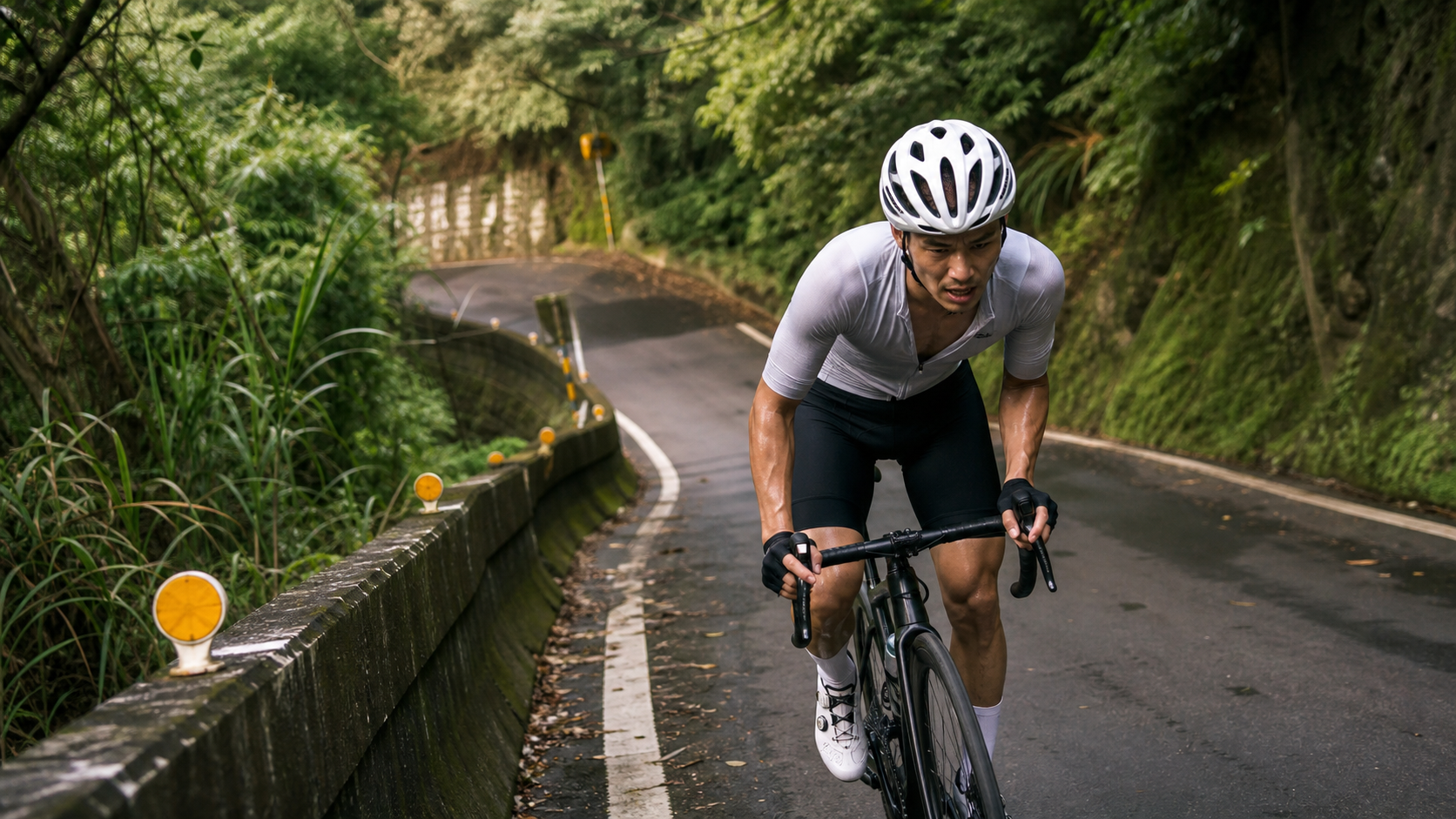
Deep Pit Shennan Road Practical Guide: 2.6 km, 220 m of Climbing, a Brutal Test of Short-Distance, High-Intensity Effort
Route Overview and Real Data Analysis
Shennan Road in Shenkeng District is a well-known short-distance, high-intensity climbing segment in New Taipei City, corresponding to the segment record numbered 8592978 on Strava. Compared to the Xiping Highway introduced earlier, which features climbs of 8 km or more, Shennan Road’s numbers look relatively “mini” — a distance of only 2,596.5 meters (2.6 km), yet a total elevation gain of 220.1 meters, with an average gradient of 6.5%.
Let’s first do an honest check of the numbers: 2,596.5 meters multiplied by 6.5% gives a theoretical climb of about 169 meters, which is clearly at odds with the 220.1 meters recorded on Strava. This discrepancy is actually quite common on short, steep routes — because the distance is short, any dramatic variation in local gradient is amplified in the total elevation statistics. Shennan Road is likely a typical example of “unevenly distributed gradients”: some sections are close to or below the average, while other stretches clearly exceed it, with the steepest parts possibly reaching double-digit percentages. Since we lack point-by-point detailed gradient distribution data, I won’t fabricate specific precise figures here, but one thing is certain: this route is by no means a “uniform 6.5% gentle climb,” but rather a high-intensity route packed with multiple steep surges within just 2.6 km.
From an intensity-density perspective, Shennan Road delivers roughly 85 meters of climbing per kilometer — a figure that already exceeds the intensity level of many well-known long-distance climbing routes. In other words, if you put Shennan Road and Xiping Highway on the same scale, Shennan Road may be more than three times shorter in distance, but the climbing pressure per unit distance is by no means inferior — and in certain local sections, the instantaneous intensity may even be more ferocious. This is precisely why Shennan Road is known in the cycling community as a “small but fierce” route — short, but by no means easy.
For riders accustomed to long-distance endurance climbing, Shennan Road offers a completely different type of challenge: it tests not sustained aerobic output, but short-duration anaerobic power and the muscles’ ability to withstand high-intensity loads. This type of route is actually closer to the “climbing sprint” intervals in interval training — except that Shennan Road is a real, existing road that lets riders experience this high-intensity training effect on actual terrain.
The Shenkeng area itself is known for its hilly topography, and many of its connecting roads feature a certain degree of gradient. Shennan Road is simply one where the intensity is more concentrated and the most frequently recorded and challenged by the cycling community. This terrain characteristic, to some extent, also explains why Shenkeng developed a tradition of making tofu with mountain spring water — the mountainous terrain provides abundant groundwater sources and stream environments suitable for agricultural irrigation. And this very terrain also happens to create the appeal of short, steep routes like Shennan Road for cycling enthusiasts. From a sports science perspective, this type of “short-distance, high-intensity, terrain-concentrated” segment holds irreplaceable value in training planning, because it can reach intensity stimulation close to the VO2max zone in an extremely short time — a training effect that many flat or gently sloping routes cannot replicate.
It’s worth noting that, due to the lack of official point-by-point gradient profile data, this article takes a conservative approach in describing the local steep sections. Actual gradient perception during riding should be based on your personal GPS tracks and on-site road conditions. But regardless of the exact figures, the accumulation of 220.1 meters of total climbing within 2.6 km is already enough to show that this route is no pushover — it deserves serious attention and careful pacing strategy planning.
Segment-by-Segment Guide from Start to Finish
Since the entire route is only 2.6 km, Shennan Road cannot be divided into four or five distinct segments like a long-distance climbing route. Here, we break down the pacing strategy into three phases, though actual gradient changes should still be based on on-site road conditions and your personal GPS track records.
Segment 1 (0 to 0.8 km): Get into the Zone Immediately at the Start — Do Not Let Your Guard Down
Shennan Road offers little room for warming up; you’ll feel the gradient soon after setting off. For this section, it’s advisable not to go all-out from the very beginning. Even though Shennan Road is short, the strategy of pushing at maximum power for the entire route will almost certainly lead to a collapse in the latter half on any climbing road. Treat this section as a transitional phase to “quickly get into the zone.” Your heart rate can be slightly higher than when starting a long-distance climb, going straight to the edge of Zone 3 to Zone 4, but still reserve enough in the tank for the potentially steeper sections that may appear in the middle and later stages.
Segment 2 (0.8 to 1.8 km): The Core Steep Zone — A Test of Instantaneous Power Output
This is the most demanding section of the entire route. Based on the discrepancy between total elevation gain and average gradient, this stretch likely contains the steepest sections of the whole climb. At this point, it’s recommended to decisively shift into the easiest gear and use a standing climbing position, combining a higher cadence with a lighter gear to get through the steepest parts — avoiding the predicament of an overly heavy gear causing cadence to drop extremely low and placing excessive strain on the knees. This type of short-distance, high-intensity climbing, to some extent, feels closer to the latter half of an all-out sprint — the burning sensation in the muscles comes on fast and fierce.
Segment 3 (1.8 to 2.6 km): Sprint to the Finish — Manage Your Remaining Energy
Entering the final stretch of less than one kilometer, many riders are already near their physical limits by this point. The key here is “don’t give up prematurely.” Because the total distance is short, even if your pacing in the earlier sections was slightly off, as long as you can maintain a basic output intensity, you can usually complete the challenge within a reasonable time. It’s recommended to adjust your breathing rhythm in this section, riding toward the finish with a steady pace that isn’t completely stalled — avoiding the waste of all the momentum you’ve painstakingly built up earlier by being overly conservative.
What this finishing phase truly tests is mental toughness rather than purely physiological capacity. Many riders experience “heavy legs from lactic acid accumulation” at this stage, as if their legs are filled with lead and they can barely maintain cadence. At this point, rather than staring at the gradient or distance, it’s better to shift your attention to your breathing rhythm — matching a fixed breathing cadence with your pedaling cadence often effectively distracts from the sensation of fatigue and helps your body push through this final ordeal. If you’re tackling this route as part of a group ride, verbal encouragement from teammates is especially effective at this stage — a simple “almost there, hang in there” can often spark an unexpected surge of final sprinting power.
After reaching the finish, it’s recommended not to stop pedaling completely right away. Instead, continue rolling slowly in an extremely light gear for a few minutes to let your heart rate and breathing gradually return to normal. This method of active recovery, compared to stopping and collapsing on the spot, is more effective at accelerating lactic acid metabolism and reducing the severity of muscle soreness the next day.
Gear Ratio and Equipment Recommendations
Short-distance, high-intensity climbing routes have slightly different gear ratio requirements compared to long-distance endurance climbs, placing greater emphasis on the ability to “switch quickly and withstand sudden high loads”:
| Rider Level | Recommended Gear Setup | Notes |
|---|---|---|
| Beginner / Average fitness | 34/50 front, 11-32 or wider rear | Short, steep climbs pose a major challenge to a beginner’s cardiovascular system and leg strength; a wider gear range provides more buffer |
| Intermediate rider | 34/50 front, 11-30 rear | Balances full-on sprinting with adaptability on localized steep sections |
| Advanced / Race-oriented | 36/52 front, 11-28 rear | Pursues the fastest completion time, but requires a solid anaerobic power base |
Since Shennan Road’s challenge profile leans toward short-duration, high-intensity output, it is essential to warm up thoroughly before riding—at least 10 to 15 minutes of progressive warm-up riding to let the cardiovascular and muscular systems adapt to the impending high-intensity load in advance. This differs noticeably from the “warm up as you ride” strategy used on long-distance climbs. No special lightweight equipment is needed, but it is recommended to confirm that the shifting system responds crisply, as this route may require consecutive gear changes within a short time to handle dramatic gradient swings. Sloppy shifting will directly affect pacing rhythm and energy management efficiency.
A power meter is especially valuable for training on this type of short, high-intensity segment. Unlike long-distance climbs where you can roughly gauge pace by feel and heart rate, on a route like Shennan Road where intensity is concentrated and explosive, heart rate response often lags noticeably—by the time the heart rate monitor catches up to the actual exercise intensity, you may already be near the finish. Power data provides more immediate and accurate intensity feedback, allowing you to replicate or fine-tune your pacing strategy more precisely on the next attempt. If you don’t have a power meter, you can also use the Rating of Perceived Exertion (RPE) scale as a supplementary gauge. On a segment like Shennan Road, it is recommended to maintain a high-intensity zone of RPE 7 to 9 throughout, with brief touches of RPE 9 to 10 maximum output allowed on the steepest core section.
Tire selection is also worth attention. Short, steep climbs demand no less grip than long-distance climbs, especially if the road surface occasionally has fallen leaves, gravel, or wet conditions. It is recommended to choose training tires with better grip and confirm that tire pressure settings match the day’s road conditions, to avoid slipping that compromises climbing efficiency or even raises safety concerns.
Nutrition and Hydration Strategy
Shennan Road is only 2.6 km in total length, with typical riding time falling between 5 and 15 minutes (depending on individual fitness), so in theory there is no need for mid-route refueling at all. However, precisely because the intensity is concentrated into an extremely short burst, preparation before the ride becomes even more important—make sure you start with adequate hydration and energy reserves, and avoid attempting this kind of high-intensity short climb on an empty stomach or dehydrated, as this increases the risk of dizziness or muscle cramps on the mid-section steep pitches.
If you plan to incorporate Shennan Road into a repeated-climb interval workout (for example, 3 to 5 consecutive attempts), the fueling strategy needs to shift to “active hydration between repeats,” because repeated short, high-intensity efforts can deplete electrolytes faster than you might expect. It is recommended to take in moderate fluids and electrolytes after every 1 to 2 repeats, and give your body at least 5 to 10 minutes of recovery before the next attempt, to avoid compromised form or injury from excessive fatigue.
This repeated-climb training pattern is actually a classic workout design many coaches use to improve anaerobic threshold and climbing economy. Given Shennan Road’s length and intensity, arranging 3 repeated attempts with recovery time totals roughly 30 to 45 minutes of training, making it a highly efficient after-work training option—no need to spend the two or three hours that long-distance climbs typically require, yet still achieving comparable anaerobic stimulation. For urban riders with busy schedules and limited training time, the value of this kind of “small but refined” training route, in some ways, transcends what the raw distance and elevation numbers alone suggest.
As for fueling products, since a single attempt is extremely short, it is not recommended to consume additional energy gels or solid food during the ride, as this can easily cause gastrointestinal discomfort. Instead, focus hydration and electrolyte intake between repeats, and within 30 minutes after the entire workout, consume an appropriate amount of protein and carbohydrates to support muscle repair and glycogen replenishment.
Weather and Seasonal Recommendations
The Shenkeng area features hilly terrain in the New Taipei City suburbs, with climate noticeably influenced by orographic rainfall and summer afternoon convection. Tackling a high-intensity short climb like Shennan Road during the hot summer season places a heavier perceived burden on the body than usual. It is recommended to choose early morning or evening hours when temperatures are lower, and to strengthen sun protection and hydration measures. Since Shennan Road’s intensity is concentrated into an extremely short burst, heatstroke and heat exhaustion risks also require special attention in summer—if you feel noticeably unwell, stop the attempt immediately and rest in a shaded area.
In autumn and winter, the Shenkeng area occasionally experiences cold, wet rain. Combined with Shennan Road’s steep gradients, wet road surfaces amplify the impact on grip and braking distance. It is recommended to avoid attempting this route on rainy days or when the road is slick, or to significantly reduce aggressiveness in cornering and braking. Spring and autumn offer relatively stable weather and are the best seasons for tackling this route and chasing personal bests.
Because Shenkeng District sits in the central hilly belt of New Taipei City, adjacent to Nangang and Wenshan Districts of Taipei City, it is relatively easy to reach by transport, making Shennan Road a popular training option for many Taipei urban riders after work or on weekend mornings. This geographic convenience, combined with the route’s concentrated intensity and controllable training time, means that even though Shennan Road is not as famous as classic long-distance climbs like Yangjin Highway or Beiyi Highway, it has still accumulated considerable recognition and challenge records within the cycling community.
If you plan to repeatedly tackle this route across different seasons, it is recommended to establish personalized weather judgment criteria—for example, setting specific thresholds for temperature, precipitation probability, and wind speed. If thresholds are exceeded, adjust training intensity or postpone the attempt rather than simply deciding by feel whether to head out. This systematic approach to weather risk management can effectively reduce the likelihood of accidents or injuries caused by weather factors, especially on steep, concentrated segments like Shennan Road, where wet surfaces or strong winds affect riding safety more significantly than on flat roads.
Common Mistakes and DNF Risks
Although Shennan Road is short, precisely because it is short, riders tend to underestimate its intensity—this is the most common source of mistakes. Many people approach it with a “it’s only 2.6 km, it should be over quickly” mindset and charge in recklessly, only to feel a sudden, intense anaerobic shock on the mid-section steep pitches. Lacking mental preparation, they choose to dismount and walk early. This “underestimating because it’s short” mentality is the most common pattern in Shennan Road DNF cases.
Another common issue is insufficient gear ratio setup. Because Shennan Road’s steep sections are concentrated and intense, if a rider uses a traditional standard crankset with a narrow-range cassette that lacks sufficiently light gears, they are easily forced to grind at extremely low cadence on the steepest sections. This state sharply increases knee strain, and repeated or frequent attempts can lead to overuse injuries. Be sure to confirm in advance, based on the gear ratio table above, whether your setup is adequate for this route’s intensity demands.
Insufficient warm-up is also a risk factor unique to short, high-intensity routes. Unlike long-distance climbs where you can warm up while riding, Shennan Road is almost “all-out from the moment you start.” Without proper prior warm-up, a reckless attempt can easily lead to muscle strains or excessive cardiovascular strain, especially for riders with weaker cardiovascular function or relevant medical history—it is recommended to progress gradually and never overexert yourself.
Excessive pursuit of Strava rankings is another hidden risk commonly seen on this route. Because Shennan Road is short and completion times are brief, riders can easily fall into a cycle of “repeated attempts, constantly refreshing records,” ignoring the body’s actual accumulated fatigue. Even when chasing a personal best, it is recommended to set a reasonable cap on the number of attempts per training session, and to closely monitor heart rate recovery speed and subjective fatigue. Once you notice significantly slower recovery or abnormal signs of fatigue, stop that day’s repeated attempts immediately to avoid overtraining-related injuries or immune suppression.
Additionally, traffic conditions on the roads around Shennan Road should also be factored into risk assessment. Traffic on Shenkeng District’s connecting roads can increase noticeably when holiday tourist crowds arrive, especially near Shenkeng Old Street where tour buses and private vehicles are common. Stay highly alert while riding, obey traffic rules, and maintain a proper safety distance, avoiding the tendency to neglect surrounding road conditions while focused on chasing a personal record.
Target Times for Riders of Different Levels
The times below are for reference only; actual results will vary based on fitness, daily condition, and gear ratio setup:
| Rider Level | Target Completion Time (2.6 km per run) | Average Power Reference (estimated for a 70 kg rider) |
|---|---|---|
| Beginner / Recreational Rider | 12 to 18 minutes | 100 to 150 W |
| General Amateur Rider | 8 to 12 minutes | 160 to 220 W |
| Intermediate Club Level | 5 to 8 minutes | 230 to 280 W |
| Race Level / High-Intensity Rider | 3 to 5 minutes | 300 W and above |
Because the intensity of Shennan Road is concentrated in a very short burst, this type of route reflects the demands of power-to-weight ratio much more clearly in completion time than longer climbs do. For riders interested in tracking their performance, in addition to recording completion time, pairing it with a heart rate monitor to observe heart rate response speed and recovery ability on the steepest sections is highly valuable for assessing your anaerobic threshold and the effectiveness of short-duration power training.
It is worth noting that on short, steep climbs, differences in completion time are often more easily influenced by details such as reaction speed at the start, timing of gear shifts, and judgment of road position than on longer climbs. Therefore, if you want to improve your performance on this route, beyond simply building fitness, spending more time studying the route details, practicing gear shift timing, and refining the transition of pedaling rhythm can also bring considerable gains. This is another layer of value that makes Shennan Road a route testing both technique and fitness.
Conclusion: A Short Route, a Big Challenge
Shenkeng Shennan Road proves with real data that “short distance does not mean easy.” The combination of 2.6 km, 220 meters of elevation gain, and a 6.5% average gradient, along with the significant gap between total elevation gain and the theoretical value that hints at localized steep sections, makes this route one of the few in the New Taipei City suburbs that can deliver high-intensity training effects in a very short time. For riders with limited time who still want a solid training effect, Shennan Road is an ideal choice—no need to spend a large amount of time, yet you can get an intensity stimulus close to interval training level in just a few minutes.
Before taking on this route, be sure to warm up thoroughly, confirm that your gear ratio setup can handle the steep sections, and go in with the correct mental expectation that it is “short but by no means easy.” Only then can you truly unlock the training value of this route, rather than being caught off guard and defeated on the mid-section steep slopes.
For riders already familiar with long-distance climbing routes such as Xiping Highway, Shennan Road can be seen as a complementary option in the training menu—long climbs build endurance and pace management, while short, steep climbs build power and anaerobic threshold. Using both together can create a more comprehensive climbing ability. It is recommended to incorporate Shennan Road into one part of your weekly training cycle, for example, as a high-intensity day after a recovery day, using short-duration, high-efficiency methods to fill the gap in anaerobic stimulation in your training plan. Accumulated over the long term, this will bring noticeable improvements to your overall climbing performance.
Related Reading
- Xiping Highway Practical Guide: 8.3 km, 793 Meters of Climbing, the Most Solid Climb Test Near New Taipei City
- Xiding Road Practical Guide: A Gentle Warm-Up Climb on the 4.35 km North 33 Tung Blossom Road, with Full Data Pacing Analysis
- Xindian Shitoushan South Side Climb Full Guide: 7.64 km, 499 Meters of Climbing, Section-by-Section Tactics from Beginner to Advanced
- Sanxia North 113 Dongyan Bridge Practical Guide: Don’t Be Fooled by the “6.7% Average Gradient”—This Road Hides 12% Grade Killers
台北闊瀨陡坡 騎旅 / 日本單車雜誌編輯車友臨時加入!/ 髮香才是最強的 / feat. 北迴歸線小隊 / 公路車 CT Yeh
6 個月前
單車 梅山36灣 坡度介紹 路段介紹 空拍 (相關遊記影片,請參考說明或我的頻道喔,歡迎訂閱)
6 年前
半日 小台灣 極限單車路線挑戰實錄
7 年前
萬年峽谷! 30% 超激陡坡 里佳部落DAY2 還是很硬! | 公路車 | CT Yeh
3 年前
那瑪夏x茶山 阿里山系深山單車行 Day2 累積爬升6000M | 🥶超陡連續下坡 整路看隊友刷 | 爬升一座西進武嶺 | JJSC | 公路車 | CT Yeh
3 年前
梅山36彎 奮起湖 #公路車 之旅 2400m
6 年前
#北橫 + #北進武嶺 最硬的員工旅遊 EP1 | #公路車 #拉拉山 | 明池 | 武嶺 | 武陵農場 | 雲海 | Taiwan Cycling Route Wulin
6 年前
大武山後門26%歡樂陡坡!JJSC南台灣單車行Day2 / 被颱風追著跑 / 公路車 / CT Yeh
2 年前