Complete Guide to Climbing Xianshan in Shitan from the Side: 5.89 km, 475 m of Elevation Gain, 8.1% Average Grade — A Tough Climb in Miaoli
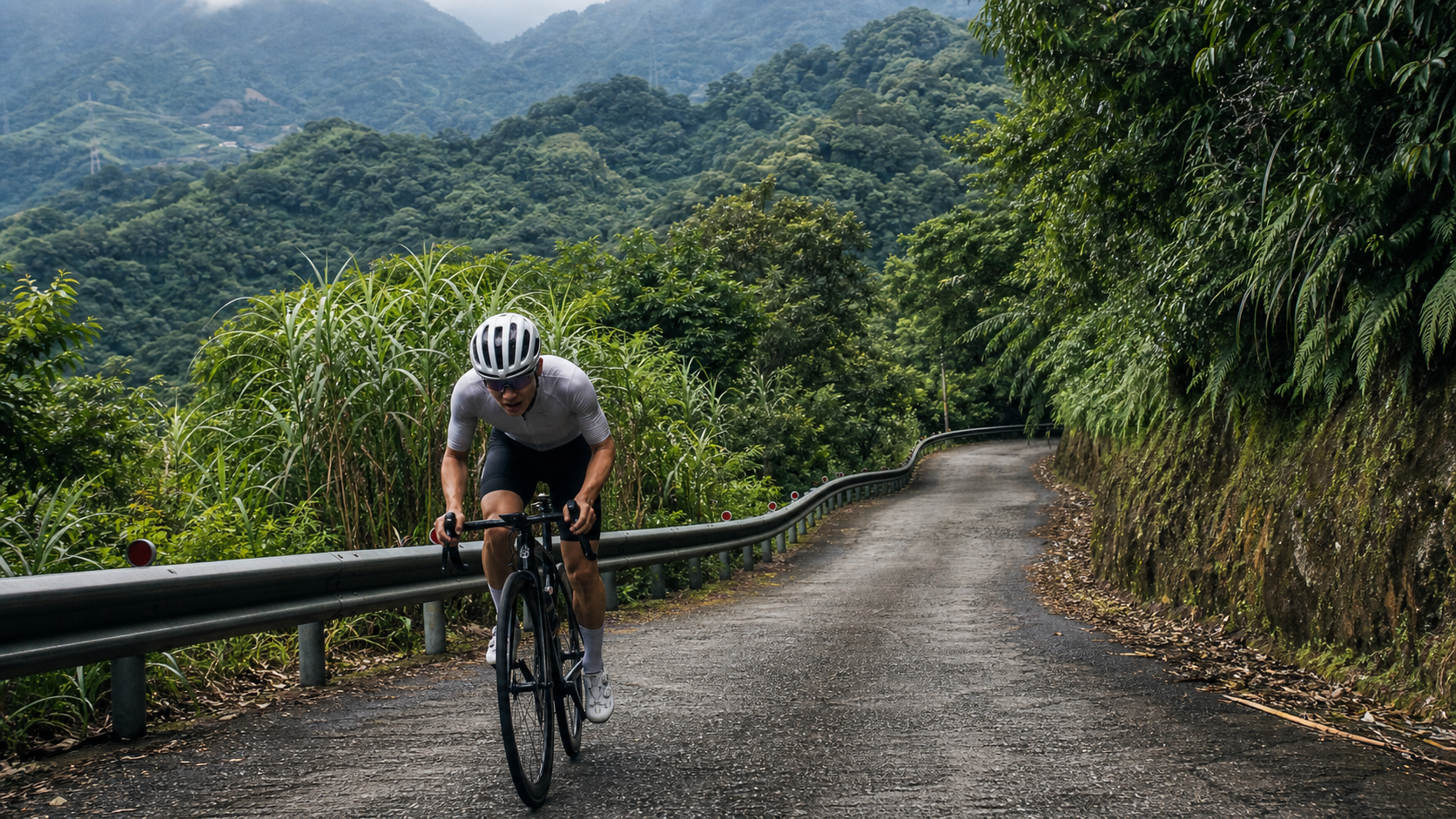
Let the Numbers Speak: Just How Hard Is the Xianshan Shitan Side?
Let’s lay the numbers out first. The Xianshan Shitan side climb is 5,890.8 meters in total length, which translates to 5.89 km, with 475.4 meters of total elevation gain and an average grade of 8.1%. Where does this string of numbers sit on Taiwan’s climbing map? We can build a tangible frame of reference by comparing it to a few familiar benchmark climbs.
The Wuling west approach (from the Hehuan Mountain direction) is roughly 40-plus kilometers long with over 2,500 meters of climbing, averaging around 5% grade—a “long-distance attrition battle.” The grade itself isn’t particularly steep, but it wears down your physical and mental reserves through sheer duration. The Hehuan Mountain east approach (counting from Guanyuan or Dayuling) is shorter but pushes the average grade up to the 6%–7% range, where a more sustained power demand becomes apparent. Nuannuan Mountain (Keelung) is roughly 3-plus kilometers with an average grade between 7% and 8%, a “short, high-tension” classic familiar to northern riders—the key challenge being that there’s almost no flat section to recover, pushing your muscles’ lactate tolerance to the limit.
The Xianshan Shitan side combines both of these traits: the distance isn’t short (5.89 km, nearly double Nuannuan Mountain), yet the average grade holds firm at 8.1%—even steeper than Nuannuan Mountain. What does this mean? It means you can’t rely on a “push hard early, then gut it out on willpower” strategy, because after the early steep sections deplete your anaerobic reserves, there’s still a longer climb ahead in the middle and later stages, with no sign of the grade easing significantly. The 475.4 meters of total elevation gain may not look as daunting as Wuling’s, but compressed into under 6 kilometers, your power output intensity gets pushed dramatically higher. This is exactly why the Xianshan Shitan side is so easy to underestimate—and why riders blow up halfway up the mountain.
Looking at it from a grade distribution perspective, an 8.1% average means there’s no true “easy recovery section” throughout. Riders typically break a climb into three phases when planning perceived effort—“warm-up gradient,” “main climbing section,” and “sprint section”—but the Xianshan Shitan side jumps straight into main-climb intensity from the mountain entrance. There are occasional slightly flatter stretches, but the grade variation isn’t enough to let your heart rate drop noticeably. This is why many riders who can hold a steady pace on Wuling or Beiyi find their rhythm disrupted the first time they tackle the Xianshan Shitan side.
One more thing to note: Xianshan itself sits at an elevation of about 974 meters, a well-known sacred mountain at the border of Miaoli’s Shitan Township and Nanzhuang Township. The Xianshan Lingdong Temple sits at the summit, and the area is also a trailhead where several county roads and industrial roads converge. Climbing from the Shitan side follows the west approach. While this route isn’t as widely known on the map as Beiyi or Wuling, it has long been a staple training route for local Miaoli teams to build climbing endurance and interval capacity, and it’s often used as a fitness checkpoint before tackling longer mountain routes in Miaoli (such as Xiangtian Lake, Luchang, or Baguali).
Segment-by-Segment Strategy from Start to Finish
Breaking the 5.89 km into stages will help you allocate your energy more precisely. The following segments are organized based on typical grade variation patterns and rider-reported feel; for actual mileage markers, please refer to roadside signs and your cycling computer.
Segment 1 (0–1.5 km): Entrance Recon and Breathing Calibration
The first stretch from the Shitan side trailhead is usually the relatively gentlest part of the entire route—and also the easiest to let your guard down on. The purpose of this section isn’t to go fast; it’s to help your body adapt physiologically from flat-road riding to climbing—your heart rate will climb rapidly from the lower aerobic zone toward the lactate threshold within this kilometer and a half. It’s recommended to hold a Rating of Perceived Exertion (RPE) of 6 to 7 throughout this section, keep power around 75% to 85% of FTP, and heart rate in the 80% to 85% of max HR range. The most common mistake here is seeing that the grade isn’t too extreme and pushing the pace, only to enter the real steep section in Segment 2 already carrying an oxygen debt—this is the most frequent “opening error” on the Xianshan Shitan side.
Segment 2 (1.5–3.5 km): The Core Climbing Zone, Where the Grade Ramps Up Across the Board
This is the heart of the entire route and the main contributor to that 8.1% average. Over these two kilometers, the grade holds steadily in the 8% to 10% range, with localized sections exceeding 12%, and no meaningful flat sections for recovery. This is where you should make a key adjustment to your pedaling rhythm: seated climbing with a higher cadence (85 to 95 rpm) effectively spreads the load across your quadriceps and glutes, preventing premature muscular fatigue. If the grade spikes above 12% locally, you can briefly stand and power out of the saddle, but keep it to 10 to 20 seconds before sitting back down to avoid letting your heart rate spiral out of control. Power should be held between 90% and 100% of FTP—this is classic “climbing-type VO2 max threshold intensity”—with heart rate approaching 88% to 93% of max HR. The most important mental note for this section: don’t panic and drop your cadence to grind a heavy gear just because the road gets steep. That will only accelerate lactate buildup in your quadriceps and force you to stop and walk before you even reach the finish.
Segment 3 (3.5–4.8 km): The False Flattening Zone—A Test of Pacing Discipline
Entering the middle-to-late portion of the route, the grade eases locally (possibly dropping to 5% to 6%)—this is the closest thing to a “breathing opportunity” on the entire climb. But here’s the trap: many riders misread this section as “almost there” and accelerate early, burning their reserves and leaving nothing for the final push. The correct approach is to treat this as an active recovery zone: maintain a steady aerobic heart rate (75% to 82% of max HR), deliberately drop power to around 70% to 80% of FTP, and give your heart rate and breathing a chance to settle slightly, storing muscle glycogen and neuromuscular reactivity for the final stretch.
Segment 4 (4.8–5.89 km): The Final Ramp—The Hardest Part of a Hard Climb
In the last kilometer or so, the grade typically kicks back up, sometimes featuring the steepest sections of the entire route. This is the critical zone where willpower and pacing discipline are tested simultaneously. By now, your body has been operating at sustained high intensity for 15 to 25 minutes (depending on individual ability), muscle glycogen is near critical levels, and this is where you should switch to a “segmented target method”: don’t think about the full kilometer ahead—break it into 200-meter mini-goals and push through them one by one. Cadence can drop slightly to 75 to 85 rpm, using a bigger gear combined with a more forward torso angle to maintain pedaling efficiency. Power output can be allowed into the anaerobic zone (100% to 110% of FTP), because the finish is near—this is the moment to cash in all your reserves.
Gear Ratio and Equipment Recommendations
The 8.1% average grade on the Xianshan Shitan side, combined with localized sections exceeding 12%, makes the gearing requirements clear: this is not a route you can handle with a 53/39 crankset and an 11-25 cassette. Below are recommended setups organized by rider level.
| Rider Level | Recommended Crankset | Recommended Cassette | Lowest Gear Ratio (Chainring/Cog) | Notes |
|---|---|---|---|---|
| Advanced/Racing (FTP 4.0 W/kg and above) | 50/34 or 52/36 compact | 11-28T | ~1.21 | Can maintain cadence on localized 12% sections |
| Intermediate (FTP 3.0-4.0 W/kg) | 50/34 standard compact | 11-30T or 11-32T | ~1.06-1.13 | Recommend wide-range cassette for extra margin |
| Recreational (FTP below 3.0 W/kg) | 50/34 compact | 11-34T | ~1.00 | Pair with long-cage derailleur to avoid blowing up |
| Mountain bike or gravel bike | Per factory spec | Recommend lowest ratio near 1:1 | — | Heavier weight requires more conservative gearing |
Beyond gearing, a few equipment details are worth noting. First, wheel selection: the Xianshan Shitan side is a short-to-mid-distance, high-intensity climb. If you normally train on deeper-section wheels (50mm or more) for flat roads, consider switching to mid-to-shallow rims or lightweight climbing wheels (30mm or less rim depth) for this route, reducing rotational weight that hampers acceleration and grade response. Second, tire pressure: mountain industrial roads aren’t always smooth, so consider running 5 to 10 psi lower than your flat-road pressure to increase grip and comfort, especially reducing slip risk when standing out of the saddle. Third, bottle cage setup: the climbing is concentrated in the middle section with limited refueling opportunities, so carry at least two bottles or a hydration pack to ensure uninterrupted fluid intake.
Nutrition and Hydration Strategy
Based on the intensity of 475.4 meters of climbing at an 8.1% average grade, a typical intermediate rider will need 25 to 40 minutes of sustained high-intensity output to complete this route—a time frame that sits right at the threshold where “refueling intervention” becomes relevant. Here’s a practical fueling cadence.
30 to 60 minutes before departure, consume a serving of easily digestible carbohydrates (about 30 to 50 grams), such as a banana, energy bar, or sports drink, avoiding high-fiber or high-fat foods that can burden the stomach. During the ride, if your total challenge time is under 30 minutes, you don’t actually need additional carbohydrate intake, but hydration remains important—take small sips every 10 to 15 minutes, totaling 300 to 500 milliliters, adjusted for temperature. Miaoli’s mountain areas are hot and humid in summer, with perceived temperatures often higher than forecasts; if you’re riding around midday, increase your hydration frequency further.
For electrolytes, sustained high-intensity output at an 8.1% average grade will significantly increase sweat loss. Make sure at least one of your bottles contains an electrolyte drink rather than plain water, which can dilute blood sodium concentration and trigger cramping. Cramping is one of the most common physiological warning signs on this type of short, high-intensity climb, typically striking in the final ramp when muscles are already highly fatigued and electrolyte loss has peaked.
If you’re incorporating the Xianshan Shitan side into a longer route (for example, linking with Nanzhuang, Xiangtian Lake, or other Miaoli mountain routes), your fueling strategy needs to be planned in advance: complete a full refuel (fluids and carbohydrates) before reaching the Xianshan Shitan side trailhead, treating this climb as a key segment that requires “full-tank combat,” not just a casual stretch of the ride.
Weather and Seasonal Recommendations
The Shitan and Nanzhuang township area of Miaoli features mountainous, hilly terrain where weather shifts are more dramatic than on the plains, which materially affects the difficulty of a climbing challenge. Overall, late autumn through early spring (roughly November through March of the following year) is the best season to tackle the Xianshan Shitan side, with cool temperatures and relatively lower humidity that benefit thermoregulation and cardiorespiratory load management during high-intensity climbing.
Riding this route in summer (June through September) requires extra caution. Miaoli’s mountain areas have a high probability of afternoon convective showers, and the terrain is prone to fog, which can cut visibility dramatically in a short time. The mountain roads have many curves and narrow shoulders, so limited visibility significantly increases risk. It’s recommended to start in the early morning during summer—this avoids the high-risk afternoon thunderstorm window and takes advantage of cooler morning temperatures to reduce the risk of heatstroke and heat exhaustion.
Post-rain road conditions are another key concern. The roads around Xianshan are mostly industrial-road grade, and after rain you may encounter fallen leaves, washed-out gravel, and localized slick spots. On steep sections (locally over 12%), wet surfaces compromise both braking and grip, so it’s advisable to wait 1 to 2 days after rain before attempting the climb, allowing the road surface to dry thoroughly.
Under the influence of winter northeast monsoons, Miaoli’s mountain areas can occasionally see low temperatures and even freezing fog. Especially in the early morning, mountain temperatures can be 5 degrees or more lower than the plains, so bring a windproof jacket or arm warmers to handle the cold wind on the descent afterward.
Common Mistakes and DNF Risks
Here are the most frequent failure modes riders encounter on the Xianshan Shitan side, compiled for your advance prevention.
First, going out too hot and collapsing in the later stages. As mentioned in the segment strategy, the relatively gentle grade in the first section makes it easy to misjudge overall difficulty. Once you push your heart rate near threshold in the first 1.5 km, you’ll rapidly run out of steam entering the core climbing zone in Segment 2—this is the most common and most typical failure pattern.
Second, incorrect gear ratios, forcing a dismount. Many riders accustomed to flat or gentle roads don’t adjust their cassette range for an 8.1% average with localized 12%+ sections, causing cadence to drop below 50 rpm on the steepest parts. The knees and quadriceps then bear excessive torque, and eventually, with energy spent, the only option is to get off and walk. This isn’t just a fitness issue—it’s an equipment planning issue.
Third, insufficient hydration leading to cramps or heat exhaustion. Especially when riding in hot, humid summer conditions, if you don’t increase your hydration cadence, you’re likely to experience calf or hamstring cramps in the final stretch, forcing an interruption of the challenge.
Fourth, underestimating localized steep sections and getting body position wrong. 8.1% is just the average; actual road sections can exceed 12% or even higher. If your center of gravity is too far forward or too far back, you risk the front wheel washing out or lifting, or the rear wheel spinning out—especially on wet surfaces.
Fifth, lacking mental preparation and giving up midway. The short distance of this route makes it easy to underestimate the psychological challenge. In reality, because the grade is concentrated and the duration is short but intense, the test of willpower rivals longer climbs. It’s recommended to do mental preparation beforehand, breaking the route into segmented mini-goals rather than measuring progress by total distance, to avoid the illusion of “still so far to go” that causes premature abandonment.
Target Times by Rider Level
The following times are for reference only; actual completion times will vary based on fitness, weather conditions, and road surface. Adjust based on your own FTP or recent climbing performance.
| Rider Level | Target Completion Time | Average Power Reference (W/kg) | Average Heart Rate Reference (%HRmax) |
|---|---|---|---|
| Pro/Racing | Under 15 minutes | 5.0 and above | 88-93% |
| Advanced | 18-22 minutes | 4.0-5.0 | 85-90% |
| Intermediate | 23-30 minutes | 3.0-4.0 | 82-88% |
| Recreational | 31-40 minutes | 2.5-3.0 | 78-85% |
| Beginner Challenger | Over 40 minutes | Below 2.5 | Depends on individual |
It’s worth noting that performance on this route doesn’t scale proportionally with longer climbs (such as Wuling), because the intensity is concentrated into a short distance, placing higher demands on anaerobic endurance and lactate clearance. This is also why long-distance specialists who perform well on Wuling don’t necessarily achieve comparable relative rankings on the Xianshan Shitan side—the two routes test subtly different physiological systems.
Practical Interpretation of Power Curves and Heart Rate Drift
If you have a power meter, the Xianshan Shitan side is an excellent route for examining your “climbing power stability.” Because the distance is short and intensity is concentrated, power output fluctuations are magnified under scrutiny—a different logic from long climbs (like Wuling, which often exceeds an hour) that emphasize “sustained steady output.” On the Xianshan Shitan side, what you need to focus on is the “coefficient of variation” of power—how much your power surges and dips throughout the climb. An ideal ride will show an “M-shaped” curve: slightly lower power in the first segment (the gentle section), power rising and holding in the Segment 2 core climbing zone, deliberately dropping power for recovery in the Segment 3 false flattening zone, and power rising again in the Segment 4 final ramp—rather than a “single-peak, steep-decline” curve of going all-out then collapsing.
Heart rate drift is also a physiological phenomenon worth noting on this route. Since the total challenge time for intermediate riders falls between 23 and 30 minutes, this is exactly the window where cardiac drift becomes noticeable—meaning that even if power output stays constant, heart rate will slowly creep upward over time, a combined result of rising core body temperature and increasing dehydration. Understanding this phenomenon can prevent you from misreading “heart rate is rising = I should back off” and easing off too early in the later stages. In fact, this is often just normal physiological drift; as long as your perceived exertion hasn’t clearly worsened, you can maintain your planned power target.
For riders using heart rate as the primary intensity metric (without a power meter), it’s recommended to cross-validate with RPE, especially in the Segment 2 core climbing zone where heart rate rises very quickly. Relying solely on heart rate numbers can easily cause pacing misjudgment—at that point, breathing rhythm and leg burn are actually more immediate intensity feedback indicators.
Route Integration Planning with Other Miaoli Mountain Routes
Due to its geographic location, the Xianshan Shitan side is frequently incorporated into longer training or challenge routes by local teams. The mountain roads around the Shitan and Nanzhuang township border are dense, and linking with Xiangtian Lake, Luchang, Baguali, or Nanzhuang Old Street routes is all feasible—but this also means you must treat the Xianshan Shitan side as the “highest-intensity node” of the entire ride, not a casual transitional stretch.
If you place the Xianshan Shitan side early in the route (for example, tackling it right after warm-up), the advantage is that your reserves are most complete and muscle glycogen hasn’t been depleted—suitable for riders chasing a personal best (PB). The downside is that if subsequent segments include other climbs (such as Xiangtian Lake), the high-intensity output in the core climbing zone will compromise your performance on later sections, so be mentally prepared for overall energy allocation.
If you place the Xianshan Shitan side late in the route as the grand finale, you need to pay special attention to whether your fueling has been adequate and whether your current muscle state can still handle sustained climbing at 8%+. It’s recommended to do a full energy and fluid refill before reaching the trailhead, and to temper your target time expectations, focusing on “safe completion” rather than “chasing a PB.”
Regardless of the arrangement, it’s advisable to use route planning tools or GPX tracks in advance to confirm the total elevation gain and mileage distribution, avoiding physical exhaustion in the later stages from underestimating the Xianshan Shitan side’s intensity. This is especially important when riding solo in the mountains—some sections of Miaoli’s mountain roads see very little traffic, and if you run out of energy and have an incident, rescue time could be significantly longer than in urban areas.
Strategy Differences Between Group Rides and Solo Challenges
Because the Xianshan Shitan side is steep with limited road width, group riding formation and communication strategies differ markedly from flat or gentle routes. First, this route isn’t suitable for maintaining a tight drafting formation while climbing. Grade variations and individual climbing rhythms mean that poor following distance can easily cause collision risk. It’s recommended that once you enter the Segment 2 core climbing zone, the group naturally spreads out according to individual ability, using visual or verbal checks to confirm each other’s status rather than forcing formation.
Second, when tackling this route as a group, agree on a “meeting point” before departure—such as the Xianshan trailhead or the route finish—so stronger riders can chase their own personal bests at their own pace, while weaker riders won’t exhaust themselves prematurely trying to match the group’s tempo. This “each rides their own race, regroup at the finish” model suits the short, high-intensity nature of this route far better than requiring the entire group to arrive at the finish simultaneously.
For solo challenges on the Xianshan Shitan side, since the route runs through relatively remote Miaoli mountain areas, inform friends or team members of your challenge window and estimated time, and carry basic emergency gear (power bank, basic puncture repair kit, whistle, etc.). Especially on non-holiday early mornings or evenings, mountain traffic is low, and if a mechanical failure or physical issue occurs, wait times for assistance could be extended.
Filming and Documentation Recommendations
If you want to document this challenge with video or photos, the Xianshan Shitan side is actually quite well-suited for fixed-point shooting due to its concentrated grades and varied scenery along the curves. The steep sections in the Segment 2 core climbing zone are the most visually dramatic shooting points, clearly capturing a rider’s posture against the gradient. The Segment 3 false flattening zone, with its more open views, is ideal for aerial or wide shots overlooking the Miaoli hill country. If you’re recording the entire ride with a GoPro or action camera, choose wide-angle mode to capture both the road grade changes and your pedaling rhythm, making it easy to review your pedaling posture and pacing in each segment afterward against the strategies recommended in this article.
Conclusion: An Underrated Hard Climb in Miaoli
The Xianshan Shitan side packs 475.4 meters of climbing and an 8.1% average grade into under 6 kilometers—a numerical combination that absolutely qualifies as a “concentrated hard fight” on Taiwan’s climbing map. It doesn’t require planning a full-day itinerary with aid stations like Wuling, nor does it demand high-altitude physiological adaptation like Hehuan Mountain. Instead, it tests every challenger’s pacing discipline and gear planning in the most direct way possible: sustained steep grades and limited recovery space. If you’ve already conquered the well-known short, hard climbs in the north, consider adding the Xianshan Shitan side to your next challenge list—it will show you, with the most honest grade numbers, where your true limits lie.
Related Reading
- Xiangtian Lake Climb Complete Guide: 5.83 km, 418 m of Climbing, Strava-Certified Nanzhuang Classic Hard Climb
- Xindian Shitoushan South Side Climb Full Guide: 7.64 km, 499 m of Climbing, Segment-by-Segment Tactics from Beginner to Advanced
- The Sacred Mountain Steep Climb of a Hakka Hill Town: Riding into Shitan, Encountering Xianshan
- Miaoli Shitan 100 km Challenge: Leg-Strength Test and Strategy on Rolling Terrain
台北闊瀨陡坡 騎旅 / 日本單車雜誌編輯車友臨時加入!/ 髮香才是最強的 / feat. 北迴歸線小隊 / 公路車 CT Yeh
6 個月前
大武山後門26%歡樂陡坡!JJSC南台灣單車行Day2 / 被颱風追著跑 / 公路車 / CT Yeh
2 年前
半日 小台灣 極限單車路線挑戰實錄
7 年前
2024 南庄仙山KOM 多視角賽事精華!/ 500元報名費媲美富士山登山賽!/ 公路車 / CT Yeh
1 年前
#北橫 + #北進武嶺 最硬的員工旅遊 EP1 | #公路車 #拉拉山 | 明池 | 武嶺 | 武陵農場 | 雲海 | Taiwan Cycling Route Wulin
6 年前
大武山20%魔王陡坡【JJSC南台灣遊騎Day2】!屁股真的要裂開了...凡士林抹滿也沒用?神秘金教堂還有超便宜夜市
3 個月前
大禹嶺 到 武嶺牌樓 全程前後實況錄影 | 北進武嶺 | 東進武嶺 | KOM | 訓練台 | 坡度分析 | Taiwan KOM Last 10 km HARD | 公路車
6 年前
超激烈!2025 南庄仙山KOM 賽事精華 / 男菁英A x 女菁英A / 公路車 / CT Yeh
9 個月前