Dahu Ginger Garden Practical Guide: A Systematic Breakdown of the 5.8km, 384m Climb to the Sea of Clouds
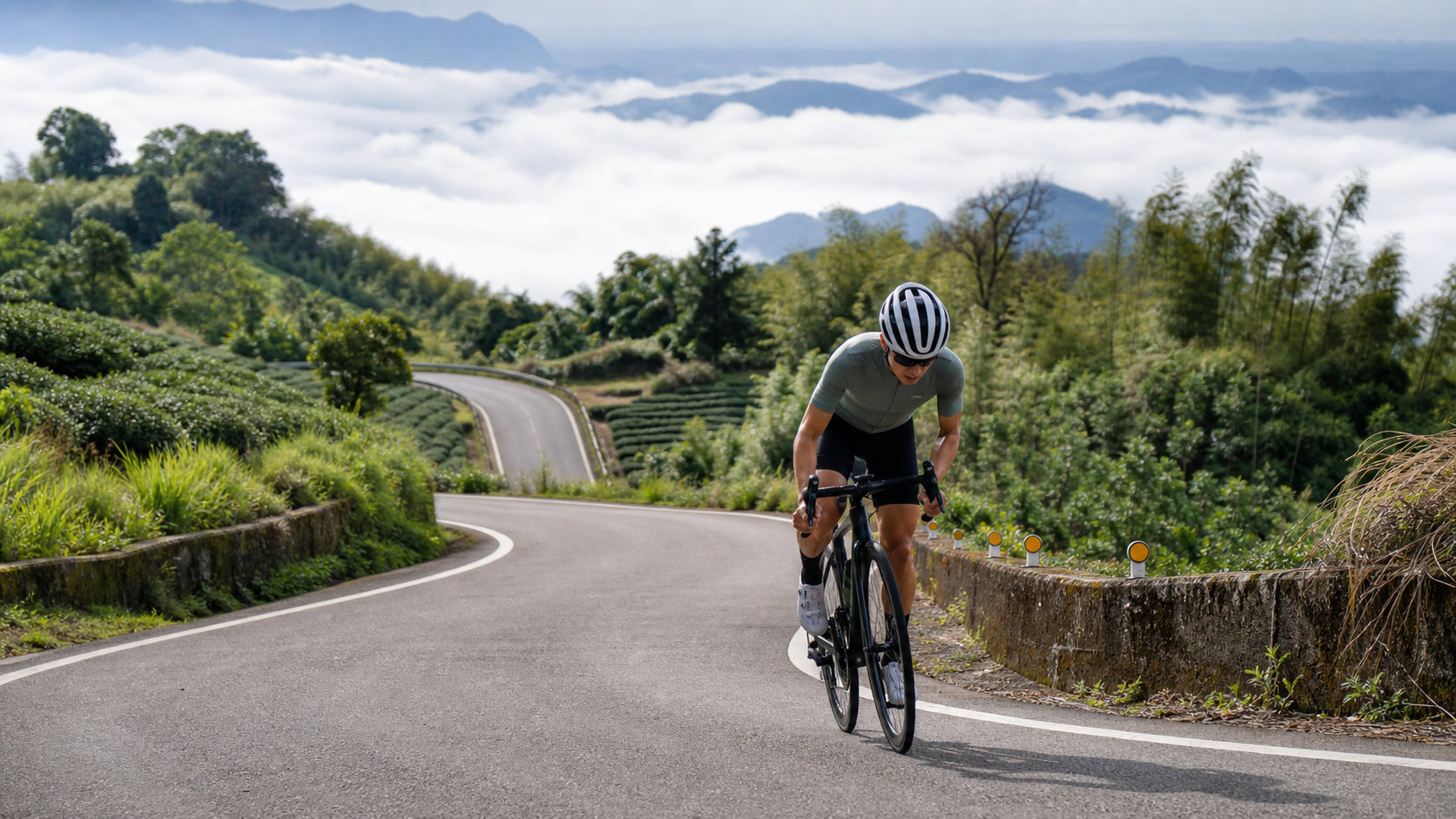
Data Analysis: Positioning Compared with Other Famous Climbs
To understand where Dahu Jiangmayuan sits on Taiwan’s climbing map, the most effective approach is to place it in a coordinate system alongside other well-known routes. The average gradient of 6.6%, in the context of cycling climb grading, falls roughly in the “moderately hard” range—compared with the western approach to Wuling, which stretches over 10 km with an average gradient around 5% but total elevation gain often exceeding 1,000 meters in a “marathon-style” long climb, Jiangmayuan is a classic “short but intense” climb. A better comparison would be certain consecutive switchback sections on the Beiyi Highway, or those mountain roads in the central-southern hilly regions that span less than 6 km yet demand you output power near your threshold (FTP, Functional Threshold Power) within a short time frame.
Looking at total elevation gain, 384.2 meters of accumulated climbing—if converted to the height of a standard 10-story building—is roughly equivalent to climbing about 120 stories continuously, and all compressed within less than 6 km of horizontal distance. This means you have virtually no “flat recovery sections” to catch your breath. Compared with longer challenge routes at national scenic area level, Jiangmayuan is closer to a real-world embodiment of “high-intensity interval training” rather than a steady-cruise endurance challenge. This is also why many local Miaoli cycling teams incorporate this route into their midweek intensity sessions, using it to train sustained output near the anaerobic threshold, rather than simply using it for LSD (Long Slow Distance) endurance rides.
Looking further at the statistical characteristics of the gradient distribution: an average of 6.6% represents total elevation divided by horizontal distance, but the actual terrain has undulations—some sections have instantaneous gradients far exceeding this average, while others are relatively gentle or even feature brief descents or flats for recovery. Based on road surface types and the general characteristics of Miaoli’s hilly terrain, the steepest switchback sections in the middle of the Jiangmayuan route likely see instantaneous gradients reaching 8% to 10% or so. This level of gradient is already enough to make power-based riding strategies (maintaining steady watts) relatively difficult, because the body must constantly adjust pedaling cadence and gear selection in response to gradient changes—this is precisely the core of the route’s dual demands on both technique and fitness.
From a training science perspective, a route under 6 km in total length with nearly 400 meters of climbing is essentially a high-intensity mixed anaerobic and aerobic stimulus. In exercise physiology, this kind of high-intensity climb lasting between 20 and 40 minutes (depending on rider ability) falls precisely within the most effective time window for “Lactate Threshold Training”—too short a climb (e.g., 1–2 minutes) primarily stimulates the anaerobic glycolytic system and neuromuscular power, while too long a climb (e.g., over 1 hour) leans toward pure aerobic endurance and energy metabolism efficiency. A mid-distance climb like Jiangmayuan, in the 20-to-40-minute range, can simultaneously train the body’s ability to clear lactate and its tolerance for maintaining steady output near threshold intensity. This is also why many coaches recommend riders incorporate this type of route into the base phase of pre-season training as a key tool for building threshold power, rather than treating it merely as a recreational challenge route.
It’s worth noting that the reason Jiangmayuan has accumulated considerable challenge popularity in the Strava community, besides the well-designed difficulty curve of the route itself, also relates to its high accessibility and convenient out-and-back logistics. Many cycling teams from Taipei, Hsinchu, and Taichung schedule Jiangmayuan into weekend “one-day double crossing” or “one-day multi-climb” itineraries, using it as a connecting point between other famous routes (such as the Guandao Mountain system or the road network around Liyu Lake). This geographic hub role has also allowed the route to accumulate a large volume of actual performance data from riders of varying abilities for reference and comparison.
Segment-by-Segment Guide from Start to Finish
Segment 1: Warm-Up Climb Phase (0–1.5 km)
The route typically starts near the junction of the industrial road heading toward Jiangmayuan from Dahu’s urban area. The gradient here is relatively gentle, making this one of the few sections on the entire route where the cardiorespiratory system can gradually ease into working condition. It’s recommended to keep your heart rate between 70% and 75% of your maximum heart rate during this section—the boundary between what’s commonly called Zone 2 and Zone 3—with power output suggested at around 65% to 75% of FTP. The most common mistake at this stage is riding too fast because the gradient isn’t yet obvious, prematurely depleting muscle glycogen. Cadence is recommended to be maintained between 80 and 90 revolutions per minute (RPM), using lighter gears to keep the legs spinning smoothly rather than attacking the gradient with heavy gears from the start. This stage is also the golden time window for adjusting breathing rhythm, confirming that nutrition and equipment are secure, and verifying that the GPS cycling computer has started recording.
This section typically features the two-way asphalt surface common to industrial roads, with limited road width but relatively open visibility, and occasional scattered residences and orchards on both sides. Since the steep section hasn’t truly begun here, many riders tend not to have mentally switched into “climbing mode” yet. It’s recommended to use this distance for several deep-breathing exercises, shifting your focus from flat-road cruising mentality to the focused psychological state required for climbing. Also, use the gentler sections here to fine-tune saddle height feel and confirm that cleats and pedals are engaging properly—because once you enter the steeper sections later, any minor equipment issue will be magnified into a serious riding obstacle. For group rides, this is also the stage where the group naturally splits by individual ability and rhythm; there’s no need to force yourself to match the pace of the rider ahead, since the real test is still to come.
Segment 2: Gradient Transition Point (1.5–3 km)
After entering this section, the gradient rises noticeably—this is where the entire Jiangmayuan route truly starts to “make itself felt.” The terrain gradually shifts from the gentle climb of the industrial road to the continuous switchback climbing characteristic of hilly terrain, with orchard and tea plantation scenery beginning to appear on both sides of the road, while the gradient also starts approaching or even exceeding the route’s average of 6.6%. Here, it’s recommended to keep heart rate between 80% and 85% of maximum, with power output raised to 85%–95% of FTP, entering what’s known as the “upper aerobic threshold” training intensity. Cadence should naturally drop to 70–80 RPM in response to the gradient, and you should shift to mid-to-low gears early to avoid frantically shifting at the last moment on steep sections, which can cause chain hesitation or derailment—this is a particularly dangerous situation on continuous switchback climbs, as shifting errors often occur at the very moment when stable torque output is most needed.
The switchback design on this section is the typical “zigzag” climbing pattern of Miaoli’s hilly industrial roads, where the road follows the hillside’s contour lines in repeated turns to reduce the perceived overall gradient. This design is a double-edged sword for riders: on one hand, the straight sections between each switchback have relatively uniform gradients, helping establish a steady pedaling rhythm; on the other hand, the exit of each switchback is often where the gradient suddenly steepens, because roads typically have a brief acceleration in climbing right at the turn—this is also the critical point where many riders lose speed or need to shift down abruptly. It’s recommended to anticipate the road ahead before approaching each switchback and complete gear changes in advance, ensuring the rear cassette and front chainring are already in the appropriate gear combination before entering the turn, so that torque output can be maintained on exit without losing momentum due to shifting hesitation. Additionally, from this section onward, you’ll begin to see scattered fields of ginger and related crops—this is also the origin of the name “Jiangmayuan” (Ginger and Hemp Garden). If your riding rhythm allows, it’s worth taking a brief notice of the surrounding agricultural landscape, which can help divert your focus from the accumulating fatigue.
Section 3: The Core Challenge Zone (3–4.5 km)
This is the most critical and mentally taxing section of the entire Jiangmayuan route. Based on the gradient distribution of the route, this is where the steepest consecutive switchbacks are likely to appear, with instantaneous gradients potentially approaching or even exceeding 10%. The strategic core of this section lies in “pacing discipline”: many riders, upon seeing the gradient spike, panic and surge forward, only to deplete their anaerobic reserves before reaching the finish, leaving them to complete the latter part with a defeated mindset. The correct approach is to keep your heart rate near but not exceeding your threshold heart rate (approximately 88% to 92% of max heart rate), maintain power output between 95% and 105% of FTP, allowing brief surges but immediately reining them back in. Cadence should be lowered to 65–75 RPM, alternating between seated pedaling and occasional out-of-the-saddle efforts to distribute muscle load. Especially at the exit of the steepest switchbacks, standing climbs can effectively maintain speed, but be aware that heart rate will spike instantly—keep these efforts short.
Mental preparation in this section often outweighs physiological readiness. When the gradient numbers or perceived effort noticeably steepen, the brain naturally triggers an impulse to “end the suffering as quickly as possible,” driving the body to unconsciously accelerate—a phenomenon known in sports psychology as the “pain-avoidance response.” However, the golden rule of climbing pacing is precisely the opposite: when facing the steepest sections, you should deliberately slow down, lengthen your breathing cycle, and use willpower to resist this instinctive urge to accelerate. Practically, you can employ the “segmentation method”: break the 1.5 km ahead into three or four smaller visual targets—such as the next switchback, the next utility pole, or the next prominent tree—and conquer them one by one rather than treating the entire stretch as one vague, overwhelming goal. This effectively reduces mental burden and maintains pacing stability. Additionally, this section is where dehydration and cramping warning signs are most likely to appear. If you feel slight twitching in your calves or inner thighs, immediately reduce output intensity rather than pushing through, because a full-blown cramp mid-climb often means you’ll have to dismount and rest entirely—a far worse trade-off.
Section 4: The Sky City Finish (4.5–5.8 km)
In this final stretch, the route gradually approaches the area around the “Sky City”-famous Yun Ye Ju landscape restaurant, where the gradient begins to ease—but muscle fatigue peaks here, and many riders actually lose the most speed on this “theoretically easier” section. It’s recommended to prepare mentally: even as the gradient numbers drop, your subjective effort may still feel heavy. This is a normal physiological response and does not mean your pacing strategy has failed. Maintaining a steady cadence, relaxing tension in your upper body and core, and keeping your gaze fixed on the distance rather than staring at your front wheel will all help you push through this final finishing climb. When you reach the open viewpoint near Guan Yun Ting, the elevation advantage will grant you a panoramic view of the entire Dahu River Valley—the ultimate reward for the entire climb’s effort.
From a sports physiology perspective, this phenomenon of “easier gradient but no less—or even greater—perceived fatigue” is directly linked to central nervous system fatigue and localized muscle glycogen depletion. After the high-intensity output of the earlier sections, the quadriceps and gluteal muscles—the primary drivers of climbing—have significantly depleted their local glycogen stores. Even as the external gradient eases, the efficiency of muscle fiber recruitment is compromised by fatigue, meaning the same power output requires greater subjective effort (RPE, Rate of Perceived Exertion) to achieve. Understanding this physiological mechanism helps riders approach their fatigue more rationally in the final stage, preventing them from misjudging their pacing strategy as flawed simply because “the gradient has eased but I’m still breathless,” which could lead to unnecessary over-acceleration or even giving up. Upon reaching the finish, avoid stopping pedaling immediately. Instead, continue riding at very low intensity or walk the bike slowly for 3 to 5 minutes to allow heart rate and breathing to gradually return to a calm range. This active recovery approach is more effective at accelerating lactate metabolism and reducing next-day delayed onset muscle soreness (DOMS) than immediately stopping to sit and rest.
Gear Ratio and Equipment Recommendations
A route like Jiangmayuan—short in distance but with dramatic gradient changes—demands more from your gear ratio setup than it might initially appear. Below are recommended gear configurations for riders of different fitness levels:
| Rider Level | Recommended Chainring | Recommended Cassette | Lowest Gear (Climbing Gear) | Notes |
|---|---|---|---|---|
| Advanced / Competitive | 52-36T (semi-compact) | 11-30T | 36×30 | Suitable for riders with high FTP who prefer high-cadence standing climbs |
| Intermediate / General Training | 50-34T (standard compact) | 11-32T | 34×32 | Balances flat-road cruising and climbing endurance |
| Beginner / Recreational | 50-34T or smaller | 11-34T or larger | 34×34 | Prioritizes completing the climb at a steady cadence |
Beyond gear ratios, tire pressure is another often-overlooked detail. The Jiangmayuan route surface is mostly industrial-road asphalt, generally in good condition but with occasional potholes and accumulated fallen leaves. It’s recommended to run tire pressure 5 to 10 psi lower than your flat-road cruising pressure to increase grip and reduce vibration, especially for stable cornering traction at switchback exits. For wheel selection, this short climbing route doesn’t require excessive aerodynamic focus; instead, prioritize lightweight construction, as wheel weight has a far greater impact on acceleration response and overall power efficiency during climbs than drag coefficient.
Bike weight management is also worth serious consideration on this route. With a total elevation gain of 384.2 meters over 5.8 kilometers, every additional kilogram of bike-plus-rider weight theoretically adds a significant amount of extra climbing work. For competitive riders chasing PR times, checking whether water bottles, saddle bags, and on-board supplies can be streamlined before departure is a detail worth investing in. Of course, this doesn’t mean sacrificing essential safety equipment—spare tubes, a pump or CO2 inflator, and a basic multi-tool should still be carried. After all, while this route isn’t long, if a mechanical failure occurs, walking your bike up steep sections would be extremely exhausting. Additionally, brake system condition should be specifically checked before departure, especially for hydraulic disc brake users who should inspect remaining pad thickness. Since the Jiangmayuan descent also has a notable gradient, poor brake condition significantly increases handling risk during the descent. For clothing, given that core body temperature rises rapidly during climbs, a breathable, moisture-wicking short-sleeve jersey is recommended, paired with lightweight arm warmers depending on the season for easy on/off temperature regulation—avoiding premature fatigue from overheating.
Nutrition and Hydration Strategy
For a 5.8 km route with an estimated completion time between 20 and 45 minutes (depending on rider level), substantive on-bike nutrition isn’t theoretically necessary during the climb itself—but pre-ride preparation absolutely cannot be skipped. It’s recommended to complete a carbohydrate-containing meal or snack 30 to 45 minutes before starting, with a portion of approximately 30 to 60 grams of carbohydrates, to ensure blood sugar and glycogen stores are in a relatively full state. For hydration, given that sweat rate increases significantly during the climb—especially in Miaoli’s humid summer hill terrain—ensure you’re well-hydrated before riding, consuming about 500 ml of fluid 1 to 2 hours prior. If you’re attempting a PR or doing repeated interval sessions, supplement with electrolyte drinks between efforts to prevent electrolyte imbalance-induced cramping from repeated high-intensity output.
If Jiangmayuan is part of a larger long-distance ride (such as a one-day through-ride combining the surrounding road network), your nutrition strategy needs more comprehensive planning. In this case, it’s recommended to complete a full refueling stop before reaching the Jiangmayuan starting point, confirming your water bottle supply is sufficient for the upcoming climb, and considering carrying an instant energy gel or bar as an emergency backup during the climb. Even if you don’t end up using it, it’s a reasonable part of risk management. Post-ride recovery nutrition is equally important. When you pause briefly at the scenic viewpoint near Sky City, take advantage of the “golden window” of carbohydrate and protein replenishment within 30 minutes after exercise—consuming adequate carbs and protein accelerates muscle repair and glycogen resynthesis. If you plan to continue tackling other sections or ride longer distances afterward, this recovery fueling will directly impact your performance in the latter part of the ride.
Seasonal Weather Recommendations
The hilly terrain around Jiangmayuan, located at the border of Dahu Township and Sanyi Township, experiences significant seasonal climate variations that noticeably affect the riding experience. In summer (roughly June to September), afternoon thunderstorms are common, and the humid, muggy conditions in the mountains raise the perceived temperature. It’s recommended to start in the early morning to avoid the midday heat and the risk of afternoon rain, while also making sure to step up sun protection and hydration frequency. In autumn and winter (roughly October to February of the following year), the climate is relatively cool and dry, making this the golden season for attempting a PR on this route. Muscles can maintain better power output efficiency at lower temperatures, but the mountains may experience fog during early morning low-temperature periods—when visibility drops, be sure to slow down and turn on your bike lights. In spring (March to May), it’s the tail end of Dahu’s strawberry harvest season, and the agricultural scenery along the route is at its richest, but be mindful of slippery roads brought by spring rain systems.
Common Mistakes and DNF Risks
The first common mistake is underestimating the intensity required for a short climb. Many riders see “only 5.8 kilometers” and let their guard down, skipping a proper warm-up and going all out from the start, only to be forced to slow down dramatically or even dismount and walk in the core challenge section (at the 3 to 4.5 km mark) due to rapid lactate accumulation. The second common mistake is improper gear selection, especially for road cyclists using a standard crankset (53-39T) paired with a small cassette. When facing instantaneous gradients approaching 10%, they often find themselves “out of gears” and are forced to grind at an extremely low cadence, which places considerable strain on the knee joints and can lead to overuse injuries over time. The third mistake is insufficient nutrition and hydration preparation. Summer challengers in particular tend to underestimate their sweat rate, leading to signs of dehydration in the latter half of the ride, such as dizziness and muscle cramps. The fourth mistake is pacing errors caused by unfamiliarity with the route. Because Jiangmayuan’s gradient changes are dramatic and concentrated in specific sections, riders who don’t know the road can be caught off guard where the pitch suddenly steepens. First-time challengers are advised to adopt a conservative pace, aiming first simply to finish, and only attempting to break their time on a second visit. The fifth risk is misjudging the weather—especially the sudden, intense afternoon thunderstorms in summer. With slippery mountain roads and poor visibility, it’s strongly recommended to keep a close eye on real-time weather forecasts and maintain the flexibility to bail out along a retreat route.
A sixth easily overlooked risk is the problem of mismatched pacing in group rides. When a group of riders with significantly different fitness levels tackles Jiangmayuan together, the weaker riders often push themselves to keep up with the pace of the riders ahead because they don’t want to hold the group back. This kind of “putting on a brave face” riding is extremely dangerous on a route with an average gradient of 6.6% and sections approaching double digits—it can easily lead to premature exhaustion or even losing balance and crashing on the steeper sections. It’s recommended that when riding Jiangmayuan in a group, everyone agrees beforehand that it’s acceptable to naturally split up and ride at their own pace through the core challenge section, arranging to regroup at the scenic overlook area near Sky City, rather than forcing the group to stay together all the way to the top. A seventh detail to pay attention to is the handling risk on the descent. Many people focus entirely on the physical challenge of the climb and overlook the fact that when retracing the route back down after finishing, the continuous switchbacks combined with the gradient will cause speed to build up rapidly in a short time—especially in a state where leg strength and reaction speed have already declined after completing a high-intensity climb. The handling risk is actually higher than the climb itself. Be sure to keep a cautious speed, brake early, and avoid hugging the outside edge of hairpin turns.
Target Times for Riders of Different Levels
The time ranges below are reasonable estimates based on the route’s length, elevation gain, and average gradient data, cross-referenced with typical completion time distributions for climbs of similar difficulty. Actual results will vary depending on individual fitness, weather conditions on the day, and equipment setup:
| Rider Level | Estimated Completion Time | Average Power Output (approx.) | Average Speed |
|---|---|---|---|
| Elite competitive (FTP above 4.5W/kg) | 16–19 min | Above 95% of FTP | Approx. 18–21 km/h |
| Advanced training (FTP 3.5–4.5W/kg) | 20–25 min | 85–95% of FTP | Approx. 14–17 km/h |
| Intermediate recreational (FTP 2.8–3.5W/kg) | 26–33 min | 75–85% of FTP | Approx. 11–13 km/h |
| Beginner leisure rider | 35–45 min | Paced by perceived effort | Approx. 8–10 km/h |
Regardless of which level you fall into, for your first attempt at Jiangmayuan it’s recommended to make “completing the ride without dismounting and walking” the primary goal, then gradually build muscle memory of the gradient transition points through repeated training. Only then can you truly pace strategically in future challenges, rather than grinding to the finish on feel alone. The value of this route lies not just in the challenge itself, but in the fact that it provides an excellent training ground for riders to practice maintaining stable power output and mental resilience on terrain with dramatic gradient changes—precisely the core capabilities required for many long-distance alpine routes.
Related Reading
- Gukeng Huashan Dahu Bottom Practical Guide: 6.88 km, 447 m of Climbing—A Mid-Elevation Test in Yunlin
- Maokong Zhinan Temple Practical Guide: 6.93 km, 388 m of Climbing, 5.6% Average Gradient—A Complete Breakdown of Taipei’s Classic Intermediate Climb
- Xiangtian Lake Climbing Complete Guide: 5.83 km, 418 m of Climbing—Strava-Certified Classic Hard Climb in Nanzhuang
- Jinguashi Jinshui Road Practical Guide: 4.84 km at 6.3% Average Gradient—Complete Segment-by-Segment Analysis
台北闊瀨陡坡 騎旅 / 日本單車雜誌編輯車友臨時加入!/ 髮香才是最強的 / feat. 北迴歸線小隊 / 公路車 CT Yeh
6 個月前
單車 梅山36灣 坡度介紹 路段介紹 空拍 (相關遊記影片,請參考說明或我的頻道喔,歡迎訂閱)
6 年前
大禹嶺 到 武嶺牌樓 全程前後實況錄影 | 北進武嶺 | 東進武嶺 | KOM | 訓練台 | 坡度分析 | Taiwan KOM Last 10 km HARD | 公路車
6 年前
半日 小台灣 極限單車路線挑戰實錄
7 年前
新竹羅平 x 天湖部落 大禹嶺級變態陡坡! 4K超高畫質 空拍 | 公路車
5 年前
嘉義大埔、阿婆灣挑戰賽,美到以為在日本!ft. 環騎5 Cool 西拉雅188 / 公路車 / CT Yeh
7 個月前
大武山20%魔王陡坡【JJSC南台灣遊騎Day2】!屁股真的要裂開了...凡士林抹滿也沒用?神秘金教堂還有超便宜夜市
3 個月前
大武山後門26%歡樂陡坡!JJSC南台灣單車行Day2 / 被颱風追著跑 / 公路車 / CT Yeh
2 年前