Clouds and Strawberries of Jiang Ma Yuan: A Road Journey into the Memory of a Hakka Mountain Town
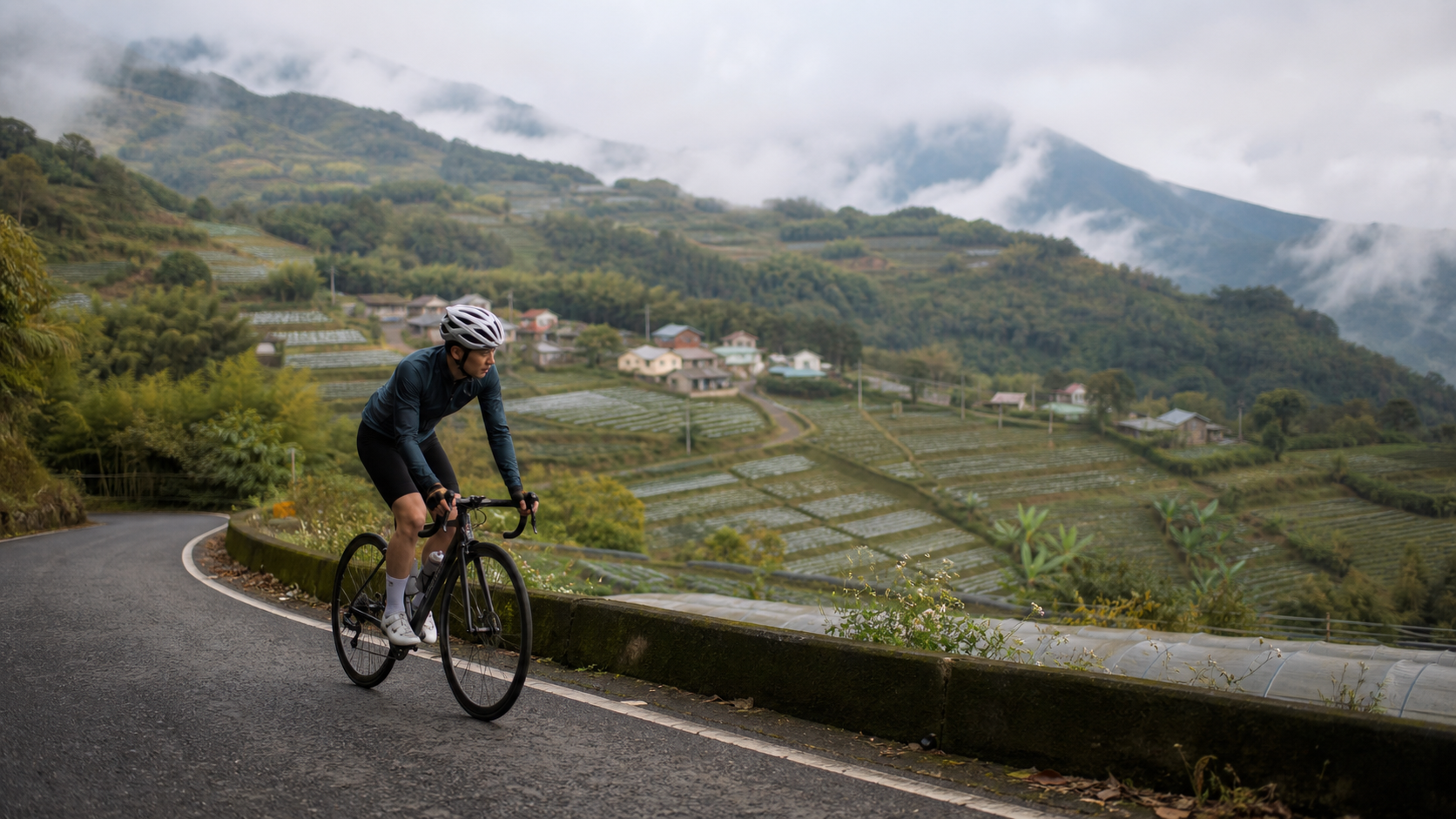
The Origin of the Name: Mountain-Town Memories of Ginger and Ramie
The name Jiangma Yuan (Ginger and Ramie Garden) carries a strong agricultural air just from its literal meaning. As the name suggests, this area was once an important production site where early Hakka settlers in Miaoli cultivated ginger and ramie. The two characters “jiang” (ginger) and “ma” (ramie) combined together precisely depict the traditional economic activities of this hilly terrain. This stretch of hills in Miaoli has well-drained soil and moderate day-night temperature differences, and has been a key area for Hakka immigrants to clear and settle since the Qing Dynasty. Although the sloping terrain was not conducive to large-scale rice cultivation, it unexpectedly proved suitable for cash crops like ginger, tea, and fruit trees that require good drainage and moderate sunlight. Ginger is drought-tolerant and thrives in poor soil, and root crops actually grow more solidly on hillside slopes. Ramie, meanwhile, was an important fiber crop in early times, used for weaving hemp cloth and making rope—an indispensable daily necessity in Hakka farm life. This agricultural wisdom of “living off the mountain” is a crucial starting point for understanding the Hakka mountain-town culture of the Dahu and Sanyi area—the early settlers here had no plains for rice farming, yet through a deep understanding of the sloping terrain, they developed a crop system that coexisted and thrived with the land. The name Jiangma Yuan is the most direct linguistic fossil of this history.
As times evolved, the scale of ginger and ramie cultivation in this area gradually shrank, replaced by the strawberry industry that later became famous throughout Taiwan. Yet the old place name Jiangma Yuan has always been preserved, becoming a geographic coordinate recognized by both local residents and visitors from elsewhere. This continuity of place names is a phenomenon visible in many Hakka settlements across Taiwan—place names often record the way of life of a particular era, and even after the industrial landscape has transformed, the name still carries collective memory, serving as an invisible thread connecting past and present. Every time I ride through these hillsides and see the occasional scattered ginger fields along the roadside, it reminds me of the industrial changes this land has undergone, as well as the resilience and wisdom of Hakka ancestors who survived in difficult terrain.
The development history of the Hakka settlements in the Dahu and Sanyi area is essentially a history of wrestling with hilly terrain and learning to coexist with nature. Compared to rice farming on the plains, which could rely on relatively regular irrigation systems and flatter farmland, the early settlers of the hilly regions had to face more complex terrain conditions—slope variations, uneven soil water retention, and relatively inconvenient transportation were all natural limitations that hillside agriculture had to overcome. It is precisely for this reason that Hakka ancestors developed a crop-selection logic highly adapted to the terrain: crops that were drought-tolerant, thrived in poor soil, and had well-developed root systems were especially favored here. This also explains why ginger, tea, and fruit trees became the main cash crops of this hilly region rather than rice, which requires abundant irrigation water. This agricultural wisdom of adapting to local conditions, accumulated through generations of experience, gradually shaped the Dahu and Sanyi hillside agricultural landscape we see today. And the name Jiangma Yuan is the most vivid linguistic marker in this entire historical epitome—every time I ride through here, it feels like reading a silent history book etched into the terrain.
Sky Castle: A Mountain-Town Viewpoint Wrapped in Clouds and Mist
The reason Jiangma Yuan has become a popular tourist and cycling destination in recent years is largely due to its romantic nickname—“Sky Castle.” The origin of this title is closely related to the area’s unique topographical and climatic conditions. Dahu Township is situated in hilly terrain, and with the nearby Guandao Mountain range converging with the foothills of the Snow Mountain range, under specific weather conditions—usually in the early morning or after rain when moisture has not yet dispersed—clouds and fog tend to gather at the valley floor, creating a spectacular sea-of-clouds view when observed from above. The Yunjuyuan (Cloud Dwelling) scenic restaurant area, located on the upper slopes, happens to be the ideal vantage point for appreciating this sea of clouds, hence the widely circulated nickname “Sky Castle.”
The moment I first rode up Jiangma Yuan and stood at the Guanyun Pavilion (Cloud-Watching Pavilion) looking down remains deeply impressed in my memory. It was an early morning in late autumn; the valley still held the night’s moisture, and as the sun gradually rose, the clouds and fog at the valley floor began to flow slowly, churning and shifting through the valley as if alive. That scene is difficult to fully describe in words—I had just used every ounce of strength to conquer a climb of nearly 400 meters, my muscles still trembling slightly, my breathing not yet fully settled, yet the sea of clouds before me instantly gave all the fatigue a different meaning. This experience of “exchanging sweat for scenery” is, in my opinion, one of the most captivating aspects of road cycling—unlike driving or taking a cable car to easily reach a viewpoint, you must personally propel yourself up the slope inch by inch with your own legs, and this sense of personal participation gives the scenery before you an extra layer of weight.
From the location of Guanyun Pavilion, the view encompasses the entire topography of the Dahu River Valley, and on clear days you can even see layers of mountain ridges in the distance. This commanding view makes one think of the Hakka ancestors who cleared this land—perhaps they too once stood at similar heights, gazing at the same valley clouds, contemplating how to make a living on this undulating terrain. This sense of connection across time and space is the thought that most often comes to mind when I sit resting on the viewing platform after completing a ride up Jiangma Yuan.
The reason sea-of-clouds phenomena appear so readily in the Jiangma Yuan area is closely related to the local topography. The Dahu River Valley is surrounded by hilly terrain, forming a relatively enclosed geographic basin. Nighttime radiative cooling, combined with moisture at the valley floor that cannot easily disperse, tends to create an inversion layer in the early morning hours, causing water vapor to condense into clouds and fog that linger at the valley bottom. Standing at a higher vantage point allows you to look down upon this sea of clouds. This meteorological condition is not visible every day—it typically requires stable weather, a significant day-night temperature difference, and moderate rainfall from the previous day or days to replenish air moisture. This combination makes every ride that successfully encounters the sea of clouds feel precious and serendipitous. Many local riders pay close attention to weather forecasts and deliberately set out on autumn and winter mornings with larger temperature swings, precisely to increase their chances of witnessing this sea of clouds. And even on days without the sea of clouds, the views from Jiangma Yuan remain expansive—the layered ridges of the hills and the outlines of distant mountains are still natural beauty worth a dedicated visit.
The Industrial Landscape of Strawberry Country
When it comes to Dahu, the first keyword that comes to mind for most Taiwanese people is definitely “strawberry.” Dahu Township has long been hailed as Taiwan’s strawberry capital. Its得天獨厚的 hilly terrain and climatic conditions are particularly suited to strawberries, a crop that prefers cool weather and well-drained soil. The strawberry season roughly runs from December to April of the following year (the exact start and end dates vary slightly depending on the year’s climate). During this period, the entire Dahu Township transforms into a red strawberry kingdom, with signs for strawberry-picking farms lining both sides of the roads, and the air seemingly carrying a faint fruity aroma.
Although the Jiangma Yuan climbing route itself is located on the hillside somewhat away from the main strawberry production areas, you can still feel the strong presence of the strawberry industry when passing through the Dahu urban area on the way to and from the ride. If you choose to tackle this route during strawberry season, consider scheduling time before or after the ride to visit a local strawberry-picking farm, experience the joy of picking and eating fresh strawberries on the spot, or purchase some strawberry processed products sold at local farm shops, such as strawberry jam or dried strawberries. This kind of itinerary—“sweat first, savor later”—echoes, to some extent, the Hakka philosophy of being industrious and pragmatic while still appreciating life’s pleasures: after hard work, it is only natural to reward yourself well.
The significance of the strawberry industry to Dahu Township goes far beyond mere agricultural economic value. It has become a cultural identifier for the entire region, driving the development of a series of related industries including tourism, dining, and agricultural processing. It has also allowed what was originally a Hakka settlement relying purely on hillside farming to gradually transform into a modern agricultural township combining tourism and leisure. This process of industrial transformation is, to some degree, reflected in the repositioning of the Jiangma Yuan route itself—from a purely agricultural access road in its early days to a diverse route today that combines sport and leisure, natural scenery, and agricultural experiences, bearing witness to the land’s ever-evolving vitality.
The reason strawberries were able to develop into such a representative industry in Dahu Township actually embodies a terrain-adaptation logic similar to that behind the name Jiangma Yuan. Strawberries prefer cool climates and well-drained soil, and the elevation and microclimatic conditions of Dahu’s hilly terrain happen to provide exactly these growing conditions. The generations of experience that Hakka farm families accumulated in managing hillside agriculture were naturally transferred and applied to strawberry cultivation techniques. This industrial transformation did not appear out of thin air—it was built upon decades, even centuries, of hillside agricultural knowledge, representing a continuation and reuse of techniques and experience. Today, during every strawberry season, the various sizes of pick-your-own farms throughout Dahu Township attract a steady stream of visitors from across Taiwan. Behind this prosperity stand generation after generation of Hakka farmers who have never abandoned this land. When you ride up the slopes of Jiangma Yuan, watching the scattered remnants of traditional crop fields on both sides alternate with the continuous signs of strawberry-picking farms in the distance, you are, in a sense, witnessing the living history of this land’s industrial transformation firsthand.
First-Person Riding Narrative: A Journey Pedaling into the Clouds
That day, I set out on a weekend morning in autumn when the weather was exceptionally clear. I had gone to bed especially early the night before—after all, although the Jiangma Yuan route is not long, with an average gradient of 6.6% and sections approaching double digits, it still requires a relatively well-rested physical state to handle. When I arrived at the starting point in Dahu’s urban area, dawn was just breaking, the air still carrying the cool, moist quality unique to mountain regions. The outlines of distant mountain ridges were faintly visible through the thin mist, and the entire atmosphere was so quiet that the only sound was the subtle whirring of the chain.
The early, gentler slopes were relatively easy to ride, flanked by typical hillside agricultural landscapes. Occasionally I could see early-rising farmers already beginning their work in the fields—a rhythm of life in sync with the land, completely different from the pace of urban living. Just riding through such an environment already slowed my mind down. As the gradient gradually increased, the vegetation on both sides began to change, with orchards and scattered ginger fields appearing in alternation. Occasionally, a faint scent of plants drifted through the air, mixed with the smell of morning dew evaporating—details that can only be truly felt when riding on a hillside in person, impossible to fully convey through any video or photograph.
When I entered the core challenge section, the gradient noticeably steepened. I could feel the burning soreness beginning to build in my thigh muscles, and my breathing grew increasingly rapid. The corners on this stretch came one after another, each exit seemingly testing the limits of willpower. I remember deliberately shifting my gaze into the distance, not staring at the asphalt directly ahead, but looking toward the outlines of the mountain peaks, using this method to distract myself and ease the fatigue signals coming from my body. This process of conversing with your own body, learning to find balance within pain, is perhaps the deepest appeal of climbing—it forces you to honestly confront your limits, yet through repeated challenges, it also helps you understand yourself more clearly.
When the gradient finally began to ease and the Sky Castle sign gradually came into view, the feeling of relief was beyond words. After parking my bike and walking to the viewing platform, a sea of clouds was churning right before my eyes. The village at the valley floor appeared and disappeared among the clouds, and the morning light refracted off the mist in warm golden hues. At that moment, all the soreness, the gasping, the complaints about the gradient—all became trivial in front of this scenery. I think this is why, even though Jiangma Yuan’s difficulty numbers are not particularly outstanding on Taiwan’s overall climbing map, it continues to attract wave after wave of riders to challenge it repeatedly: the reward it gives you is not just a segment record on Strava, but a complete experience that heals both body and mind.
During the time I lingered at the viewing platform, I noticed other riders gradually arriving as well—some, like me, were solo riders, while others were small groups of teams. Everyone exchanged smiles and nods of acknowledgment. This unspoken understanding between like-minded enthusiasts is another indescribable warmth of road cycling. An experienced local rider who noticed me arriving out of breath smiled and handed me a bottle of water, chatting briefly about the history of the route and the best times to photograph the sea of clouds. That natural kindness between strangers, brought together by a shared interest, was another unexpected bonus beyond the Jiangma Yuan route itself. After resting for a while, I didn’t rush to head back down. Instead, I sat quietly on the wooden bench at the viewing platform, watching the clouds and mist gradually shift and dissipate with the changing angle of the sunlight, feeling the cool breeze brush across my cheeks, letting myself slowly settle from the tension of the high-intensity climb back into a calm and content state of mind. This ritual of quietly enjoying the scenery and a moment of peace after completing a challenging route often lingers in memory even more than the climb itself, and it is the part I most look forward to revisiting every time I plan another trip to Jiangma Yuan.
Landmarks Along the Way and Suggested Side Trips
Beyond the climbing section of Jiangma Yuan itself, there are quite a few attractions worth visiting around Dahu Township that can extend this cycling trip into a more complete in-depth travel experience. The old streets and traditional markets around Dahu’s urban area retain much of the living atmosphere of Hakka settlements. If time permits, after the ride, consider finding a local eatery to taste authentic Hakka cuisine, such as Hakka stir-fry or stir-fried pork intestines with ginger—dishes that fully showcase the Hakka people’s skill at using ingredients and their emphasis on savory, robust flavors. This also echoes the deep connection between the name Jiangma Yuan and ginger itself.
The neighboring Sanyi Township is famous for its woodcarving industry and the tung blossom season. If you visit during April and May when the tung flowers are in full bloom, you can often see white tung blossoms drifting down like snowflakes along both sides of the mountain roads, complementing the sea-of-clouds scenery at Jiangma Yuan to create a seasonal spectacle unique to Miaoli’s hilly region. And for riders visiting during strawberry season, the various sizes of strawberry-picking farms throughout Dahu Township are not to be missed. Picking strawberries by hand and tasting the freshly harvested fruit on the spot—that sweet-and-tart, juicy flavor—will be the most healing taste reward after the climbing challenge.
If time and energy permit, incorporating Jiangma Yuan into a one-day light travel route combining both Dahu and Sanyi Townships is a highly recommended arrangement. You could tackle the Jiangma Yuan climb in the early morning to catch the best sea-of-clouds viewing opportunity, then return to Dahu’s urban area for an authentic Hakka breakfast or lunch to replenish your expended energy. Depending on the time remaining, you could then head to Sanyi’s woodcarving old street to admire the exquisite craftsmanship of local artisans, or visit railway heritage sites such as Shengxing Station and Longteng Bridge, experiencing the rich cultural and historical depth of this area beyond its natural landscapes. This type of travel that combines athletic challenges with local cultural experiences is, in my opinion, the best way to truly get to know a place—you are not just passing through, but genuinely integrating into the rhythm and stories of the land with your body and your time.
The Route’s Meaning to Riders
Looking back on my many rides up Jiangma Yuan, I have gradually come to realize that what makes this route special is not just its gradient data or scenic beauty, but the fact that it encapsulates the complete narrative of a Hakka mountain town—from agricultural reclamation, through industrial transformation, to the development of tourism and leisure. With every rotation of the pedals, you are also measuring the historical depth of this land with your body—from the footsteps of the ancestors who planted ginger and ramie, to the industrial prosperity of the strawberry kingdom, to the “Sky Castle” fame that now attracts riders from across Taiwan to challenge it. This route of just 5.8 kilometers carries far richer stories than its length suggests.
For many local riders familiar with this route, Jiangma Yuan is more like a seasonal ritual—riding in autumn and winter mornings to see the sea of clouds, in spring to admire the tung blossoms, and after strawberry season ends, challenging the gradient once again with memories of fruity aromas. This cycling culture, deeply connected to the land and the seasons, is perhaps the most moving aspect of Taiwan’s road cycling scene: we ride not just the route itself, but the myriad faces this land reveals as the seasons change. Every time I challenge Jiangma Yuan anew, it feels like reconnecting in conversation with this mountain town, and that sea of clouds churning through the valley is always there, quietly waiting for the next rider willing to exchange sweat for scenery.
I have also come to understand why so many local cycling teams treat Jiangma Yuan as the first stop for beginners’ climbing training. Its difficulty is not to be underestimated, yet it is not intimidating enough to deter people. The 5.8-kilometer distance gives beginners a complete and solid climbing experience without causing them to completely break down before reaching the finish, as can happen on long climbs of ten or twenty kilometers. More importantly, the scenic reward it offers is immediate and generous—without spending hours of long-distance travel, just twenty to thirty minutes of effort earns you the breathtaking experience of standing at Guanyun Pavilion overlooking the sea of clouds across the entire valley. This extremely high “return on investment” makes Jiangma Yuan the gateway route through which many people fall in love with climbing and step deeper into the sport. And for veteran riders like me who have ridden it countless times, Jiangma Yuan still retains its unique charm, because even though the route itself never changes, the weather, clouds, seasonal crop landscapes, and even my own physical condition and state of mind on each visit all present this familiar route in slightly different guises. This is precisely why I am always willing, time and again, to pedal back up this slope leading to the Sky Castle.
Related Reading
- A Climbing Road Amid Coffee Aromas: Riding Through Gukeng Huashan and Dahudi, a Journey Through the Birthplace of Taiwanese Coffee
- Dahu Jiangma Yuan Practical Guide: A Systematic Breakdown of the 5.8 km, 384 m Climb and Its Sea of Clouds
- The Steep Sacred Slopes of a Hakka Mountain Town: Riding into Shitan, Encountering Xianshan
- From Changpi Lake to Jianqing: Rediscovering the Original Joy of Cycling in the Mist of Taiwan’s Mount Fuji
[4K空拍] 三灣落羽松 秘境 與 神仙谷
7 年前
嘉義大埔、阿婆灣挑戰賽,美到以為在日本!ft. 環騎5 Cool 西拉雅188 / 公路車 / CT Yeh
7 個月前
新竹羅平 x 天湖部落 大禹嶺級變態陡坡! 4K超高畫質 空拍 | 公路車
5 年前
KHS 6/6 桃園大園單車樂騎活動紀錄 原來還有這些景點
6 年前
大武山後門26%歡樂陡坡!JJSC南台灣單車行Day2 / 被颱風追著跑 / 公路車 / CT Yeh
2 年前
鯉魚潭水庫 歡笑單車騎旅,季節限定大景 | 大湖/鯉魚潭水庫/龍騰斷橋/薑麻園 | 公路車 | CT Yeh
3 年前
藤枝二集團 單車行 Day1 | 南部小武嶺 | 爬坡爬到罵罵叫 | JJSC | 公路車 | CT Yeh
3 年前
4K單車實境) 嘉義 梅山36灣 訓練台 爬坡 輕鬆騎
6 年前