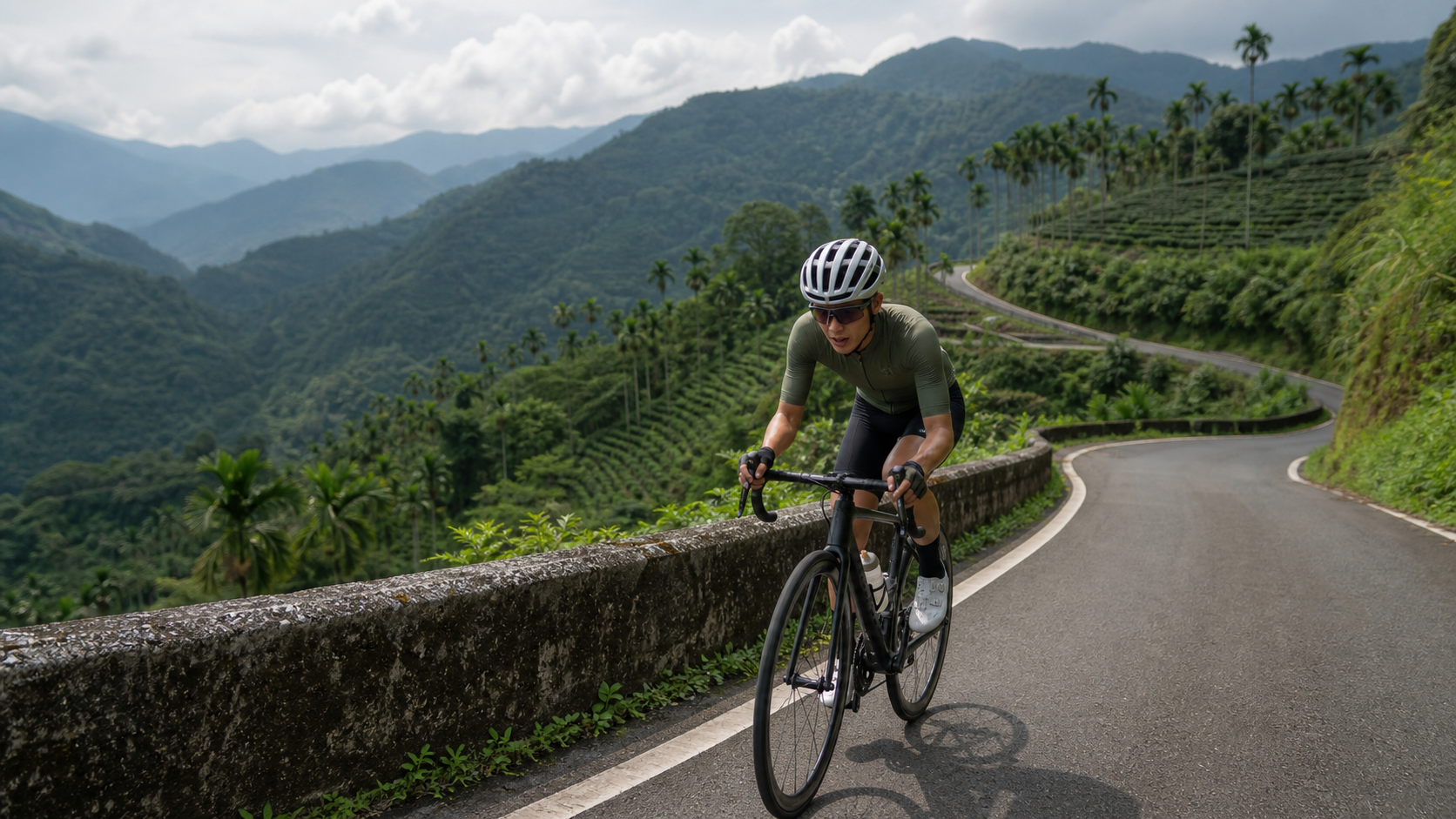
Route Overview and Data Analysis
Let’s lay out the numbers first. 6.88 kilometers of horizontal distance, 447.2 meters of vertical gain, and an average gradient of 6.3%—this means that if you ride the entire route at a steady, uninterrupted pace, your body is constantly fighting a sustained resistance slightly above 6% every minute. Compared to many well-known climbing routes in Taiwan, these figures place it squarely in the “mid-elevation training route” category. For example, the western approach to Wuling averages around 5% gradient, but the total elevation gain easily exceeds 2,000 meters over more than 30 kilometers, making it an extreme test of long-duration aerobic endurance. In contrast, Gukeng Huashan Dahu Bottom is short in distance with concentrated climbing, and its gradient distribution doesn’t offer the long recovery sections found on Wuling. Riders on this route will therefore feel a more pronounced “sustained effort” soreness, rather than the prolonged psychological attrition of Wuling.
If we compare it to shorter routes—such as sprint-style climbs of 1-3 kilometers with gradients often hitting 8-10% (like many resistance-training routes along riverside parks)—Gukeng Huashan Dahu Bottom feels considerably more moderate. Its gradient distribution is relatively even, with no prolonged hellish sections above 15%, allowing riders to complete the entire route at a fairly stable cadence and heart rate zone. This combination of “medium distance, medium gradient, and even gradient distribution” makes this route a top choice for cyclists in the Yunlin-Chiayi-Tainan region as their weekly fixed climbing workout—the distance isn’t long enough to require planning half a day around it, yet the intensity is sufficient to stimulate improvements in VO₂ max and lactate threshold.
From a sports physiology perspective, the combination of a 6.3% average gradient over 6.88 kilometers means that for a rider with basic cycling experience, completion time typically falls between 25 and 45 minutes (depending on individual fitness and pedaling efficiency). This time window sits precisely at the intersection of “anaerobic threshold training” and “aerobic endurance training.” In other words, depending on your pacing strategy for the day, this route can be trained for two distinctly different effects: if you choose to go all-out with your heart rate pushed above 90% of max, it becomes a high-intensity lactate tolerance session; but if you choose to complete it at a steady Zone 3 heart rate, it becomes a solid aerobic climbing endurance workout. This flexibility is one of the reasons Gukeng Huashan Dahu Bottom is favored by local Yunlin cycling teams—the same route can serve different training purposes depending on the phase of your training cycle.
It’s worth noting that the Huashan area where this route is located features the hilly terrain of Gukeng Township. While the elevation isn’t as extreme as the 2,000-3,000 meter mountain highways of the Central Mountain Range, its position at the junction of Yunlin’s mountain area and the Chianan Plain means the climate and terrain variations are actually quite rich. This also makes the changing views and temperature shifts during the climb an additional charm beyond the raw data. Below, we’ll break down the route segment by segment.
Segment-by-Segment Guide from Start to Finish
Segment 1: Initial Climb and Power Accumulation (0-1.5 km)
The route typically begins with a relatively gentle lead-in slope, which serves as a critical transition period as your body shifts from flat-road riding to climbing mode. For this section, a “progressive loading” pedaling strategy is recommended—don’t sprint off with high power output from the start. Instead, let your heart rate slowly climb to the lower edge of your target zone (approximately 70-75% of max heart rate), giving your lower-body muscles and cardiorespiratory system time to adapt to the sustained load ahead. The first mistake many riders make on this route is getting carried away by the excitement of the start and attacking the first slope with flat-road sprint cadence (100+ rpm). This causes lactate to accumulate too quickly, leaving you with no reserves when the gradient steepens later. For this section, it’s recommended to keep cadence between 75-85 rpm, using a lighter gear to keep your legs spinning smoothly rather than muscling a heavy gear.
Segment 2: Gradient Increase Phase (1.5-3.5 km)
Entering the middle section of the route, the gradient begins to climb noticeably, and this is where you’ll most feel the tension of the 6.3% average gradient. For this section, it’s recommended to raise your heart rate to between Zone 3 and Zone 4 (approximately 75-85% of max heart rate) and begin focusing on rhythm management through alternating between seated and standing positions. Maintaining a single riding position for extended periods causes specific muscle groups (especially the quadriceps and glutes) to fatigue excessively. Periodically standing to power over steeper sections allows blood flow to redistribute to different muscle groups, delaying the onset of localized soreness. For power meter users, it’s recommended to set a target power of 85-95% of FTP (Functional Threshold Power) for this section—an intensity range that can be sustained for a while without immediately falling apart. Heart rate monitor users can observe the rate of heart rate increase: if your heart rate spikes rapidly and refuses to stabilize, it means you’re pacing too hard and should ease off.
Segment 3: Mid-Route Recovery and Mental Adjustment (3.5-4.8 km)
Most mid-elevation climbing routes in Taiwan feature a relatively gentle section in the middle, giving riders a brief opportunity for recovery, and Gukeng Huashan Dahu Bottom is no exception. The gradient eases slightly here, making this a crucial dual adjustment point—both mentally and physically—for the entire route. Riders are advised to use this time to relax their grip on the handlebars, adjust breathing rhythm, and assess remaining energy reserves. If you notice your heart rate struggling to come down from the earlier high point, it means you may have already tapped into some of your anaerobic energy reserves. From here, you should adjust your strategy and adopt a more conservative pace to face the challenges ahead. This section is also the best opportunity for fueling—a sip of water or a small energy gel can help prepare you for the steeper sections to come.
Segment 4: Final Steep Push (4.8-6.2 km)
This is the section of Gukeng Huashan Dahu Bottom that truly tests both willpower and energy management. After the sustained climbing of the earlier sections, your leg muscles have accumulated considerable fatigue, and the gradient here typically steepens again, approaching or even exceeding the overall average. The recommended mental strategy here is “segmented goal setting”—don’t think about “how much farther to the finish,” but instead set a series of shorter visual targets (such as the next curve ahead, a utility pole) and conquer them one by one. Physiologically, this section calls for keeping power output near but not exceeding your anaerobic threshold. If you notice a distinct burning sensation in your legs and breathing becomes so labored that you can’t breathe smoothly through your nose, this is your body sending a warning signal that you’re overextending. You should immediately ease off slightly, shift to a lighter gear, and increase cadence to maintain forward progress rather than grinding a heavy gear until your muscles completely seize up.
Segment 5: Final Push and Finish Sprint (6.2-6.88 km)
Entering the final stretch of less than a kilometer, if your pacing strategy has been correct, you should still have some energy reserves for a final push. This section’s approach depends on your training goal for the day: if you’re chasing a PR (personal record), you can start increasing output once the finish is in sight, using your remaining anaerobic reserves for a final sprint. If your goal is endurance and pacing consistency, it’s recommended to maintain the steady rhythm from earlier sections and ride the entire route to completion, keeping your power curve as smooth as possible—this is actually more beneficial for long-term climbing ability development. Regardless of which strategy you choose, after crossing the finish line, it’s recommended to keep riding at an easy pace for a while to let your heart rate gradually recover rather than stopping immediately. This helps your body more efficiently metabolize the lactate produced during the effort.
Gear Ratio and Equipment Recommendations
Facing a 6.3% average gradient with local sections potentially exceeding 8-10%, your gear ratio choice directly affects whether you can maintain a smooth cadence in the later stages. Below is a reference table of gear ratio recommendations for riders of different fitness levels:
| Rider Level | Recommended Chainring | Recommended Cassette | Notes |
|---|---|---|---|
| Beginner / Average fitness | 34/50 (34T small ring) | 11-32T or 11-34T | Needs lighter gearing for the steep later sections to avoid excessive knee joint stress |
| Intermediate / Some climbing experience | 34/50 or 36/52 | 11-30T | A balanced setup for both flat cruising and climbing needs |
| Advanced / Climbing-focused training | 36/52 or standard crankset | 11-28T | Pursues power output efficiency; gearing shouldn’t be too light to avoid cadence spinning out |
| Time trial / PR chasing | Adjust based on individual FTP and power-to-weight ratio | Fine-tune based on daily target pace | Recommended to test gear ratios on similar gradient roads beforehand |
Beyond gear ratio configuration, several equipment details deserve attention. First, wheel selection: because this route features concentrated climbing over moderate distance, deep-section wheels—while offering aerodynamic advantages on flats—add unnecessary rotational weight on sustained climbs. It’s recommended to choose lighter mid-to-shallow section wheels or purpose-built climbing wheels. Second, saddle and handlebar adjustment: maintaining a climbing position for extended periods puts additional stress on the lower back and neck. Before departure, confirm that saddle height and tilt are suitable for prolonged forward-leaning riding. Finally, tire pressure settings shouldn’t be overlooked. Mountain roads occasionally have potholes and accumulated leaves, so slightly reducing tire pressure can increase grip and comfort, but it should remain within the tire’s recommended pressure range to avoid the risk of pinch flats.
Nutrition and Hydration Strategy
Although Gukeng Huashan Dahu Bottom is only 6.88 kilometers in total length and theoretically doesn’t require carrying large amounts of supplies like a long-distance climb, given the concentrated energy expenditure of mid-to-high-intensity climbing, an appropriate fueling strategy is still important. It’s recommended to consume an easily digestible carbohydrate source 30-60 minutes before departure to ensure adequate blood glucose reserves for this high-intensity effort. During the ride, since the route typically takes 25-45 minutes, additional energy gels may not be necessary, but hydration should not be overlooked—especially given Yunlin’s high summer temperatures and humidity. It’s recommended to take a sip of water every 10-15 minutes to avoid forgetting to hydrate while focused on pedaling. If you choose to tackle this route during hotter hours, consider adding electrolyte replacement to your bottles to prevent electrolyte imbalance from heavy sweating, which can trigger cramping. After completing the challenge, it’s recommended to consume a recovery mix with a protein-to-carbohydrate ratio of approximately 1:3 to 1:4 within the 30-minute golden recovery window to support muscle repair and glycogen replenishment.
Weather and Seasonal Recommendations
The climate in the Gukeng area of Yunlin is influenced by its location at the junction of the Chianan Plain and mountain terrain, resulting in relatively distinct seasonal weather variations. In summer (June to September), afternoon thunderstorms are common, so it’s recommended to start in the early morning hours—this avoids unstable afternoon weather systems, and the cooler morning temperatures also reduce the risk of heat-related issues during high-intensity climbing. Autumn and winter (November to February) offer the most comfortable conditions for tackling this route; the cool temperatures help maintain higher performance levels. However, it’s still advisable to check real-time weather forecasts, as mountain terrain can produce localized fog or rain due to shifting air currents. Always confirm road conditions and visibility before departure. In spring (March to May), pay special attention to strong winds and slippery surfaces when frontal systems pass through. Some sections of this route have steep gradients, so when descending on wet roads, be sure to slow down and maintain heightened braking awareness. Regardless of the season, it’s recommended to carry lightweight rain gear and an extra layer—mountain weather changes faster than on the plains, and being prepared ensures riding safety.
Common Mistakes and DNF Risks
The first common mistake is “losing control of pacing at the start.” As mentioned in the segment-by-segment guide, many riders are drawn in by the relatively gentle early gradient and attack with excessive intensity, only to find their energy depleted when the gradient steepens in the middle and later sections. This is the most common failure mode on this route and a primary cause of mid-route abandonment (DNF). The second common mistake is “improper gear ratio selection,” particularly for riders using standard cranksets (without compact or small chainrings). When facing local sections exceeding 8-10%, overly heavy gearing can cause cadence to plummet or even stall completely. This not only affects completion time but also increases the risk of knee joint overuse injuries from low-cadence, high-torque pedaling.
The third common mistake is “insufficient fluid and electrolyte intake,” especially when tackling this route in summer’s high heat and humidity. Many riders underestimate the importance of hydration because the route isn’t long, only to experience muscle cramps or early signs of heat exhaustion in the later stages. The fourth common mistake is “skipping warm-up and attacking directly,” particularly for riders with insufficient regular training volume or those who haven’t ridden in a while. Without proper warm-up, directly challenging a 6.3% average gradient climb places excessive instantaneous load on the cardiovascular and musculoskeletal systems, increasing the risk of injury or even cardiovascular incidents. The fifth common mistake is “letting your guard down on the descent.” Completing the climb is often followed by a descent that coincides with fatigue. If fatigue causes reduced focus or sluggish braking response, accidents can easily occur on curves or poor road surfaces—this is a critical phase where you must remain highly alert even after finishing the climb.
Target Times for Different Rider Levels
Below are reference target times based on different rider levels, which readers can use as pacing planning references according to their own fitness and training goals:
| Rider Level | Reference Completion Time | Average Heart Rate Zone | Recommended Strategy |
|---|---|---|---|
| Beginner / First-time challenger | 40-50 minutes | Zone 2-3 (65-80% max HR) | Focus on finishing and adapting to the gradient, not on speed |
| General recreational rider | 30-40 minutes | Zone 3 (75-85% max HR) | Steady pacing; conservative early, can push harder later if conditions allow |
| Advanced rider with training base | 22-30 minutes | Zone 3-4 (80-90% max HR) | Maintain near-threshold intensity throughout, emphasizing power output stability |
| Competitive / PR challenger | Under 18-22 minutes | Zone 4-5 (90%+ max HR) | Maximum output; requires a complete interval and climbing-specific training foundation |
It should be emphasized that the above times are approximate reference ranges only. Actual completion times will vary due to factors such as body weight, power-to-weight ratio, daily weather conditions, wind direction, and individual pedaling efficiency. For riders tackling this route for the first time, “safe completion and familiarizing yourself with the road” should be the top priority. After becoming familiar with the gradient distribution and your body’s responses, you can then progressively adjust pacing strategies according to your training plan and challenge faster completion times.
Periodized Training and How to Use This Route
For riders with long-term climbing ability improvement as a goal, Gukeng Huashan Dahu Bottom shouldn’t be treated merely as a one-off challenge route but rather incorporated into a complete periodized training plan. Looking at a 4-6 week training block: during weeks 1-2, this route can serve as a “base aerobic building phase” test segment, completing the full distance at a relatively conservative Zone 2 to Zone 3 heart rate. The focus is on familiarizing yourself with the rhythm of gradient changes, identifying your perceived exertion at different sections, and recording power and heart rate data as a baseline for future comparison. Weeks 3-4 can then transition into a “threshold intensity introduction phase.” During this stage, it’s recommended to raise the target power for the final steep section to approximately 95-100% of FTP, stimulating lactate threshold adaptation and improvement. At the same time, pay attention to recovery quality to avoid overtraining from intensity increasing too quickly.
By weeks 5-6, the “peak testing phase,” riders can attempt the route at near-maximal effort, comparing previously accumulated data to measure progress. At this point, completion time and average power often clearly reflect whether the training block has achieved its intended results. It’s worth noting that because Gukeng Huashan Dahu Bottom has moderate distance and concentrated climbing, it’s highly suitable as a venue for “climbing-specific intervals”—for example, repeating the steep middle-to-later sections two to three times in a single session, with adequate easy spinning recovery between efforts. This training method is particularly effective for improving short-duration high-intensity climbing tolerance, and it’s one of the key training tools many local teams use to build specific fitness before preparing for long-distance climbing events like Wuling or Hehuanshan.
Beyond tracking power and heart rate data, riders are also encouraged to develop the habit of recording subjective perceived exertion (RPE). Because Gukeng Huashan Dahu Bottom has a relatively concentrated gradient distribution, your body’s response to the same intensity can vary noticeably under different weather conditions and sleep states. Long-term RPE data logging helps you more comprehensively understand your body’s condition, avoiding overtraining judgments based solely on heart rate or power numbers. Segment data recorded via GPS sports watches or power meters should also be regularly uploaded to training platforms for trend analysis, observing whether the relationship between power output and heart rate response on the same sections shows positive changes as the training block progresses—for example, heart rate gradually decreasing at the same power output, which typically indicates improving aerobic efficiency and cardiorespiratory adaptation, a concrete manifestation of training effectiveness.
Gukeng Huashan Dahu Bottom, as a mid-elevation climbing route with complete data and representative gradient distribution, deserves to be incorporated into the regular climbing training menu of riders in the Yunlin-Chiayi-Tainan region. Through repeated challenges and data accumulation, you’ll be able to more precisely track your climbing ability growth curve, and when facing longer, more difficult challenge routes, you’ll have a more solid fitness foundation and pacing experience to rely on.
Route Integration Planning with Surrounding Yunlin Routes
Due to its geographical location, Gukeng Huashan Dahu Bottom is frequently incorporated by Yunlin-Chiayi-Tainan cycling teams into longer training or challenge itineraries—for example, connecting with the nearby Shibi Yunling Zhiqiu, Caoling Scenic Area road networks, or extending to the rolling roads around Janfusun Fancyworld. If you schedule Dahu Bottom early in the itinerary, the advantage is having the most complete energy reserves, making it suitable for riders chasing personal best times. However, note that although this route isn’t particularly long, the sustained mid-to-high-intensity effort still consumes a significant portion of glycogen stores. If subsequent plans include longer climbs (such as Shibi Yunling Zhiqiu’s sustained gentle gradient exceeding 10 kilometers), be sure to arrange adequate fueling and brief rest between the two segments to avoid imbalanced energy distribution.
If you schedule Dahu Bottom as a finishing challenge at the end of the itinerary, pay special attention to whether your current muscle fatigue level can handle sustained climbing above 6.3%. Before reaching the start point, do a complete check of energy and hydration status, and appropriately adjust expectations for target time, prioritizing safe completion over chasing personal records. Regardless of how you arrange it, it’s recommended to use route planning tools or GPX tracks to confirm total elevation gain and distance distribution in advance, avoiding underestimating this route’s intensity and running out of energy in the later stages of your itinerary.
Group Ride vs. Solo Challenge Strategy Differences
Because Gukeng Huashan Dahu Bottom’s gradient changes are concentrated in the middle and later sections, group ride formation management requires special attention. Riders of different fitness levels will see their speed gaps significantly amplified during Segment 2’s gradient increase phase and Segment 4’s final steep push. For group rides, a “segmented regrouping” strategy is recommended: pause briefly at key milestones (such as the mid-route recovery section in Segment 3) to wait, allowing less fit riders a chance to catch their breath and regroup, rather than forcing a tight formation all the way through. This approach is not only safer but also makes the overall group ride atmosphere more relaxed and enjoyable.
When challenging this route solo, since it’s located in Yunlin’s hilly mountain terrain with some sections having sparse traffic, it’s recommended to inform family or team members of your challenge time window and estimated completion time, and carry basic emergency equipment. Especially if you choose to ride during weekday early mornings or evenings when there are fewer people and vehicles, while the simpler road conditions are conducive to focused pacing, if a mechanical failure or physical discomfort occurs, the wait time for rescue or assistance may be longer. Pre-ride safety preparations are essential.
Related Reading
- Caoling Highway Practical Guide: How to Ride Yunlin’s 6.4 km, 429 m Mountain Training Climb
- Dahu Jiangmayuan Practical Guide: A Systematic Breakdown of the 5.8 km, 384 m Cloud Sea Route
- MaoKong Zhinan Temple Practical Guide: Complete Analysis of Taipei’s Classic 6.93 km Intermediate Climb with 388 m Elevation Gain and 5.6% Average Gradient
- Shibi Yunling Zhiqiu Practical Guide: The Art of Endurance and Pacing on a 10.76 km Sustained Climb
#北橫 + #北進武嶺 最硬的員工旅遊 EP1 | #公路車 #拉拉山 | 明池 | 武嶺 | 武陵農場 | 雲海 | Taiwan Cycling Route Wulin
6 年前
大禹嶺 到 武嶺牌樓 全程前後實況錄影 | 北進武嶺 | 東進武嶺 | KOM | 訓練台 | 坡度分析 | Taiwan KOM Last 10 km HARD | 公路車
6 年前
#公路車 #西進武嶺 配速配瓦實驗 坡度分析 四小時內攻略 建大盃 NeverStop #西進武嶺攻略
6 年前
單車 梅山36灣 坡度介紹 路段介紹 空拍 (相關遊記影片,請參考說明或我的頻道喔,歡迎訂閱)
6 年前
台北闊瀨陡坡 騎旅 / 日本單車雜誌編輯車友臨時加入!/ 髮香才是最強的 / feat. 北迴歸線小隊 / 公路車 CT Yeh
6 個月前
雨戰! 西進武嶺員工旅遊 加料 各路段大數據分析 | 同事端出5公斤的公路車來挑戰!? EP1
4 年前
#東進武嶺 全程實況錄影 5小時半 #夏季KOM #太魯閣 Taiwan KOM Challenge Reality Video Taroko scenery
7 年前
Never Stop 西進武嶺 前後雙機 完整全程錄影 訓練台 實境
8 年前