Shibi Yunling Hill Practical Guide: The Art of Endurance and Pacing on a 10.76km Long Gentle Climb
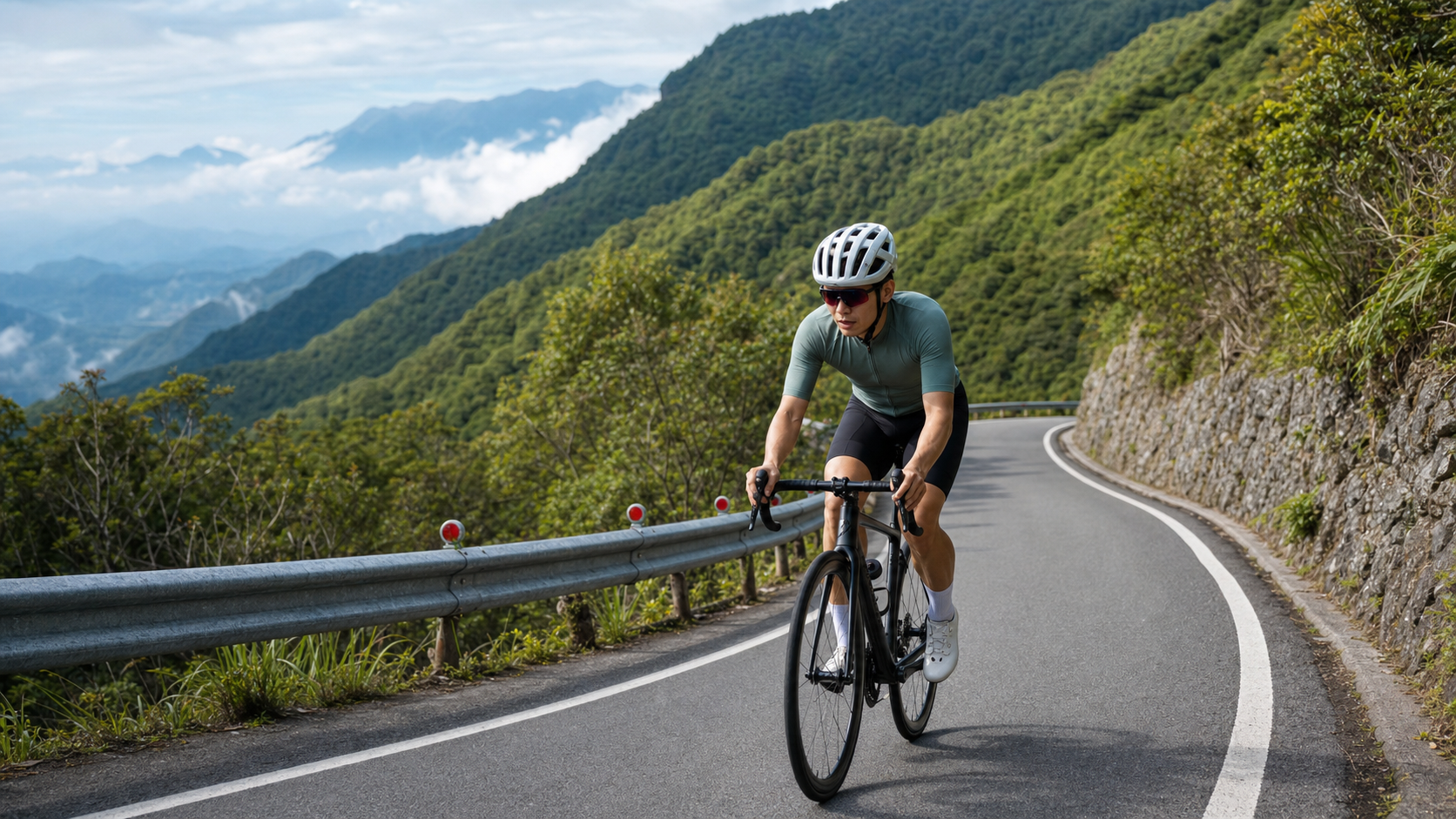
Route Overview and Data Analysis: The Hidden Difficulty of a Long, Gentle Climb
Let’s first place this route within the coordinate system of Taiwan’s climbing routes. At 10.76 kilometers, this falls squarely into the “long-distance climb” category—a distance that typically requires riders to sustain continuous output for over half an hour, demanding far more from both cardiovascular and muscular endurance than short, steep climbs. And while the 4.2% average gradient doesn’t look steep on paper, this gradient range happens to sit in a dangerous zone where riders easily “misjudge their pacing”—because the slope isn’t steep enough, many subconsciously approach it with the mindset of cruising on flat roads, only to realize at the seven or eight-kilometer mark that their energy reserves are nearly depleted. This is precisely why long, gentle climbs are where riders most often find themselves caught off guard.
Comparing this with the tactical thinking behind short, steep climbs makes the uniqueness of Shihbi Yunling Hill easier to understand. Facing a 2-3 km climb with gradients of 8-10%, riders typically adopt a “short-duration, high-intensity output” strategy—because the distance is short, even if you push too hard early on, you can reach the summit as long as you endure the pain through the middle and later sections, making the risk of blowing up relatively manageable. But facing a 10.76 km long, gentle climb like Shihbi Yunling Hill, the same “push too hard” strategy is almost guaranteed to lead to disastrous consequences, because long-distance climbs deplete energy systems in a way that more closely resembles marathon-style aerobic endurance management rather than sprint-style anaerobic explosive output. Once you’ve burned through your stored carbohydrates and glycogen in the early part of the route, even if the gradient doesn’t intensify noticeably later, your body will experience significant exhaustion due to the “hitting the wall” effect.
The Shihbi area where this route is located sits at an elevation of roughly 1,400 to 1,700 meters—an altitude range already sufficient to create measurable differences in temperature and oxygen concentration compared to sea level. While this isn’t high enough to trigger significant altitude sickness symptoms (generally considered to become a notable risk above 2,500 meters), for riders who typically train at lower elevations, sustained high-intensity output at this altitude does produce a noticeable slight decrease in breathing efficiency and a somewhat slower recovery rate. This is one of the reasons why Shihbi Yunling Hill, despite its seemingly moderate average gradient, often proves more challenging in practice than expected.
From a training-effectiveness perspective, the combination of 10.76 kilometers at a 4.2% average gradient makes this an excellent “aerobic endurance and pacing stability” training route. This intensity won’t push you into severe anaerobic metabolism within a short time; instead, it allows you to sustain the upper-middle portion of your aerobic zone (roughly the boundary between Zone 3 and Zone 4) for extended periods—precisely the golden intensity range for improving mitochondrial density, capillary density, and fat metabolism efficiency. For riders preparing to tackle longer climbing events (such as the Wuling series routes), Shihbi Yunling Hill is an ideal specialized training route that effectively simulates the sensation of sustained effort and the pacing management challenges of long-duration climbing.
Segment-by-Segment Guide from Start to Finish
Segment 1: The Start and Establishing Rhythm (0-2 km)
Facing a 10.76 km long-distance challenge, the pacing strategy at the start carries far more importance than on short climbing routes. For this segment, it’s recommended to keep your heart rate in a relatively conservative range (approximately 65-75% of max heart rate), maintain a cadence between 80-90 rpm, and begin riding at an intensity you feel “you could sustain for the entire route.” The first mistake many riders make on this route is subconsciously starting at cruising speed or even slightly faster because the gradient doesn’t feel steep—a pacing error that often only exacts its toll seven or eight kilometers later. It’s recommended to practice “pacing by feel” during this segment rather than determining output intensity based on “how steep the road looks.”
Segment 2: Entering the Tree-Lined Climbing Section (2-4.5 km)
As elevation gradually rises, the route enters a section with denser tree cover. The gradient distribution here is relatively uniform, making this a critical zone for establishing a steady pacing rhythm. It’s recommended to slightly raise your target heart rate to the middle of Zone 3 (approximately 75-80% of max heart rate) and begin focusing on breathing rhythm management—a regular breathing pattern of three pedal strokes per inhale and three per exhale (or adjusted proportionally to your cadence) is recommended. This rhythmic breathing pattern helps maintain stable oxygen uptake efficiency and prevents accelerated energy expenditure caused by disordered breathing. For power meter users, it’s recommended to set the target power for this segment at 75-85% of FTP—an intensity range that can be sustained for extended periods while still making steady progress.
Segment 3: Bamboo Sea Scenic Section and Elevation Transition (4.5-7 km)
This section gradually enters the area around Shihbi Bamboo Sea, where the interwoven Moso bamboo groves enrich the scenery along the way. However, this is also a section with more pronounced elevation transitions—temperatures gradually drop as altitude rises, and the air becomes thinner. Riders are advised to start paying attention to changes in breathing efficiency here—if you notice that at the same output intensity, your breathing feels more labored than during sea-level training, this is a normal altitude adaptation response and nothing to be overly concerned about. However, you should moderately reduce your output intensity to give your body more leeway to handle the upcoming sections. This is also an important refueling opportunity—it’s recommended to do a full water and energy replenishment here to prepare for the longer stretches ahead.
Segment 4: Mid-to-Long Distance Endurance Maintenance Section (7-9 km)
Entering the latter part of the route, this is the section of Shihbi Yunling Hill that most tests mental endurance. After roughly seven kilometers of sustained output, fatigue will begin to accumulate noticeably. While this section has no particularly steep stretches, the continuous effort will gradually drain your endurance reserves. The recommended strategy here is “pacing anchoring”—select a power or heart rate value you’re confident you can maintain to the finish, and strictly discipline yourself not to accelerate recklessly just to end the suffering sooner, nor to let your output drop too far below the target range due to fatigue. The biggest taboo in long-distance climbing is significant pacing fluctuation—a rhythm of surging and fading will deplete your energy far faster than a steady, moderate intensity.
Segment 5: The Final Push to the Yunling Hill Observation Platform (9-10.76 km)
In this final stretch, as you approach the renowned Yunling Hill observation platform, the elevation reaches the highest point of the entire route. Temperatures typically drop noticeably, and if weather conditions permit, this is also an excellent vantage point for viewing the sea of clouds. Physiologically, this segment calls for final rhythm adjustments based on your remaining reserves—if you paced the earlier sections well, you should still have enough in the tank to slightly increase intensity for the push to the finish. However, if you’re already experiencing clear signs of exhaustion (such as inability to maintain cadence, blurred vision, or unusual fatigue), you should prioritize finishing safely and moderately slow down. At this altitude combined with prolonged physical exertion, overextending yourself in a sprint could increase the risk of accidents. After reaching the summit, it’s recommended to pause briefly at the observation platform to let your body gradually adapt to the changes in altitude and temperature before beginning the descent.
Gear Ratio and Equipment Recommendations
Although Shihbi Yunling Hill’s average gradient is only 4.2%, given the 10.76 km distance, gear ratio selection should prioritize “maintaining a stable cadence over extended periods” rather than simply handling localized steep sections. Below is a reference table for gear ratio configurations:
| Rider Level | Recommended Chainring | Recommended Cassette | Notes |
|---|---|---|---|
| Beginner / Average fitness | 34/50 (34-tooth small ring) | 11-32T or 11-34T | Prioritize knee protection and cadence stability for long-distance riding |
| Intermediate / Has long-distance riding experience | 34/50 or 36/52 | 11-30T | A balanced setup between cruising efficiency and energy management |
| Advanced / Endurance-oriented rider | 36/52 or standard crankset | 11-28T | Pursuing long-duration stable output efficiency |
| Chasing limit-breaking times | Adjust based on personal FTP and power-to-weight ratio | Fine-tune based on target pacing for the day | Power meter recommended for precise output curve control |
For equipment, given the route’s higher elevation and longer riding time, special attention should be paid to layering for warmth and breathability—in mountainous areas, temperature drops approximately 0.6°C for every 100 meters of elevation gain. Considering that the Shihbi area sits between 1,400 and 1,700 meters, the temperature difference compared to sea level can be quite significant. It’s recommended to carry a lightweight windbreaker or arm warmers for easy on-and-off adjustments as body temperature and elevation change. For wheelset selection, since this route is primarily long-duration cruising climbs, a mid-profile wheelset that balances rolling efficiency and weight would be a more balanced choice. Additionally, longer riding times place higher demands on saddle comfort—it’s recommended to confirm that your saddle angle and padding material suit extended riding, to prevent discomfort from poor positioning that could compromise pacing stability.
Nutrition and Hydration Strategy
Since Shihbi Yunling Hill spans over 10 kilometers at higher elevation, the importance of a nutrition strategy far exceeds that of short climbing routes. It’s recommended to consume a complete, easily digestible meal 2-3 hours before departure to ensure adequate glycogen stores for the prolonged riding demand. During the ride, it’s recommended to replenish with energy gels or sports nutrition every 20-30 minutes, paired with regular fluid intake, to avoid “hitting the wall” from neglecting nutrition during the extended ride. A special reminder: because this route is at higher elevation with cooler temperatures, riders’ perception of thirst tends to be duller than at sea level or lower elevations, making dehydration easy to slip into unnoticed. It’s recommended to proactively hydrate on a time-based schedule rather than relying solely on thirst sensation to determine when to drink.
At higher elevations, it’s also recommended to watch for mild altitude sickness symptoms such as headaches, slight nausea, or unusual fatigue. Although the Shihbi area’s elevation hasn’t reached heights that readily trigger severe altitude sickness, for riders who rarely train at altitude, a conservative approach is still advised—if noticeable discomfort symptoms appear, immediately slow down or even stop to rest rather than pushing through. After completing the challenge, be sure to stay warm—in high-altitude mountain areas, even in summer, temperatures can drop noticeably after dusk. Since your body’s core temperature regulation is temporarily impaired after prolonged exercise, proper insulation is essential to avoid catching a chill.
Weather and Seasonal Recommendations
The Shihbi area is located in the Yunlin mountains at higher elevation, with climate conditions distinctly different from the plains or the Gukeng foothills. Yunling Hill is renowned for its sea of clouds views, which typically form under specific combinations of air pressure, humidity, and terrain conditions. During autumn and winter, early morning hours offer relatively better chances of favorable cloud-viewing conditions, but this is by no means a guaranteed pattern—whether you’ll actually see the sea of clouds depends on that day’s weather conditions. It’s recommended to check recent weather information before departure as a supplementary reference, and avoid holding absolute expectations of seeing the sea of clouds.
Due to the higher elevation, temperatures on this route are generally cooler than on flat or lower-elevation routes. Even in summer, extra insulation layers may be needed during early morning and evening hours. Tackling this route in winter requires particular attention to staying warm and the risk of slippery roads—mountain roads in cold, damp conditions are prone to moisture condensation, so be sure to reduce speed and stay alert on descents. Additionally, since the latter part of the route enters higher mountain terrain, the probability of foggy conditions is relatively higher. It’s recommended to carry a reflective vest or warning lights to ensure riding safety even in poor visibility conditions.
Common Mistakes and DNF Risks
The first common mistake is “underestimating the endurance demands of a long distance because the gradient is gentle”—this is the most representative failure mode on Shihbi Yunling Hill. Many riders see the 4.2% average gradient and mistakenly assume it’s a relatively easy route, starting at too fast a pace, only to experience a sharp decline in energy after seven or eight kilometers, sometimes reaching the point of being unable to complete the challenge. The second common mistake is “insufficient nutrition planning.” Long-distance climbs consume far more energy and fluids than short routes; without regular refueling, hitting the wall in the latter sections becomes highly likely—this is also one of the most common physiological factors behind mid-ride abandonments.
The third common mistake is “ignoring the effects of altitude and temperature differences on the body.” The Shihbi area’s elevation is significantly higher than the plains, with temperature, oxygen concentration, and humidity all differing from the starting point. Without appropriate warm clothing or adequate mental preparation, performance can suffer from temperature differences and reduced breathing efficiency, potentially even causing mild discomfort symptoms. The fourth common mistake is “significant pacing fluctuation.” The biggest taboo in long-distance climbing is a rhythm of surging and fading—some riders accelerate recklessly when they see a slightly easier gradient ahead, only to be forced to slow down dramatically when the gradient steepens again. This unstable pacing pattern depletes energy reserves faster than a steady, moderate intensity. The fifth common mistake is “underestimating the risks of the return trip or descent.” After completing a long climb, the body is typically in a fairly fatigued state. Descending over a long distance in this condition, with reduced focus from fatigue, makes accidents more likely at corners or gradient changes—this is a critical aspect that requires sustained vigilance even after finishing.
Target Times for Riders of Different Levels
Below is a reference target time table based on different rider levels:
| Rider Level | Reference Completion Time | Average Heart Rate Zone | Recommended Strategy |
|---|---|---|---|
| Beginner / First-time challenge | 70-90 minutes | Zone 2-3 (65-78% max HR) | Primary goal is finishing and familiarizing with long-distance pacing |
| General recreational rider | 50-70 minutes | Zone 3 (75-83% max HR) | Steady pacing throughout; avoid starting too fast |
| Advanced rider with training foundation | 38-50 minutes | Zone 3-4 (80-88% max HR) | Maintain steady mid-to-high intensity throughout; focus on endurance management |
| Competitive / PR chaser | Under 35 minutes | Zone 4 (85%+ max HR) | Requires complete long-distance endurance and altitude adaptation training foundation |
It’s important to emphasize that because this route is long and at higher elevation, actual completion times are subject to more variables than shorter routes, including wind direction, temperature, that day’s nutrition status, and individual endurance training foundation—all of which can cause significant differences in completion time. For riders attempting this route for the first time, it’s strongly recommended to start with a conservative pace, making “finishing safely and mastering long-distance pacing rhythm” the primary goal rather than chasing speed from the outset.
Periodized Training: Incorporating Shihbi Yunling Hill into a Long-Climb Preparation Plan
For riders aiming to tackle longer, more challenging climbing routes (such as classic mountain challenges like Wuling or Hehuan Mountain), Shihbi Yunling Hill is an exceptionally cost-effective specialized training route. Looking at a six-to-eight-week training cycle, the initial two weeks can treat this route as a “pacing perception building period”—the focus isn’t on chasing speed but on repeatedly practicing how to suppress the urge to accelerate on sections where the gradient looks deceptively gentle, completing the entire route at a steady, slightly conservative intensity to cultivate sensitivity to long-distance pacing. During this phase, it’s recommended to use a power meter or heart rate strap to record detailed per-kilometer segment data, then analyze your intensity fluctuations across different sections afterward to identify where your pacing is most unstable and improve accordingly.
Entering the middle of the training cycle, roughly weeks three to five, the training focus can shift to the “lactate threshold maintenance period”—attempting to raise the overall average intensity of the full route to a level approaching but not exceeding your personal lactate threshold, while observing how long you can sustain this intensity and at which kilometer mark significant intensity drop-off begins. This training method is highly effective for improving tolerance for prolonged mid-to-high-intensity output and is an indispensable key training stimulus when preparing for long-distance climbing events. In the latter phase of the training cycle, weeks six to eight, you can enter the “race simulation period,” attempting the route under conditions closely resembling your target event (such as similar refueling timing and similar equipment configuration), treating Shihbi Yunling Hill as a complete “mini Wuling simulation race” to test whether your nutrition strategy, pacing plan, and mental toughness are ready.
Beyond power and heart rate data, long-distance climbing training also recommends paying particular attention to the “pacing coefficient of variation” metric—observing whether the amplitude of your power or heart rate fluctuations throughout the ride gradually narrows as the training cycle progresses. The lower the coefficient of variation, the more mature your pacing control ability, which has a decisive impact on whether you can maintain stable performance and avoid premature exhaustion from pacing loss of control when tackling longer, higher-altitude climbs in the future. Because Shihbi Yunling Hill has a moderate distance (not so long that a single training session takes excessive time), uniform gradient distribution (ideal for practicing steady output), and a certain elevation (providing initial high-altitude sensation adaptation), it’s a rare choice for riders in the Yunlin-Chiayi-Tainan region that combines convenience with training effectiveness when preparing for long-distance mountain challenges.
Shihbi Yunling Hill, as a representative route featuring long distance, low-to-moderate gradient, and high elevation, is an exceptional venue for riders in the Yunlin-Chiayi-Tainan region to train endurance management and pacing stability. It’s well worth repeated challenges to continuously accumulate your own long-distance climbing experience, and it serves as the most solid and reliable mid-term checkpoint and confidence source before tackling longer, higher-difficulty mountain routes in the future.
Practical Interpretation of Power Curves and Pacing Variation
Because Shihbi Yunling Hill has relatively uniform gradient distribution and a long distance of 10.76 kilometers, it’s an excellent route for examining your “long-duration power stability.” An ideal power curve should appear as a relatively smooth line with minimal fluctuation, rather than spiking and dipping like on rolling terrain routes. If you review your data after the ride and find that your power curve is noticeably high in the early section but drops sharply in the latter section, this indicates you paced too aggressively at the start, prematurely depleting precious carbohydrate stores—this is the most common pacing error on long, gentle climbs and the one most in need of correction.
Riders equipped with power meters are advised to pay particular attention to the gap between “normalized power” and “average power”—this metric carries more reference value on long-distance climbs than on short, steep routes. If the gap between the two is too large, it means your output intensity during the ride was unstable. Even if the average power number looks respectable, the actual perceived exertion will be far higher than the number suggests. In this case, even if you complete the ride successfully, your recovery time the next day will be longer. By repeatedly challenging this route and recording data, gradually narrowing the gap between normalized power and average power is the core training direction for improving performance on long, gentle climbs—and the best training ground for building the pacing discipline foundation needed for future challenges on longer mountain routes like Wuling and Hehuan Mountain.
Route Integration Planning with Surrounding Yunlin Routes
Because Shihbi Yunling Hill is situated in the heart of the Yunlin mountain area, it’s frequently incorporated by local cycling clubs into long-distance traverse itineraries that combine Caoling Scenic Area and Gukeng Huashan Dahudi. Since this route itself is longer and at higher elevation, if you plan to connect it with other routes, it’s recommended to place Shihbi Yunling Hill at the core or early portion of the entire itinerary, ensuring you face this long, gentle climb with your body’s reserves at their most complete—avoiding tackling this route that demands high-level endurance management only after your energy has already been substantially depleted.
If your goal is to combine Shihbi Yunling Hill and Gukeng Huashan Dahudi into a single day’s challenge, be sure to note that the intensity characteristics of the two routes are completely different—Dahudi is a mid-distance, mid-to-high-intensity sustained-effort route, while Shihbi Yunling Hill is a long-distance, mid-to-low-intensity endurance management route. It’s recommended to schedule adequate rest and refueling time between the two segments, giving your body the opportunity to recover from different energy metabolism modes, ensuring the entire itinerary maintains good riding quality and safety.
Related Reading
- Luchang Steep Slope Combat Guide: The Ultimate Challenge of 4.09 km at 9.6% Average Gradient, Fully Analyzed
- Caoling Highway Combat Guide: How to Ride Yunlin’s Mountain Training Climb—6.4 km with 429 Meters of Elevation Gain
- Sanxia Xiongkong Yue Ling Combat Guide: A Hellish Climb Under Three Kilometers—Are You Really Ready?
- Guguan Uphill Guide: The 4.4 km, 11.7% Average Pure Steep Climb Refinement Textbook
台北闊瀨陡坡 騎旅 / 日本單車雜誌編輯車友臨時加入!/ 髮香才是最強的 / feat. 北迴歸線小隊 / 公路車 CT Yeh
6 個月前
大禹嶺 到 武嶺牌樓 全程前後實況錄影 | 北進武嶺 | 東進武嶺 | KOM | 訓練台 | 坡度分析 | Taiwan KOM Last 10 km HARD | 公路車
6 年前
#公路車 #西進武嶺 配速配瓦實驗 坡度分析 四小時內攻略 建大盃 NeverStop #西進武嶺攻略
6 年前
大武山後門26%歡樂陡坡!JJSC南台灣單車行Day2 / 被颱風追著跑 / 公路車 / CT Yeh
2 年前
雨戰! 西進武嶺員工旅遊 加料 各路段大數據分析 | 同事端出5公斤的公路車來挑戰!? EP1
4 年前
西進武嶺 世界紀錄挑戰!破2:30 ?!一群人推著一個夢上山 直播精華版 / ft. 張翰允 & 台視主播魏于恬 & KPLUS / #cycling 公路車 CT Yeh
2 個月前
半日 小台灣 極限單車路線挑戰實錄
7 年前
西進武嶺各路段 前8000名 大數據分析 配速攻略/功率/心律/推力比/維持率/踏頻/踏瓦比/牽車率 大公開 | 建大盃 NeverStop 可參考 | 公路車 | CT Yeh
5 年前