Zhushiku Road Practical Guide: 5.16 km, 253.6 m Elevation Gain, Rhythm Training on the Yangmingshan Valley Climb
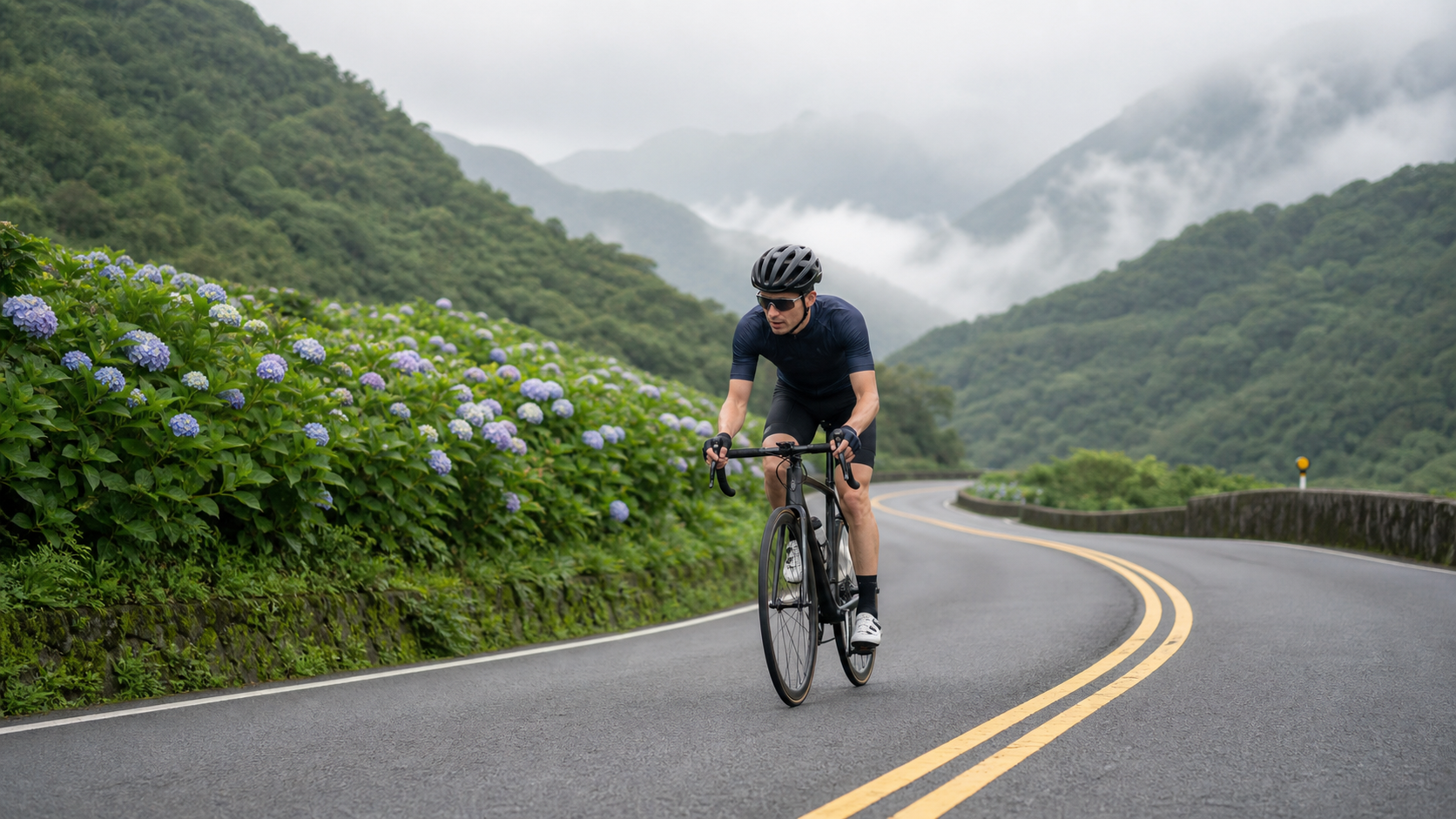
Zhuzihu Road is one of the few climbing routes in the Yangmingshan system that can be described with the single word “balanced.” Unlike Balaka Road, which keeps you gasping for air the whole way, or the sections around the Small Crater that sometimes feature gradients in the double digits, it challenges riders with a relatively stable gradient, testing your rhythm control and patience. This article will break down this route in a hard-hitting, data-driven way: where it’s tough, where you can relax, how to set up your gearing, and how to prepare your body.
Route Overview and Core Data
Let’s lay out the hard numbers first. Zhuzihu Road is 5.16 km long with a total climbing of 253.6 meters and an average gradient of 4.9%. It is registered on Strava as segment 677556 and is located in the Shilin District. Geographically, this route lies in a valley between Datun Mountain and Qixing Mountain. The elevation near the finish line is approximately 670 meters, which is why temperatures in the Zhuzihu area are noticeably lower than in Taipei City even in summer—the valley terrain combined with altitude creates a natural cooling pocket.
How should we interpret the 4.9% average gradient? Compared to other famous climbing sections in Taiwan, this gradient falls into the “noticeable but not fierce” range. It is significantly more demanding than typical urban bridge approaches (mostly 2-3%), but it is far from the level of certain continuous hairpin turn sections on the Yang-Jin Highway (often 8% or more). In terms of power, an amateur rider with an FTP (Functional Threshold Power) around 200 watts needs to output about 75-85% of their FTP to maintain an average speed while climbing for about 5 kilometers on a 4.9% gradient. This is an intensity level that can be sustained for over 20 minutes but is absolutely not easy.
It is worth noting that “average gradient 4.9%” is the average for the entire route and does not mean every section has this slope. Roads in the Yangmingshan area are mostly carved along contour lines and valley terrain, so the gradient fluctuates—some sections may flatten or even briefly descend, while others are steepened to 7-8% to make up the average. This is exactly where the “tactics” for this route come in: if you treat it as a constant 4.9% slope, your pacing will definitely be off, because when the gradient suddenly steepens, maintaining your original cadence and gear ratio will cause your heart rate to spike instantly, leading to a loss of speed in the latter stages.
Segment Strategy: Rhythm Changes from Start to Finish
Breaking the 5.16 km into several stages is the most practical way to handle this type of “valley-type climb.” Although this article does not specify every turn or exact kilometer marker (the Yangmingshan area has many road intersections; it is recommended that riders load the route data on Strava or Komoot before departure, and actual mileage should be judged by the bike computer GPS), the entire route can be conceptually divided into three major sections based on “climbing rate,” corresponding to different riding strategies.
First Stage (Warm-up Climbing Phase): When the route first starts, the body is usually not yet fully warmed up, and muscles and the cardiovascular system are still warming up. It is recommended to deliberately keep output low during this section; it is better to slightly underestimate your ability than to rush to a high heart rate at the start. Many riders’ loss of speed is not because the climb itself is too difficult, but because a “warm-up sprint” at the beginning depletes anaerobic reserves, leaving nothing for the latter stages. As a medium-distance climb (5 km level), it is recommended to keep heart rate below the lactate threshold in the first section, giving the body time to “wake up” the aerobic system.
Second Stage (Rhythm Maintenance Phase): This is the main body of the route and the interval where the 4.9% average gradient mainly occurs. The keyword here is “consistency”—try to ride with the same cadence and relative output intensity throughout, avoiding fluctuations. Sections in the Yangmingshan valley often have tree shade, so visibility opens and closes as turns change. Additionally, mountain areas often get foggy in the afternoon, and changes in visibility may cause riders to unconsciously slow down to look around. At these times, it is even more important to maintain rhythm using objective data like power meters or heart rate monitors rather than relying solely on feel.
Third Stage (Finishing and Gradient Fluctuation Phase): As mentioned earlier, when approaching the latter part of the route, valley terrain often has local steep sections to make up the average. It is recommended to start “reserving” 1-2 km in advance—adjusting the rhythm slightly more conservatively than in the middle section to leave some margin for sudden short steep slopes. This is why many veterans, when climbing this type of route, are accustomed to setting the power target for the entire route at around 95% of their theoretical limit rather than riding at 100%, because the extra 5% buffer is often used to absorb those “steep slopes hidden within the average.”
Gear Ratio and Equipment Recommendations
The characteristics of Zhuzihu Road, with an average gradient of 4.9% and sections that steepen locally, determine that its gearing requirements are “moderate to conservative.” With current mainstream road bike configurations:
| Rider Level | Recommended Gear Ratio | Description |
|---|---|---|
| Advanced/Competition | 50/34 paired with 11-28 | Use the big ring to control speed in the first section; still have margin for steep sections |
| General Leisure Riders | 50/34 paired with 11-30 or 11-32 | More generous low gears to reduce knee strain |
| Beginners/Physical Reconstruction Phase | Compact paired with 11-32 or higher | Prioritize protecting joints and cardiovascular system; finishing the climb slowly is most important |
If your bike is a mountain bike converted with road tires or uses an off-road kit like GRX, the advantage of a wide gear range will be particularly obvious on this type of route—you don’t have to sacrifice cadence to force a gear ratio. It is recommended to maintain a cadence between 75-90 rpm. A cadence that is too low (below 65 rpm) will cause the quadriceps to bear too much torque, leading to cramps or weakness in the latter stages of long distances. This is especially common on “medium-distance” routes like this one with 253.6 meters of climbing, because unlike short steep slopes that can be endured for a few minutes, it requires muscle endurance to last over 20-30 minutes.
Regarding tire pressure, road surfaces in the Yangmingshan area are mostly well-maintained but occasionally have potholes and fallen leaves (especially after rain). It is recommended to lower road bike tire pressure by 5-10 psi compared to usual to increase grip and comfort. After all, the focus of this route is stable output rather than extreme sprinting.
Nutrition and Hydration Strategy
The distance of 5.16 km with an estimated riding time of about 20-40 minutes (depending on fitness level) is theoretically not long, but the climate changes in the Yangmingshan area are the real variables to watch for on this route. Because of the valley and altitude, temperatures in Zhuzihu are naturally lower than in the city, but humidity may be higher due to terrain effects, with fog or even rain likely in the afternoon.
Pre-Ride Nutrition: It is recommended to complete a main meal 1-2 hours before departure to avoid challenging the climb on an empty stomach. Supply points around Zhuzihu are not dense during non-core tourist hours, so it is recommended to fill water bottles and prepare portable food (energy gels, bananas, or simple carbohydrate sources) in the city below before going up the mountain.
In-Ride Nutrition: Given the length of this route, most riders do not need to eat extra during the climb, but hydration remains important—especially during the summer Hyacinth season or periods with more crowds, where the feeling of stuffiness can be amplified by the terrain’s humidity. It is recommended to sip water every 10-15 minutes to avoid stomach discomfort from drinking too much at once.
Descent and Finishing: If you plan to return the same way or connect to other sections after completing the climb, remember to assess your energy and supplies. Temperature differences between day and night and rapid weather changes are common in the Yangmingshan area, with localized showers or fog often occurring in the afternoon. Visibility must be reduced, and speed must be slowed down, especially on downhill sections.
Weather and Seasonal Considerations
The most well-known seasonal landscape of Zhuzihu is the Hyacinth fields—the West Zhuzihu area is famous for its hyacinth fields, with the flowering season concentrated between February and May. During this period, tourist and traffic volume is at its peak, and the official government will hold flower season events in cooperation with locals. If your main purpose is “quiet cycling,” it is recommended to avoid peak holiday times during this period or go early in the morning on weekdays. Besides the Hyacinth season, Zhuzihu has other flower viewing periods, but the exact flowering time will be adjusted according to the year’s climate and agricultural planning. It is recommended to check current official announcements online before riding and not to plan your trip solely based on established impressions.
Regarding the climate, the Yangmingshan area is affected by terrain, so the probability of afternoon fog and brief showers is significantly higher than in the city, especially during seasons with higher humidity. During the Northeast Monsoon season in winter, mountain temperatures may be significantly lower than in the plains, with a lower perceived temperature. It is recommended to carry a lightweight windbreaker. Even for night or morning rides in summer, it is recommended to prepare a windproof layer to handle temperature differences.
Common Mistakes and DNF Risk Points
Mistake One: Rushing the First Half. As mentioned earlier, a 4.9% average gradient may not seem intimidating, leading many riders to sprint at near-maximum intensity at the start. As a result, they lack the power in the latter half when the gradient increases, forcing them to push the bike or advance at a very slow pace for extended periods.
Mistake Two: Ignoring Sudden Mountain Weather. The Yangmingshan area has complex terrain, and fog forms quickly, causing visibility to drop significantly within a short time. Without proper lighting and reflective gear, the visibility risk on such sections should not be underestimated, especially during dawn and dusk when light is already insufficient.
Mistake Three: Gear Ratio Configuration Too Heavy. Many riders are accustomed to heavy gear ratios for flat city roads and find their cadence drops below 50 rpm after climbing. In such cases, the torque on the knees increases significantly, which can lead to patellar tendon discomfort over the long term.
Mistake Four: Underestimating Slippery Road Risks. The vegetation in Yangmingshan is dense, and fallen leaves and moss tend to accumulate on the road shoulders and inside of curves after rain, significantly increasing braking distances. Riders must slow down and avoid emergency braking when turning.
Target Time Reference for Riders of Different Levels
The following times are for reference only; actual performance will vary depending on daily conditions, physical base, and equipment configuration:
| Rider Level | Estimated Completion Time | Average Speed |
|---|---|---|
| Competitive Level (FTP above 4W/kg) | About 13-16 minutes | About 20-24km/h |
| Advanced Leisure Riders | About 18-24 minutes | About 13-17km/h |
| General Fitness Riders | About 25-35 minutes | About 9-12km/h |
| Beginners/Rebuilding Physical Capacity Riders | About 35 minutes or more | About 8-9km/h or less |
The target time for a climbing route should always be a “reference” rather than a “source of pressure.” The value of the Zhuxihu Road lies in its rhythmic training significance: the sustained output on a 4.9% average gradient is excellent material for many riders to train “stable power control.” Rather than pursuing absolute speed, it is more worthwhile to treat it as a practice course for pacing.
Practical Comparison of Heart Rate and Power
For riders equipped with power meters, Zhuxihu Road is an excellent “lactate threshold capture training ground.” The average gradient of 4.9% and a climbing time of around 20 minutes fall exactly into the threshold testing interval recommended by most training theories (an extended application of the 8-20 minute test method). It is recommended that when challenging this route for the first time, do not set a specific power target at the start. Instead, ride one lap based on a perceived exertion (RPE) of 7-8 out of 10, then review the power data afterward to identify your actual output level at this gradient and duration, using it as a baseline for future pacing.
Riders without power meters can use heart rate as an alternative indicator. Generally, it is recommended to keep heart rate between 80-88% of maximum heart rate, also known as “Zone 4” intensity. This interval allows for sustained output for a relatively long time while effectively training the body’s lactate metabolism capability. Note that when mountain temperatures are lower, heart rate response may be slightly lower than during flat or city training; this is a normal physiological phenomenon (due to skin vessel constriction and different core body temperature regulation efficiency in cold environments) and should not lead to intentionally increasing output to “make up” for the numerical gap.
Regarding cadence, in addition to the suggested range of 75-90 rpm mentioned earlier, another point to note is “gear response speed during gradient changes.” Because Zhuxihu Road has local gradient fluctuations, it is recommended to downshift a short distance in advance when encountering suddenly steeper sections, rather than waiting until feeling significant resistance before shifting gears temporarily. Although electronic shifting systems respond quickly, mechanical shifting systems carry a risk of chain drop or skipping teeth under high load, especially when muscles are already fatigued and pedaling force is unstable in the latter half.
Strategy Differences Between Group Rides and Solo Rides
If challenging Zhuxihu Road as a group ride, pacing strategy needs to additionally consider the disparity in rider levels within the team. Since this route has a moderate average gradient but still a certain amount of climbing, weaker riders are easily left behind in the latter half. It is recommended that the team agree beforehand on rules such as “no waiting” or “meet at designated points,” and assign a stronger rider to follow up and assist, avoiding anyone being left alone on mountain sections. Some sections of Yangmingshan have significant traffic, especially on holidays afternoons with many tour buses and cars; the risk increases for novice riders riding alone who may experience physical exhaustion leading to unstable handling.
Solo challenges are more suitable for treating this route as a personal pacing training tool. Since the entire route is not very long, it is very suitable for arranging repetitive training menus such as “three ascents”—the first lap to capture the rhythm, the second lap to try increasing intensity, and the third lap to check the recovery status and stability of the previous two laps. This repetitive climbing training method is often more precise for riders preparing to challenge longer-distance climbing events than simply riding a longer route once, as it allows for multiple data comparisons on the same gradient segment.
Extended Equipment List Recommendations
In addition to the gear ratio configuration mentioned earlier, the following items are worth paying special attention to when challenging Zhuxihu Road:
Lights and Reflective Gear: Even if departing during the day, road sections with dense tree shade in Yangmingshan will have significantly dimmer light, and fog is common in mountainous areas. It is recommended to turn on the daytime running mode for front and rear lights even during the day to improve visibility in traffic.
Mobile Repair Tools: Supply points and bicycle shops in mountainous areas are relatively scarce. It is recommended to carry basic inner tubes, a pump (or CO2 cartridges), and a hex wrench set to avoid being unable to seek help in case of a flat tire or mechanical issues.
Windproof and Warmth Layer: Even in summer, Zhuxihu has significantly lower temperatures due to altitude and valley effects, and the feeling of temperature drops further when wind blows after sweating. It is recommended to carry a lightweight windproof jacket, especially when preparing to descend or turn back after completing the climb, as body temperature drops faster than imagined.
Mobile Phone and Navigation: Signal reception is unstable on some sections of Yangmingshan. It is recommended to download offline maps or confirm that the route track is saved on the computer before departure, avoiding the inability to connect to the internet when needing to check the route temporarily.
Difficulty Comparison with Other Yangmingshan Mountain Routes
Placing Zhuxihu Road into the overall climbing spectrum of the Yangmingshan system makes it easier to understand its positioning. The Yangmingshan system covers many famous climbing routes with varying combinations of gradient and length. Zhuxihu Road’s average gradient of 4.9% and climbing of 253.6 meters belong to a medium-distance, medium-intensity combination. Compared to sections with climbs exceeding 1,000 meters or average gradients easily breaking 7-8%, Zhuxihu Road is more suitable as the first stop for “introductory Yangmingshan system climbing” or as a connecting section in the middle of a long-distance mountain road route.
For riders who want to gradually accumulate climbing experience in the Yangmingshan system, the recommended training sequence is: first familiarize with medium-difficulty routes like Zhuxihu Road to establish mastery of mountain road feel and shifting rhythm, then challenge steeper gradients and longer distances. Such progressive training arrangements can effectively reduce the risk of sports injuries while also allowing riders to have a more precise understanding of their ability boundaries.
Recovery and Follow-up Arrangements
The recovery process after completing the climb on Zhuxihu Road is also worth serious planning, especially if this is only part of the day’s riding plan (e.g., continuing to Baraka Road or other Yangmingshan sections). For the first 5-10 minutes after the climb, it is recommended to maintain easy pedaling rather than stopping immediately, allowing lactate metabolism time to buffer. This is especially important for riders who intend to continue riding or descend immediately after the climb—suddenly switching from high-intensity output to being stationary can cause poor lower limb blood return, leading to dizziness or cramps.
If the day’s itinerary only includes the climb on Zhuxihu Road and the descent is made by returning along the same route, pay attention to the braking rhythm during the descent. Yangmingshan has many curves, some sections have large gradient changes, and combined with the fallen leaves and slippery risks mentioned earlier, it is recommended to adopt “point braking” rather than continuous braking for a long time during the descent to avoid reducing braking efficiency due to heat generated by continuous friction on rims or disc rotors (commonly known as disc brake fade). This point is especially important for long downhill sections. Even though the descent distance on Zhuxihu Road is not particularly long, cultivating correct braking habits is still a basic skill for riding safety.
Regarding supplies, the first 30 minutes after completing the climb is the golden time for replenishing muscle glycogen. It is recommended to consume a combination of carbohydrates and a small amount of protein (e.g., simple triangular rice balls with sports drinks, or commercially available recovery supplements) to help accelerate recovery, especially if there are other training or riding plans scheduled for the next day.
Common Questions for Beginners
Q: Is Zhuxi Lake Road suitable for cycling beginners?
With an average gradient of 4.9% and a total length of 5.16 km, this route is challengeable for beginners who have a basic riding experience (e.g., have a fixed cycling habit and can ride continuously for over an hour). However, it is recommended to use a wider gear ratio configuration (11-32 or even 11-34) and not set time pressure, with the primary goal being to complete the ride. For beginners with no climbing experience, it is recommended to start by accumulating confidence and muscle strength on shorter and gentler slopes before challenging this route.
Q: Do I need to prepare a mountain bike or can I ride a road bike?
Both are suitable. Road bikes are more efficient on paved surfaces and are suitable for riders pursuing speed and training data; mountain bikes or gravel bikes, due to their typically wider gear ratios and more upright riding position, are more comfortable for leisure riders who simply want to complete the challenge and enjoy the scenery. The road surface conditions of Zhuxi Lake Road are mainly paved, so no special off-road tire models are needed.
Q: What time is best for riding?
Considering weather and crowd factors, weekday early morning is a relatively ideal time—the temperature is lower and there are fewer vehicles and people, suitable for focusing on training rhythm. If you want to take the opportunity to appreciate seasonal flower landscapes such as lilies, it is recommended to avoid peak holiday times and allow more buffer time to cope with surrounding traffic congestion.
Conclusion: Training Value of Zhuxi Lake Road
Overall, Zhuxi Lake Road is a “data-friendly” route—its gradient distribution is relatively moderate and does not test your anaerobic explosive power like some of the extremely steep and short slopes in Yangmingshan, but rather is more suitable for practicing the ability to maintain stable output for a long time. For riders preparing to challenge longer and harder climbing races (e.g., Wuling or other classic routes), Zhuxi Lake Road can be used as one of the daily menus for medium-distance rhythm training. With appropriate gear ratios and replenishment strategies, it will be a route that balances training benefits and scenery. The Yangmingshan area itself is also a popular gathering place for cycling training and activities in Taipei, and weekday early mornings often see many cyclists conducting routine training in this area, making it worth adding to your pocket route list. Whether your goal is to accumulate training mileage, test your pacing ability, or simply find a climbing route that is not too torturous on holidays, Zhuxi Lake Road can provide just the right challenge intensity. Combined with the changes in view brought by the valley terrain along the way, it is a training route with a very high cost-performance ratio.
Related Topics
- Linxu Dake Road Practical Guide: 5.13 km, 255 m Climbing, Urban Climbing Entry Course
- Taipei Yangmingshan Cycling Routes: Mountain Biking Experience from Angde Avenue to Zhuxi Lake
- Guanyin Mountain Lingyun Road Practical Guide: 4.73 km, 409.7 m Climbing, 6.2% Average Gradient, How to Ride the Volcanic Hard Climb
- Lengshuikeng Practical Guide: 3.59 km, 290 m Climbing, 7.0% Average Gradient, Hard Fight on the East Side of Yangmingshan
半日 小台灣 極限單車路線挑戰實錄
7 年前
新竹羅平 x 天湖部落 大禹嶺級變態陡坡! 4K超高畫質 空拍 | 公路車
5 年前
台北闊瀨陡坡 騎旅 / 日本單車雜誌編輯車友臨時加入!/ 髮香才是最強的 / feat. 北迴歸線小隊 / 公路車 CT Yeh
6 個月前
單車 梅山36灣 坡度介紹 路段介紹 空拍 (相關遊記影片,請參考說明或我的頻道喔,歡迎訂閱)
6 年前
梅山36彎 奮起湖 #公路車 之旅 2400m
6 年前
4K單車實境) 舊陽金P字道 第1P 仰德大道至小油坑 誤跟武嶺神人們 被拉爆爽飛天 Taiwan Cycling Climb Route Recommend
7 年前
萬年峽谷! 30% 超激陡坡 里佳部落DAY2 還是很硬! | 公路車 | CT Yeh
3 年前
嘉義單車路線推薦:碧湖山茶園超陡坡挑戰!里佳部落-奮起湖-瑞峰 (附路線)
7 個月前