Jinshan Juming Museum Climb Practical Guide: How to Ride a 2.29 km, 11.9% Average-Grade Steep Short Climb
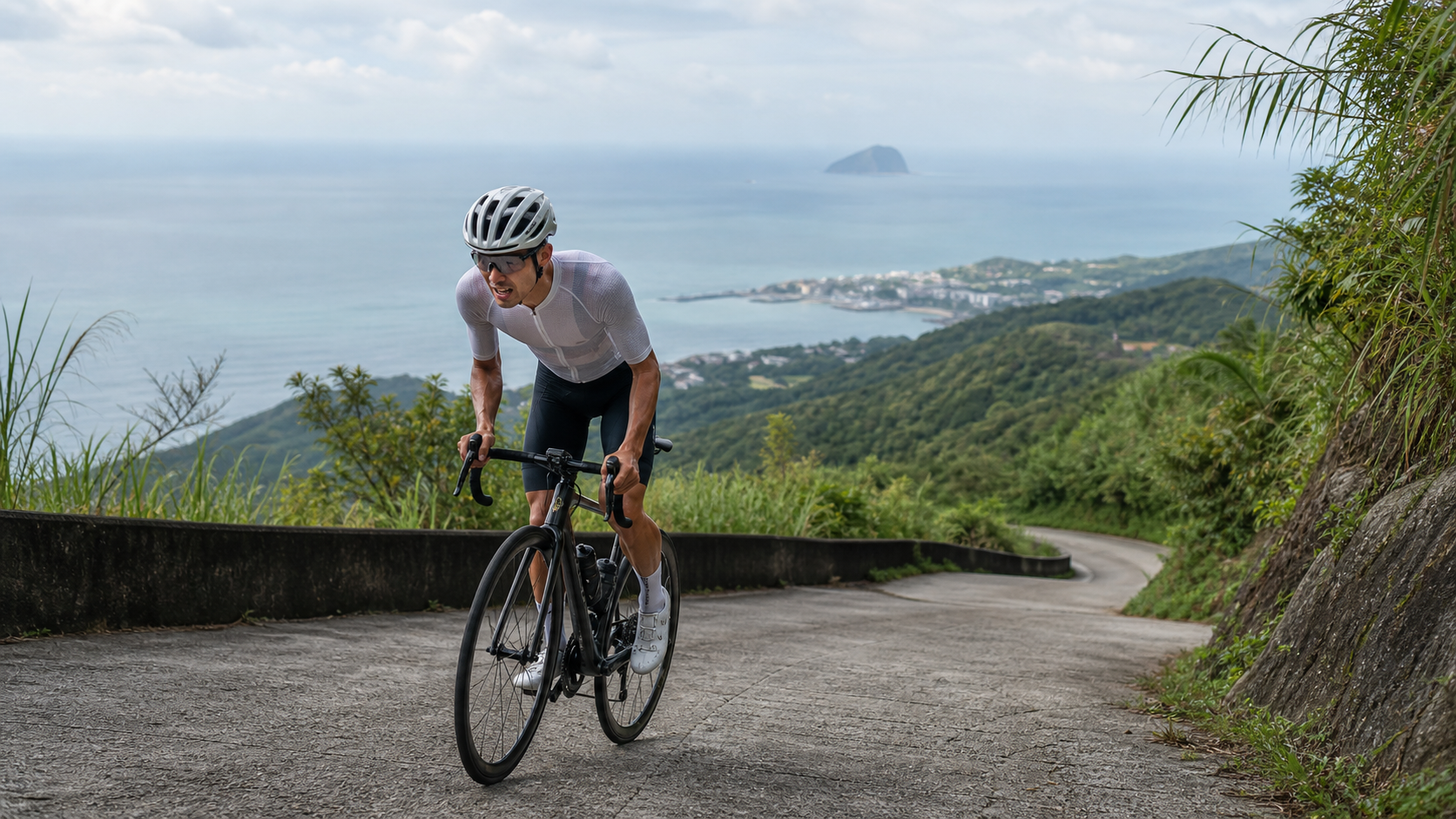
Route Overview: First, Understand the “Data Personality” of This Climb
The Jinshan Juming Museum climb, officially recorded on Strava as “Rulai Shenzhang Counterclockwise (Thumb Climb Section),” is a name that has long circulated in the North Coast cycling community. Many seasoned riders immediately think of “Rulai Shenzhang” rather than “Juming Museum climb” when this hill comes up. However, for most cyclists, referring to it by its endpoint landmark—the Juming Museum—remains the most intuitive way to identify it. Therefore, this article primarily uses “Juming Museum climb” as the main designation while retaining the colloquial name “Rulai Shenzhang” so readers familiar with North Coast routes can make the connection.
Let’s lay out the hard numbers first: 2.29 km in total length, 294 meters of total elevation gain, and an average grade of 11.9%. This average-grade figure only makes sense when placed within the spectrum of Taiwan’s cycling climbs. Typical long climbs like the Beiyi Highway or Beiheng Highway usually have average grades between 3% and 6%, with ride times ranging from 40 minutes to over 2 hours—essentially aerobic endurance efforts. The Juming Museum climb is a completely different species. At 2.29 km, most amateur riders will finish in just 10 to 20 minutes, but an 11.9% average grade means this road offers almost no respite sections—it is a “short, steep, hard” explosive-power test climb.
The simplest way to understand an 11.9% average grade: if the road surface had no undulations, every 100 meters ridden forward would require climbing 11.9 meters vertically. In reality, mountain roads are never a constant gradient—there are always steeper and easier sections—which also means the middle of the route very likely contains sections far exceeding 15%, even approaching 20%. The section-by-section guide later will explain in detail why you should be mentally prepared in advance.
Geographically, this road is located in Jinshan District, New Taipei City, with the endpoint at the Juming Museum. The museum’s address is No. 2, Xishihu, Jinshan District, New Taipei City, at an elevation of approximately 165 to 185 meters. Founded by the late sculptor Ju Ming, it officially opened on September 19, 1999, covering about 11 hectares, making it one of Taiwan’s largest outdoor museums. In other words, this climb’s 294 meters of elevation gain rises from near sea level around downtown Jinshan, climbing steeply to the gentle hill terrain where the museum sits. The elevation difference will feel very pronounced—as you near the summit, the sea view toward Jinshan gradually opens up. Beyond the “pain,” this is one of the few scenic rewards this climb offers to comfort you.
For anyone planning to ride this route, the most important premise to understand is: do not approach this short, steep climb with the logic of riding a long climb. Long climbs demand steady pacing, heart rate controlled near the lactate threshold, and energy conservation for the later stages. Because the Juming Museum climb is short in total duration, its intensity profile more closely resembles interval training or hill-sprint training. Muscular explosive power and gear selection matter just as much as cardiovascular endurance.
Start-to-Finish Section Guide: Riding Rhythm Across Three Key Sections
Breaking this 2.29 km climb into three sections is a more practical way to plan: the opening attack section, the core steep section, and the easing finish section.
Section 1 (approximately the first 600–800 meters after the start): Probing and Setting the Tone
This section is the psychological hurdle of the entire route. Transitioning from flat or gentle roads into a steep climb, your body hasn’t yet adapted, and many riders, driven by the habit of “wanting to go fast,” surge out at power slightly above their limit. This is the most common failure mode on short, steep climbs. The recommendation here is to start with your heart rate held between 85% and 90% of your maximum—don’t push toward your anaerobic threshold right from the start, because harder sections lie ahead. Maintain a cadence between 70 and 85 rpm in the mid-to-high range, avoiding the temptation to mash a heavy gear from the beginning, which causes lactic acid to accumulate prematurely in the quadriceps.
Section 2 (middle section, the core zone where grades concentrate): This Is the Real Test
An 11.9% average grade is only the route’s mean value; in reality, the core section will very likely feature grade peaks approaching or exceeding 15%. At such grades, most amateur riders’ cruising speed drops to 5–8 km/h, close to walking pace. At this point, aerodynamic drag is no longer the primary limiting factor—gravity and gearing are what determine everything. Your riding strategy in this section should shift to alternating between standing sprints and seated pedaling: use standing sprints to overcome the steepest few dozen meters of instantaneous grade, then return to the saddle to let your glutes rest and regulate your breathing. Do not stubbornly grind seated through the steepest parts—this can cause the front wheel to lift due to rearward weight shift, especially when instantaneous grade exceeds 15%. This risk will be discussed further in the common-mistakes section later. Your heart rate may approach your maximum in this section; this is normal. Short, steep climbs are precisely the type of route where entering the near-anaerobic zone is acceptable.
Section 3 (finishing stretch around the museum entrance): Grade Eases, but Don’t Let Up
In the final few hundred meters, the grade typically begins to ease, and the view gradually opens up to reveal the sea outline toward Jinshan. This is a chance to catch your breath and bring your heart rate back below 90%, but maintain your cadence—don’t completely relax and slump in the saddle just because “you’re almost there.” Upon reaching the museum entrance area, it’s advisable to find a safe spot roadside to stop and cool down before deciding whether to enter the museum grounds (the interior is a tourist walking route, not part of the climb itself).
Gearing and Equipment: Key Preparatory Differences for an Extremely Steep Short Climb
This is the point this article most wants to emphasize: the Juming Museum climb cannot be handled with the gearing logic of a typical long climb.
For typical Taiwanese long climbs (e.g., routes with 5–6% average grades), a road bike with a 50/34 compact crankset paired with an 11-28 or 11-30 cassette is sufficient for most riders. But on a route with an 11.9% average grade and instantaneous grades approaching or exceeding 15%, such a gearing setup will force you to grind at extremely low cadence in the core steep section—or leave you unable to turn the pedals at all, forcing a dismount and walk.
Recommended gearing setups:
| Bike Type | Recommended Setup | Notes |
|---|---|---|
| Road bike | 34/32 or lighter (if frame and drivetrain support it, consider 34/34 or even lighter mountain-style gearing) | Standard racing cassettes like 11-28 or 11-30 will be extremely taxing on this climb. If possible, switch to a larger cassette (32T or above), or use crossover drivetrains like GRX or Eagle to achieve lighter gearing—this will dramatically reduce the suffering in the core steep section |
| Gravel/Adventure bike | Factory mountain-style gearing is usually sufficient | These bikes typically have wider gear ranges and usually need no additional adjustment |
| Standard racing road build | Not recommended for direct attempts | If your bike has a purely race-oriented compact gearing (e.g., 52/36 with 11-25), this climb will be extremely painful. Assess your FTP and grade tolerance first |
Beyond gearing, tire pressure and width are also worth attention. Short, steep climbs demand more grip than long, gentle climbs, especially during standing sprints when front-rear weight distribution shifts dramatically. Avoid inflating tires to maximum pressure; reducing by 5–10 psi to increase grip and comfort will help maintain control and prevent slipping on steep sections.
Regarding braking systems, hydraulic disc brakes inspire more confidence on descents at this grade (if you plan to return the same way), as the heat-fade issue from prolonged braking is relatively less pronounced on disc systems.
Nutrition and Hydration Management: Special Considerations for Short, High-Intensity Efforts
Because the entire climb may take only 10–20 minutes (depending on individual ability), many people mistakenly assume no special fueling is needed—this is an easily overlooked trap.
The key isn’t how much to fuel “during the climb itself,” but rather to place this climb within the context of your overall ride plan for the day. If you’re treating the Juming Museum climb as one segment of a North Coast loop itinerary (e.g., a longer route combining roads around Jinshan, the Yangjin Highway system, and other networks), then before reaching the base of the climb, you should ensure your bottle is at least half full and your muscle glycogen isn’t already depleted. A short, steep climb with an 11.9% average grade depletes muscle glycogen far faster than flat cruising. If you arrive at the base already running on fumes, you’ll be highly susceptible to weak legs or cramping in the core steep section due to low blood sugar or electrolyte deficiency.
Practical recommendations:
- 5–10 minutes before reaching the base, take a simple carbohydrate source (energy gel or sports drink) to allow blood sugar time to rise
- If you feel cramping precursors during the ride (tightness in the calves or inner thighs), stop immediately, hydrate, and stretch—don’t push through
- After completing the climb, rest briefly around the museum and remember to replenish electrolytes, especially during hot summer hours when losses are rapid
- If you plan to descend the same way, remember that descending doesn’t expend much energy but you’ll still sweat and dehydrate—keep hydrating
Around downtown Jinshan, there are well-known dining options such as Jinbaoli Old Street and the locally famous Jinshan duck, suitable for pre- or post-ride fueling or meals. However, actual restaurant choices should be decided on-site based on current operating hours and personal taste.
Weather and Seasons: Risk Variables on North Coast Mountain Roads
The Jinshan area sits on the windward side of the northeast monsoon, and its weather patterns differ markedly from those inside the Taipei Basin—a factor that cannot be ignored when planning a ride up the Juming Museum climb.
Autumn/Winter (approximately October to March): Under the influence of the northeast monsoon, the Jinshan area frequently experiences damp, cold, and rainy weather. Even when Taipei City is sunny, the Jinshan coast may still see drizzle or wet road surfaces due to orographic lifting. Once steep sections become wet, grip drops noticeably, and the risk of front-wheel slip during standing sprints increases. It’s advisable to check real-time weather and road conditions before setting out in this season, and avoid attempting this climb in strong winds or heavy rain.
Summer (approximately June to September): Weather is relatively stable but hot and humid, with a higher chance of afternoon thunderstorms. Because the grade is extremely steep and the ride is short but intense, the risk of heatstroke and heat exhaustion when tackling this climb in summer should not be underestimated. It’s recommended to start in the cooler early morning or evening hours and increase hydration.
Spring: Overall weather is more pleasant, making it a relatively comfortable seasonal window for attempting this climb, though brief showers from afternoon convective clouds in the mountains should still be watched for.
Regardless of season, checking real-time weather information, assessing wind speed and precipitation probability before departure is essential homework before riding an extremely steep short climb—steep sections have far less tolerance for poor road conditions than gentle grades.
Common Mistakes and DNF Risks: The Situations Most Likely to Make People Abandon
The most common frustrating experiences on short, steep climbs usually aren’t from running out of energy, but from the following preventable situations:
Mistake 1: Incorrect gearing, forcing a mid-climb stop
As covered in the gearing section, this is the most common and most regrettable cause of failure. Many riders accustomed to typical long-climb gearing arrive for their first attempt without anticipating that instantaneous grades will approach or exceed 15%. When they hit the core steep section, even at full effort they can’t turn the pedals and are forced to dismount and walk—sometimes finding even walking difficult at such grades. Be sure to confirm before departure that your lightest gear can handle an 11.9% average with even steeper instantaneous sections.
Mistake 2: Starting too fast, running out of steam later
As mentioned earlier, many riders push too hard in the opening section due to the psychological urge to “get through it first.” By the time they reach the core steep section, their heart rate is already near its limit, leaving no reserve to handle the harder terrain ahead—forcing them to slow down or stop to catch their breath. The correct approach is to distribute effort evenly, even deliberately holding back in the early section to save reserves for the hardest middle part.
Mistake 3: Front wheel lifting or slipping during standing sprints
When sprinting hard out of the saddle on sections exceeding 15%, if your center of gravity isn’t shifted sufficiently forward, the front wheel can lift off the ground or lose traction and slip—especially risky in rain or on sandy surfaces. When sprinting standing, lean your upper body slightly forward and balance your weight between the front and rear wheels.
Mistake 4: Underestimating fueling needs, sudden blood sugar crash
As covered in the nutrition section, many assume a 10-minute climb needs no fueling. But if you’re tackling this climb late in a long ride, with muscle glycogen nearly depleted, you’re highly likely to “hit the wall” midway through the steep section.
Mistake 5: Poor braking control on the descent
If you choose to descend the same way, speed control on the way down is especially critical. On a descent with an 11.9% average grade, letting speed run freely will stretch braking distances dramatically. Combined with limited visibility on mountain curves, it’s recommended to brake intermittently throughout to control speed, avoiding prolonged single-side braking that causes heat fade (less pronounced on disc systems, but riders with rim brakes need to be especially careful).
Reference Target Times for Different Rider Levels
The following times are for reference only; actual performance will vary based on individual fitness, daily weather and wind resistance, equipment, and other factors. Use these as a baseline for self-assessment:
| Rider Level | Reference Completion Time | Notes |
|---|---|---|
| Advanced/Competitive (high FTP-to-weight ratio, regular climbing training) | Approximately 6–9 minutes | Possesses good explosive power and cardiovascular endurance, can maintain relatively high cadence throughout, only briefly slowing in the core steep section |
| Intermediate/Regular riding habits | Approximately 10–15 minutes | Has basic climbing experience, can complete the full route but needs to slow noticeably in the middle section, possibly with brief stops to catch breath |
| Beginner/First-time extremely steep climb | Approximately 15–25 minutes, possibly including walking sections | If gearing is insufficient or steep-climb experience is lacking, dismounting and walking part of the route is a common and reasonable choice—not a failure |
It’s worth emphasizing that because this climb is only 2.29 km total, even beginners who choose to rest in segments or walk portions of the route won’t compromise the completeness of the overall riding experience—the priority is finishing safely, not forcing yourself to ride the entire thing without stopping. Compared to long climbs that require one to two hours, the “penalty time” on the Juming Museum climb is relatively short. This is also one reason it’s regarded in the cycling community as a “test-your-courage route” and a “training climb”: testing your limit gearing, explosive power, and willpower in a short time makes it a warm-up benchmark route many riders use to self-assess before formally tackling longer, harder climbs (such as Beiheng, Hehuan Mountain, or Dawu Mountain-level long climbs).
Training Plan Recommendations: How to Prepare Specifically for This Climb
If you’ve set the Juming Museum climb as a near-term challenge goal, rather than showing up unprepared, spending two to three weeks on targeted training adjustments will make a significant difference. Short, steep climbs test “anaerobic explosive power” and “muscular lactate tolerance,” which isn’t the same training logic as the “aerobic steady output” emphasized for long climbs. Your training menu should reflect that distinction.
Interval training is the core: Schedule one to two sessions of hill intervals per week. Find a short climb of 1–3 minutes with a grade near 8% or above, and perform 4–6 all-out efforts, recovering with easy pedaling or coasting for 3–5 minutes between reps. This training pattern most closely matches the intensity distribution of the Juming Museum climb’s core steep section and effectively improves muscular tolerance under high-intensity contraction.
Standing sprint practice: Because the core section of this climb will almost certainly require standing sprints to overcome instantaneous steep grades, deliberately incorporate standing sprint drills into regular training. Familiarize yourself with shifting weight forward, stabilizing the upper body, and coordinating cadence with power output, so you don’t waste unnecessary energy on your first formal attempt due to unfamiliar technique.
Core strength and lower-body training: Standing sprints demand high core stability. If you already have a weight-training routine, moderately emphasize squats, step-ups, and core stabilization exercises—the results will directly translate to better body control when climbing steep grades.
Simulation reconnaissance: It’s recommended to do at least one or two on-site reconnaissance rides. First, ride the route at a conservative intensity to familiarize yourself with grade changes, corner positions, and road surface conditions, then schedule a formal timed attempt. This “recon first, then challenge” strategy significantly reduces the risk of misjudging pace on your first formal attempt due to insufficient information.
Extended Challenges: Combining with Other North Coast Routes
For riders already familiar with the Juming Museum climb who want to push their challenge intensity further, consider incorporating this climb into longer North Coast route combinations, creating rides with higher intensity and greater commemorative value.
The North Coast corridor itself is dotted with numerous distinctive climbing routes. From Jinshan and Wanli to Shimen and Sanzhi, the interplay of mountains and coastline creates diverse terrain. Placing the Juming Museum climb in the middle-to-late portion of a long loop itinerary tests whether you can still summon sufficient explosive power for this extremely steep short climb after considerable energy expenditure—which actually mirrors real-world long-distance riding scenarios more closely than tackling it solo on fresh legs.
Additionally, the nearby Yangjin Highway system is itself a major mountain artery connecting the Taipei Basin with the North Coast, featuring rich elevation changes along its route—suitable for arranging long-distance challenge routes linking the Yangming Mountain system with the North Coast. If your goal is to prepare for future longer, harder classic climbs (such as the Wuling east/west approaches or Hehuan Mountain-level long challenges), the training effect of an extremely steep short climb like the Juming Museum climb serves as an excellent explosive-power supplement, filling the gap in instantaneous output that pure long-distance endurance training lacks.
It’s worth noting that if you plan a multi-day route combination, be sure to re-examine the overall itinerary’s resupply point planning and time management, to avoid a single segment (like this steep climb) consuming more energy and time than expected, thereby compressing the safety margin of subsequent sections. Towns along the North Coast such as Jinshan and Wanli have basic resupply and rest points; plan intermediate resupply locations and time checkpoints in advance.
Summary: Treat This Climb as an “Explosive Power Exam”
The Jinshan Juming Museum climb—whether you call it the “Juming Museum climb” or its insider nickname “Rulai Shenzhang”—is fundamentally a training-oriented route that concentrates extreme grades into a short distance. The combination of 2.29 km, 294 meters of elevation gain, and an 11.9% average grade determines that this road cannot be approached with long-climb pacing logic; it’s closer to a compressed explosive-power test.
For riders aiming to challenge Taiwan’s other famous long climbs, this hill is an excellent calibration point for gearing and cardiovascular limits. For riders simply seeking “a hardcore challenge in a short time,” this climb—combined with the cultural landscape of the Juming Museum at the summit and the Jinshan sea view—also makes for a high-value North Coast mini-journey. With an ultra-light gear setup, adequate fueling, and the right weather window, this climb isn’t difficult to complete—the real key has always been whether your preparation before departure is thorough enough.
Related Reading
- Juming Museum Climb: A Riding Memory of the Steep North Coast, and the Folk Legend of “Rulai Shenzhang”
- Jinguashi Jinshui Road Practical Guide: Complete Section-by-Section Analysis of 4.84 km at 6.3% Average Grade
- Luchang Steep Climb Practical Guide: Full Analysis of the 4.09 km, 9.6% Average-Grade Ultimate Challenge
- Jinguashi Teapot Mountain Practical Guide: Complete Analysis of the 3.15 km, 7.1% Average-Grade Mining Road
半日 小台灣 極限單車路線挑戰實錄
7 年前
大武山20%魔王陡坡【JJSC南台灣遊騎Day2】!屁股真的要裂開了...凡士林抹滿也沒用?神秘金教堂還有超便宜夜市
3 個月前
台北闊瀨陡坡 騎旅 / 日本單車雜誌編輯車友臨時加入!/ 髮香才是最強的 / feat. 北迴歸線小隊 / 公路車 CT Yeh
6 個月前
2024 如來神掌 百人約騎挑戰!feat. 秘境單車社團 / 神人們太可怕 / 全程錄影 x 完整坡度解析 / 公路車 / CT Yeh
2 年前
大武山後門26%歡樂陡坡!JJSC南台灣單車行Day2 / 被颱風追著跑 / 公路車 / CT Yeh
2 年前
4K單車實境) 舊陽金P字道 第1P 仰德大道至小油坑 誤跟武嶺神人們 被拉爆爽飛天 Taiwan Cycling Climb Route Recommend
7 年前
單車 梅山36灣 坡度介紹 路段介紹 空拍 (相關遊記影片,請參考說明或我的頻道喔,歡迎訂閱)
6 年前
大禹嶺 到 武嶺牌樓 全程前後實況錄影 | 北進武嶺 | 東進武嶺 | KOM | 訓練台 | 坡度分析 | Taiwan KOM Last 10 km HARD | 公路車
6 年前