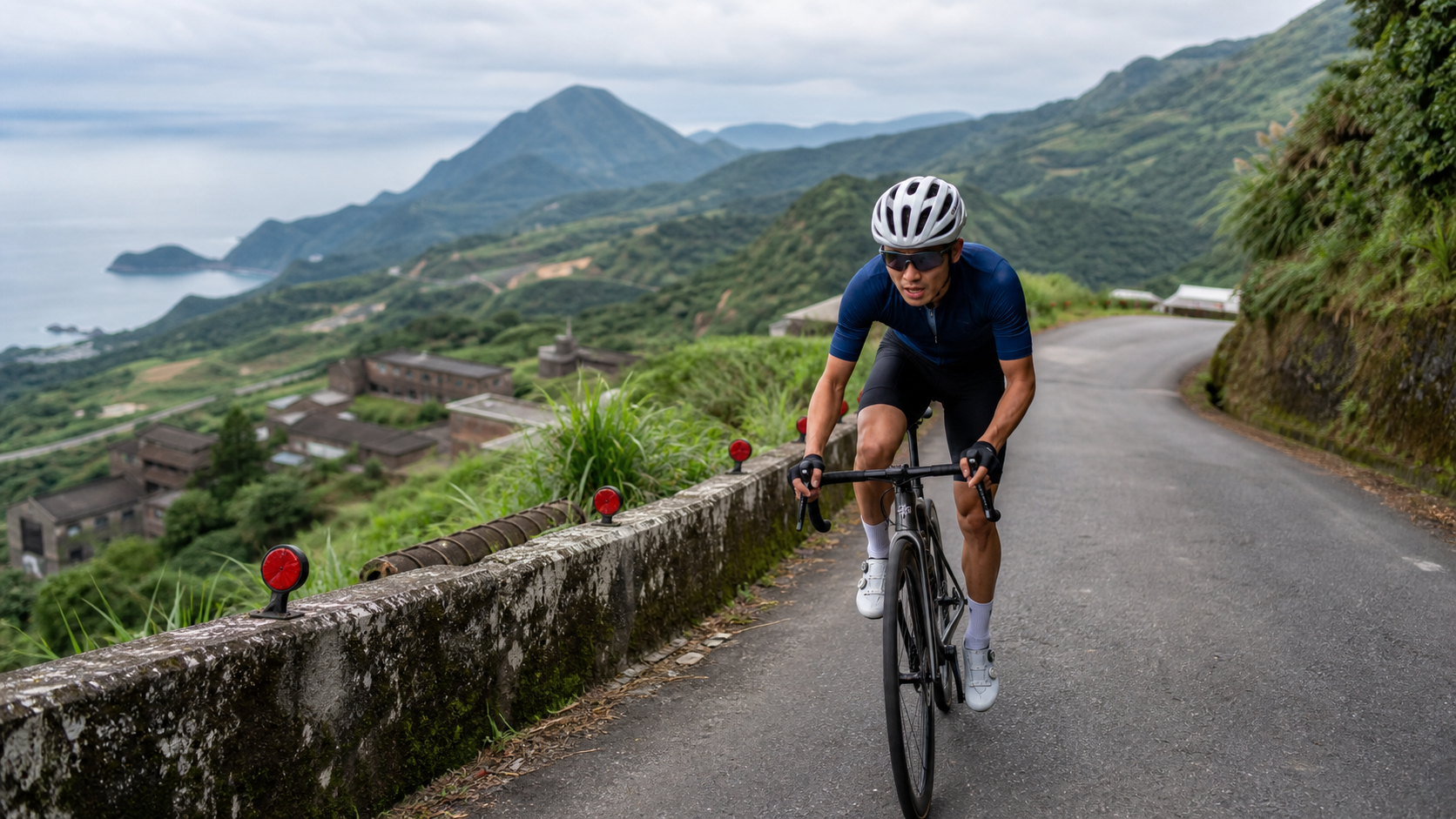
Maokong Zhinan Temple Practical Guide: 6.93 km, 388 m of Climbing, 5.6% Average Grade — A Complete Breakdown of Taipei’s Classic Intermediate Climb
Starting from Shenkeng District and climbing all the way into the tea hills of Maokong in Wenshan District, this route is widely recognized in Taipei’s cycling community as the “entry-level pilgrimage climb” — not particularly long, not outrageously steep, yet enough to lay your cardiovascular and leg limits bare in plain sight. Today we’re not talking scenery, not talking history — only data, tactics, and equipment, breaking down this 6.93 km, 388 m elevation gain, 5.6% average grade route as an engineering problem.
Route Overview and Real Data Analysis
Let’s lay the numbers out first. This route is officially registered as Strava segment 782516, starting in Shenkeng District and ending near Zhinan Temple in Wenshan District, with a total length of 6.93 km, total elevation gain of 388 m, and an average grade of 5.6%. Looking at just the 5.6% average, many people would think, “That’s just a gentle slope, isn’t it?” But the average grade is a figure calculated by spreading the total elevation gain evenly across the entire route — the actual riding experience is nowhere near as mild as a steady 5.6% throughout.
Almost all mountain roads in the Taipei suburbs share a common grade distribution pattern: the early section of the route typically features a warm-up gentle slope, keeping both body and equipment in “warm-up mode”; the middle section begins a continuous series of steeper gradients, which is where aerobic capacity and pedaling efficiency are truly tested; the latter section then converges depending on the terrain, sometimes with brief easing or even short descents to let riders catch their breath before facing the final push to the summit. The Maokong Zhinan Temple route roughly follows this distribution logic — the overall 5.6% average means the entire ride sits within a “demanding but sustainable” range, unlike the short, punchy pain of the Juming Museum climb (11.9% average), or the long, grinding effort of Zhulu Mountain (7.9% average). Instead, it sits between the two — a mid-distance climb that demands “pace consistency.”
Comparing against the grade spectrum of well-known climbs in the Taipei suburbs, Maokong Zhinan Temple is positioned relatively friendly: it won’t force you out of the saddle to grind on sections exceeding 10% like some parts of Yangjin Highway, but it’s definitely not flat warm-up level like riverside bike paths. Converting 388 m of elevation gain over 6.93 km, that means an average of about 56 m of climbing per kilometer — a figure that, within the hilly terrain surrounding the Taipei Basin, qualifies as a typical “suburban hill training route” level, well-suited as a climbing endurance training milestone before half-distance or full-distance road races.
One thing worth noting: the endpoint of this route is near the Maokong Gondola Taipei Zoo Station and the Zhinan Temple area, where elevation has already risen considerably — meaning that before you reach the finish, your body has been switching between oxygen debt and aerobic energy supply for a substantial period. This kind of “mid-distance, mid-intensity” climbing profile is actually the ideal route type for testing your FTP (Functional Threshold Power) and long-duration output stability, because it forces you to ride the entire distance at a “sustainable” power output rather than relying on short bursts of explosive strength to power through.
Let’s further unpack the meaning of the grade distribution. If you compare the 5.6% average against internationally common climb categorization systems — such as the HC (Hors Categorie), Category 1, 2, 3, and 4 logic used in the Tour de France — this route typically falls between “Category 3 and Category 4,” meaning it’s at a level that “has training value but won’t scare off the average rider.” This is also why the route is frequently used by Taipei cycling clubs and training groups as an “entry-level climbing test segment” — its difficulty curve happens to sit right at the sweet spot between “beginners can finish it through gritted teeth, and experienced riders find it easy yet still get training benefit.”
From a power perspective, assuming a 70 kg rider wants to complete this 6.93 km, 388 m elevation gain route in around 20 minutes, the rough estimate for sustained climbing power falls between 2.8 and 3.2 watts per kilogram — a range already approaching the threshold power performance of amateur club-level riders. This means that while the route isn’t long, riding a “good” time still demands a certain level of physical conditioning and training foundation. Conversely, if you approach it with a training-and-experience mindset and ride at a pace you can sustain, the route’s accessibility is actually quite high — which is exactly why it has remained popular for years and is widely recommended to advanced beginners.
Segment-by-Segment Strategy: From the Shenkeng Start to the Zhinan Temple Finish
Breaking the 6.93 km down into several psychological and physiological phases will help more than staring at the mileage numbers.
Phase 1: The warm-up climb from the Shenkeng start. Any route with a 5.6% average grade typically won’t knock you out right from the opening. In the first 1 to 2 km from the start, deliberately keep your heart rate around 70% to 75% of your maximum — the so-called “Zone 2 to Zone 3 boundary.” The goal of this phase isn’t to test your limits but to gradually bring your muscles and cardiovascular system into working state and warm up the lactate clearance mechanism. The mistake many riders make in this phase is seeing that the grade isn’t too steep and charging ahead, only to run out of fuel in the later sections — this is the most classic pacing trap on this type of mid-distance climb.
Phase 2: The rhythm battle of the middle continuous climbing. When the route enters the middle section and the grade begins showing more continuous gradient changes, this is the section of the entire route that most tests your “pedaling rhythm.” Keep your cadence between 85 and 95 rpm, and avoid grinding with overly heavy gearing, which will cause premature lactate buildup in your quadriceps. In this phase, adopt a “seated-first, standing-as-supplement” strategy — seated pedaling maintains energy efficiency over longer periods, while standing out of the saddle is reserved for brief sections where the grade suddenly steepens, used to shift muscle fatigue and engage a different set of muscles.
Phase 3: The psychological endurance period of the mid-to-late section. This is the section of any mid-to-long climb where “mental surrender” signals most commonly appear — the body is already fatigued, but the finish line is still out of sight. In this phase, shift your attention from “how much farther” to “maintaining power output,” using your bike computer or power meter to lock onto your target range rather than constantly glancing at the remaining distance and demoralizing yourself. At this point, heart rate will naturally climb to near threshold heart rate — this is a normal physiological response, no need to panic and slow down excessively, but also avoid exceeding your sustainable power range by too much, or you risk “blowing up” in the final stretch.
Phase 4: The finishing section entering Wenshan District and approaching the Zhinan Temple area. As elevation gradually builds and the finish approaches, the terrain around Maokong begins to clearly show the rolling contours of tea-hill country. The strategy for this phase is a “measured final push” — if you paced well in the earlier sections and still have energy in reserve, you can try slightly increasing output in the final kilometer to experience the satisfaction of crossing the line; but if you’re already spent from the earlier sections, this phase should honestly maintain cruising speed and prioritize finishing the ride above all else. After all, this is a route that balances training and pilgrimage — you don’t need to go all-out every time.
Worth adding: the psychological transitions between these four phases are often harder to manage than the physical load itself. Many riders feel confident during the Phase 1 warm-up, thinking “this climb is nothing,” only to realize in the Phase 2 continuous climbing that their pacing judgment was off. I recommend setting segment goals before riding — for example, mentally dividing the route into “first third warm-up, middle third rhythm maintenance, final third endurance and finish” — and using the lap timing function on your bike computer to verify whether you’re executing the plan. This habit of “pre-race pacing mental rehearsal” is a practical technique many veteran climbers use to combat mid-to-late mental fatigue, and it’s worth borrowing for the average amateur rider.
Additionally, since this route starts in Shenkeng and ends near Zhinan Temple in Wenshan District, the entire route crosses administrative boundaries on mountain roads, meaning road surface quality, corner curvature, and shoulder width may vary slightly by section. Before attempting to set a personal record or push your pace, I recommend riding the route once at a sightseeing pace to familiarize yourself with the road conditions, noting the locations of corners and grade changes, to avoid dangerous braking or evasive maneuvers during full-effort riding due to unfamiliarity. This is especially important on the Maokong-area roads, which are frequently shared with hikers and other recreational riders on weekends — safety always comes before results.
Gearing and Equipment Recommendations
For a route with a 5.6% average grade and 388 m of total climbing, most amateur riders can handle it with standard road bike gearing (e.g., a 50/34 chainset paired with an 11-28 or 11-32 cassette), but gear selection still directly affects your fatigue curve and overall ride quality.
| Rider Level | Recommended Gearing | Notes |
|---|---|---|
| Beginner / Limited climbing experience | 34T small chainring + 28T or 32T large cog | Prioritize maintaining cadence above 80 rpm, avoid relying too heavily on leg strength to grind |
| Intermediate / Some climbing mileage | 34T small chainring + 25T or 28T cassette | Balances efficiency and rhythm, suitable for those with a basic aerobic base |
| Advanced / Chasing results | 36T or 39T small chainring + 25T cassette | Heavier gearing, suited for riders with stable power output seeking consistent pacing |
Regarding wheelsets, this type of mid-distance climb doesn’t require chasing ultra-light climbing wheels — general training aluminum rims or entry-level carbon wheels are more than sufficient. The real priority investment is tire rolling resistance and grip — mountain roads occasionally have fallen leaves, wet patches, or loose gravel, so I recommend using tires 25c or wider, with tire pressure not set too high, to balance rolling efficiency and cornering safety.
For clothing, since the route’s endpoint is at a considerable elevation, even in Taipei Basin summers, there can be significant temperature differences between morning and evening in the mountains. I recommend carrying a lightweight windbreaker or arm warmers, especially for riders planning to linger around Maokong after finishing to cool down — be mindful of staying warm to avoid catching a chill.
Beyond gearing and wheels, frame geometry and saddle height adjustments also have a non-negligible impact on pedaling efficiency for this type of mid-distance climb. When climbing seated for extended periods, an improperly set saddle height (too low causes excessive knee joint stress; too high causes the hips to slide on the saddle, compromising power transfer) can make sections that should be rideable at a steady rhythm feel exhausting. Before tackling this route, take the time to confirm your riding position is suitable for extended climbing output, and if necessary, have a professional bike fitting service help with fine-tuning — this investment is well worth it for riders who frequently tackle mountain routes.
Bike weight configuration is another often-overlooked factor. Climbing routes are relatively sensitive to total bike weight. If you’re used to carrying a heavier toolkit, pump, spare tubes, and other gear, consider trimming down carried items on days specifically dedicated to chasing a personal record — but always keep basic tire repair tools and electrolyte supplies. Safety and ride-completion assurance always trump setting a new PR, especially since cell phone reception in the mountain areas along this route can be unreliable. Being stranded alone halfway up a mountain with a flat tire and no way to call for help would be a rather miserable situation.
Nutrition and Hydration Management
For a 6.93 km climb at 5.6% average grade, most riders will finish in roughly 25 to 50 minutes (varying greatly depending on individual fitness and pacing strategy — a tiered target time table appears later). This duration falls into the “short-to-mid distance, high intensity” energy metabolism range, so nutrition strategy doesn’t need to be as complex as for long-distance endurance events, but a few principles are still worth noting:
- Before the ride: Finish a proper meal 1 to 2 hours before departure, avoiding riding on an empty stomach which can cause mid-ride hypoglycemia, and also avoiding eating too much which can cause gastrointestinal discomfort affecting climbing performance.
- During the ride: For this distance range, most riders don’t actually need to consume solid food mid-ride, but hydration remains important — take small sips every 15 to 20 minutes. Taiwan’s humid, hot climate means sweat loss can exceed expectations even on shorter climbs.
- Electrolytes: In summer climbing, consider adding electrolyte supplements to your bottle to prevent sodium and potassium depletion from heavy sweating, which can cause cramping — especially in the steeper middle sections, which are the most common time for leg cramps.
- After the ride: After finishing near Zhinan Temple, the Maokong area is itself a renowned tea region, and many riders choose to linger there to replenish fluids and calories. This is one of the route’s biggest advantages over purely remote training climbs — there are clear options for refueling and rest after finishing.
Weather and Seasonal Considerations
The weather patterns in the mountain areas around the Taipei Basin have a significant impact on this type of climbing route. Summer afternoon convective showers are the most common weather risk in Taipei’s mountains — I recommend departing in the cooler morning or evening hours and keeping an eye on the forecast, avoiding heading up during thunderstorm warnings. Wet mountain roads combined with poor visibility significantly increase the risk of crashes.
In winter and spring, watch for the cold, damp conditions and fog brought by the northeast monsoon. While Maokong’s elevation isn’t particularly high, the mountain air is humid, and poor visibility can throw off braking distance judgment on descents — slow down and leave extra braking margin.
Regardless of season, avoid riding this type of mountain route immediately before or after typhoons or heavy rain, as mountain roads are prone to rockfalls, standing water, or unstable roadbeds. Safety should always take precedence over ride records.
Common Mistakes and DNF Risks
Even on a relatively friendly grade like 5.6%, several common riding errors can cause riders to abandon mid-ride (DNF) or have a significantly diminished experience:
- Pacing too hard in the early section: This is the most common mistake. Seeing that the grade figure isn’t extreme, riders start with a flat-road sprint mentality, only to have lactate accumulate too quickly in the middle section, forcing a drastic slowdown or even dismounting and walking.
- Wrong gear selection: Less experienced riders often hesitate to use small gears, worried it looks “weak,” and end up grinding the entire way with overly heavy gearing, placing excessive strain on knees and muscles, leading to cramps or knee discomfort in the later sections.
- Neglecting hydration timing: Many assume that because the climb isn’t long, they don’t need to drink, only to experience dizziness, weakness, and other low-blood-volume symptoms in the mid-to-late sections due to pre-ride dehydration or miscalculated sweat loss.
- Excessively high tire pressure: Mountain roads occasionally have potholes, fallen leaves, or wet patches. While higher tire pressure offers slightly lower rolling resistance, it reduces grip and comfort, increasing crash risk.
- Ignoring weather changes: Taipei mountain weather can change on a dime. Without carrying a lightweight rain jacket or windbreaker, encountering an afternoon thunderstorm or fog can turn the ride from training into misery, and even increase safety risks.
Beyond these five core errors, there’s one easily overlooked detail — braking strategy on the descent. Many riders focus all their attention on “how to get up,” forgetting that after finishing, they often need to descend via the same or alternate routes. Mountain roads have many corners and varying gradients, and if you descend with insufficient focus after the tension of the climb, or use brakes improperly with continuous braking causing overheated brake pads and reduced stopping power, it can be dangerous. On descents, use “intermittent braking” rather than “continuous hard braking” to give the braking system room to cool, and always watch for oncoming traffic and road conditions. Especially on weekends around Maokong, where there are often tourists and slower riders, keep your descent speed within a range where you can react safely.
Target Time Reference by Rider Level
The following times are for reference only — actual performance will vary based on individual fitness, weather conditions, load (whether carrying supplies), and other factors:
| Rider Level | Estimated Finish Time | Characteristics |
|---|---|---|
| Recreational rider (occasional cycling) | 45–60 minutes | Completes at cruising speed throughout, may stop 1–2 times |
| General training rider | 30–45 minutes | Has a basic aerobic base, can maintain a steady rhythm without stopping |
| Advanced club rider | 22–30 minutes | Has a certain FTP level, can sustain mid-to-high intensity throughout |
| Competitive-level rider | 18–22 minutes | Has excellent climbing power-to-weight ratio, rides near threshold output the entire way |
This route is ideal as a “regular checkup” segment for climbing ability — I recommend repeatedly challenging it under similar weather and time-of-day conditions, objectively tracking your climbing improvement through changes in finish time, heart rate, and power data. It’s not as brutal as Zhulu Mountain, which deters most amateur riders, nor as short as the Juming Museum climb, which tests only explosive power. The 6.93 km Maokong Zhinan Temple route tests the most fundamental and important abilities — steady output and pacing discipline — which are precisely the foundation for all longer, harder climbs.
Recommendations for Readers with Different Goals
If you’re a beginner just starting climbing training, this route is an excellent entry-level choice — not long, friendly grade, and with the Maokong tea area for rest and refueling after finishing, the overall experience is far more complete than a purely utilitarian training climb.
If you’re an intermediate rider with some foundation, preparing for a long-distance road event (such as the Wuling Challenge or a round-island route), you can incorporate this route into your weekly training menu as a fixed tempo-pace training segment, using repeated rides to calibrate your power output and pacing instincts.
If you’re an advanced or competitive rider chasing results and targeting the Strava leaderboard, while this route’s average grade isn’t the hardest, its 6.93 km length is enough to separate true ability gaps — pure explosive power won’t get you far here. Only with excellent threshold power and pacing discipline can you post a strong time on Strava segment 782516.
Regardless of which type of rider you are, the Maokong Zhinan Temple route deserves a place on your shortlist — it’s one of the few mid-level climbs in the Taipei suburbs that combines training value with convenient post-ride refueling options, and it’s the most honest mirror before moving on to harder challenges.
Training Periodization Recommendations
If you plan to incorporate this route into a long-term training plan, I recommend scheduling frequency and intensity according to periodized training logic rather than going all-out to chase a personal record every time. Generally, mid-distance climbing routes are best planned across three phases: “Base,” “Build,” and “Peak”:
Base phase (6–8 weeks before race season): Focus on building aerobic endurance. Ride the full route at moderate-to-low intensity, with emphasis on maintaining a steady pedaling rhythm and breathing control. Keep heart rate mostly in Zone 2 to Zone 3, with the goal of building the aerobic metabolic foundation rather than chasing speed.
Build phase (3–4 weeks before race season): This phase can introduce tempo and threshold-intensity interval challenges. For example, split the route into two to three segments, riding each at near-threshold heart rate intensity, with easy spinning recovery between segments, simulating the repeated high-intensity output demands of a long-distance race.
Peak phase (1–2 weeks before race day): This phase should focus on maintaining form and avoiding overtraining. One full-effort attempt at a personal best can validate training progress, but avoid scheduling excessive high-intensity climbing training close to race day, so the body has time to recover and perform on the actual event or challenge day.
Through this kind of periodized arrangement, the Maokong Zhinan Temple route can transform from a one-off challenge into a fixed test segment for tracking your climbing ability improvement curve over the long term. This is also why many well-trained club riders repeatedly ride specific climbs as their “personal fitness gauge.”
Related Reading
- Maokong Zhinan Temple Practical Guide: 6.93 km, 388 m of Climbing, 5.6% Average Grade — A Complete Breakdown of Taipei’s Classic Intermediate Climb
- Jinguashi Teapot Mountain Practical Guide: 3.15 km, 7.1% Average Grade — A Complete Breakdown of the Mining-Area Mountain Road
- Maokong Zhanghu Yue Ling Practical Guide: 4.17 km at 6.2% Average Grade — A Complete Breakdown of the Tea-Region Mountain Road
- Pingjing Street Climb Practical Guide: 4.66 km at 6.3% Average Grade — A Complete Breakdown of the Cold Water Pit Prelude
半日 小台灣 極限單車路線挑戰實錄
7 年前
台北闊瀨陡坡 騎旅 / 日本單車雜誌編輯車友臨時加入!/ 髮香才是最強的 / feat. 北迴歸線小隊 / 公路車 CT Yeh
6 個月前
單車 梅山36灣 坡度介紹 路段介紹 空拍 (相關遊記影片,請參考說明或我的頻道喔,歡迎訂閱)
6 年前
4K單車實境) 嘉義 梅山36灣 訓練台 爬坡 輕鬆騎
6 年前
大武山後門26%歡樂陡坡!JJSC南台灣單車行Day2 / 被颱風追著跑 / 公路車 / CT Yeh
2 年前
爬坡ITT實境)台中 魔王 松鼠坡 首航 6:12 大肚山 大三元 科福路
8 年前
4K單車實境) 舊陽金P字道 第1P 仰德大道至小油坑 誤跟武嶺神人們 被拉爆爽飛天 Taiwan Cycling Climb Route Recommend
7 年前
大武山20%魔王陡坡【JJSC南台灣遊騎Day2】!屁股真的要裂開了...凡士林抹滿也沒用?神秘金教堂還有超便宜夜市
3 個月前