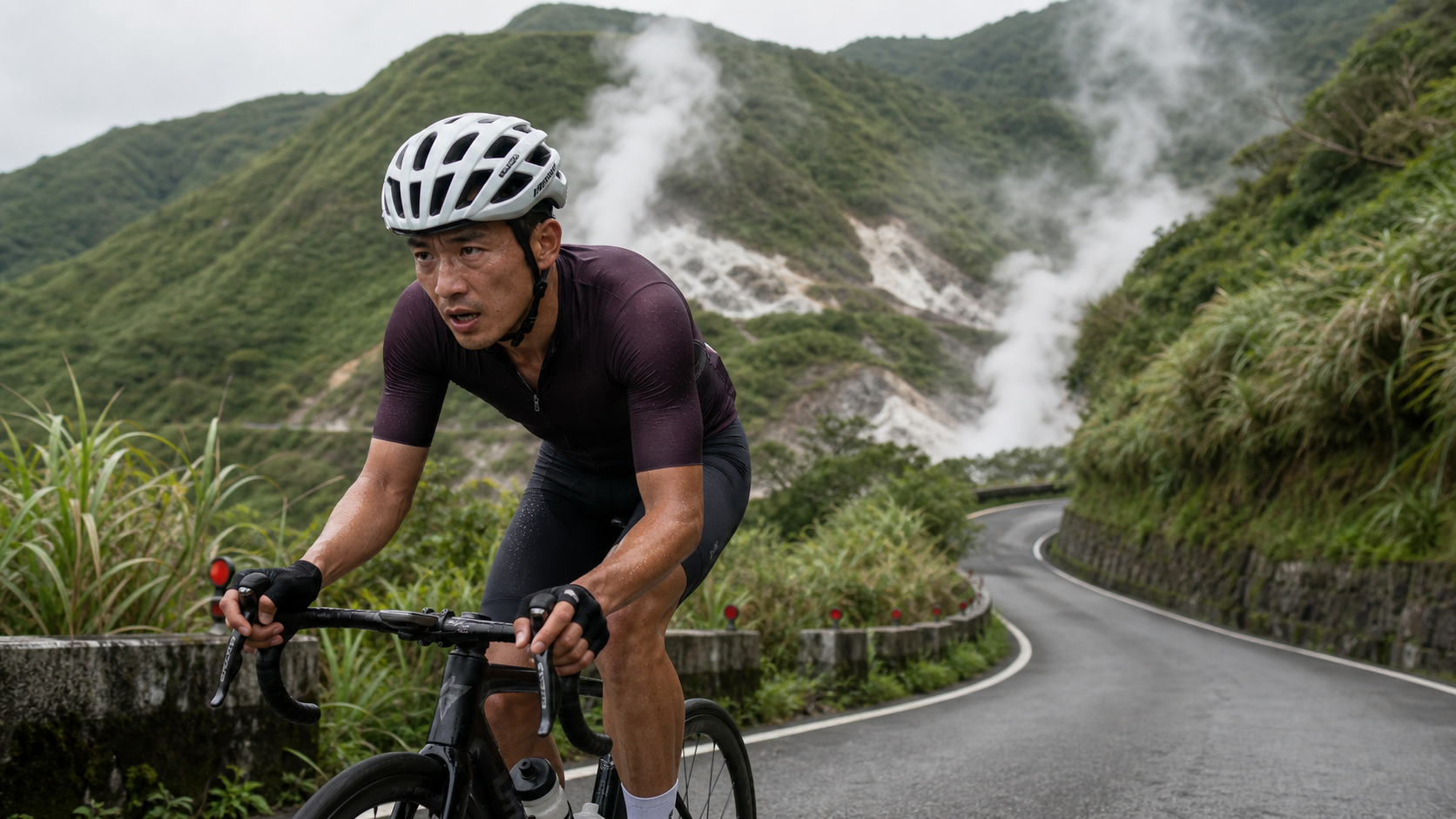
Short climb beside Macao Hot Springs: the most concentrated sweat and steam on Yangjin Highway
Summary: The Macao section is a compact short climb on Yangjin Highway right next to Macao Hot Springs—6.3 kilometers, 275 meters of elevation gain, with steep and tightly packed gradients. This is not just a training ground, but a unique landscape where hot spring steam and cycling sweat intertwine, and the starting point of many riders’ private itinerary of “climb first, soak later.”
Along Yangjin Highway (Provincial Highway 2C), the most memorable sights besides the geothermal spectacle of Xiaoyoukeng are the Macao area in the middle section. The name of this place is closely tied to its geothermal hot springs—due to its unique geological structure, hot spring water has been flowing year-round in the Macao area, making it one of the few renowned hot spring settlements around the Tatun Volcano Group. The Macao section of Yangjin Highway is precisely this short climb adjacent to the hot spring area, with concentrated and compact gradients—6.3 kilometers in length, 275.2 meters of elevation gain, and an average gradient of 4.3%. For riders familiar with northern Taiwan’s cycling scene, the Macao section is a familiar yet special presence—it’s short, yet it condenses the most essential gradient challenge of the entire Yangjin Highway; it’s tough, yet it sits right next to natural hot springs that can soothe sore muscles, creating a peculiar tension and balance.
A hot spring town nurtured by volcanoes
To understand the significance of the name Macao, one must start with the geological background of the Tatun Volcano Group. Because residual heat from the underground magma chamber continues to conduct upward, this area is rich in geothermal resources. Besides the fumarole landscape of Xiaoyoukeng, the hot spring water in the Macao area is a product of the same mechanism. Geothermal heat warms groundwater, which then surfaces through fractures in the strata, forming hot spring sources with moderate temperatures and rich mineral content that have long attracted visitors and local residents for soaking and wellness.
The Macao hot spring area is home to several hot spring resorts, with waters mostly of a weakly acidic sulfur type that offer certain soothing effects for the skin and muscle soreness. For riders who have just completed a high-intensity climb challenge, this is practically a heaven-sent recovery spot—after finishing the core climbing section of the Macao stretch, muscles are in a state of high tension with lactic acid buildup. Being able to soak in a nearby hot spring, letting the warm water ease tight muscles, brings a sensation of simultaneous physical and mental release that many riders tacitly understand as part of their private itinerary. This also gives the Macao section, among the many climbing routes, a unique dual experience of “painful yet soothing.”
A short, concentrated poem of gradients
Riding up the Macao section, you quickly sense how this stretch differs from other parts of Yangjin Highway. There isn’t much flat terrain for warming up—the gradient starts climbing shortly after departure, with dense forest on both sides and occasional glimpses of hot spring steam rising in the distance, creating a curious echo with the rider’s own labored breathing from the climb—as if the land and the body are both, at the same moment, exhaling heat and energy in their own ways.
The core climbing section in the middle is steep and dense, with continuous ascents leaving almost no room to catch your breath, forcing you to focus solely on each pedal stroke before you. This highly concentrated gradient experience is completely different from the full Xiaoyoukeng stretch of Yangjin Highway, which demands careful pacing and a long-drawn battle—the Macao section is more like a short, fierce clash, an unrelenting head-on duel between rider and gradient, with little room for tactical maneuvering, leaving only the most direct willpower and physical strength to face it.
That’s precisely why many riders describe the Macao section’s riding experience as “short, but pure.” With few opportunities for distraction and no prolonged agony, just over twenty minutes of high-intensity output instead allows riders to enter a state of highly focused flow, where outside thoughts are almost completely屏蔽, leaving only the most primitive rhythm of breathing, heartbeat, and pedaling.
Riding memories where steam and sweat intertwine
The name Macao itself carries imagery closely tied to heat and vapor. The sweat riders shed during the climb forms a subtle visual and sensory echo with the steam rising from the surrounding hot spring area. Some riders describe that after finishing the Macao section, standing drenched in sweat by the roadside and watching the white steam drifting from the rooftops of nearby hot spring resorts, they feel a curious connection—“so this land and I are releasing the same heat in different ways.”
This feeling, to some extent, echoes the geological essence of the Macao land—beneath the surface lies continuously active geothermal energy, while on the surface, riders generate physiological heat by pushing their legs against the gradient. Though the sources differ, the two converge and coexist in the same valley. For riders who have long ridden this route, this indescribable connection is precisely what elevates the Macao section beyond a mere training route into a vessel of emotional memory.
Where local hot spring culture meets the cycling community
The Macao hot spring area has long attracted visitors from all walks of life. Beyond casual tourists coming for a soak, it has in recent years gradually become a well-known “post-ride recovery” hotspot among the cycling community. Many cycling teams combine high-intensity climb training on the Macao section with the dining and hot spring services of local resorts, planning a complete “train and recover” itinerary—interval training with repeated ascents of the Macao section in the morning, a light meal at the resort at noon, soaking in the afternoon, and a leisurely ride back to the city in the evening, transforming what would otherwise be a simple training ride into a mini-trip that satisfies both sport and leisure.
This combination has also led local businesses in the Macao hot spring area to gradually become familiar with the consumption habits and needs of cyclists. Some resorts even provide bicycle parking and washing facilities, making it convenient for riders to tidy up their gear before and after soaking. A mutually beneficial, symbiotic interaction has gradually formed between the local community and the cycling community, adding a more human and lifestyle-oriented warmth to the Macao section—a training route originally known purely for its gradient statistics.
Light and sound in the valley
Due to the valley terrain of the Macao section, flanked by mountains on both sides, the play of light and shadow in the early morning and afternoon is especially distinct. Before the morning sun fully penetrates the valley, the entire stretch is shrouded in soft shadow, where the rider’s breathing, the whirring of gears, and the faint sound of hot spring water flowing in the distance weave together into a quiet yet tense backdrop—as if nature had carefully composed a low, sustained soundtrack for this short and fierce climbing duel.
As the sun climbs higher, light finally spills into the valley, and the previously shadowed road surface begins to show dappled spots of light, brightening and opening up the rider’s view. This transition from dark to light, in a way, also symbolizes the climbing process itself—from the difficult fumbling at the start, to gradually adapting to the gradient and finding one’s rhythm in the latter half, and finally, at the moment the sunlight pours down, experiencing the release and joy of completing the challenge.
Suggested side trip: fitting the Macao section into a hot spring getaway
For riders looking to incorporate the Macao section into a more complete itinerary, a day trip combining cycling challenge and hot spring relaxation is recommended. Starting in the morning from Jinshan or Beitou, warming up on the ride to connect with Yangjin Highway, then tackling the core climbing section of the Macao stretch at full effort, followed by heading directly to a nearby hot spring resort to let the warm water ease the muscle soreness from the climb. In the afternoon, if energy permits, you can also continue toward Xiaoyoukeng to complete the entire Yangjin Highway, giving your day a triple experience of high-intensity training, hot spring therapy, and geothermal scenery.
For visitors who aren’t particularly pursuing athletic intensity and simply want to feel the unique atmosphere of the Macao land, a slower pace of riding is also an option—without deliberately challenging your speed, focusing instead on appreciating the scenery of the mountain forest interwoven with hot spring steam, then leisurely enjoying a local meal at a hot spring resort, experiencing a slower rhythm different from urban life.
The special meaning of this short climb to riders
For many riders in northern Taiwan, the Macao section carries a special dual significance—it is both a touchstone for testing one’s climbing ability and, because of its proximity to the hot spring area, a bridge between riding and the enjoyment of life. Few training routes combine high-intensity exercise and relaxing recovery so closely in a single location like the Macao section does. This “bitter first, sweet later” combination of experiences gives the Macao section a unique presence and emotional connection among the many climbing routes in the north.
Whether you’ve come specifically to challenge the gradient statistics or simply to soak in the leisurely atmosphere of the Macao hot spring area, this short 6.3-kilometer climb is worth slowing down for, savoring the unique landscape where steam and sweat intertwine. Next time you plan a Yangjin Highway trip, consider adding the Macao section’s hot spring recovery stop to your itinerary, so both body and mind can receive the fullest release and nourishment in this valley brimming with geothermal energy.
Epilogue: One Road, Two Kinds of Release
What Mazao Section teaches cyclists may not just be how to handle a concentrated and steep gradient, but also a life philosophy about “effort and reward”—pedaling hard and sweating profusely yields not only physical gains, but also the hot spring healing that awaits just around the corner. This immediate reward mechanism is especially precious and rare in the cycling training world, which emphasizes long-term accumulation and delayed gratification.
Every time you finish riding Mazao Section and step into the hot spring resort, feeling the warm spring water envelop muscles that were just contracting violently, that sensation of both body and mind being released at once may well be the most genuine and moving reason Mazao Section continues to draw cyclists back again and again. This road is short, yet it condenses the two most captivating faces of cycling—the thrill of challenge and the healing of recovery, inseparable and united as one.
Mazao’s Charms Through the Seasons
Mazao Section presents a completely different appearance across the four seasons. In spring, vegetation on both sides of the valley gradually sprouts new shoots, the air carries a moist scent of greenery, and hot spring steam rises in wisps, creating a hazy, poetic scene. Many photography enthusiasts make special trips during this season to capture the moment where light and steam intermingle. In the summer heat, the hardship of climbing is amplified, but precisely for that reason, the sense of physical and mental refreshment from soaking in the hot spring afterward feels especially precious—even when the outside temperature is already high, many seasoned cyclists insist on taking a brief hot spring soak while their bodies are still warm, allowing their thermoregulation system to experience a unique “heat on heat, then sudden relief” sensation, which is said to significantly enhance muscle recovery.
In autumn and winter, temperatures around Mazao begin to drop, fog occasionally rolls through the valley, and hot spring steam appears even more dense and vivid against the cold air. From a distance, it looks as if the entire valley is emitting white smoke, lending the area an otherworldly, fairy-tale atmosphere. Riding Mazao Section during this season, the lower perceived temperature makes the high-intensity climb less stifling and oppressive. Combined with the ability to immediately immerse in warm spring water afterward, that stark contrast of transitioning from cold to warmth is widely regarded by cyclists as one of the most healing moments of riding Mazao Section in autumn and winter.
Local Elders’ Recollections of Mazao’s Past
The history of hot spring development in the Mazao area actually traces back to the Japanese colonial era. At that time, the Japanese had already noticed the abundant geothermal resources around the Datun Volcano Group and successively built hot spring facilities in Beitou, Mazao, and elsewhere for recuperation and tourism. Through the passage of time, the Mazao hot spring area has undergone multiple renovations and transformations, gradually evolving from simpler early bathhouses into today’s complex of hot spring resorts offering accommodation, dining, and soaking services. According to local elders, Mazao was once an important living space for nearby residents. Besides hot springs, the surrounding forests also served as vital sources for foraging wild vegetables and medicinal herbs. This wisdom of living in close interdependence with the land can still be glimpsed today in the traditional cooking techniques preserved by some local establishments.
While these historical threads may not directly appear in the gradient data of a cycling route, they add a deeper layer of cultural richness to Mazao Section. When cyclists sweat their way up this steep, short climb, gaining some understanding of the life memories and industrial transformations this land once carried may add a richer dimension of cultural imagination and emotional connection to what would otherwise be a purely physical challenge.
Advice for Those Preparing to Conquer Mazao Section for the First Time
For cyclists tackling Mazao Section for the first time, it’s recommended to warm up thoroughly on the gentler stretches of Yangjin Highway first, allowing your body and cardiovascular system to enter an athletic state before formally beginning the core climbing section of Mazao. Since the gradient on this stretch is concentrated with almost no room for respite, it’s advisable not to chase speed records initially. Instead, complete one pass at a comfortable perceived effort, familiarize yourself with the gradient changes and corner positions, then gradually increase the challenge intensity based on your own condition.
After the ride, if time permits, it’s strongly recommended to schedule at least half an hour to an hour of hot spring soaking to allow the intensely tensed muscle groups to fully relax and recover. Many cyclists share that this “bitter first, sweet later” arrangement not only accelerates physical recovery but also leaves a deeper, more positive impression of the entire ride, making them more willing to return again and again to this valley brimming with geothermal energy—to keep challenging and keep experiencing.
Anecdotes Circulating Among Cyclists About Mazao Section
In the northern cycling community, quite a few amusing stories circulate about Mazao Section. Some team coaches like to use Mazao Section as an “initiation test” for new members, using one all-out effort to assess a newcomer’s baseline climbing ability, then tailoring a subsequent training plan based on the data. Other cyclists share that on their first ride up Mazao Section, they underestimated the concentration of the gradient and could barely pedal through the middle core climbing section, ultimately relying on sheer willpower to walk their bike through the final stretch. That experience of being “thoroughly schooled by a mere 6.3 kilometers” ironically became the crucial motivation that drove them to train seriously, return for a rematch, and ultimately conquer the climb.
Many cyclists also treat Mazao Section as a route to tackle together with partners or family members. Because the distance is short and the time is controllable, even two riders with significantly different fitness levels can ride together without the weaker rider becoming overly discouraged by an overly prolonged effort. After completing the challenge, they walk into the hot spring resort together, soak, chat, and share the ups and downs of their climbing experience. This arrangement combining athletic challenge with shared memories has also allowed Mazao Section to carry warm, tangible emotional memories from the personal lives of many cyclists.
Seeing the Many Facets of Cycling Through Mazao Section
Mazao Section, a route of just 6.3 kilometers, condenses in a sense the most captivating multiple facets of cycling—it can be a rigorous training tool for precisely testing threshold power and cardiovascular adaptability; it can be a leisurely outing rich in cultural warmth, connecting hot spring culture with local historical memory; and it can be a vessel for emotional connection, carrying precious moments of cyclists striving together and celebrating together. This diverse and abundant combination of values may well be the fundamental reason Mazao Section, despite its modest length, continues to maintain its unique appeal among the many climbing routes in the north.
The next time you plan a ride on Yangjin Highway, consider slowing down. Beyond paying attention to gradient data and completion times, also try to feel the unique geothermal atmosphere, historical context, and human warmth of the Mazao area. After all, what truly makes a route worth revisiting is often not cold numbers, but those unique experiences during the ride that are difficult to quantify yet are indelibly etched into memory.
Portraits of Riders at the Hot Spring Resorts
Walking into the hot spring resorts around Mazao in the afternoon, you’ll often see cyclists in jersey kits with sun-darkened skin gathered in small groups—some chatting by the outdoor foot-soaking pools, others sitting around tables sharing their climbing experiences from earlier. Over time, this scene has become a distinctive part of the Mazao hot spring area’s charm. The resorts’ original clientele was mostly families on outings or seniors soaking for wellness; now, the influx of cyclists has injected a vibrant new energy into this otherwise slow-paced hot spring community, prompting local businesses to adjust their services—offering cyclist-friendly meal options, for example, or extending business hours to accommodate riders’ rhythm of departing at dawn and arriving in the afternoon.
Some long-time regulars have even developed friendships with hot spring resort owners akin to old acquaintances. Upon arrival, no introduction is needed—the owner already knows which meal to prepare and which pool’s water temperature best suits a body that just finished a high-intensity climb. This gradually established rapport and trust between locals and visiting sports enthusiasts is, in a sense, another layer of Mazao Section’s most heartwarming added value, beyond the gradient data.
Conclusion: A Short Climb, A Lasting Aftertaste
The riding time on Mazao Section may be only about twenty-odd minutes, but the aftertaste it leaves cyclists far exceeds the length of that time. Whether it’s the physical challenge of the gradient, the physical and mental healing of the hot springs, or the human warmth woven from local culture and the cycling community, this seemingly simple short climb possesses unexpectedly rich layers. The next time you ride up Yangjin Highway and prepare to face the test of Mazao Section, consider bringing along this curiosity about the land and its people, making the ride a complete journey where both body and mind return fully loaded—after all, being able to experience simultaneously the saltiness of sweat and the warmth of hot spring water in the same valley is a rare and precious opportunity among Taiwan’s many cycling routes. It deserves every rider who loves pedaling through the mountains to visit in person, savor it carefully, and turn this short 6.3-kilometer slope into a unique cycling story of their own—one worth revisiting and relishing again and again.
Related Reading
- Yangjin Highway Machao Section Battle Guide: A 6.3km High-Intensity Short Climb Interval Training Haven
- Riding from Jinshan Coast to the Volcanic Crater: Geothermal Heat, Clouds, and Local Warmth at Xiaoyoukeng on Yangjin Highway
- Yangjin Highway and Lengshuikeng: A Loop Ride Through Yangmingshan’s Volcanic Landscape
- Yangjin Highway Xiaoyoukeng Battle Guide: A 17.8km, 793m Climb Test in Taipei’s Backyard
4K單車實境) 舊陽金P字道 第1P 仰德大道至小油坑 誤跟武嶺神人們 被拉爆爽飛天 Taiwan Cycling Climb Route Recommend
7 年前
水金九不厭五分 10度寒流冷到不願停!feat. 卡卡 / 公路車 / CT Yeh
6 個月前
阿里山塔塔加 兩倍特濃版!全新隧道開通! 進喔!公路車 | CT Yeh
3 年前
台北闊瀨陡坡 騎旅 / 日本單車雜誌編輯車友臨時加入!/ 髮香才是最強的 / feat. 北迴歸線小隊 / 公路車 CT Yeh
6 個月前
大武山後門26%歡樂陡坡!JJSC南台灣單車行Day2 / 被颱風追著跑 / 公路車 / CT Yeh
2 年前
單車 梅山36灣 坡度介紹 路段介紹 空拍 (相關遊記影片,請參考說明或我的頻道喔,歡迎訂閱)
6 年前
觀霧 變好騎了! | 北高車友爆笑大會師 | 公路車 | 單車旅遊 Taiwan Cycling Route GuanWu
6 年前
虎豹潭!日本老師來台一日約騎 台灣車友熱情招待私房路線 / CT Yeh
19 天前