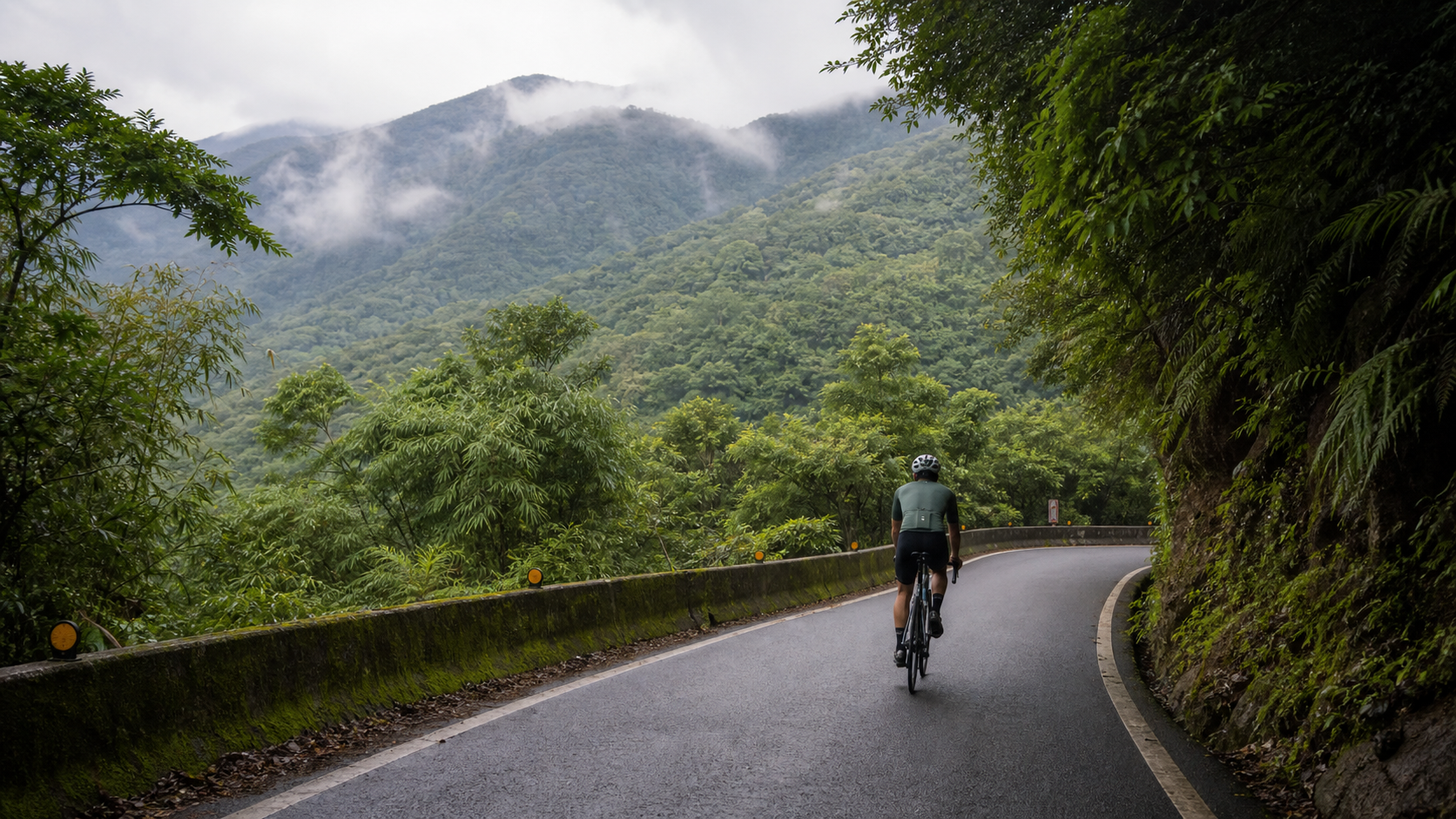
Solo Ride on Macao Mountain Road: The Forgotten Quiet Trail Deep in Jinshan
Summary: Tucked away in the mountains of Jinshan, Macao Mountain Road stretches 9.9 kilometers with 607 meters of climbing, offering sparse traffic and serene conditions. This is a hidden trail that carries little tourist fame yet holds deep emotional significance for local riders. This article chronicles a solo ride through it—a journey of dialogue with the mountains and with oneself.
Within the mountain road network around Jinshan, Yangjin Highway enjoys the greatest fame, with the Macao section renowned for its hot springs. Macao Mountain Road, by contrast, is like an old friend who doesn’t talk much but possesses profound depth—it doesn’t seek attention, rarely appears on popular check-in lists, yet stands quietly there, waiting for those who appreciate it to come visit. This route spans 9.9 kilometers with an actual elevation gain of 607.4 meters, featuring varied terrain and relatively light traffic. It is a hidden mountain trail passed down by word of mouth among riders familiar with the local road network.
A Quiet Path Overshadowed by the Main Road
Because of the high profile of Yangjin Highway, this mountainous area of Jinshan attracts large numbers of weekend riders eager to tackle the climbs and admire the geothermal wonders of Xiaoyoukeng. Yet around Yangjin Highway, numerous lesser-known secondary mountain roads crisscross the area, and Macao Mountain Road is one of them. It may lack the grand geothermal terminus scenery of Yangjin Highway, nor does it possess the healing charm of the hot springs along the Macao section. But precisely because it lacks these conspicuous “selling points,” Macao Mountain Road has preserved a purer riding experience closer to the original character of the mountain forest.
Once you ride onto Macao Mountain Road, you quickly sense an atmosphere entirely different from the main road—no endless stream of traffic noise, no holiday crowds’ clamor, only the rustling of wind through the treetops and your own gradually quickening breathing rhythm. This nearly absolute quiet riding environment is a rare and precious experience for riders accustomed to urban clamor who yearn for a moment of stillness through cycling.
Solitary Time Amid Rolling Terrain
The terrain of Macao Mountain Road is highly varied, with an actual climb of 607 meters noticeably exceeding the theoretical average gradient calculation, meaning riders will encounter numerous undulating sections along the way. This rhythm of rising and falling, combined with the nearly undisturbed quiet road conditions, imbues the entire ride with a meditative, solitary atmosphere. With no conversation from fellow riders to distract you, you can only focus on your own breathing, heartbeat, and the constantly changing road gradients ahead. This state of heightened focus is, in a sense, a rare opportunity for mental clarity that modern people can scarcely obtain amid busy lives.
Many riders who have ridden Macao Mountain Road share that it is precisely this relatively solitary riding experience that allows them to sort through accumulated thoughts and emotions from daily life amid the rolling terrain. Without the gaze of others or comparisons, there is only oneself and this mountain forest, this winding road, facing each other honestly. This pure solitude, in an age of information overload and social media saturation, feels especially precious and scarce.
Subtle Signs of Life Deep in the Forest
Because traffic and foot traffic are sparse, the natural ecology along Macao Mountain Road remains relatively well preserved. During the ride, one might occasionally catch a glimpse of squirrels darting through the woods, or hear the crisp calls of unidentified birds echoing from the treetops. On clear days, sunlight filters through layers of leaves, casting dappled, dancing shadows on the road surface. As the breeze stirs, the light spots gently sway, composing a tranquil yet vibrant natural tableau.
Because this forest sits within the Tatun Volcano Group, the soil and vegetation ecology carry a distinctive regional character. Along certain sections, drought-tolerant, nutrient-poor-adapted native plant communities can be seen on both sides, showcasing the ecological resilience unique to this volcanic geological zone. For riders who enjoy observing natural ecology, Macao Mountain Road offers a relatively pristine observation field, free from excessive human interference—worth slowing down to savor the subtle vitality hidden within this mountain forest.
A Local Rider’s Memory of a Private Route
A veteran rider who lives in Jinshan and has ridden Macao Mountain Road for over a decade once shared that what makes this route special is not its astonishing gradients, but the riding memories it has carried him through from his prime years into middle age. In his youth, he often challenged speed records here, conquering every undulation in the fastest time possible. As he grew older, though his physical capacity was no longer what it once was, he began reacquainting himself with the road at a slower, more nuanced pace—noticing a wildflower he had missed while speeding past before, a vista that suddenly opened up after a bend, or even the bird calls that appeared only in certain seasons.
He said Macao Mountain Road is like an old friend who has witnessed the changes across his life stages. Regardless of condition or mood, it remains quietly there, greeting each visit with the same rolling terrain. This emotional bond of long-term companionship and witnessed growth is a precious value that popular tourist routes cannot replicate, and it is why Macao Mountain Road, despite its low profile, has always held a firm and profound place in the hearts of local riders.
A Life Philosophy Seen Through Riding Rhythm
The alternating terrain of Macao Mountain Road, to some extent, mirrors a life philosophy—not pursuing an effortlessly smooth shortcut, but accepting the highs and lows with equanimity and adjusting one’s pace in response to change. Many riders who have long frequented this route share that it is precisely this process of contending with the terrain and learning to go with the flow that gradually cultivates a more composed and flexible mindset when facing life’s challenges.
Unlike popular racing routes that chase excitement and speed, Macao Mountain Road is more like a practice session in patience and awareness—you cannot force your way through every climb with brute strength; you must achieve a delicate balance with the terrain through subtle pacing adjustments and breath control. This riding philosophy, requiring wisdom rather than force, is the most profound and useful life lesson Macao Mountain Road teaches every visitor.
Hidden Scenery Across the Seasons
Macao Mountain Road presents entirely different appearances across the four seasons. In spring, wildflowers occasionally blooming among the woods add splashes of color to the otherwise monochrome shaded road, while the moist air carries the fresh scent of soil and vegetation. In summer, cicadas chirp in succession; although the tree canopy blocks some of the scorching sun, the humid, stuffy sensation still tests a rider’s endurance. In autumn and winter, vegetation along certain sections turns to desolate shades of withered yellow, accompanied by the cool air of the northeast monsoon, creating a uniquely serene and melancholic beauty—a season favored by many photography enthusiasts.
Because it lacks tourists and commercial development, the seasonal changes of Macao Mountain Road bear no traces of commercial packaging, presenting a more primitive, unadorned natural appearance. This unpretentious yet genuinely moving scenery holds an indescribable appeal for riders weary of overly commercialized attractions.
For Riders Willing to Slow Down and Explore
If you have already ridden all the famous routes like Yangjin Highway and the Macao section, and long to discover a more secluded, soul-settling riding sanctuary, Macao Mountain Road is a choice worth serious consideration. It will not please you with grand geothermal vistas or hot spring healing, but it can, with its purest rolling terrain and tranquil atmosphere, invite you to slow down and relearn how to be at peace with yourself and with nature.
When tackling this route, it is advisable to let go of obsessions with speed and records, and approach it with an open, curious mind, feeling every subtle change in scenery along the way and listening to your breathing rhythm gradually adjusting to the terrain. You will find that what Macao Mountain Road gives you is often not about how fast you finish, but about that rare tranquility and time for self-dialogue that lingers long in your heart, leaving an endless aftertaste.
Epilogue: A Trail Forgotten Yet Always Present
Macao Mountain Road may never become a viral check-in hotspot on social media. It has no grand landmarks, no compelling marketing stories—only unadorned rolling terrain and an unwavering quiet atmosphere. But it is precisely this quality of being “unremembered yet always present” that makes it the most precious and private riding sanctuary in the hearts of many local riders.
Next time you yearn to escape the noise and find inner peace through the turning of your pedals, consider visiting Macao Mountain Road. Let this quiet path, overshadowed by the main road’s glory, accompany you through a stretch of solitary time worth revisiting again and again, in its usual understated yet profound way.
The Industrial Memory Behind the Trail’s Name
The place name “Macao,” while its exact origin is now difficult to fully verify, likely follows the naming logic of many mountainous areas in Taiwan, probably related to early local topographical features, industrial activities, or clan settlements. The mountainous region around Jinshan has seen Han settlers gradually move in since the Qing Dynasty, engaging in farming, logging, or mining for their livelihoods. Many of these winding mountain roads were originally opened not for tourism or recreation, but to transport goods or connect settlements.
Today, these mountain paths that once bore the weight of ancestral livelihoods have, amid waves of industrial transformation and urban-rural development, gradually shed their original practical functions and become an alternative stage for cycling enthusiasts to explore nature and build fitness. When riding Macao Mountain Road, if you can slightly imagine the historical trajectory this path has carried over a century—from the hardship of ancestors carrying loads on foot to the steady roll of today’s bicycle tires—that sense of connection across time adds a layer of profound humanistic meaning to what seems like a simple physical challenge.
The Surprise of Chance Encounters with Wildlife
Because of sparse human and vehicular traffic and relatively intact ecology, Macao Mountain Road is also a place where many riders unexpectedly encounter wildlife. Besides the common squirrels and birds, with luck one might even catch a distant glimpse of medium-to-large wild animals such as muntjac deer or pangolins darting through the woods at dawn or dusk. These unplanned natural surprises are experiences that popular tourist routes cannot replicate, and they give every visit to Macao Mountain Road a hint of unpredictable exploratory delight.
Of course, when encountering wildlife, it is essential to maintain a proper distance and not disturb their natural behavior, allowing this mountain forest to sustain its original ecological balance and wild charm, and giving future riders the same opportunity to experience this precious serendipity with living creatures.
A Riding Practice in Letting Go
The fast pace of modern life and the information-saturated environment keep our brains processing various messages and stimuli almost around the clock. The nearly absolute quiet of Macao Mountain Road, free from signal interference, offers to some extent a rare “digital detox” opportunity—no constantly popping phone notifications, no social media comparison anxiety, only the rolling gradients, the scent of the forest, and your own most authentic bodily responses.
Many riders working in high-pressure environments share that whenever life’s stress accumulates to a certain level, they deliberately choose routes like Macao Mountain Road with few people around, trading a seemingly grueling physical challenge for a stretch of time entirely their own, undisturbed mental respite. This riding philosophy of “seeking stillness through motion” may well be the most precious and healing significance Macao Mountain Road holds for modern urban dwellers.
The Unique Aroma of the Trail After Rain
Rain in Taiwan’s mountainous areas always brings a completely different sensory experience to the otherwise tranquil forest roads. After rain on Macao Mountain Road, the air is filled with the fresh scent released by moist soil and plants—a unique fragrance colloquially called “earth smell” in Taiwanese, a natural gift that the urban concrete jungle can never replicate. The road surface becomes slightly slick from the rain’s washing, forcing riders to slow down and more carefully control speed and cornering angles. But precisely because of this caution, the entire ride’s rhythm becomes more unhurried, offering greater opportunity to savor the changing surroundings.
Sunlight breaking through cloud gaps after the rain falls on the damp road surface and forest leaves, reflecting glistening specks of light. That fresh, post-rain clearing scene often makes riders stop involuntarily to quietly admire the mountain scenery, washed clean and exceptionally translucent. Many local riders share that the post-rain Macao Mountain Road is, in their eyes, one of the most stirring appearances of this route across the seasons.
A Metaphor for Perseverance
The repeatedly undulating terrain of Macao Mountain Road, in a sense, closely resembles the psychological journey one inevitably undergoes in long-term commitment to cycling—never a perpetual tailwind, but full of cycles of highs and lows, where a descent that seems close to the finish is immediately followed by another climb requiring renewed resolve. Many riders who have long frequented this route admit that it is precisely this back-and-forth struggle with the terrain that has given them a deeper, more concrete understanding of the word “perseverance.”
This insight is not limited to cycling itself but often extends to other aspects of life and work. When you learn on terrain like Macao Mountain Road not to let up during brief descents, nor to be discouraged by the climbs that immediately follow, that psychological resilience in calmly responding to change will, to some extent, subtly carry over into your attitude and mindset when facing various challenges in life.
The Joy of Seeking Hidden Trails
As the cycling community becomes increasingly saturated and popular routes grow ever more crowded, seeking out relatively obscure yet solid hidden routes like Macao Mountain Road is gradually becoming a new pleasure pursued by some veteran riders. This “exploratory” riding motivation no longer simply chases speed records or social media likes, but returns to the most original purpose of cycling—exploring the land through two wheels, getting to know the environment, and conversing with nature.
If you too feel drawn to this spirit of exploration, why not start with Macao Mountain Road and personally experience this hidden trail, overshadowed by the main road’s glory yet rich in natural and cultural depth. I believe that during the ride, you will gradually understand why this route, despite rarely being heavily promoted, has always held an irreplaceable special place in the hearts of local riders.
A Private Sanctuary Shared with Family
Some riders who have lived in Jinshan for years deliberately reserve Macao Mountain Road as a private route for spending holiday time with family. Compared to the crowded holiday atmosphere of Yangjin Highway, the tranquility and seclusion of Macao Mountain Road are better suited for slowing down with children and experiencing the natural ambiance of the forest together. One father once shared that he enjoyed using a child trailer to carry his young children along the gentler sections of Macao Mountain Road, letting them grow close to nature from an early age and learn about the geological and ecological stories of the land beneath their feet—rather than passively sitting in the back seat of a car, watching scenery flash by through the window glass.
This intergenerational riding memory elevates Macao Mountain Road beyond the scope of a mere exercise route, becoming a shared emotional asset across generations in certain local families. When children grow up and can independently complete the challenge of the entire route, the gratification and emotion of witnessing that growth often touches the heart more deeply than mere physical achievement.
Conclusion: Profound Resonance in a Quiet Trail
Macao Mountain Road has never been the kind of route that dazzles at first sight, making you eager to snap a photo and share it immediately. It requires you to slow down, to let go of obsessions with speed and fame, before you can truly feel the unique charm it holds within—the rhythmic wisdom of rolling terrain, the mental stillness of a tranquil atmosphere, the subtle vitality of natural ecology, and that deep emotional bond spanning generations between local people and this mountain forest.
If you too yearn to find, through cycling, a way of riding closer to the essence and more capable of inner dialogue, consider adding Macao Mountain Road to your shortlist. Through repeated visits, slowly build your own unique and profound resonance with this mountain forest.
Afterword: A Long-Standing Pact with This Land
One rider wrote these words in his riding journal: “Macao Mountain Road never invites you proactively; it simply exists quietly there, waiting for those willing to spend the time to get to know it.” This sentence may be the most fitting portrayal of this route. It does not chase excitement, does not deliberately cultivate an image; it simply, day after day, year after year, with the same rolling gradients and the same serene shade, quietly welcomes every rider willing to set foot on this path.
And every rider who has shared a profound encounter with Macao Mountain Road seems to have made an invisible yet enduring pact with this land—no matter how life changes, no matter how physical condition fluctuates, there will always be a particular season, a moment when one needs to settle the mind, when they return to this familiar trail that never fails to offer new discoveries, allowing this emotional bond between people and land to grow ever deeper and longer with time, becoming an indelible chapter in a cycling career, worth writing and savoring for a lifetime. And each time you set foot on the slopes of Macao Mountain Road again, you may find that what changes is your age, your state of mind, and your physical condition, but what never changes is the pure and profound power of stillness this trail bestows, continuing to accompany every rider willing to pause and feel with intention, through one after another long journey of life’s alternating ups and downs that remain always worth persevering through. And so this quiet trail hidden deep in Jinshan continues, through the changing years and turning seasons, to quietly await the next kindred spirit who knows how to appreciate it—as always, unassuming, and never truly absent from anyone’s riding memories.
Related Reading
- Macao Mountain Road Practical Guide: A Hidden 9.9 km Training Route of Continuous Undulations
- The Short Climb by Macao Hot Springs: The Most Concentrated Sweat and Steam on Yangjin Highway
- Yangjin Highway Macao Section Practical Guide: An Interval Training Haven on a 6.3 km High-Intensity Short Climb
- From Jinshan Coast to the Volcanic Crater: Geothermal Heat, Clouds, and Human Warmth at Xiaoyoukeng on Yangjin Highway
4K單車實境) 舊陽金P字道 第1P 仰德大道至小油坑 誤跟武嶺神人們 被拉爆爽飛天 Taiwan Cycling Climb Route Recommend
7 年前
虎豹潭!日本老師來台一日約騎 台灣車友熱情招待私房路線 / CT Yeh
21 天前
台北闊瀨陡坡 騎旅 / 日本單車雜誌編輯車友臨時加入!/ 髮香才是最強的 / feat. 北迴歸線小隊 / 公路車 CT Yeh
6 個月前
經典 陽金P字道 | 路線解析 | 魔王親臨指導 | 武嶺備戰訓練營 | NeverStop | 公路車 | 單車
7 年前
太平山單車員工旅遊 | 這樣玩CP值最高!| 公路車
5 年前
觀霧 變好騎了! | 北高車友爆笑大會師 | 公路車 | 單車旅遊 Taiwan Cycling Route GuanWu
6 年前
水金九不厭五分 10度寒流冷到不願停!feat. 卡卡 / 公路車 / CT Yeh
6 個月前
金門 ! 我騎過最棒的離島了 / 最後可以騎車上金門大橋的機會!?/ 公路車 / CT Yeh
1 年前