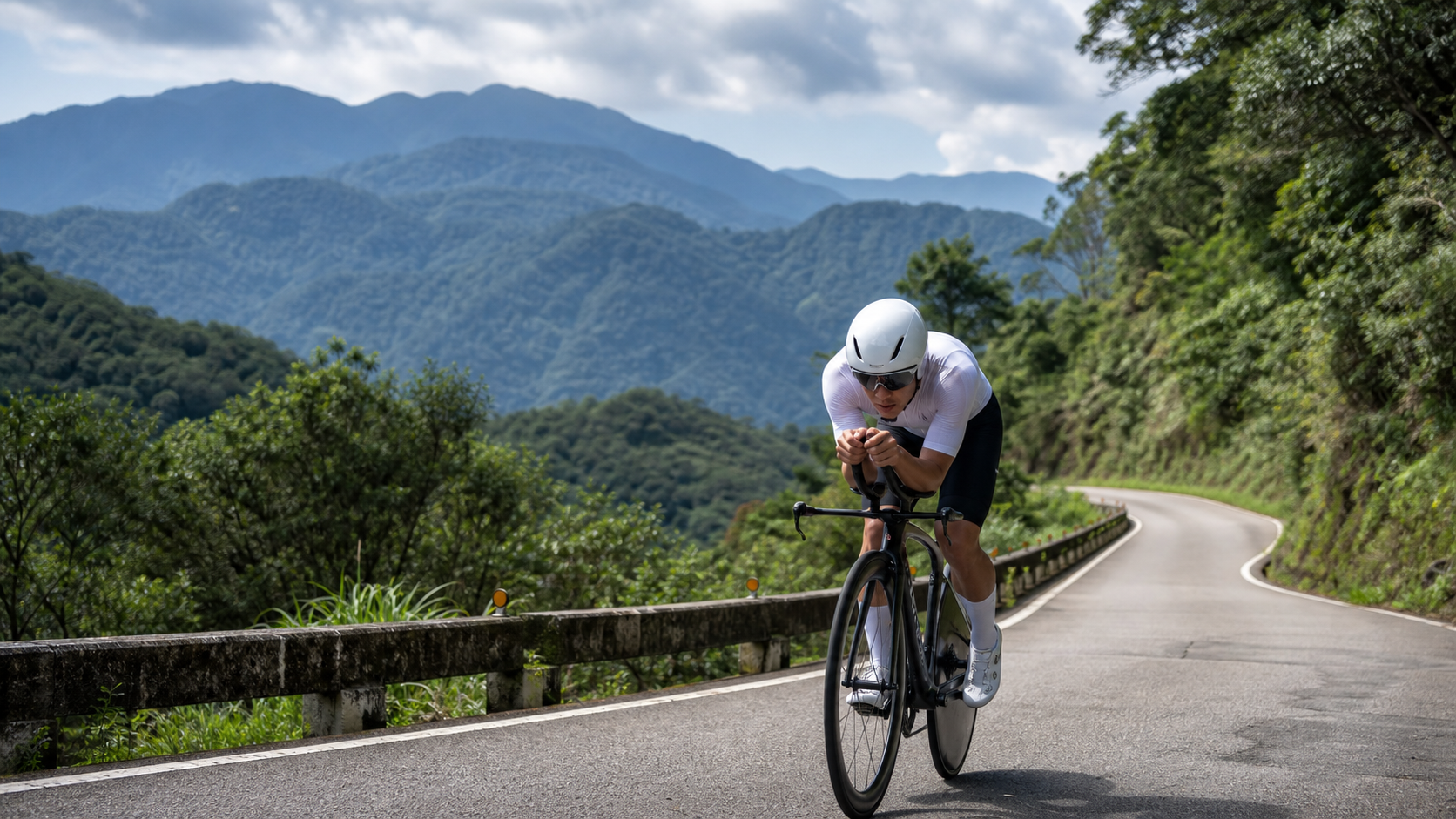
Bashan Mountain ITT Practical Guide: A 12.4km Individual Time Trial in Jianshi’s Mountainous Terrain
Summary: The Bashan Mountain ITT is located in Jianshi Township, Hsinchu County, spanning 12.4 kilometers with a Strava-recorded elevation gain of 895.7 meters and an average gradient of 4.3%. Positioned by cyclists as an Individual Time Trial (ITT) segment, this route offers sufficient distance to test endurance pacing while featuring pronounced variations in gradient distribution. This article breaks down segment gradients, pacing strategies, and training applications.
Jianshi Township in Hsinchu is an important region in northern Taiwan where Atayal indigenous culture and high-mountain landscapes converge. The area’s winding mountain roads and varied gradients have long made it a key training ground for advanced cyclists in the Hsinchu-Miaoli region practicing long-distance climbing and mental fortitude. The “Bashan Mountain ITT” is a renowned segment within these mountains, classified by the cycling community as an Individual Time Trial (ITT) route. It spans 12.4 kilometers with a Strava-recorded total elevation gain of 895.7 meters and an average gradient of 4.3%.
It should be noted that based on a 12.4-kilometer distance and a 4.3% average gradient, the theoretical elevation gain would be approximately 533 meters. However, the actual recorded gain is as high as 895.7 meters—a significant discrepancy that indicates the route features numerous undulating sections rather than being a steady, continuous climb at a fixed gradient. This characteristic, combined with the ITT segment’s emphasis on all-out effort and pushing against one’s own limits, makes Bashan Mountain a composite challenge that simultaneously tests long-duration endurance pacing and terrain adaptability. Its difficulty is far greater than the surface-level average gradient figure suggests.
Route Overview and Real Data Analysis
Let’s start with the hard numbers. The Bashan Mountain ITT spans 12.4 kilometers with a Strava-recorded total elevation gain of 895.7 meters and an average gradient of 4.3%, placing it in the Category 3 (moderate difficulty) classification. The actual elevation gain is significantly higher than the theoretical value, reflecting multiple undulating sections along the way. Combined with its ITT designation, where cyclists typically adopt near-maximal high-intensity pacing, the overall intensity of this route is far more demanding than the average gradient figure alone implies.
| Item | Data |
|---|---|
| Total Distance | 12.4 km |
| Total Elevation Gain | 895.7 m (Strava record) |
| Average Gradient | 4.3% |
| Classification | Category 3 (moderate difficulty) |
| Terrain Characteristics | Localized undulations; actual gain significantly exceeds distance × average gradient theoretical value |
| Route Nature | ITT (Individual Time Trial) segment |
| Location | Jianshi Township, Hsinchu County |
The 12.4-kilometer distance means estimated completion times will fall between 35-55 minutes (depending on fitness level). This duration extends beyond the scope of most short-distance TT segments, entering the realm of mid-to-long-distance time trial challenges that require careful energy allocation planning, which in turn elevates the importance of pacing strategy.
Segment Guide: Start Section Pacing Control (0-4 km)
As a mid-to-long-distance ITT segment, the biggest pitfall on Bashan Mountain is losing control of your pacing from the start. It’s recommended to keep your output at approximately 85-90% of threshold power for the first 4 kilometers, rather than surging to near or above threshold intensity from the outset. Because the total effort duration is longer (35+ minutes), going out too hard at the start can easily lead to premature fatigue in the middle and later sections, ultimately resulting in a slower overall finish time rather than a faster one.
For heart rate control, it’s recommended to maintain 80-85% of maximum heart rate during the opening section, allowing your body to gradually adapt to the exercise intensity while closely monitoring your perceived exertion. If you already feel significantly strained at this stage, you should immediately be alert and ease back your pace, reassessing whether your physical condition that day is suited for attempting an all-out full-distance pace.
Segment Guide: Core Undulating Climb Zone (4-9 km)
The 4-to-9-kilometer stretch is the core zone where the Bashan Mountain ITT’s climbing is most concentrated—and the key to explaining why the actual elevation gain far exceeds the theoretical value. Here, the terrain features interwoven undulations, with continuous climbs punctuated by brief descents, and instantaneous gradients frequently exceeding 6-7% on climbing sections. It’s recommended to employ the dynamic pacing strategy mentioned earlier—moderately increasing output to 95-105% of threshold power on climbs, then actively easing back to 75-80% on descents or gentler sections for recovery, keeping overall normalized power near a sustainable threshold intensity.
This stage is the most demanding section of the entire ITT challenge, testing both mental fortitude and pacing wisdom. Many cyclists, driven by impatience, push too hard on the first climb and find themselves completely unable to respond to the subsequent undulations. It’s strongly advised to remain rational, using power or heart rate data—rather than sheer subjective willpower—to guide your pacing decisions.
Segment Guide: Final Endurance Test and Sprint Finish (9-12.4 km)
Past the 9-kilometer mark, your body has accumulated considerable fatigue, and this section tests pure endurance and willpower. It’s recommended to rationally assess whether you still have reserves for a final sprint based on how well you executed your pacing in the earlier sections. If your pacing was well controlled and energy was properly allocated in the first and middle sections, you can attempt to gradually increase output here in pursuit of a better finish time. If you’re clearly exhausted, however, prioritizing a steady cadence and safely completing the challenge should take precedence, avoiding cramps or physical distress from forcing a sprint.
For the final 1-2 kilometers, it’s recommended to mobilize all remaining energy reserves and sprint all-out toward the finish. After completing the challenge, be sure to perform a thorough cool-down ride and stretching to allow your body to gradually recover from the high-intensity effort. Also record your completion time, power, and heart rate data for the day as important reference points for comparing future training progress.
Gear Ratio and Equipment Recommendations
Given the Bashan Mountain ITT’s longer distance and pronounced gradient variations, gear ratio configuration should balance efficiency with adaptability. A road bike equipped with a compact crankset (50/34T) paired with an 11-28T cassette is a relatively versatile choice. Advanced cyclists pursuing maximum efficiency might consider a tighter 11-25T configuration, leveraging higher cadence efficiency to complete the long-distance challenge. For general cyclists or heavier riders, it’s recommended to have at least a 34x28 combination to ensure sufficient margin for handling sudden steep sections in the core undulating zone.
Because the challenge duration is longer, it’s recommended to carry at least one bottle of water or energy supplies. Even for a time-trial-style high-intensity effort, longer riding durations still require basic hydration maintenance to avoid a noticeable performance drop in the latter stages due to dehydration.
Nutrition, Hydration, and Weather/Seasonal Considerations
The mountain climate in Jianshi Township varies considerably, with pronounced day-night temperature differences. Additionally, the mountain area is prone to fog or brief showers in the afternoon. It’s recommended to check the day’s weather forecast before riding. For summer challenges, starting in the early morning is advised to avoid the periods of highest heat and UV intensity. In winter, warmth retention is essential—mountain temperatures can be significantly lower than in the lowlands, and especially after completing high-intensity exercise, your body temperature drops more rapidly. It’s recommended to prepare lightweight warm clothing to address this.
Common Mistakes and DNF Risks
The most common failure mode on the Bashan Mountain ITT is underestimating how the actual elevation gain and terrain undulations affect long-distance pacing strategy. Many cyclists look only at the 4.3% average gradient figure, misjudge the overall difficulty, and start with overly optimistic pacing—only to burn out in the core undulating section and fail to maintain their ideal pace in the latter stages. It’s strongly recommended to plan your pacing and energy allocation based on the actual 895.7-meter elevation gain, not the surface-level average gradient figure.
Target Time References by Rider Level
| Rider Level | Estimated Finish Time | Average Power Reference (% of FTP) |
|---|---|---|
| Advanced / Race-level | 32-40 minutes | FTP 90-100% |
| Intermediate / Regular training | 42-55 minutes | FTP 80-90% |
| General recreational | 55-75 minutes | FTP 65-75% |
| Beginner / First attempt | 75+ minutes | Pace by feel |
Training Application: A Touchstone for Mid-to-Long-Distance Pacing Ability
Because of its moderate distance (12.4 km, 35+ minute completion time) and challenging terrain undulations, the Bashan Mountain ITT is an excellent venue for training mid-to-long-distance pacing control. For cyclists preparing to tackle longer high-mountain routes (such as Yulao or Wuling), it serves as an excellent stage-gate test segment. It’s recommended to incorporate this route as a regular benchmark test in your pre-race condition assessment, periodically recording completion times and power data to track your progress in pacing control and physical capacity for mid-to-long-distance high-intensity challenges.
In summary, the Bashan Mountain ITT—with its moderate distance, varied undulating terrain, and the all-out commitment demanded by its ITT designation—has become one of the most representative training routes in Hsinchu’s Jianshi mountain area. Master dynamic pacing strategy and rational energy allocation, and this route will prove to be an exceptional proving ground for honing your mid-to-long-distance endurance and mental fortitude.
Power Curve Analysis: Finding Your Critical Pacing Threshold
For cyclists equipped with power meters who pursue precise training data, the Bashan Mountain ITT—with its moderate distance and pronounced undulations—is an ideal venue for analyzing your personal power curve’s critical pacing threshold. The critical pacing threshold refers to the highest sustainable power a rider can maintain over a specific duration. Given the Bashan Mountain ITT’s estimated 35-55 minute completion time, this duration closely aligns with most amateur riders’ functional threshold power testing window (typically estimated as 20-minute power × 0.95). Therefore, all-out effort data from this route can serve as an important reference for evaluating whether your own FTP estimate is accurate.
It’s recommended to closely monitor the discrepancy between real-time power readings and cumulative average power during the challenge. If you notice that your instantaneous power frequently far exceeds threshold in the core undulating section but you clearly fade in the latter endurance zone, this typically indicates a pacing strategy that’s too front-loaded. For your next attempt, consider moderately reining in output during the first and middle sections, reserving more energy for steady output and the final sprint in the latter stages to achieve a more optimal overall finish time and normalized power performance.
Mental Resilience Training: The Art of Coexisting with Discomfort
A 12.4-kilometer, 35+ minute all-out effort demands far more mental resilience than a short TT segment. As your body enters a state of continuous lactate accumulation and muscles progressively stiffen with soreness, your brain constantly sends “stop now” signals. How to maintain rational pacing decisions and pedaling efficiency amid this sustained discomfort is the most important psychological lesson the Bashan Mountain ITT teaches every challenger.
It’s recommended to manage this sustained discomfort through segmented psychological anchoring—breaking the 12.4-kilometer route into three or four smaller mental blocks. Upon completing each block, give yourself a brief positive self-affirmation rather than fixating entirely on the distant finish line. Many veteran endurance athletes note that truly elite performance often comes not from ignoring pain, but from learning to coexist with it peacefully—acknowledging the discomfort’s presence while still making rational, resolute pacing judgments.
Jianshi Mountain Terrain Specifics and Risk Reminders
Jianshi Township in Hsinchu sits at the junction of the Xueshan Range and Atayal indigenous territory, featuring steep, complex terrain. Mountain roads here are carved along the contours of the hills, resulting in a high density of curves and limited visibility on some sections. When tackling a high-speed, all-out segment like the Bashan Mountain ITT, it’s essential to maintain heightened awareness of road conditions and corners while pursuing your pacing goals. Uphill sprints in particular can cause riders to become overly focused on power output and heart rate data, neglecting real-time assessment of the road ahead—a state of divided attention that is especially dangerous on mountain roads.
It’s recommended that even during all-out ITT efforts, you moderately rein in speed and allocate attention to cornering sections, ensuring safe riding as the foundation before pursuing peak pacing and performance. Safety should always be the first priority in any training or challenge. No record-breaking sense of achievement outweighs the importance of completing every ride safely.
Training Progression to Yulao, Wuling, and Other High-Mountain Routes
The Bashan Mountain ITT is located in Jianshi Township, Hsinchu, geographically close to the Yulao climb route in the same area. Both serve as important training stepping stones for advanced cyclists preparing to tackle higher-difficulty mountain routes (such as Wuling or Hehuan Mountain). For cyclists preparing to challenge ultra-high-difficulty climbs like Wuling, it’s recommended to incorporate the Bashan Mountain ITT into an 8-12 week pre-race training cycle. Through repeated all-out efforts, you can progressively build the endurance foundation for mid-to-long-distance high-intensity climbing while closely tracking power and finish time improvement curves as objective criteria for assessing whether you’re ready for higher-difficulty routes.
This progressive training philosophy—gradually transitioning from moderate-difficulty routes to ultra-high-difficulty challenges—effectively reduces the risk of sports injuries from prematurely tackling difficult routes and makes overall training outcomes more solid and sustainable. The Bashan Mountain ITT is an indispensable link in this training progression.
Balancing Team Support and Individual Challenge
Although the name carries the “Individual Time Trial (ITT)” designation, most cyclists still prefer to ride in groups when tackling Bashan Mountain. On one hand, the mountain route is relatively remote, and riding together improves safety. On the other hand, mutual encouragement among teammates and tracking each other’s pacing performance adds a degree of healthy competitive fun and motivation to what might otherwise be a grueling long-distance effort.
When riding in a group, it’s recommended to still adhere to the core spirit of ITT—each person paces independently without relying on drafting. This allows everyone to honestly confront their true physical condition at that moment, rather than making pacing decisions that don’t match their own capabilities simply because they’re following a teammate’s rhythm. After completing the challenge, team members can share their respective power curves and insights. This riding model that combines individual effort with team exchange often generates richer training insights and emotional connections.
Positioning Recommendations in Periodized Season Training
Within a complete periodized season training plan, it’s recommended to position the Bashan Mountain ITT as an important transition benchmark between the late base phase and the intensity phase. The base phase focuses on accumulating aerobic endurance, while the intensity phase introduces more threshold and anaerobic training stimuli. The Bashan Mountain ITT’s characteristics—mid-to-long distance requiring sustained high-intensity output—are perfectly suited to verify whether a rider has the physiological foundation to smoothly transition from base endurance into intensity training.
It’s recommended to schedule one all-out Bashan Mountain ITT effort before the end of the base phase as a starting baseline for entering intensity training. Then, in the middle-to-late intensity phase, schedule one to two repeat attempts, tracking power and finish time improvements to evaluate whether intensity-phase training outcomes are meeting targets. Adjust pre-race peak phase training intensity distribution accordingly to ensure you arrive at target races or higher-difficulty route challenges in optimal condition.
Equipment Durability and Additional Considerations for Long Climbs
Given the Bashan Mountain ITT’s longer distance and the substantial load sustained high-intensity output places on the drivetrain, it’s recommended to regularly inspect chain tension, shift cable tension, and brake system wear. Sustained high pedaling power output also raises the precision requirements for rear derailleur alignment. Any minor shifting delay, in an ITT challenge pursuing ultimate pacing efficiency, can cause unnecessary power loss and rhythm disruption.
For wheelset selection, considering the 12.4-kilometer distance and undulating terrain, it’s recommended to choose mid-profile wheels that balance climbing lightweight characteristics with rolling efficiency, paired with 25-28C tires offering balanced grip and puncture resistance. This ensures safety while minimizing unnecessary weight and aerodynamic drag, allowing every ounce of effort to be effectively converted into forward momentum.
The Importance of Post-Race Recovery and Data Review
After completing a high-intensity mid-to-long-distance challenge like the Bashan Mountain ITT, your body accumulates considerable fatigue and micro-muscle damage. It’s recommended to schedule low-intensity recovery rides or complete rest within 24-48 hours after the challenge, combined with adequate sleep and protein intake to support muscle tissue repair and supercompensation effects. If you skip the recovery process and jump straight into the next high-intensity training session, you won’t achieve the expected training outcomes and may instead increase the risk of overtraining or sports injuries.
Data review is equally an indispensable part of the training process. After the challenge, carefully examine your power curve, heart rate variations, and segment pacing records to identify aspects of your pacing strategy that can be optimized—Was the opening output too aggressive? Was normalized power in the core undulating section too high? Did the latter-stage endurance remain stable? Through this systematic data analysis, every all-out effort can be transformed into concrete, actionable training improvements rather than merely accumulating one round of fatigue after another.
Conclusion: A Mid-to-Long-Distance Trial of Endurance and Wisdom
With its moderate 12.4-kilometer distance, substantial 895.7-meter elevation gain, and terrain undulations significantly exceeding theoretical values, the Bashan Mountain ITT has become a highly representative and training-valuable mid-to-long-distance challenge route in Hsinchu’s Jianshi mountain area. It tests not merely physical capacity and willpower, but also whether a rider can employ rational pacing strategies and precise data interpretation to make one correct decision after another throughout a long and grueling effort.
Whether you’re an advanced cyclist preparing to tackle higher-difficulty mountain routes or an intermediate rider simply wanting to assess your mid-to-long-distance pacing control, the Bashan Mountain ITT will provide honest, concrete feedback through its solid and varied terrain. It will continue to accompany you on the long road of cycling training, helping you grow steadily and solidly, repeatedly resetting the limits you once thought unattainable. Every journey into the Jianshi mountains becomes the most authentic and inescapable examination of your true ability, urging every cyclist to face the next self-transcendence with ever-greater data discipline and mental fortitude—transforming every painful yet solid pedal stroke into nourishment for becoming a stronger version of yourself. The Bashan Mountain ITT stands as the most honest and reliable fitness yardstick in every season’s training cycle, continuously witnessing the effort and transformation of every rider.
Supplementary Advice: A Progressive Plan for First-Time Beginners
For beginner cyclists tackling the Bashan Mountain ITT for the first time, it’s not recommended to challenge the entire route with an all-out ITT mindset from the start. Instead, it’s suggested to first complete one ride in a sightseeing-cruising mindset, familiarizing yourself with gradient changes, corner positions, and the distribution of resupply points. After building a basic understanding of the route, you can progressively increase challenge intensity. On your second visit, attempt to complete the full distance at moderate intensity (70-80% of threshold power) to feel the overall pacing rhythm. After accumulating two to three riding experiences, you can then formally attempt a near-all-out ITT pacing strategy. This progressive approach effectively reduces the risk of sports injuries from inadequate preparation and ensures your eventual all-out effort is built on a more solid foundation of route familiarity and physical conditioning.
Related Reading
2025 崇越盃「西進武嶺」CT挑戰直播測試 / 公路車 / CT Yeh
1 年前
單車AI教練!全新 ChatGPT4o 幫你分析訓練成果!排武嶺課表,分析騎車姿勢! 太神了! / 公路車 / CT Yeh / feat. 緯緯
2 年前
台北闊瀨陡坡 騎旅 / 日本單車雜誌編輯車友臨時加入!/ 髮香才是最強的 / feat. 北迴歸線小隊 / 公路車 CT Yeh
6 個月前
西進武嶺 免費訓練分析服務 Intervals | 練不夠還是練過頭?你哪一種類型選手?AI模型告訴你! | 備戰神器 | 公路車 訓練 | CT Yeh
4 年前
西進武嶺 世界紀錄挑戰!破2:30 ?!一群人推著一個夢上山 直播精華版 / ft. 張翰允 & 台視主播魏于恬 & KPLUS / #cycling 公路車 CT Yeh
2 個月前
團練) 4K NEKO 雙崎部落 間歇 狂拉 爽飛天 19/05/11
7 年前
半日 小台灣 極限單車路線挑戰實錄
7 年前
Live) 備戰2019彰化經典百K 賽前攻略 (已完賽請看新影片
7 年前