Smart Helmet Features Explained: From MIPS to Turn Signals, from Crash Detection to Bone-Conduction Audio
Complete Guide to Smart Helmet Features: From MIPS to Turn Signals, Crash Detection to Bone Conduction Audio
The helmet is the most important safety accessory in cycling equipment, and with technological advancements, modern helmets are no longer just a hard shell protecting the head. Smart helmets integrate lighting, communication, sensors, and other features, turning the helmet into the rider’s intelligent hub.
Evolution of Safety Protection Technology
MIPS: Multi-directional Impact Protection System
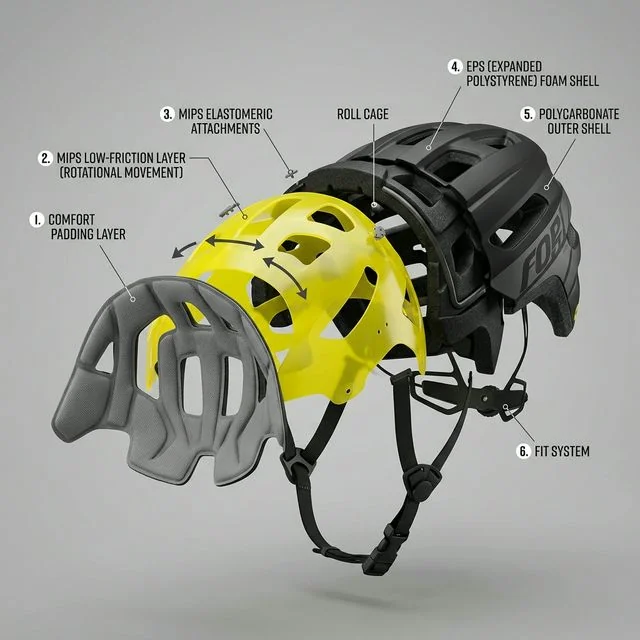
MIPS (Multi-directional Impact Protection System) has become standard equipment on mid-to-high-end helmets. Its principle involves adding a low-friction layer inside the helmet that can slide slightly. In the event of an angled impact, this layer absorbs rotational forces, reducing torsional stress on the brain.
Research shows that most head impacts in cycling accidents are not direct frontal hits but angled, oblique impacts. The MIPS system is specifically designed for this most common impact scenario.
Evolution of MIPS versions:
- MIPS C: Standard version, yellow plastic liner
- MIPS Spherical: Developed in collaboration between Giro and MIPS, featuring a spherical sliding interface between two EPS layers
- MIPS Integra: Integrated design, lighter and more breathable
- MIPS Air: Latest version, using air cushions instead of the plastic liner
WaveCel and SPIN
Beyond MIPS, there are other rotational force protection technologies:
Bontrager WaveCel: Uses a honeycomb-folded structure to replace traditional EPS foam, providing both linear and rotational impact protection. Bontrager claims WaveCel reduces the risk of concussion by 48 times compared to traditional helmets (this figure is disputed).
POC SPIN (Shearing Pad INside): Uses silicone shear pads inside the helmet to provide rotational force protection. POC’s SPIN technology is similar in principle to MIPS but implemented differently.
Smart Feature One: Integrated Lighting
Rear LED Warning Lights
Several smart helmets integrate LED light sets at the rear:
Specialized Prevail 3 / S-Works Prevail 3:
- Rear ANGi LED light
- Pairs with crash detection feature
- Visible up to approximately 200 meters in daylight
Lumos Ultra / Kickstart:
- Front white LED + rear red LED
- Supports turn signal function (requires remote control)
- Brake sensor automatically activates the light
- Brightness and flash patterns configurable via the App
Trek/Bontrager Starvos WaveCel:
- Integrated rear LED daytime running light
- No need to install a separate tail light
Turn Signal System
The most distinctive feature of the Lumos helmet series is the turn signal. LED light sets are located on both sides of the helmet, paired with a remote control mounted on the handlebar. Pressing left or right activates the corresponding turn signal.
Practical usage insights:
- Highly effective at night; drivers behind can easily recognize the signals
- Limited visibility during the day; hand signals are still recommended
- Water resistance of the remote control requires attention
- Turn signals do not auto-cancel; they must be manually turned off
Smart Feature Two: Crash Detection and Emergency Alerts
How It Works
The built-in accelerometer and gyroscope in the helmet continuously monitor head movement. When a sudden impact and abnormal motion pattern resembling a crash are detected, the system initiates an emergency alert sequence:
- The helmet detects an impact event
- The phone App receives a notification
- A countdown begins (typically 30-90 seconds)
- If the rider does not cancel before the countdown ends
- An emergency text message is automatically sent to preset emergency contacts
- The message includes the rider’s GPS location
Comparison of Major Products
| Product | Sensor | Countdown Time | Location Sharing | Monthly Fee |
|---|---|---|---|---|
| Specialized ANGi | Built into helmet | 90 seconds | GPS coordinates | Free |
| Garmin Incident Detection | Built into bike computer | 30 seconds | GPS coordinates + map | Free |
| Apple Watch Fall Detection | Built into watch | 60 seconds | GPS coordinates | Free |
| ICEdot Crash Sensor | External sensor | Customizable | GPS coordinates | Free |
False Alarm Issues
The biggest challenge with crash detection is false alarms. The following situations can easily trigger them:
- Helmet dropped on the ground
- Vigorous head shaking
- Intense vibration during off-road riding
- Helmet hitting a door frame or low-hanging object
Most systems handle false alarms through the countdown mechanism—the rider simply cancels before the countdown ends. However, frequent false alarms can reduce willingness to use the feature and may create a “cry wolf” effect with emergency contacts.
Smart Feature Three: Bone Conduction Audio
Technical Principle
Bone conduction audio uses vibration elements inside the helmet to transmit sound directly to the inner ear through the skull, allowing you to hear audio without plugging your ears. This is crucial for cycling because maintaining awareness of ambient sounds is a fundamental requirement for safe riding.
Representative Products
Sena R2 / R2 EVO:
- Built-in bone conduction speakers
- Supports Bluetooth connection to smartphone
- Can answer calls, listen to music, and receive navigation voice prompts
- Supports intercom function (multi-party calls)
- Battery life of approximately 5-6 hours
Coros SafeSound:
- Open-ear audio system (not strictly bone conduction)
- Speakers positioned near the ears but not sealed
- Sound quality superior to traditional bone conduction
- Supports Bluetooth 5.0
Usage Recommendations
- Volume control: Keep the volume at a level where ambient sounds remain audible; recommended not to exceed 60%
- Navigation voice prompts: The most suitable use case, reducing the frequency of glancing at the bike computer
- Phone calls: Acceptable for short calls, but avoid distractions during long rides
- Music: A personal choice, but recommended to turn off in heavy traffic areas
Smart Feature Four: Communication and Intercom
Communication Needs While Riding
Communication during group rides has always been a pain point. Traditional shouting is inaudible at high speeds or into headwinds, and hand signals have their limitations. Communication systems built into helmets offer a solution.
Sena Intercom System:
- Maximum communication range of approximately 900 meters
- Supports up to 4 people in simultaneous conversation
- Voice quality is acceptable at low to medium speeds
- Wind noise at high speeds still affects call quality
Buying Recommendations
Safety First
No matter how appealing the smart features are, the protective performance of a helmet is always the top priority. When purchasing, verify:
- Passes safety certifications (e.g., CPSC, CE EN 1078)
- Equipped with rotational force protection (MIPS or equivalent technology)
- Proper fit for your head shape: Asian and Western head shapes differ significantly
- Ventilation performance: Taiwan’s climate is hot, making ventilation extremely important
Choose Features Based on Needs
Commuter riders: Integrated lighting + crash detection (Lumos Ultra recommended)
Road cyclists: MIPS + lightweight + crash detection (Specialized Prevail 3 recommended)
Group ride enthusiasts: Bone conduction audio + intercom function (Sena R2 EVO recommended)
Value seekers: MIPS protection is sufficient; smart features can be added later with external accessories
Price Range Reference
| Tier | Price Range | Representative Features |
|---|---|---|
| Entry | NT$3,000-5,000 | MIPS + basic protection |
| Mid-range | NT$5,000-8,000 | MIPS + integrated lighting |
| High-end | NT$8,000-12,000 | MIPS + lighting + crash detection |
| Flagship | NT$12,000+ | Full features (lighting + audio + communication + detection) |
Future Outlook
The development trend of smart helmets is moving toward greater feature integration:
- AR Head-Up Display: Displaying speed, navigation, and other information within the field of view
- Environmental Awareness: Radar detection of vehicles approaching from behind with alerts
- AI Accident Prediction: Using AI to analyze riding patterns and predict potential hazards
- Solar Charging: Using solar panels on the helmet surface to power electronic components
Technology is transforming helmets from passive protection into proactive safety partners, but remember: the best helmet is the one you are willing to wear every time.
Related Reading
- Helmet Technology Decoded: MIPS, WaveCel, and Modern Head Protection Systems
- In-Depth Cycling Helmet Review: MIPS Technology, Ventilation Design, and Mainstream Options in the Taiwan Market
- Cycling Helmet Buying Guide: Three Key Selection Criteria—MIPS, Aerodynamics, and Ventilation
- Cycling Helmet Buying Guide: The Trade-off Between MIPS Technology and Ventilation Design
#公路車 #Fitting 靠人工智慧APP 幫你調整單車
6 年前
摔車後補裝備: 好市多新款單車安全帽& Specialized Romin 北高整路屁股都不痛的坐墊 | 一千元居然有MIPS | CT Yeh | 公路車
4 年前
趣味單車配件:多功能智慧尾燈 / 有方向燈 可app編輯圖案!? / GRC x Lumii 聯名款 / 公路車 CT Yeh
9 個月前
車錶新黑馬? / 超狂續航 / 超好用錶冠 / 無敵準定位 / Dash圖表合成!?/ COROS DURA 評測!/ 公路車 / CT Yeh
2 年前
Insta 360 One 超級防手震技術實測
7 年前
3C開箱) SoundBot 老車升級智慧音響 SB360 藍芽 免持 接收器 Aux in 手機 汽車音響 美國聲霸
7 年前
邁金 T500 訓練台開箱!有下坡輔助、路感模擬、不用插電、直驅電機 !兩萬級距頂規享受新選擇!/ 公路車 / 室內訓練 / CT Yeh
1 年前
Insta360/DJI做不到的!如何製作「騎士頭頂瓦數特效」單車影片?CycleDash 完整教學 / 超強批次影片數據疊加軟體
14 天前