The Complete Guide to Cassette and Chainring Compatibility: Understanding Drivetrain Pairing Logic
The Complete Guide to Cassette and Chainring Compatibility: Understanding Drivetrain Pairing Logic
Introduction
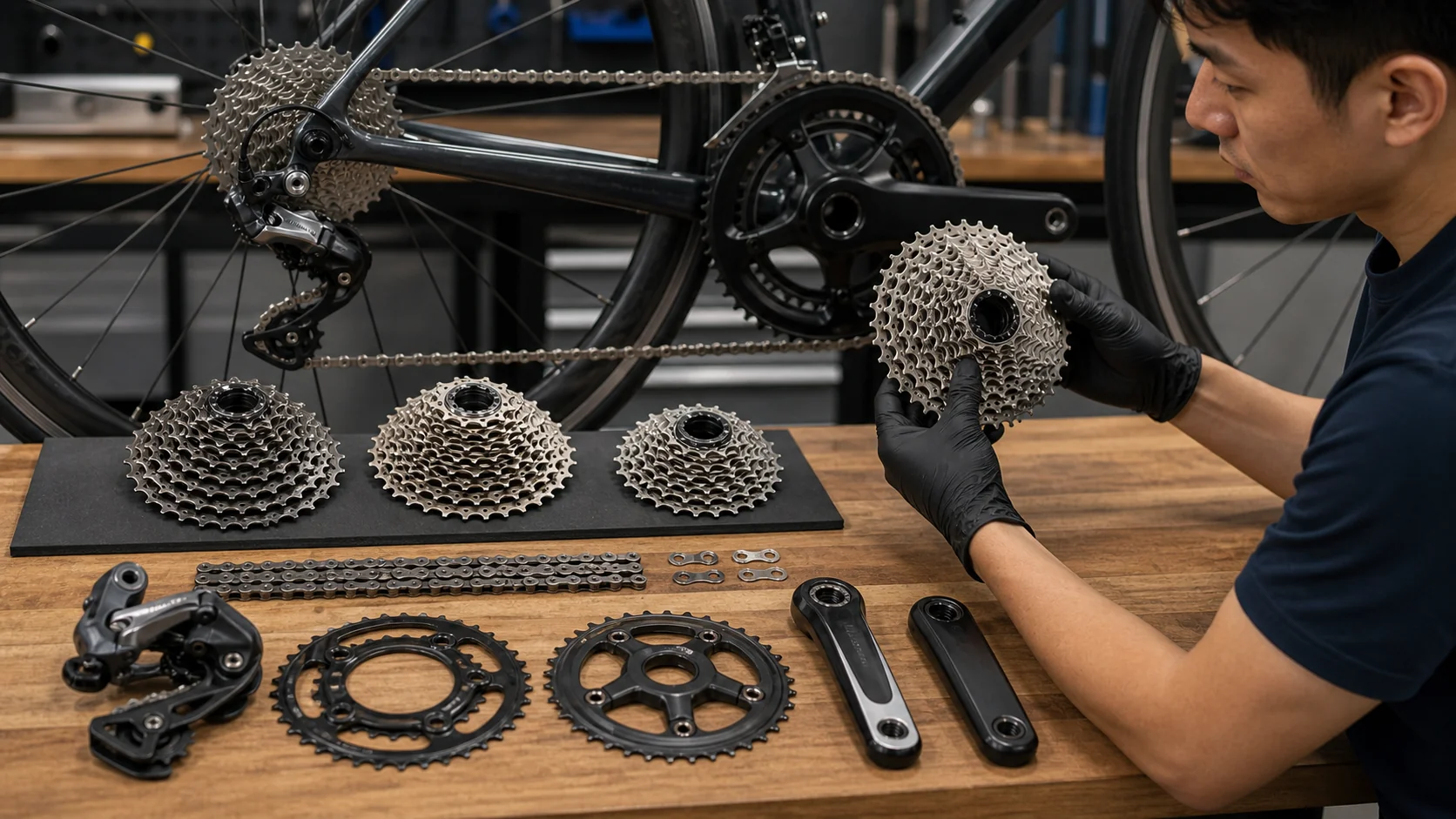
“Will this cassette fit on my wheelset?” “Can a Shimano chainring pair with a SRAM cassette?” “I want to upgrade from 10-speed to 11-speed — which parts do I need to replace?” These questions come up on cycling forums every single day. Drivetrain compatibility is a tangled web of brands, speed counts, model years, and specifications, and a single misstep can leave you with parts that simply won’t work together. This article breaks the problem down into clear categories to help you make the right call when upgrading or replacing components.
The Core Dimensions of Compatibility
Drivetrain compatibility can be analyzed along several dimensions:
- Freehub Body Spline: Whether the cassette can be mounted on the wheelset
- Cassette Cog Range and Rear Derailleur Capacity: Whether the rear derailleur can handle the cassette
- Chain Width and Speed Count: Whether the chain works with both the cassette and chainring
- Cable Pull Ratio: Whether the shifter’s cable pull matches the rear derailleur
- Chainring BCD and Crank Interface: Whether the chainring can be mounted on the crankset
Freehub Body Compatibility
Major Spline Standards
| Spline Standard | Developed By | Compatible Cassettes | Spline Width |
|---|---|---|---|
| Shimano HG | Shimano | Shimano 8-11 speed, SRAM 8-11 speed | 35mm |
| Shimano Micro Spline | Shimano | Shimano 12-speed (MTB and road) | 35mm |
| SRAM XD | SRAM | SRAM 10-12 speed MTB | 17mm (smallest cog down to 10T) |
| SRAM XDR | SRAM | SRAM 10-12 speed road | 1.85mm longer than XD |
| Campagnolo Traditional | Campagnolo | Campagnolo 9-12 speed | Proprietary standard |
| Campagnolo N3W | Campagnolo | Campagnolo 13-speed | Proprietary standard |
Key Things to Watch For
Capacity Issues with the Shimano HG Spline:
- 8-speed and 9-speed cassettes are narrower and require spacer rings during installation
- 10-speed cassettes come in “road” and “mountain bike” versions with different widths
- 11-speed road cassettes require an 11-speed-specific HG freehub body (1.85mm longer than the traditional HG spline)
- Some hubs can accommodate different speed counts by swapping spacers
SRAM XD’s Special Advantage:
- The XD spline allows for a smallest cog as small as 10T (traditional HG tops out at 11T minimum)
- This lets SRAM design wider-range gear ratios (such as 10-50T or 10-52T)
- XD and XDR are not interchangeable (XDR has an extra 1.85mm of spacer room)
Pairing Cassettes with Rear Derailleurs
Maximum Cog Capacity
A rear derailleur’s spec sheet lists a “Max Cog” value — the largest cassette cog it can accommodate:
| Derailleur | Rated Max Cog | Actual Max (with margin) |
|---|---|---|
| Shimano 105 R7000 SS | 30T | Usually up to 32T |
| Shimano 105 R7000 GS | 34T | Usually up to 36T |
| Shimano Ultegra RX | 34T | 34T (precisely rated) |
| SRAM Force 1 | 42T | 42T |
| Shimano GRX RD-RX812 | 42T | 42T |
What Happens If You Exceed the Rated Range?
- The B-tension screw may not provide enough clearance, and the guide pulley may hit the largest cog
- The derailleur’s parallelogram may not be able to fully extend to reach the largest cog
- The chain may be too short, causing the derailleur to be over-stretched
Total Capacity
A rear derailleur’s “total capacity” defines the difference in chain slack it can take up:
Total Capacity = (Largest Cassette Cog − Smallest Cassette Cog) + (Large Chainring − Small Chainring)
Example: an 11-34T cassette paired with a 50-34T chainring
- Cassette spread: 34 − 11 = 23
- Chainring spread: 50 − 34 = 16
- Total requirement: 23 + 16 = 39
If the rear derailleur’s rated total capacity is 37T, this combination theoretically cannot be handled perfectly, and chain tension may be off in extreme gear combinations (large chainring + large cog, or small chainring + small cog).
Chain Compatibility
Speed Count Correspondence
Chain outer width narrows as speed count increases:
| Speed Count | Outer Width (approx.) | Compatibility |
|---|---|---|
| 6/7/8-speed | 7.1-7.3mm | Interchangeable among the three |
| 9-speed | 6.5-6.7mm | Its own standard |
| 10-speed | 5.9-6.2mm | Its own standard |
| 11-speed | 5.5-5.6mm | Its own standard |
| 12-speed | 5.0-5.3mm | Varies slightly by brand |
Cross-Brand Chain Compatibility
Shimano and SRAM Chain Interchangeability:
- 8-11 speed: Shimano and SRAM chains are generally interchangeable
- 12-speed: Using each brand’s own chain is recommended, since cog tooth profiles and chain plate shapes are more precisely matched
- KMC chains: as a third-party brand, KMC offers universal chains across speed counts with consistent quality
Campagnolo Chains:
- 11-speed and below: KMC or Shimano chains can be used as substitutes (though Campagnolo does not officially recommend this)
- 12-13 speed: Using genuine Campagnolo chains is strongly recommended
Chainring Compatibility
BCD (Bolt Circle Diameter)
BCD is the diameter of the circle formed by a chainring’s mounting bolt holes, and it determines which crankset the chainring can be mounted on:
| BCD | Bolt Count | Matching Crankset | Tooth Range |
|---|---|---|---|
| 130mm | 5 | Older road cranksets | 38-55T |
| 110mm 4-bolt | 4 | Modern Shimano road | 34-52T |
| 110mm 4-bolt (AXS) | 4 | SRAM AXS road | 33-50T |
| 96mm | 4 | Shimano MTB (XT/XTR) | 30-38T |
| 104mm | 4 | Universal MTB | 32-42T |
| Direct Mount | - | Brand-specific | Varies |
Direct Mount Chainrings
More and more modern cranksets are adopting direct-mount chainrings, doing away with the traditional BCD bolt pattern. This makes chainring-to-crankset pairing even more brand-specific:
- Shimano Direct Mount: Shimano-proprietary interface
- SRAM DUB Direct Mount: SRAM 8-bolt proprietary interface
- Race Face Cinch: Race Face proprietary
- SRAM 3-Bolt Direct Mount: SRAM 1x systems
Direct-mount chainrings cannot be used across brands.
Tooth Count Pairing Principles
Chainring Tooth Difference:
In double-chainring setups, the tooth difference between the big and small ring affects shifting performance:
- Standard 53-39T: 14T difference, suited to riding that’s mostly flat
- Compact 50-34T: 16T difference, the most versatile setup
- Semi-compact 52-36T: 16T difference, a versatile setup leaning toward speed
- Sub-compact 48-32T: 16T difference, suited to climbing-focused riding
The larger the tooth difference, the farther the front derailleur must push the chain, which increases shifting difficulty accordingly. Most front derailleurs can handle a maximum tooth difference of about 16T.
Guide to Upgrading Across Speed Counts
Upgrading from 10-Speed to 11-Speed
Parts You’ll Need to Replace:
- Cassette (11-speed cassette)
- Rear derailleur (11-speed specific)
- Shifters (11-speed specific, different cable pull ratio)
- Chain (11-speed chain)
- Possibly the freehub body (the 11-speed HG spline is 1.85mm wider than the 10-speed version)
Parts You Can Keep:
- Front chainring (if the BCD matches and tooth count is suitable)
- Front derailleur (compatible in some cases)
- Rim and hub (if the freehub body can be swapped)
Upgrading from 11-Speed to 12-Speed
The Shimano Path:
- Requires a Micro Spline freehub body
- A full set of 12-speed drivetrain components (shifters, front/rear derailleur, cassette, chain, chainring)
- Essentially a full replacement
The SRAM Path:
- Requires an XDR freehub body
- A full set of 12-speed AXS electronic shifting components
- Also essentially a full replacement
The Gray Area of Mixing Brands
Shimano Shifters + SRAM Rear Derailleur
This is the most commonly discussed mixed setup. Because the two brands use different cable pull ratios:
- Shimano 11-speed road: pulls approximately 1.7mm of cable per shift
- SRAM 11-speed road: pulls approximately 1.1mm of cable per shift (SRAM uses a 1:1 ratio)
Mixing them directly causes each shift to move the derailleur the wrong amount, so it can’t line up with the cogs.
The Workaround: Use a cable-pull converter (such as the JTek ShiftMate) to adjust the ratio. This adds complexity, though, and isn’t recommended for beginners.
Mixing Cassettes Across Speed Counts
- An 11-speed cassette on a 10-speed system: physically it may mount fine (the HG spline is compatible), but the 10-speed rear derailleur’s shift increments won’t match the 11-speed cassette’s cog spacing
- The reverse: also incompatible
- Exception: some Shimano mountain bike 10-speed and 11-speed systems from specific model years happen to share the same cable pull ratio and may work by coincidence
Pre-Purchase Checklist
Before buying any drivetrain component, confirm the following:
Cassette
- [ ] Freehub body spline type (HG / Micro Spline / XD / XDR / Campagnolo)
- [ ] Speed count (must match the rear derailleur and shifters)
- [ ] Largest cog doesn’t exceed the rear derailleur’s capacity
- [ ] Smallest cog isn’t below the rear derailleur’s rated minimum
Chainring
- [ ] BCD or direct-mount standard matches the crankset
- [ ] Tooth difference is within the front derailleur’s handling range
- [ ] Tooth count is compatible with the chain for that speed count
- [ ] Large chainring teeth + largest cassette cog doesn’t exceed the rear derailleur’s total capacity
Chain
- [ ] Correct speed count
- [ ] Appropriate length (big ring + largest cog + 2 links)
- [ ] Connection method confirmed (quick link or connecting pin)
Rear Derailleur
- [ ] Cable pull ratio matches the shifters
- [ ] Capacity is sufficient to handle the cassette and chainring tooth spread
- [ ] Mounting interface (traditional hanger / direct mount / UDH) is compatible with the frame
Conclusion
Drivetrain compatibility really is a complex topic, but once you’ve grasped the four core concepts — spline type, speed count correspondence, cable pull ratio, and capacity calculations — you’ll be able to make the right call when shopping for parts. When in doubt, a manufacturer’s official compatibility chart is always the most reliable reference — you can usually find these in the technical documentation section of the brand’s website. A few minutes spent checking a chart beats spending real money on the wrong part.
Related Reading
鉅齒紋輪組!? ControlTech MEG-T50 EVO 碳纖維幅條輪組/ 功率對比實驗 / 公路車 / CT Yeh
2 年前
再一組! 全碳幅條 碟煞/無內胎輪組 開箱! 到底好騎嗎? UNAAS X40 | 公路車 | CT Yeh
4 年前
SRAM FORCE E1 首發!/ 改成短腿了 / 煞車升級有感嗎? / TIME ADH 變速大升級 / 公路車 / CT Yeh
1 年前
2025崇越「西進武嶺」挑戰VLOG / 賽前改短成165曲柄會如何? / 選手昏倒? / 公路車 / CT Yeh
1 年前
來都來了!改好改滿 / CS大導輪 + BB 可以省幾瓦? / 同場加映 TIME XPRO卡踏 / #公路車 #ceramicspeed / CT Yeh
1 年前
功率實測 Lun Hyper 2023 碳幅條輪組 D45 碟煞 | 公路車 | CT Yeh
3 年前
碟煞公路車 銑面器 !? 原來銑完差這麼多! 降低蹭碟機率! | TIME 公路車 保養小記錄 | CT Yeh
3 年前
碟煞公路車 優缺點?換車一年半實際經驗分享 / 公路車 / CT Yeh
2 年前