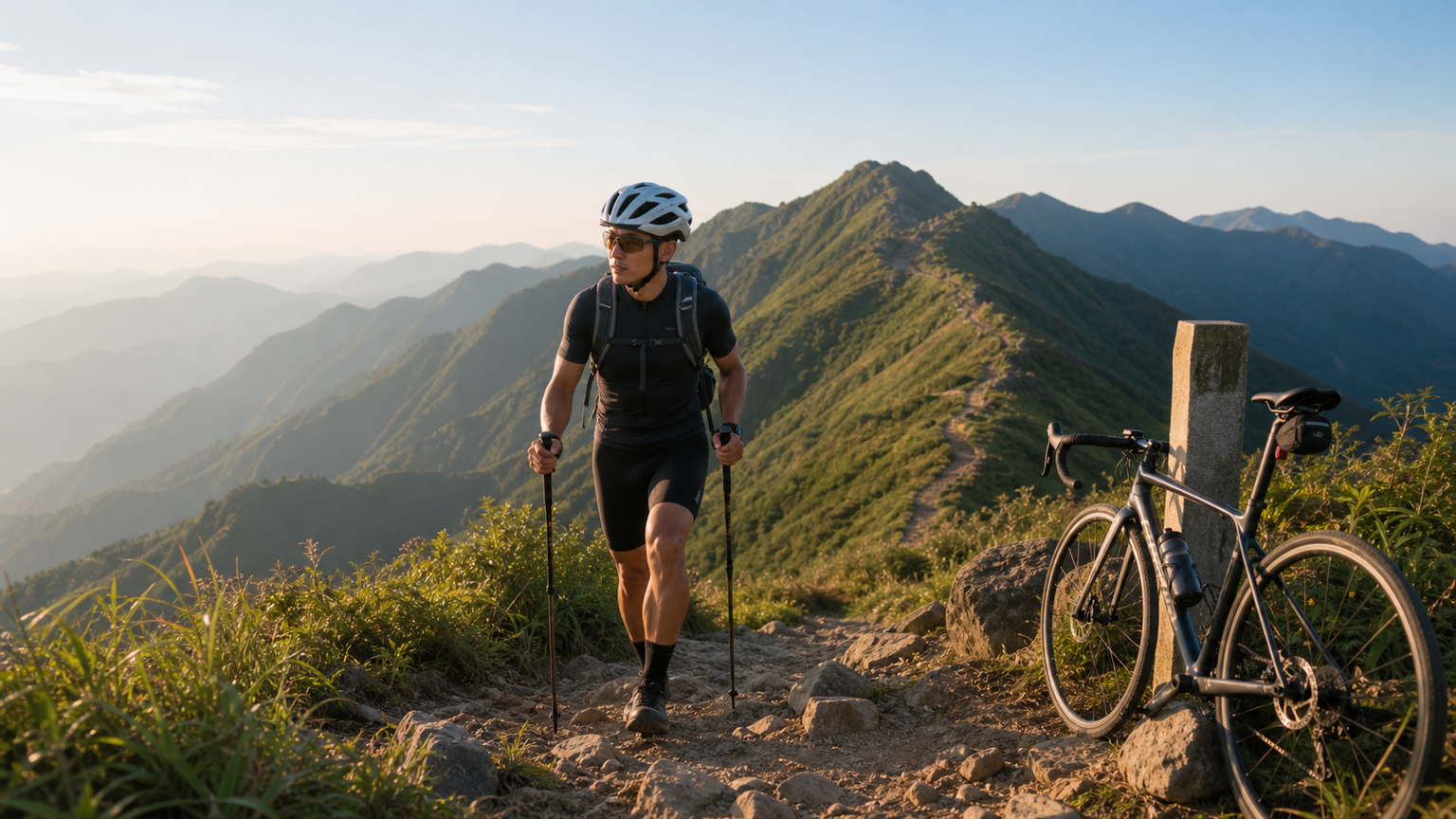
Hiking and Cycling: How to Build Mountain Trekking into Your Training Plan
Cycling and mountain hiking may look like different sports, but they actually share a lot of physiological ground: both rely primarily on the aerobic system, both demand lower-body muscular endurance, and both can be done in mountain terrain. More and more professional cyclists are folding hiking into their off-season or recovery training, not just to maintain fitness but to rediscover their enthusiasm for the outdoors.
Concrete Benefits of Hiking for Cyclists
A Different Stimulus for the Same Muscle Groups
Uphill hiking primarily engages the glutes, quadriceps, and calves — nearly the same muscle groups used when climbing on a bike. However, the walking motion of hiking provides a full range-of-motion stretch that riding simply cannot: every step involves a greater hip extension angle, which helps relieve the hip flexor tightness that cycling tends to cause.
Low-Impact Aerobic Training
Compared with running, hiking places much less impact stress on the knees and hips, making it a better alternative for cyclists (who are often unaccustomed to the pounding of running) looking for extended aerobic work. On mountain trails, heart rate can comfortably stay within the aerobic base zone (60–75% of max heart rate), building up meaningful aerobic training volume.
Proprioception and Ankle Training
Uneven mountain trails train ankle stability and proprioception (the body’s sense of its own position) — a stimulus that cycling almost entirely lacks. Better proprioception helps reduce the small ankle-related injuries that can occur in cycling.
Mental Recovery Benefits
Research shows that exercising in natural environments significantly lowers cortisol (the stress hormone) and improves mood and motivation. For highly structured cyclists, adding the freer, less regimented activity of hiking into the gaps of a training plan helps prevent burnout.
When Hiking Training Fits Best
Off-Season (Winter)
When winter riding conditions are poor, hiking is an excellent substitute for maintaining aerobic base. Hiking mountain trails 3–4 times a week for 2–3 hours each session can accumulate substantial aerobic training volume (TSS) without adding to riding fatigue.
Active Recovery After High-Intensity Training
An easy hike on flat ground or gentle slopes (heart rate below 60% of max) is a better recovery strategy than complete static rest — it promotes blood circulation and helps ease muscle soreness.
A Supporting Tool for Altitude Training
If you have the opportunity to train at high altitude, combining riding with hiking stimulates red blood cell production more comprehensively and helps your body adapt more fully to the low-oxygen environment.
How to Scientifically Plan Hiking Intensity
Using Heart Rate to Quantify Training Load
A heart rate monitor works just as well for hiking. Cyclists can apply their existing cycling heart rate zones directly:
- Z1 (Recovery): Below 60% of max heart rate — easy walking
- Z2 (Aerobic Base): 60–75% of max heart rate — suitable for most hikes
- Z3 (Tempo): 75–85% of max heart rate — steeper uphill sections
Most hiking sessions should stay within Z1–Z2, avoiding excessive fatigue accumulation.
Converting Elevation Gain into Riding Training Volume
A rough rule of thumb (individual variation applies):
- Every 100 m of elevation gain ≈ 10–15 minutes of aerobic training
- A 4-hour hike with 800 m of elevation gain ≈ the training load of 2.5–3 hours of Z2 riding
When to Use Trekking Poles
Using trekking poles on descents significantly reduces knee stress, especially for cyclists unaccustomed to long downhills. On ascents, poles can also assist propulsion, engaging the upper body in the effort.
Sample Integrated Training Plan
Example: 12-week winter cross-training plan
| Weeks | Riding | Hiking | Focus |
|---|---|---|---|
| 1–3 | 3x/week | 1x/week (3–4 hrs) | Aerobic base, adaptation |
| 4–6 | 3x/week | 2x/week (incl. 1 long hike) | Increasing aerobic volume |
| 7–9 | 4x/week | 1x/week (long hike, 1000m+ gain) | Climbing muscular endurance |
| 10–12 | 5x/week | 1x/week (recovery hike) | Gradual shift back to riding as primary training |
Precautions and Risk Management
Protecting Your Knees on Descents
Descending places far more stress on the front of the knee (patellar tendon) than climbing does, and cyclists — accustomed to linear motion — may have weaker eccentric control on downhills. Recommendations:
- In the early stages, choose routes with moderate elevation gain and well-maintained descents
- Use trekking poles to distribute knee stress
- Shorten your stride on descents to reduce impact
Gear Choices
- Trail running shoes or lightweight hiking boots (offering better ankle support than cycling shoes)
- A heart rate monitor (to track training intensity)
- Adequate hydration and fuel (energy expenditure in the mountains is easy to underestimate)
Watch Out for Overtraining
Hiking may look easy, but the training stress accumulated over long hikes — especially routes with significant elevation gain — should not be underestimated. When planning your total weekly training load, hiking fatigue must be factored in.
Recommended Route Types
- Aerobic base phase: Gentle-gradient foothill trails with 400–600 m of elevation gain and 3–4 hours of walking
- Muscular endurance training: Mid-level mountains with a clear elevation gain (800–1200 m), such as Qixing Mountain in northern Taiwan or the area around Fenqihu in the south
- Recovery hikes: Park trails or gentle waterside paths
Conclusion
Mountain hiking is an often-underrated training tool in a cyclist’s toolbox. It stimulates the same energy systems in ways cycling simply cannot, while delivering mental recovery benefits and injury-prevention advantages. Especially in a place like Taiwan, rich in mountain resources, weaving hiking into your training plan is both convenient and effective. Schedule 2–4 mountain hikes a month, and your riding fitness will show a noticeably stronger foundation when the spring racing season begins.
Related Reading
靠單車減肥35公斤 心得分享與整理
7 年前
#公路車 #Fitting 靠人工智慧APP 幫你調整單車
6 年前
太平山單車員工旅遊 | 這樣玩CP值最高!| 公路車
5 年前
滑雪新手們慘摔學習全紀錄(請開字幕),滑雪好好玩 | Snowboard + Ski | 岩原 スキー場 | 滑雪APP使用 | GoPro Max
6 年前
單車 一日北高 ( 雙城 ) 肥宅雙人瘋狂行 紀錄片 REACTO
10 年前
大武山後門26%歡樂陡坡!JJSC南台灣單車行Day2 / 被颱風追著跑 / 公路車 / CT Yeh
2 年前
單車 梅山36灣 坡度介紹 路段介紹 空拍 (相關遊記影片,請參考說明或我的頻道喔,歡迎訂閱)
6 年前
一日北高/長距離團騎 常見問題補充篇 / 組團或跟團的眉角 / 壯車友容易被瘦車友慢性拉爆 / 原來屁股痛可能是這個原因...? / 風場配速法 / 公路車 / CT Yeh
2 年前