Core Training for Running: Which Exercises Are Most Effective
“Core strength is important” is advice every runner has heard, but most people don’t understand why, or which exercises to do. This article explains the specific role the core plays in running and provides a list of the most effective core training exercises.
1. Why the Core Matters for Running
The “core” isn’t just the six-pack abs—it’s an integrated muscle system covering the abdomen, back, glutes, and pelvic floor. During running, the core plays the following roles:
- Stabilizing the pelvis: Prevents excessive pelvic sway with each foot strike
- Transferring force: Transmits upper-body power through the core to the lower limbs
- Maintaining posture: Prevents excessive forward lean or hunching in the later stages of a long run
- Protecting the spine: Absorbs impact forces from landing
Research shows that core training can improve running economy by 3 to 5%, equivalent to running 8 to 12 minutes faster in a full marathon.
2. 7 Core Exercises Every Runner Should Do
Exercise 1: Plank
Target muscles: Transversus abdominis, quadratus lumborum, glutes
Proper form:
- Rest on your forearms, elbows directly under your shoulders
- Keep your body in a straight line from head to heels
- Brace your abs—don’t let your hips sag or pike up
- Breathe normally, don’t hold your breath
Recommended volume: 3 sets × 30 to 60 seconds
Running connection: Mimics the isometric contraction needed for core stability while running
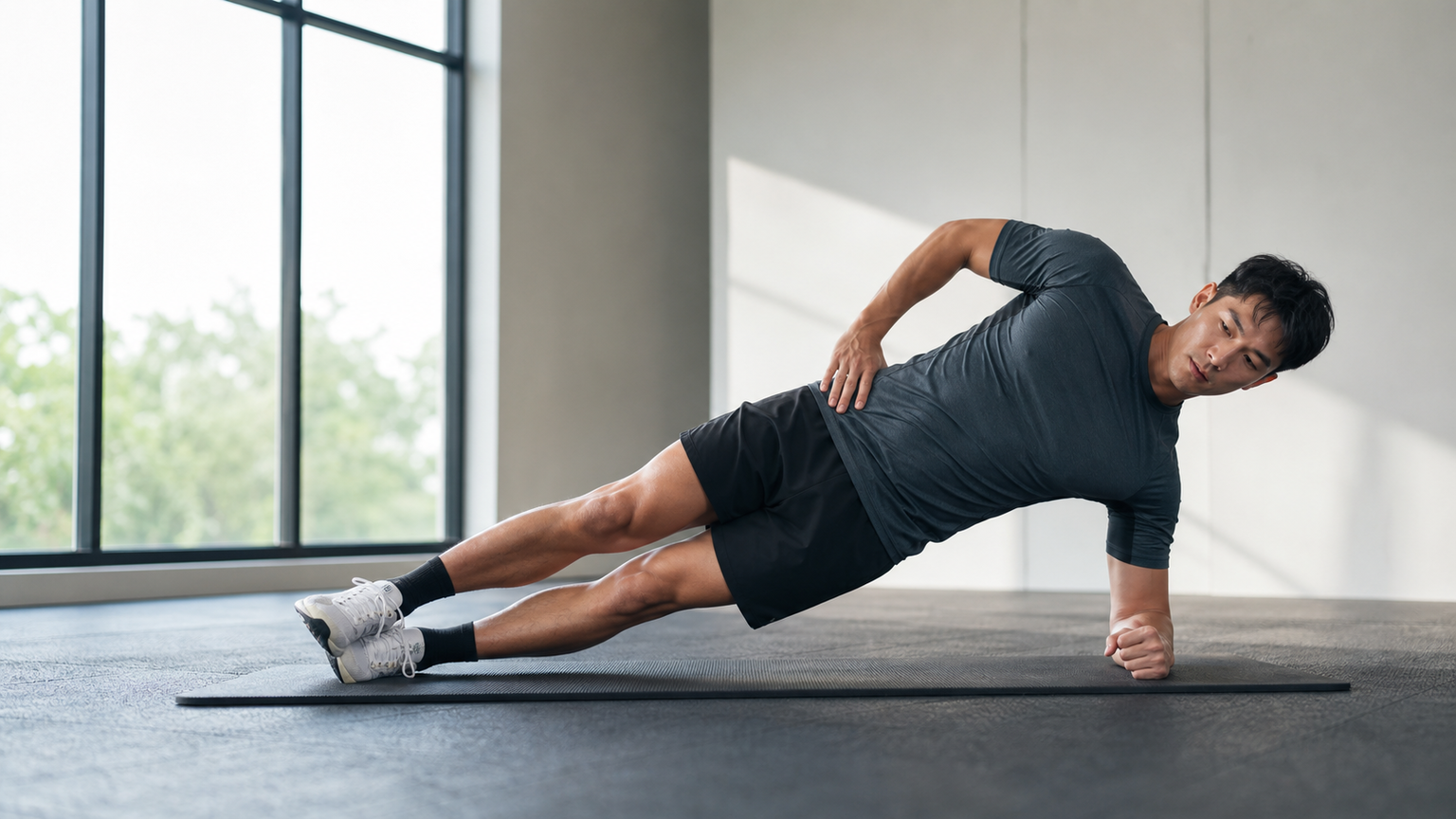
Exercise 2: Side Plank
Target muscles: Obliques, gluteus medius (the muscle runners most need to strengthen)
Proper form:
- Lie on your side, resting on your forearm
- Lift your hips so your body forms a straight line from head to feet
- Place your top hand on your hip or extend it toward the ceiling
- Keep your pelvis from rotating
Recommended volume: 3 sets × 20 to 45 seconds (each side)
Why it matters: Weak gluteus medius is a common cause of runner’s knee and IT band issues
Exercise 3: Glute Bridge
Target muscles: Gluteus maximus, hamstrings, core stabilizers
Proper form:
- Lie on your back, knees bent at 90 degrees, feet flat on the floor
- Brace your abs and push your hips up until your body forms a straight line
- Hold at the top for 2 seconds, feeling your glutes contract
- Lower slowly (about 3 seconds)
Advanced version: Single-leg glute bridge (one leg lifted)
Recommended volume: 3 sets × 15 to 20 reps
Exercise 4: Dead Bug
Target muscles: Transversus abdominis, multifidus (deep core stabilizers)
Proper form:
- Lie on your back, arms extended toward the ceiling, legs lifted with knees bent at 90 degrees
- Keep your lower back pressed into the floor (don’t arch)
- Slowly extend your right arm while simultaneously straightening your left leg (without touching the floor)
- Return to the starting position, then switch sides
Recommended volume: 3 sets × 10 reps (each side)
Key tip: Your lower back must stay pressed to the floor throughout the entire movement
Exercise 5: Bird Dog
Target muscles: Multifidus, gluteus maximus, shoulder stabilizers
Proper form:
- Start on all fours, wrists under shoulders, knees under hips
- Brace your abs and keep your spine neutral
- Slowly extend your right arm while reaching your left leg back
- Hold at the top for 2 to 3 seconds
- Return to the starting position, then switch sides
Recommended volume: 3 sets × 10 reps (each side)
Exercise 6: Russian Twist
Target muscles: Obliques, core rotators
Proper form:
- Sit with knees bent, leaning your torso back about 45 degrees
- Clasp your hands together or hold a weight
- Rotate your torso, bringing your hands toward the floor (or extending to the side)
- Return to center, then switch sides
Recommended volume: 3 sets × 20 reps (10 each side)
Exercise 7: Mountain Climber
Target muscles: Full-core engagement + cardiovascular conditioning
Proper form:
- Start in a push-up position, hands on the floor
- Brace your abs and keep your body in a straight line
- Alternately drive your knees toward your chest at a fast pace
- Maintain speed without letting your hips bounce
Recommended volume: 3 sets × 30 to 45 seconds
3. Core Training Program Structure
3 Core Sessions Per Week
Time per session: 15 to 20 minutes
Suggested structure:
| Phase | Exercise | Time/Sets |
|---|---|---|
| Activation | Glute Bridge + Dead Bug | 2 sets each |
| Main | Plank + Side Plank + Bird Dog | 3 sets each |
| Strengthening | Russian Twist + Mountain Climber | 2 sets each |
When to Do It
- After running: Ideal (muscles are already warmed up)
- Before running: Light activation moves (glute bridge, bird dog); high-intensity core work is not suitable
- Rest days: Full core session can be done
4. Special Recommendations for Runners
Muscle Groups Runners Most Often Neglect
| Muscle Group | Importance | Recommended Training |
|---|---|---|
| Gluteus medius | Prevents runner’s knee | Side plank, lateral band walks |
| Deep transversus abdominis | Pelvic stability | Plank, dead bug |
| Hamstrings | Prevents hamstring injuries | Single-leg glute bridge, Nordic hamstring curl |
| Gluteus maximus | Source of propulsion | Glute bridge, Romanian deadlift |
5. When You’ll See Results
| Timeframe | Expected Results |
|---|---|
| 2-4 weeks | Improved pelvic stability while running, reduced side-to-side sway |
| 6-8 weeks | Noticeably better posture maintenance in the later stages of long runs |
| 3 months | Overall running economy improves, slight speed gains |
Conclusion
Core training doesn’t require a huge time commitment. With systematic training of just 3 sessions per week, 15 minutes each, you’ll see clear improvements in your running form and efficiency within 3 months. Incorporating core work into your regular running routine is one of the most cost-effective investments you can make in your running.
Related Reading
- Core Stability and Running Efficiency: Which Core Exercises Are Most Effective
- The Impact of Core Strength on Running Efficiency
- Core Muscle Activation in Running: The Scientific Link Between Stability and Efficiency
- Core Training for Runners: 15 Key Exercises to Improve Efficiency and Reduce Injury
實景訓練台) 彰化經典百K 高強度喵團 90分鐘 跟著一起練功 2019 Indoor workout Changhua Classic 100 Taiwan
7 年前
CT 喇低賽) 武嶺牽車 才是王道 西進牽車四小時內秘訣 攝手位置 如何判斷 防抽筋小秘訣
7 年前
[教學] Premiere 影片 手震 修正 教學 防抖 單眼 影像 GoPro 穩定 Video Stabilization
8 年前
西進武嶺 免費訓練分析服務 Intervals | 練不夠還是練過頭?你哪一種類型選手?AI模型告訴你! | 備戰神器 | 公路車 訓練 | CT Yeh
4 年前
Live) 備戰2019彰化經典百K 賽前攻略 (已完賽請看新影片
7 年前
#公路車 #Fitting 靠人工智慧APP 幫你調整單車
6 年前
DJI Osmo Action 6 / 單車運動拍攝實用技巧 公路車 CT Yeh
7 個月前
大家都在開箱的...單車用藍芽對講耳機真的有幫助嗎? SENA BiKom 20 長距離旅遊 & 海鷗繞圈賽 實際體驗心得 / 公路車 / CT Yeh
9 個月前