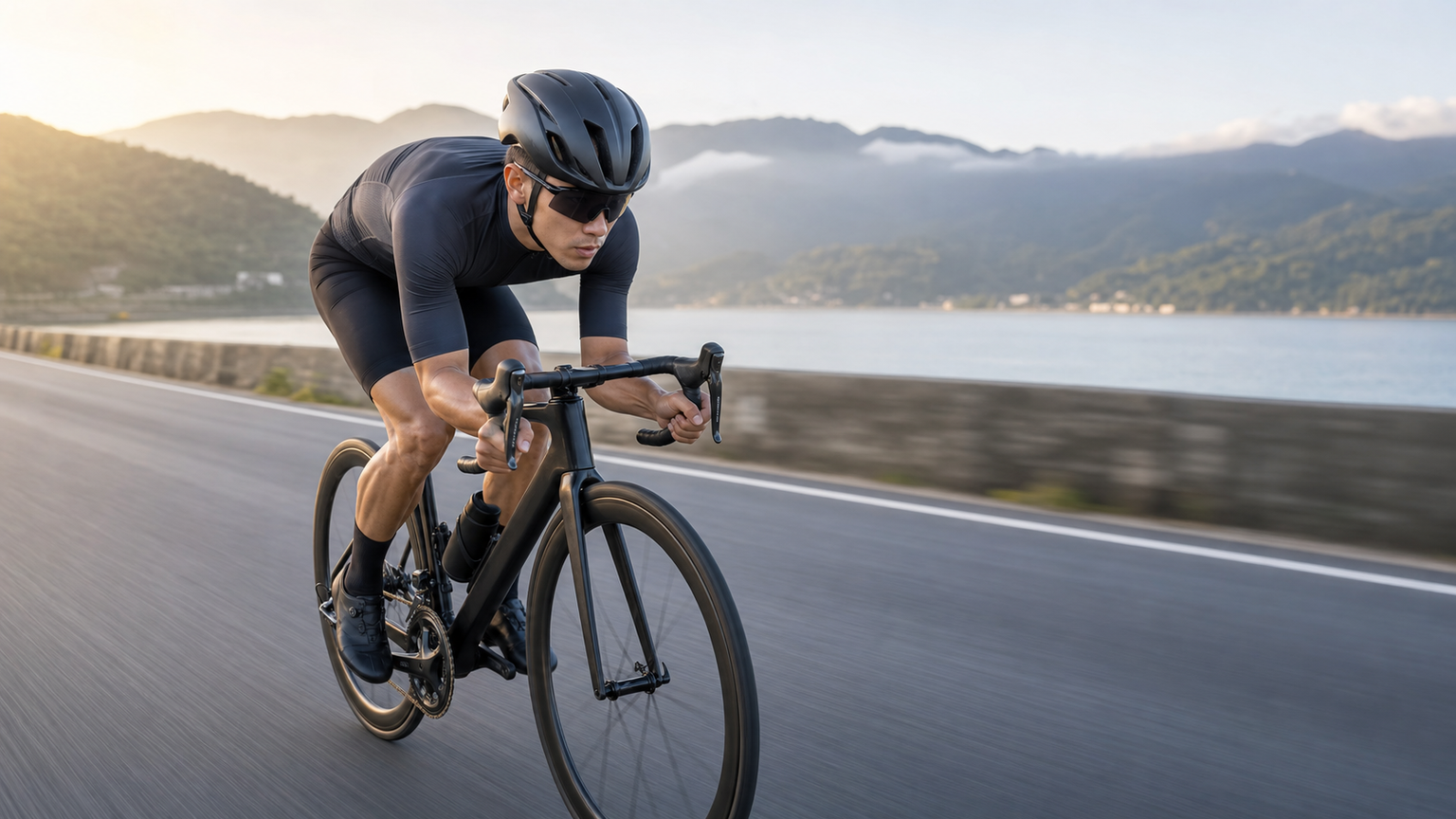
Aerodynamics in Cycling: The Benefits of a Low Position, Helmets, and Clothing
When riding on flat ground at 40 km/h, air resistance accounts for more than 90% of total resistance. This means that at the same power output, optimizing aerodynamics can bring a significant increase in speed. This article analyzes the practical benefits of various aerodynamic improvements from a scientific perspective.
Basic Concepts of Air Resistance
CdA: The Core Metric of Aerodynamics
CdA (Drag Area) = Cd (drag coefficient) × A (frontal area)
The lower the CdA, the lower the air resistance, and the faster the speed at the same power output.
Typical CdA values for different riding positions:
| Riding Position | Typical CdA (m²) |
|---|---|
| Mountain bike upright position | 0.60–0.80 |
| Road bike relaxed position | 0.35–0.45 |
| Road bike training position (hands on drops) | 0.28–0.35 |
| Time trial / triathlon position | 0.20–0.25 |
| Pro rider low position (Tour de France) | 0.22–0.30 |
The Effect of Air Resistance on Speed
At the same power output (e.g., 250W), speed varies with CdA as follows:
| CdA | Estimated Speed (Flat Ground) |
|---|---|
| 0.40 | approx. 37 km/h |
| 0.35 | approx. 39 km/h |
| 0.28 | approx. 43 km/h |
| 0.22 | approx. 47 km/h |
At the same power, lowering CdA from 0.40 to 0.28 can increase speed by about 6 km/h!
Position Optimization: The Most Effective Aerodynamic Improvement
Low Road Bike Position
Position improvement offers the greatest benefit of all aerodynamic measures. Key adjustments include:
Lowering the Upper Body (Head and Torso Position):
- Hands on the drops rather than the tops of the bars
- Lean the torso forward so the spine is more parallel to the ground
- Drop the head, looking forward from beneath the eyebrows
Reducing Frontal Area:
- Knees tucked in
- Elbows narrowed
- Relax the back muscles and round the spine (avoid arching the back, which creates a “sail” effect)
Estimated benefits:
- Switching from the tops to the drops: saves about 20–30W (at the same speed)
- Leaning the torso forward 5 degrees: saves about 5–10W
Time Trial (TT) Position
For riders with time trial or triathlon needs, the TT position can further reduce CdA:
- Using TT bars (aero bars) or bull horn bars
- Forearms horizontal, elbows close together (the “Superman position”)
- Upper body nearly parallel to the ground
- Benefit: saves an additional 15–25W compared to a regular road bike drop position
The Trade-off Between Position and Power
A lower position requires stronger core strength and flexibility to support it. If an overly low position causes core fatigue and the drop in power output exceeds the air resistance saved, the trade-off backfires. Finding “your own optimal aerodynamic position” requires training combined with a proper bike fitting.
Helmet Selection
Comparison of Helmet Types
| Helmet Type | Aerodynamic Benefit | Weight | Ventilation | Suitable Use |
|---|---|---|---|---|
| Traditional road helmet | Low | Light | Excellent | General training, long climbs |
| Aero road helmet | Medium-high | Medium | Good | Racing, flat-road races |
| TT helmet (tear-drop) | Highest | Medium-heavy | Poor | Time trials, short distances |
| Climbing helmet | Low | Extremely light | Excellent | Climbing races |
Practical Benefits of Aero Helmets
Research shows that using an aero helmet (vs. a traditional helmet):
- Saves about 10–20 seconds per hour (on flat roads at 40km/h)
- Equivalent to about 3–8W of power savings
Notes on TT helmets:
- Head angle is very important: the tail of the helmet must align with the spine; a head position that is too high or too low will “break the streamline”
- Poor ventilation: not recommended for climbing in Taiwan’s summer heat
- Limited field of vision: allow adequate time to adjust before use
Helmet Recommendations for Taiwanese Riders
Taiwan’s climate is hot, so ventilation should be a priority:
- Daily training: traditional road helmet (with many vents)
- Flat-road races / time trials: aero road helmet
- TT races / triathlon: TT helmet (verify head angle)
- Climbing races such as Wuling: climbing helmet (lightweight + ventilated)
Cycling Apparel (Skinsuits & Jerseys)
The Aerodynamics of Cycling Apparel Fabric
Loose clothing “catches” airflow, increasing drag. The benefit gap between form-fitting cycling apparel and loose clothing:
- Form-fitting jersey vs. a regular T-shirt: saves about 15–25W
- Skinsuit (one-piece) vs. separate jersey and shorts: saves about 5–10W (avoiding turbulence at the seam)
Skinsuit (One-Piece Cycling Apparel)
A one-piece garment commonly used by professional riders in races, combining the jersey and shorts into a single unit:
Advantages:
- No waist seam, eliminating one point of turbulence
- Usually uses aerodynamic fabric (surface texture optimization)
- Most significant benefit in time trials
Disadvantages:
- Inconvenient for bathroom breaks
- Poorer ventilation than a two-piece kit in Taiwan’s summer
- Higher price
Cycling Gloves and Shoe Covers (Overshoes)
- Fingerless gloves: slightly better aerodynamically than full-finger gloves, but the difference is minimal
- Aero overshoes: cover the shoe laces/buckles, can save 3–5W (moderate benefit)
- Aero leg covers: some research shows they can optimize leg streamline, but the benefit varies by individual
Bike Aerodynamics
Wheelset Selection
| Wheelset Type | Aerodynamic Benefit | Climbing | Suitable For |
|---|---|---|---|
| Low-profile wheelset (under 30mm) | Low | Light | Climbing, mountain races |
| Mid-profile (40–50mm) | Medium | Medium | Mixed-terrain routes |
| High-profile (60–80mm) | High | Heavy | Flat-road time trials |
| Disc wheel | Highest | Heaviest | Time trials |
Recommendation for Taiwan: Taiwan has many mountainous routes, so high-profile wheelsets of 60mm or more may not be worthwhile on climbs due to the weight disadvantage. For mixed-terrain routes, 40–50mm is recommended.
Frame
Compared to traditional lightweight frames, modern aero frames (such as the Cervélo S5, Trek Madone) can save about 30–60 seconds per hour (on flat ground at 40km/h).
Practical Recommendations for Taiwan
Priority order for aerodynamic improvements (by benefit/cost ratio):
- Position optimization (free): Learn the correct low position — the greatest benefit
- Form-fitting cycling jersey (NT$2,000–5,000): Replace loose clothing
- Aero helmet (NT$5,000–15,000): Upgrade your helmet
- Mid-profile wheelset (NT$15,000–40,000): Upgrade your wheels
- Aero frame (NT$50,000+): Consider this last
Conclusion
Aerodynamics isn’t just for professional riders — amateur cyclists can also achieve faster speeds at the same power output through position optimization and appropriate equipment. Start with the most important factor, position, and gradually invest in other aerodynamic equipment so that not a single watt goes to waste.
Related Topics
3D 列印車褲墊 / 舒適改善? / 無痕 x 分區壓縮 / ATK & Decider系列 / JE22黑科技 / #公路車 #CTYEH
11 個月前
多機位拍片神器 DJI Action 2 拍出速度張力感 | 類空拍機視角 4陣列麥克風超強降風噪 實測! | 公路車 | CT Yeh
3 年前
一日北高/長距離團騎 常見問題補充篇 / 組團或跟團的眉角 / 壯車友容易被瘦車友慢性拉爆 / 原來屁股痛可能是這個原因...? / 風場配速法 / 公路車 / CT Yeh
2 年前
用了AirTag 單車就不怕被偷?盲點大測試 結果… |公路車|CT Yeh
5 年前
靠單車減肥35公斤 心得分享與整理
7 年前
再快都跟的上!? 單車跟隨攝影機之王 HOVERAir X1 PROMAX 全面實測 / 唯一!8K畫質&自行車專用模式和跟蹤信標&前後避障 / DJI Neo 可參考/ 公路車 / CT Yeh
1 年前
#公路車 #Vo2Max #最大攝氧量 測驗 體驗 | 心肺測試
6 年前
2026 車錶排行榜!誰是最多車友正在使用?練家子最愛哪款?🏆 (2萬名車友數據) / 公路車 / CT Yeh
5 個月前