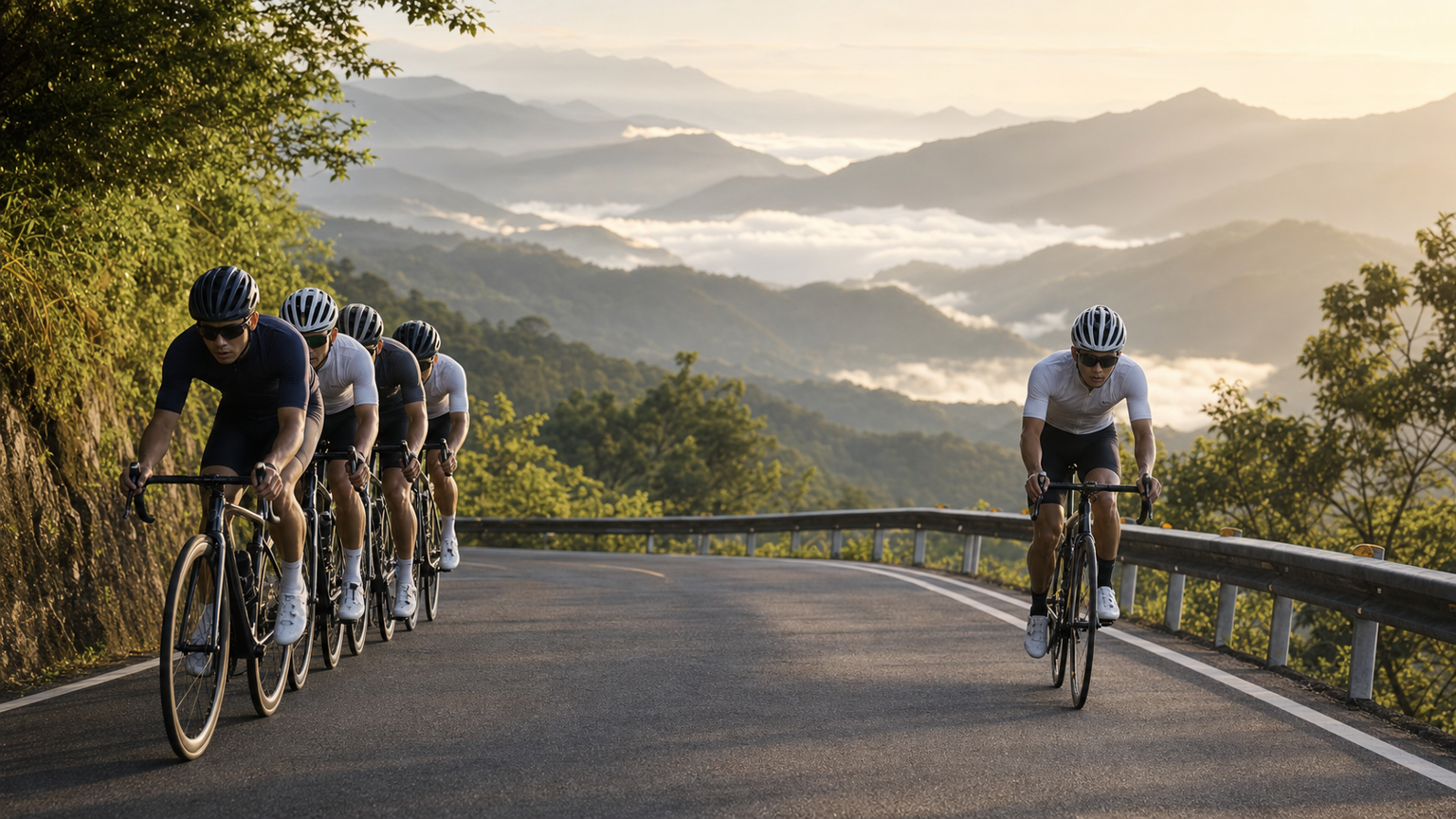
Team Training vs. Solo Training: Which Is More Effective
“Should I join a team?” is a question many riders face once they start training seriously. Team training offers the advantages of community support and group riding skills, but solo training has its own value in flexibility and precision. This article takes an in-depth look at both approaches to help you find the best fit for your needs.
Characteristics of Team Training
Advantages
1. Community Motivation and Accountability
Once you join a team, the sense of responsibility from “there’s training tomorrow” makes it much harder to find excuses to skip a ride. Research shows that exercise programs with social support have a 40–60% higher long-term adherence rate than training alone.
2. Learning Group Riding Skills
Skills such as group riding, pace lining, and hand signals can only be effectively learned in a group setting. These skills are crucial in racing and cannot be learned from a book.
3. Indirect Intensity Stimulus
In a group, even if you don’t want to push high power, the group’s pace carries you along. This “forced intensity” can sometimes produce unexpected training benefits.
4. Real-Time Tactics and Race Simulation
Scenarios in team training such as “surprise attacks” and “climbing competitions” are the best simulations of real racing.
5. Sharing Knowledge and Route Information
Regarding road conditions, rest stops, and photo spots across Taiwan, a team’s collective knowledge far exceeds what any individual can gather.
Disadvantages
1. Training Intensity Cannot Be Precisely Controlled
The group’s intensity is dictated by the strongest few riders, which may be too hard or too easy for members with different goals.
2. Training Plan Cannot Be Personalized
If you’re in a recovery week but the team has scheduled a high-intensity session, you’ll need to decide for yourself whether to “keep up.”
3. Fixed Schedule, Low Flexibility
Teams typically train at set times (e.g., Saturday at 7 a.m.), which cannot be adjusted to fit your personal schedule.
4. Higher Risk of Injury
The risk of collisions and crashes in group riding is far higher than riding solo, especially in mixed-ability teams where skill levels vary.
5. The “Wheelsucker” Problem
In a group, you might spend the entire ride sheltered from the wind, lacking sufficient independent riding stimulus.
Characteristics of Solo Training
Advantages
1. Precise Execution of Training Plan
- Can strictly train within target power zones
- No interference from others’ pace
- Fully aligned with your own recovery weeks and recovery plan
2. Flexible Scheduling
You can train at 4 a.m. or 9 p.m., fully adapting to your personal lifestyle. In Taiwan, 5–7 a.m. in summer is the best time to ride, and solo training makes this much easier to achieve.
3. Better Data Tracking
Every session is executed exactly as planned, making the data cleaner and making it easier to track fitness changes.
4. Higher Focus
No need to divide attention watching the group’s dynamics; you can fully concentrate on your own pedaling, breathing, and pacing.
Disadvantages
1. Lack of Social Motivation
When riding solo, it’s easier to make excuses to skip training. “I’m too tired today, I don’t want to ride alone” is a common reason to give up.
2. Group Riding Skills Cannot Improve
The most obvious drawback: riding solo doesn’t allow you to practice pace lining, group positioning, cornering techniques, and other race-essential skills.
3. Safety Risks
If a mechanical issue or accident occurs while riding solo, there are no teammates to help. Riding alone on Taiwan’s mountain roads requires extra attention to safety.
4. Hard to Push Past Limits at High Intensity
Without a competitor, it’s difficult to push yourself to maximum intensity. Many riders cannot reach the same peak heart rate and power in solo rides as they do in group rides.
Efficiency Comparison Analysis
Comparison by Training Goal
| Training Goal | Recommended Approach | Reason |
|---|---|---|
| Building aerobic base (Zone 2) | Solo training | Group rides too fast; cannot maintain Zone 2 |
| Threshold training (FTP improvement) | Solo or team depending on situation | Requires steady power; hard to control in a group |
| Improving group riding skills | Team training | Irreplaceable |
| Max power sprinting | Team training | Competition stimulates greater explosive power |
| Long-distance endurance | Solo or small group | Steady pace matters more |
| Pre-race preparation | Small team training | Simulates race scenarios |
Reference from Research Data
A study of amateur cyclists found:
- With a competitor present, average peak sprint power was 15% higher
- In a group, speed at the same heart rate was 8–12% higher (drafting benefit)
- However, during Zone 2 training, group riders’ heart rates often exceeded the target range by 25–35%
Characteristics of Taiwan’s Team Culture
Taiwan’s cycling team culture has several distinctive features that influence your choice:
Weekend Group Training Culture: Teams in Taiwan commonly train together on Saturday and Sunday mornings, with individual training on weekdays.
Uneven Coaching Quality: Many amateur teams lack professional coaches, and training quality depends on knowledge passed down from senior members, resulting in inconsistent standards.
Strong Social Function: The social cohesion of Taiwanese teams is often very strong (group meals, outings), which positively impacts long-term training motivation.
Highly Competitive: Taiwanese riders are highly competitive, and “surprise attacks” during team climbs are common—a double-edged sword.
Best Strategy: A Hybrid Approach
For most amateur riders, the most effective strategy is to combine both:
Suggested Ratio:
- Monday to Friday: Solo training (strictly execute Zone 2 and interval plans)
- Saturday: Team group training (group riding skills, intensity stimulus)
- Sunday: Solo long ride or easy recovery ride
Maintaining Autonomy Within Team Training:
- On climbs, ride at your own pace; don’t blow up trying to keep up
- On Zone 2 days, tell teammates “easy ride today” and don’t follow the pace
- Use the group’s intensity stimulus, but don’t force yourself to fully keep up
Building Your Own Mini-Team
If you can’t find a suitable team, find 2–4 riders of similar ability and goals to form an informal “training group”:
- Schedule 1–2 fixed weekend group sessions
- Each person trains independently on weekdays
- Participate in a few target races together
- Share training resources and information
Conclusion
Team training and solo training are not opposing choices but complementary tools. Understand your training goals and personality traits, and choose the right ratio. For most amateur riders, a hybrid approach provides the best environment for improvement and sustained motivation.
Related Reading
- Group Coaching vs. One-on-One Coaching: Which Model Suits You Better?
- The Benefits of Group Training: Why Riding with Stronger Riders Makes You Improve Faster
- Solo Riding vs. Group Riding Training: A Complete Comparison of Psychological and Physiological Benefits
- Trainer vs. Outdoor Riding: Is Indoor Training Really More Efficient?
一日北高/長距離團騎 常見問題補充篇 / 組團或跟團的眉角 / 壯車友容易被瘦車友慢性拉爆 / 原來屁股痛可能是這個原因...? / 風場配速法 / 公路車 / CT Yeh
2 年前
一個測試有沒有認真練車的方法😂 #公路車
10 個月前
昇陽SYB車隊 & Fuji 菁英選手們的趣味經驗分享,長知識了!市民車友必看~ 一路被拉爆後才給問 | 戀戀197 武嶺 凸台經驗分享 | 公路車 | CT Yeh
4 年前
福隆鐵人團練隨拍
8 年前
JJSC一槍北港 百K團實錄!跟團技巧分享 ft. Roden / 中部練車新選擇 / 開箱全台最便宜早餐店!/ 公路車 / CT Yeh
1 年前
西進武嶺 免費訓練分析服務 Intervals | 練不夠還是練過頭?你哪一種類型選手?AI模型告訴你! | 備戰神器 | 公路車 訓練 | CT Yeh
4 年前
車隊介紹) 台北 一年開團365天 車隊 Apollo Ride 晨騎 好選擇 ( 陽明山 風櫃嘴 冷水坑 平等里 聖人 關渡 大稻埕 ) 找人騎車
7 年前
2026 輪霸西濱200K 挑戰VLOG / 第一集團 / 首次參加..經驗不足、膀胱不足 /死守6H內 / AI戰鬥力顯示系統 / 公路車 / CT Yeh
4 個月前