Bicycle Tire Buying Guide: Differences in Width, Tread, and Material
Tires are the most overlooked yet most impactful component on a bicycle. A good tire doesn’t just prevent flats — it improves grip, lowers rolling resistance, and boosts comfort. This article covers everything from width and tread to material, giving you a complete framework for choosing tires.
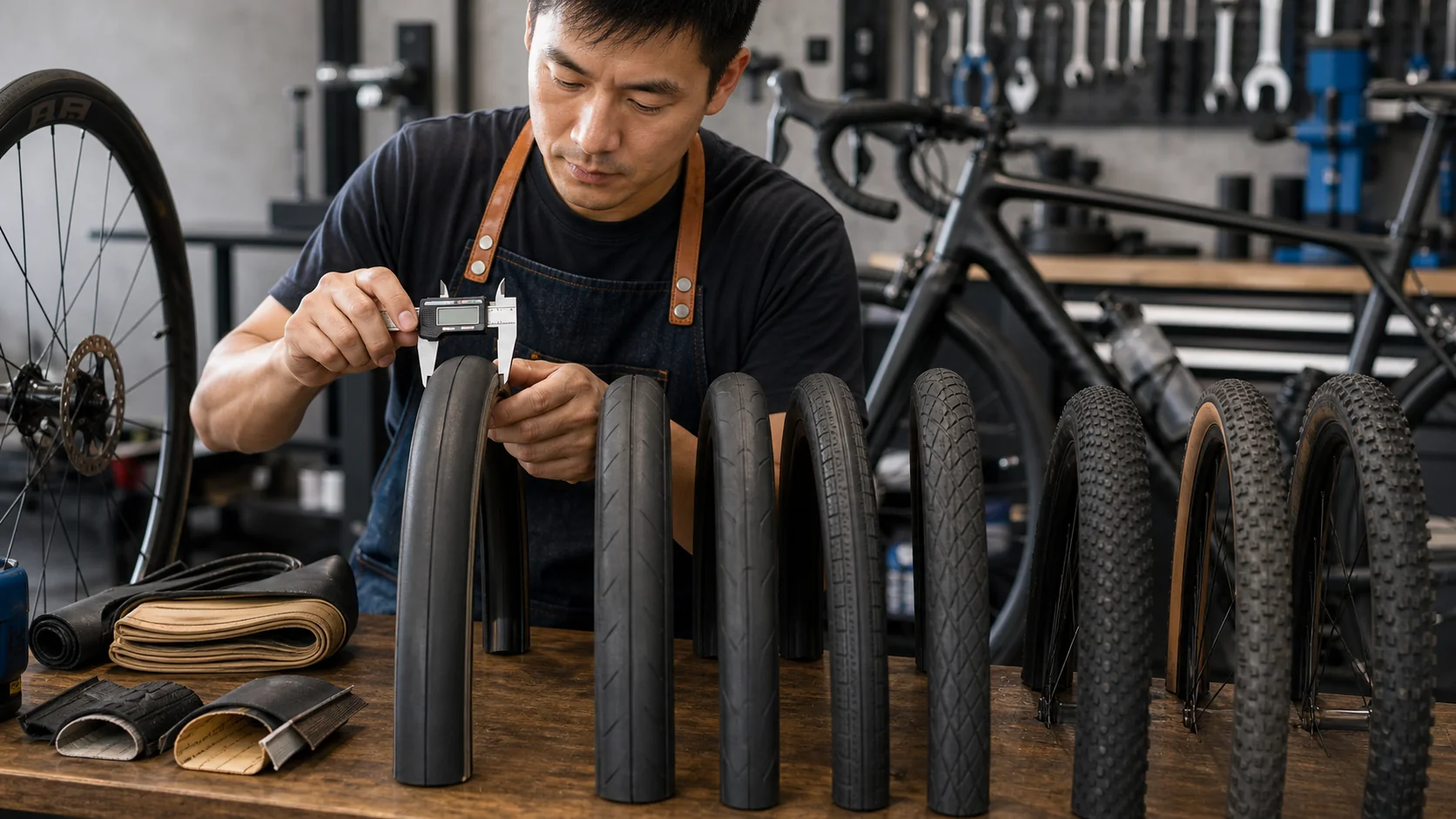
Tire Types
Clincher (Tube-Type)
The most common tire type, with a separate inner tube and outer tire. Easy to swap and low cost. The vast majority of entry-level to mid-range road bikes use this design.
Tubeless
The tire seals directly onto the rim and requires a tubeless-compatible rim along with sealant. Advantages include the ability to run lower pressures, strong puncture resistance, and low rolling resistance; downsides are more complex installation and the need to periodically top up sealant.
Types of Puncture Protection
| Puncture Protection | Weight Impact | Puncture Resistance |
|---|---|---|
| None | Lightest | None |
| Basic (Puncture Belt) | +30-50g | Average |
| Kevlar/Aramid Fiber | +20-40g | Good |
| Multi-layer Protection | +50-80g | Best |
Taiwan’s road surfaces vary widely, so it’s recommended to choose a tire with at least basic puncture protection, and multi-layer protection for long-distance touring.
Choosing Tire Width
The Evolution of Road Tire Width
23mm used to be the mainstream road tire width. Recent research shows that moderately increasing width (25-28mm) results in lower rolling resistance at the same pressure, along with better comfort.
| Width | Best Use Case | Recommended Pressure |
|---|---|---|
| 23mm | Racing, time trials (increasingly rare) | 90-110 psi |
| 25mm | Balanced choice for training and racing | 80-100 psi |
| 28mm | Daily training, rough roads | 70-90 psi |
| 32mm+ | Gravel roads, long-distance touring | 50-70 psi |
Important note: The internal width of your rim limits the widest tire you can mount, so be sure to check rim compatibility.
Tread Design
Slick
The standard for road bikes — a smooth tread surface offers the lowest rolling resistance. Many people mistakenly believe slick tires are unsafe in the rain, but the main risk for road bikes on wet surfaces is actually the oil-and-water mix on the road (not a drainage issue), and tread pattern has far less impact on road bikes than it does on car tires.
Semi-Slick
Smooth in the center with light tread on the sides, adding grip when cornering. Suitable for riders who want extra cornering confidence.
Treaded (Full Tread)
Full tread pattern designed for gravel or off-road riding. Rolling resistance increases noticeably when used on paved roads.
Tire Material
TPI (Threads Per Inch)
The thread density of the tire casing. A higher number generally means:
- A lighter tire
- Better road feel (a smoother, more supple ride)
- Lower rolling resistance under equal conditions
- But potentially weaker puncture resistance
| TPI Range | Tier | Characteristics |
|---|---|---|
| 30-60 TPI | Entry-level | Durable, heavier |
| 90-120 TPI | Mid-range | Balanced choice |
| 180-320 TPI | High-end | Lightweight, great ride feel |
Rubber Compound
Premium tires use specialized rubber compounds (such as Continental BlackChili or Vittoria Graphene) to boost grip and durability. Entry-level tires use standard rubber compounds — durable but with average grip.
Popular Brand Recommendations
Entry-Level Choices (NT$600-1,200/tire)
- Continental Ultra Sport III: Durable with balanced grip — a great first choice for beginners
- Vittoria Zaffiro Pro: Italian brand with excellent value for money
Mid-Range Choices (NT$1,200-2,500/tire)
- Continental Grand Prix 5000: Widely regarded as the best value training/racing tire in the industry
- Michelin Power Road: French brand known for outstanding grip
High-End Choices (NT$2,500+/tire)
- Continental Grand Prix TT: Built for time trials, extremely low rolling resistance
- Vittoria Corsa Pro TLR: Tubeless version, a top-tier racing choice
Recommendations for Taiwan’s Road Conditions
- Taipei metro area: Continental Grand Prix 5000, 25mm, with puncture protection
- Northern mountain areas (Yangmingshan, Wulai): 28mm semi-slick tires, accounting for rain
- Central and southern plains: 25mm slick tires, prioritizing rolling efficiency
- Eastern touring routes: 28-32mm, prioritizing comfort and durability
Conclusion
Tire choice varies by rider and terrain, but it’s best not to cut corners on tires. A good pair of tires (around NT$2,500-4,000) can dramatically improve the overall feel of your bike — far better value than upgrading to a pricier wheelset. Regularly checking tire pressure and wear is a fundamental part of maintaining riding safety.
Related Reading
- Choosing Between Clincher and Tubeless Tires: A Guide to Pressure Settings and Valve Types
- The Science of Road Tire Selection: How Tread, Pressure, and Material Affect Rolling Resistance and Grip
- Choosing MTB Tires: A Guide to Matching Tread, Pressure, and Terrain
- The Complete Guide to Mountain Bike Tires: Tread, Width, and Pressure Explained
再一組! 全碳幅條 碟煞/無內胎輪組 開箱! 到底好騎嗎? UNAAS X40 | 公路車 | CT Yeh
4 年前
碟煞公路車 銑面器 !? 原來銑完差這麼多! 降低蹭碟機率! | TIME 公路車 保養小記錄 | CT Yeh
3 年前
鉅齒紋輪組!? ControlTech MEG-T50 EVO 碳纖維幅條輪組/ 功率對比實驗 / 公路車 / CT Yeh
2 年前
Unaas X50 全碳纖幅條輪 數據實測對比PK | Lun Hyper 的高階版 | 板輪爬坡也可以很厲害? ! 武嶺2小時大師一起親測! CP值超高 | 公路車 | CT Yeh
4 年前
單車胎壓觀察到的有趣現象,SRAM Quarq TyreWiz 2.0 無內胎胎壓計 / 裝了有哪些幫助? / Tubeless / 公路車 / CT Yeh
1 年前
2025 自行車錶排行榜 兩萬車友大數據 / Garmin Bryton 排名會大洗牌嗎? / 全新的碼表前身分析 /公路車 / CT Yeh
1 年前
2022 前十五大自行車錶 !? 兩萬名車友大數據統計 | 你的上榜了嗎? | 菁英車友都用哪些錶? | Bryton Garmin 誰能拔得頭籌?| 車錶推薦 | 公路車 CT Yeh
4 年前
Vision Metron RS 37碳幅條輪組 (非SL)官網沒有的 低調開箱 / 這重量太銷魂了 / 公路車 / CT Yeh
6 個月前