Best Sports Sunglasses Guide: Optical Technology for Cycling and Running
For outdoor sports enthusiasts, a good pair of sports sunglasses is essential gear — not just for looks, but as an important tool for protecting your eyes and improving visual safety. This article covers everything from lens technology to brand comparisons to help you choose the sports eyewear that suits you best.
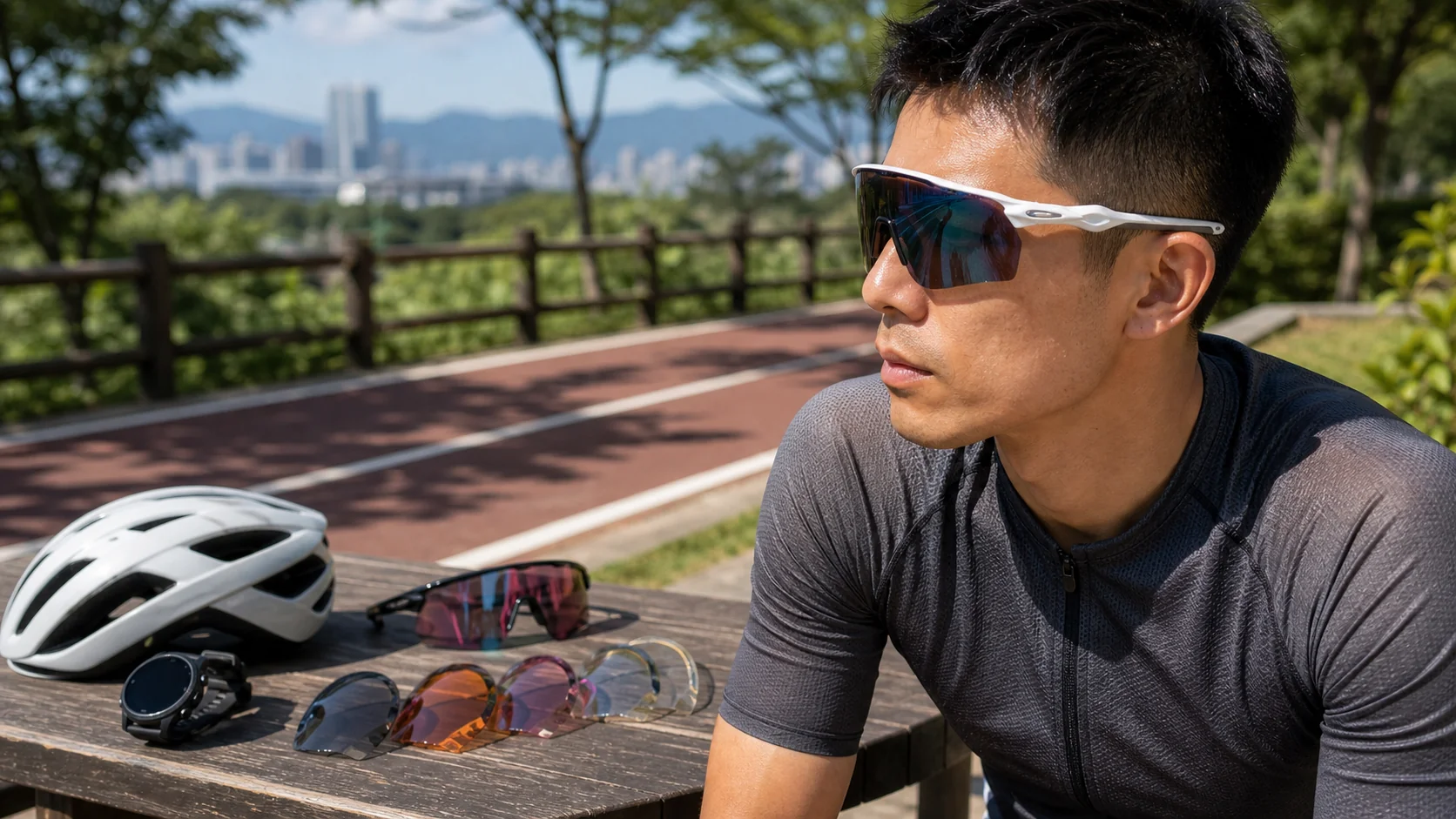
Basic Requirements for Sports Eyewear
The demands placed on eyewear during cycling and running differ from everyday sunglasses:
- UV protection: 100% UVA/UVB protection (UV400 standard)
- Protection from insects and debris: at high cycling speeds, the airflow ahead brings bugs and dust, which pose real hazards
- Anti-fog performance: intense exercise causes heavy sweating, so anti-fog lens coatings matter
- Face-hugging design: shouldn’t obstruct peripheral vision or shift out of place from vibration
- Lightweight comfort: shouldn’t press on the face during long wear
Understanding Lens Technology
Polarized Lenses
Polarized lenses eliminate glare from water and road surfaces, improving contrast. They’re very useful for riding on sunny days in Taiwan, but note: some GPS cycling computer LCD screens (especially Garmin units) can become hard to read through polarized lenses — it’s worth checking this when trying them on.
Photochromic Lenses
These automatically adjust lens tint based on light intensity, making them well suited to Taiwan’s changeable weather (strong sun one moment, then a tunnel, then a shaded mountain road, all within a single ride). The drawback is a 1-3 minute delay in the tint transition, and the reaction is slower in cold temperatures.
Lens Color and Function
| Lens Color | Suitable Conditions | Characteristics |
|---|---|---|
| Gray | Sunny, normal light | True color, no distortion |
| Brown/Amber | Cloudy, partly overcast | Enhances contrast |
| Yellow/Orange | Overcast, dawn/dusk | Maximizes contrast, good for low light |
| Red/Pink | Various conditions | Enhances depth perception |
| Clear | Night riding | Protects against bugs and wind |
Anti-Fog Technology
Heavy sweating during exercise makes anti-fog treatment essential. Main approaches include:
- Hydrophilic anti-fog coating: disperses moisture into a thin film instead of droplets
- Ventilated design: vents in the frame promote airflow
- Dual-layer lenses: insulate against temperature differences that cause fogging
Comparing Major Brands
Oakley (USA)
The gold standard name in sports eyewear. Its Prizm lens technology can be optimized for color contrast in specific sports scenarios. Prices are high (NT$4,000-15,000), but the visual performance is outstanding and the frames are durable.
Recommended model: Oakley Jawbreaker (built for cycling, with an oversized lens for a wide field of view)
Rudy Project (Italy)
A premium sports eyewear brand with excellent RP OPTICS lens technology; its photochromic lenses react quickly and are widely used in professional European racing. Prices in Taiwan run about NT$5,000-12,000.
Recommended model: Rudy Project Rydon (interchangeable lenses, can be fitted with prescription inserts)
Bolle (France)
A solid mid-to-high-end option with good value for money. The B-CLEAR anti-fog coating performs well, making it suitable for Taiwan’s hot, humid climate. Prices are around NT$2,500-6,000.
Tifosi (USA)
Known for affordable pricing, ideal for riders on a budget who still want functionality. The interchangeable lens system lets one frame handle multiple lighting conditions. Prices in Taiwan run about NT$1,500-3,500.
Taiwanese Brands: STACY & KTAIL
Local brands with affordable pricing (NT$800-2,500). Some models offer interchangeable lenses, and after-sales support is convenient, making them a good fit for beginners.
Solutions for Riders Who Wear Glasses
Option 1: Clip-In Prescription Inserts
Some brands (Rudy Project, Oakley) offer custom prescription inserts that clip inside the sports eyewear frame. The advantage is a single pair of glasses solves the problem, though the cost is high (NT$3,000-8,000).
Option 2: Contact Lenses + Sports Sunglasses
The most common approach — wear disposable contact lenses during exercise, with sports sunglasses on top. For long-distance rides, it’s a good idea to carry spare contacts and lens solution.
Option 3: OTG (Over-The-Glasses) Design
Frames designed to fit over regular prescription glasses. Suitable for riders with mild nearsightedness, though the fit against the face is less snug and can let in wind at high speeds.
Buying Recommendations
- Budget under NT$2,000: Tifosi interchangeable-lens models
- Budget NT$3,000-5,000: Bolle or entry-level Rudy Project
- Budget NT$6,000+: Oakley Prizm series or Rudy Project Rydon
Care Tips
- Wipe with a dedicated lens cloth; avoid rough fabrics that can scratch coatings
- Clean with a neutral detergent and rinse with warm water
- Store in a hard-shell case to avoid pressure on the lenses
- If anti-fog coating wears off, an anti-fog spray can restore performance
Conclusion
Sports eyewear is a long-term investment — a good pair can stay with you for years of riding. Taiwan’s summer UV levels are intense, so UV400-or-better protection is the baseline requirement. If your budget allows, photochromic lenses’ all-weather adaptability will serve you well through Taiwan’s ever-changing climate.
Related Reading
開箱) 近視車友 也可以很帥的 Envis Transform 太陽眼鏡開箱 翔鷹 配近視框超便宜秘訣
7 年前
#公路車 #Fitting 靠人工智慧APP 幫你調整單車
6 年前
多機位拍片神器 DJI Action 2 拍出速度張力感 | 類空拍機視角 4陣列麥克風超強降風噪 實測! | 公路車 | CT Yeh
3 年前
Insta360 Ace Pro 2 適合單車拍攝嗎?/ 萊卡色彩直出有夠狂 / GoPro 13 & DJI OM 5 夜間對比 / 公路車 / CT Yeh
1 年前
Insta360 X3 單車YT界的拍攝神器! 首發實測 | 超強AI後製! 超強夜拍實測! 帥氣騎車錄影自己來! | 公路車 |CT Yeh
3 年前
DJI OSMO Action 3 新韌體超強! 2.5H續航!運動攝影新神器!超強快充!今年不換GoPro了🤣| 公路車 | CT Yeh
3 年前
再快都跟的上!? 單車跟隨攝影機之王 HOVERAir X1 PROMAX 全面實測 / 唯一!8K畫質&自行車專用模式和跟蹤信標&前後避障 / DJI Neo 可參考/ 公路車 / CT Yeh
1 年前
DJI Osmo Action 4 / 單車運動攝影最佳選擇!比賽 2.5 H 續航測試 / 超強夜拍 / 墾丁&日本實地拍攝測試! GoPero / 公路車 / CT Yeh
3 年前