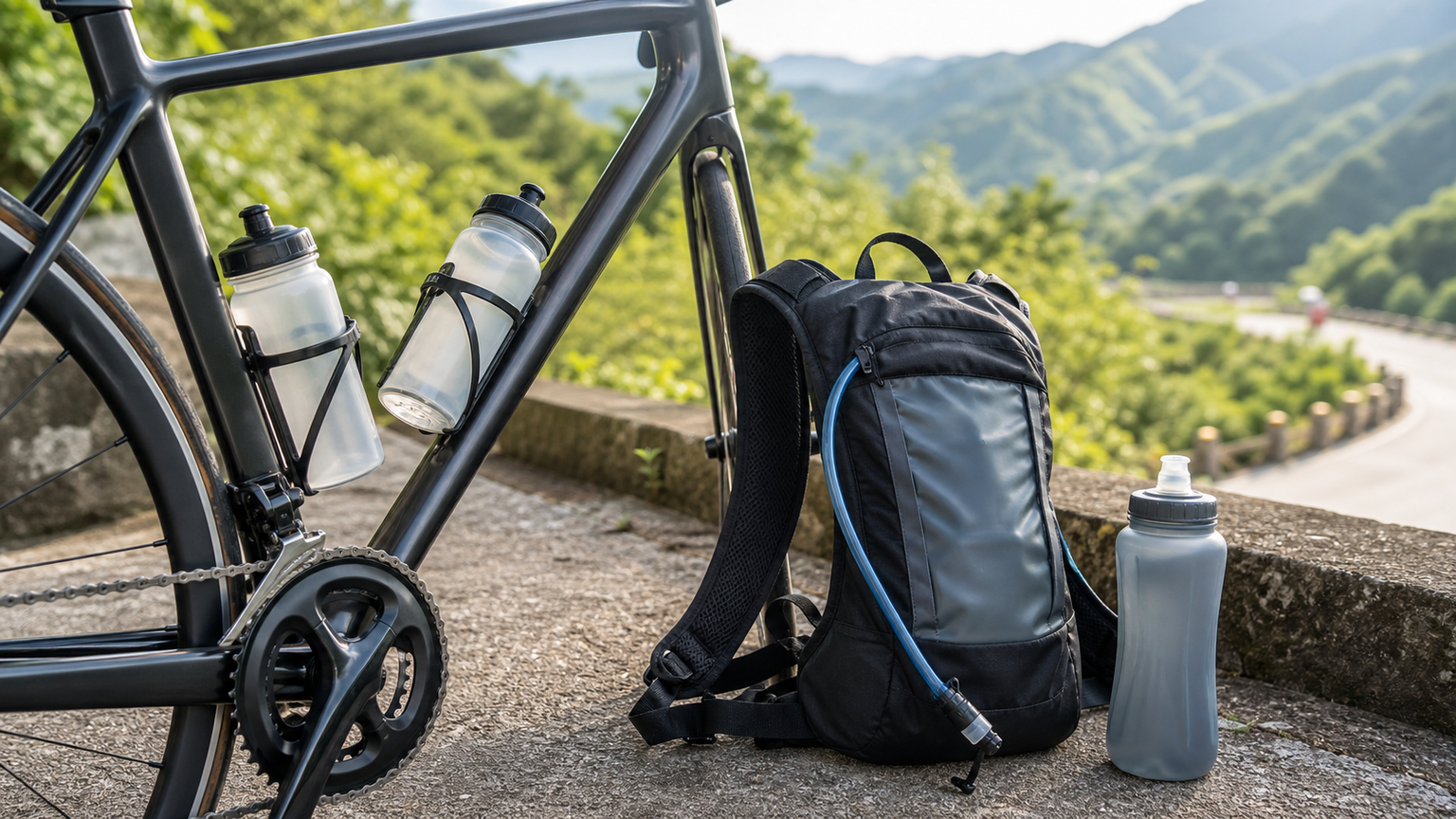
Bottle Cage and Hydration System Comparison: Traditional Bottles vs. Hydration Backpacks
Hydration is the most fundamental need in endurance sports, but choosing a hydration system is more complex than you might think. Traditional bottles with bottle cages, waist-pack bottles, or hydration backpacks—each has its own suitable use cases. This article provides a comprehensive comparison of various hydration systems to help you find the best setup for your needs.
The Impact of Dehydration on Athletic Performance
To understand the importance of hydration, let’s start with the physiological mechanisms:
- A 2% loss of body weight in fluids begins to affect performance (approximately 1-1.5kg)
- 5% dehydration can reduce athletic performance by 20-30%
- Summer riding in Taiwan can result in 1-1.5L of sweat loss per hour
General recommendation: Replenish 500-750ml of fluid per hour, increasing to 1L in high-temperature conditions.
Traditional Bottle and Bottle Cage Systems
Bottle Specifications
| Specification | Capacity | Suitable Use Cases |
|---|---|---|
| Standard bottle | 500-750ml | Training, general riding |
| Large-capacity bottle | 1L and above | Long distances without refill points |
| Insulated bottle | 500-750ml | Warmth in winter, cold drinks in summer |
| Squeeze bottle | 600ml | Racing (squeeze-to-spray) |
Bottle Material Options
Plastic (BPA-Free) bottles: Lightest, easy to squeeze, mainstream choice. Be sure to choose food-grade BPA-free materials.
Stainless steel bottles: Heavier, excellent insulation, highly durable. Suitable for commuters or riders who don’t mind the extra weight.
Recommended bottle brands: Elite (Italy), Specialized Purist (anti-algae inner coating), Camelbak Podium.
Bottle Cage Types
Standard cage: Mounted on the frame’s bottle cage mounts, standard for racing. Material options:
- Plastic: Cheapest, weighs approximately 60-80g
- Aluminum alloy: Mid-range, weighs approximately 40-60g, NT$200-500 in Taiwan
- Carbon fiber: Lightest, weighs approximately 15-25g, NT$800-2,000 in Taiwan
Angled bottle cage: Mounted on the frame’s down tube or seat tube, suitable for frames with limited down tube space (TT bikes, time trial bikes).
Under-saddle bottle cage: Mounted beneath the saddle, suitable for riders who already have two bottles on the frame but need additional hydration (ultra-long distances).
Waist-Pack Hydration Systems
The most common hydration method in running, divided into:
Handheld Bottles
Capacity of 250-500ml, featuring a grip design, suitable for shorter-distance runs (5-15km).
- Pros: Easy to use, no added weight sensation
- Cons: Prolonged gripping affects arm swing efficiency
Running Belts
Carry 1-2 small bottles at the waist (150-250ml each), suitable for half-marathon training.
- Recommendation: Nathan Speed 2 bottle belt, with two 250ml bottles plus a small storage pouch
- Taiwan price: NT$1,200-2,500
Hydration Packs/Vests
Design Principles
A hydration pack contains a built-in 1-3L bladder, with a drinking tube extending to the front of the shoulder strap, allowing riders/runners to hydrate without stopping.
Key Specification Comparison
| Brand | Capacity | Weight | Features | Taiwan Price |
|---|---|---|---|---|
| Camelbak Pursuit | 2L bladder + 3L storage | 340g | Basic storage + hydration | NT$2,500 |
| Osprey Raptor 10 | 2.5L bladder + 10L storage | 680g | High storage capacity, suitable for cycling | NT$4,000 |
| Salomon ADV Skin 5 | 1.5L bladder + 5L vest | 220g | Ultra-lightweight running vest | NT$5,000 |
| Nathan VaporAir | 2L bladder + 7L storage | 350g | Excellent ventilation | NT$4,500 |
Suitable Use Cases
Advantages of using a hydration pack for cycling:
- Ultra-long distances (150km and above) with enough water carried at once
- Long mountain routes without refill stations (e.g., Hehuan Mountain, Wuling)
- Ability to carry tools, snacks, rain gear, and other items simultaneously
Disadvantages of using a hydration pack for cycling:
- More back sweating, making ventilation an important consideration
- Added back weight, leading to back pain on long rides
- More suitable for off-road/mountain biking; road cyclists primarily use bottles
Advantages of using a hydration pack for running:
- Essential for ultramarathons (100km and above require self-carried supplies)
- Trail races where rules require self-carried supplies
- Vest-style packs feel close to running without a pack
Bladder Maintenance
Always clean your hydration pack after use:
- Clean with cleaning tablets or diluted bleach
- Dry thoroughly (hang upside down or store in the refrigerator to prevent mold)
- Replace the drinking tube regularly
- Check connector seals every season
Special Recommendations for Taiwan
Given Taiwan’s hot summers, it is recommended when riding:
- Carry at least 750ml of water per ride (using a large-capacity bottle)
- Refill at water stations after mountain descents
- Plan refill points for long rides (convenience stores, water refill stations)
Conclusion
For daily training and rides within 100km, a traditional bottle cage + 750ml bottle is the lightest and least intrusive choice. For ultra-long distances or trail running, hydration packs offer greater water and gear-carrying capacity. Running belts are a compromise solution for distances up to half-marathon. Choose based on your primary riding/running scenarios—there’s no need to invest in all hydration systems at once.
Related Reading
- Cycling Bottle Cages and Bottles: Aero Design and Hydration Convenience
- Hydration Packs vs. Handheld Bottles vs. Waist Packs: A Complete Comparison of Road Running Hydration Methods
- Cycling Bottle Cages and Bottles: Optimizing Material, Mounting Position, and Capacity
- Road Running Hydration Packs: Long-Distance Choices Among Soft Flasks, Waist Packs, and Backpacks
洗單車神器 吹水機! 實際洗車用用看 暴力洗鍊條大法 | 公路車 | CT Yeh
4 年前
風櫃嘴! 現實與虛擬騎乘 會有誤差嗎? 背著iPad邊騎一趟風櫃嘴實際測試一次 | 公路車 | CT Yeh
3 年前
類空拍神器 Feiyu Pocket 2s (有優惠連結)三軸穩定 運動攝影機 開箱!比GoPro 還強的滑順視角!三小時長時間錄影 行車記錄器 | 環花東365實測 | 公路車 CT Yeh
4 年前
單車 重低音 藍芽喇叭 音質實測 SoundBot SB525 Real Sound Test
8 年前
雨戰! 西進武嶺員工旅遊 加料 各路段大數據分析 | 同事端出5公斤的公路車來挑戰!? EP1
4 年前
靠單車減肥35公斤 心得分享與整理
7 年前
2025 自行車錶排行榜 兩萬車友大數據 / Garmin Bryton 排名會大洗牌嗎? / 全新的碼表前身分析 /公路車 / CT Yeh
1 年前
全台首發神車錶! iGPSPORT iGS630 兩趟一日北高的續航! 超強導航、功率訓練、超人性APP! Garmin & Bryton 有對手了嗎? | 公路車 |CT Yeh
3 年前