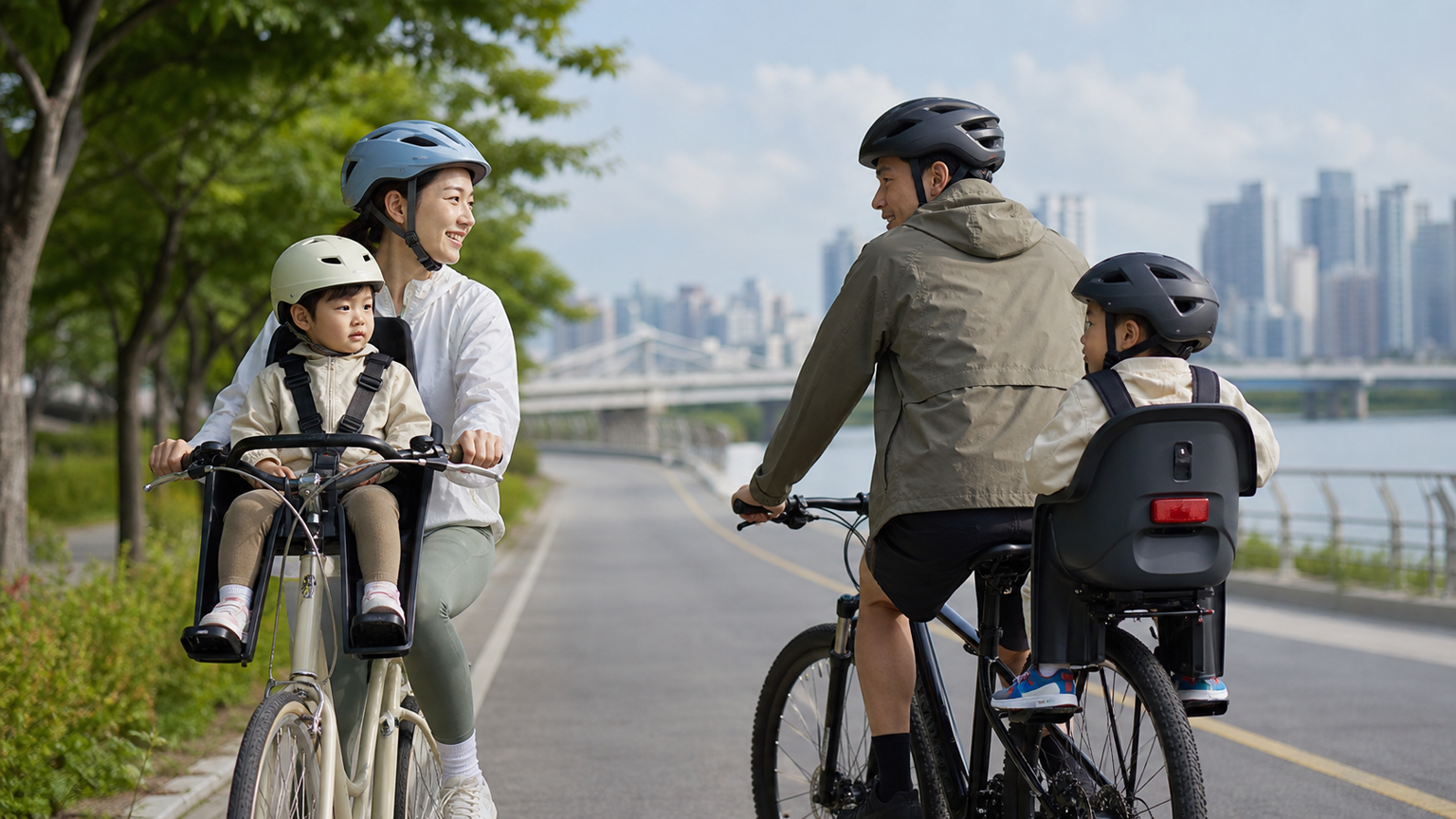
Choosing a Bicycle Child Seat: A Safety Comparison of Front vs. Rear Mounted Seats
Cycling with children has become an increasingly popular family activity in Taiwan, but the choice of child seat directly affects your child’s safety. Is a front-mounted or rear-mounted seat safer? Which style suits which age group? This article answers these questions one by one.
Safety Certification for Child Seats
The EU EN14344 safety certification is the most important standard for bicycle child seats, covering:
- Impact testing
- Leg protection testing
- Seatbelt strength testing
- Structural strength testing
Before purchasing, always confirm the product carries the EN14344 certification mark — European and American brands sold locally in Taiwan typically meet this standard.
Front-Mounted Child Seats
Design Features
Front-mounted seats are installed between the stem and handlebar, with the child seated in front of the rider, allowing the rider to see the child directly.
Suitable Age Range
Typically suitable for 9 months to 3 years old (some models up to 4 years), with a weight limit generally of 15-18kg.
Advantages
- Best for parent-child interaction: You can check on your child’s status and talk with them in real time
- Good visibility for the child: The child can enjoy the forward view
- Relatively small effect on bike balance: The weight is at the front, which the rider can feel and compensate for
- Safer emergency braking: During sudden braking, the rider’s body can shield the child
Disadvantages
- Affects rider posture: Arms must reach around the child, limiting riding position
- Shorter suitable age range: The child needs to switch seats once they exceed 15kg
- Not suitable for larger road bikes: Requires sufficient space around the handlebar and fork
Recommended Models
- Thule Yepp Nexxt Mini: NT$4,500-6,000, a top European brand with excellent cushioning design
- Bobike One Mini: NT$3,500-5,000, a Dutch brand with good coverage/support
- Polisport Koolah: NT$2,000-3,000, a Portuguese brand with excellent value for money
Rear-Mounted Child Seats
Design Features
Rear-mounted seats are installed on the rack position above the rear wheel, with the child seated behind the rider.
Suitable Age Range
Typically suitable for 1 to 5-6 years old, with a weight limit generally of 22-25kg.
Installation Methods
- Rear rack type: Requires a rear rack on the frame, offering the highest stability
- Seat post clamp type: Clamps onto the seat post, suitable for road bikes without a rear rack
- Rear axle type: Clamps onto the rear wheel axle, suitable for specific bike types
Advantages
- Longer suitable age range: Usable from age 1 to 5-6 years, a longer period of use
- More natural rider posture: Does not affect handlebar operation
- Higher weight capacity: Can carry children over 25kg
- Multiple installation options: Suitable for various bike types
Disadvantages
- Cannot see the child directly: Requires checking via a rearview mirror or turning around
- Poorer safety during sudden braking: The child in the rear risks tipping forward during sudden braking
- Affects the bike’s center of gravity: Rear weight makes steering slightly less responsive
- Seatbelt design is more critical: The belt needs to secure the child’s head if they fall asleep
Recommended Models
- Thule Yepp Nexxt Maxi: NT$6,000-8,000, an all-around top-tier design with excellent head protection
- Bobike One Maxi: NT$4,500-6,500, good leg-guard coverage design
- Hamax Caress: NT$5,000-7,000, a Norwegian brand that can recline, comfortable even if the child falls asleep
Key Points for Safe Use
The Child’s Helmet
Whether front or rear seat, the child must wear a properly sized helmet. Taiwan requires helmets for those under 16, but infants and toddlers need even more attention. Choose a children’s helmet that meets CPSC or CE EN1078 standards.
Confirming Height and Weight
The child’s height and weight must fall within the seat’s specified range — exceeding the weight or height limit reduces safety.
Ride Duration Limits
- A single ride is recommended not to exceed 1 hour to avoid child fatigue
- Avoid riding on highways or dangerous road sections
- Taiwan regulations: it is prohibited to carry children on bicycles on expressways or highways
Weather Considerations
Taiwan’s weather is highly variable — make sure your child has sun and rain protection:
- Sun canopy (an optional accessory for some seats)
- Windproof blanket (for winter or mountain road use)
Front vs. Rear: When to Choose Which
| Situation | Recommendation |
|---|---|
| Child is 9 months - 2 years old | Either front or rear (confirm age suitability) |
| Want to interact with your child | Front seat |
| Child is over 2 years old, weight >15kg | Rear seat |
| Riding a road bike | Rear seat (seat post clamp type) |
| Riding a city bike/family bike | Either front or rear |
| Long-distance rides | Rear seat (better comfort) |
Conclusion
Both front and rear seats have their ideal use cases, and many families’ best strategy is to use a front seat when the child is young (better interaction), then switch to a rear seat as they grow (longer usable period). Most importantly, choose a product with EN14344 certification, ensure your child wears a helmet, and enjoy quality family riding time.
再快都跟的上!? 單車跟隨攝影機之王 HOVERAir X1 PROMAX 全面實測 / 唯一!8K畫質&自行車專用模式和跟蹤信標&前後避障 / DJI Neo 可參考/ 公路車 / CT Yeh
1 年前
碟煞公路車 優缺點?換車一年半實際經驗分享 / 公路車 / CT Yeh
2 年前
再一組! 全碳幅條 碟煞/無內胎輪組 開箱! 到底好騎嗎? UNAAS X40 | 公路車 | CT Yeh
4 年前
訓練台體驗) 2019台北自行車展 三大家 訓練台體驗 Tacx Neo Flux 2 Xepdo Apx Wahoo Kickr
7 年前
鉅齒紋輪組!? ControlTech MEG-T50 EVO 碳纖維幅條輪組/ 功率對比實驗 / 公路車 / CT Yeh
2 年前
Fitting訓練兩用功率車 ! Thinkrider ST900 完整實測!/ 坡度升降 / 鄰居測試/ smart bike/公路車/ CT Yeh
2 年前
#公路車 #Fitting 靠人工智慧APP 幫你調整單車
6 年前
用了AirTag 單車就不怕被偷?盲點大測試 結果… |公路車|CT Yeh
5 年前