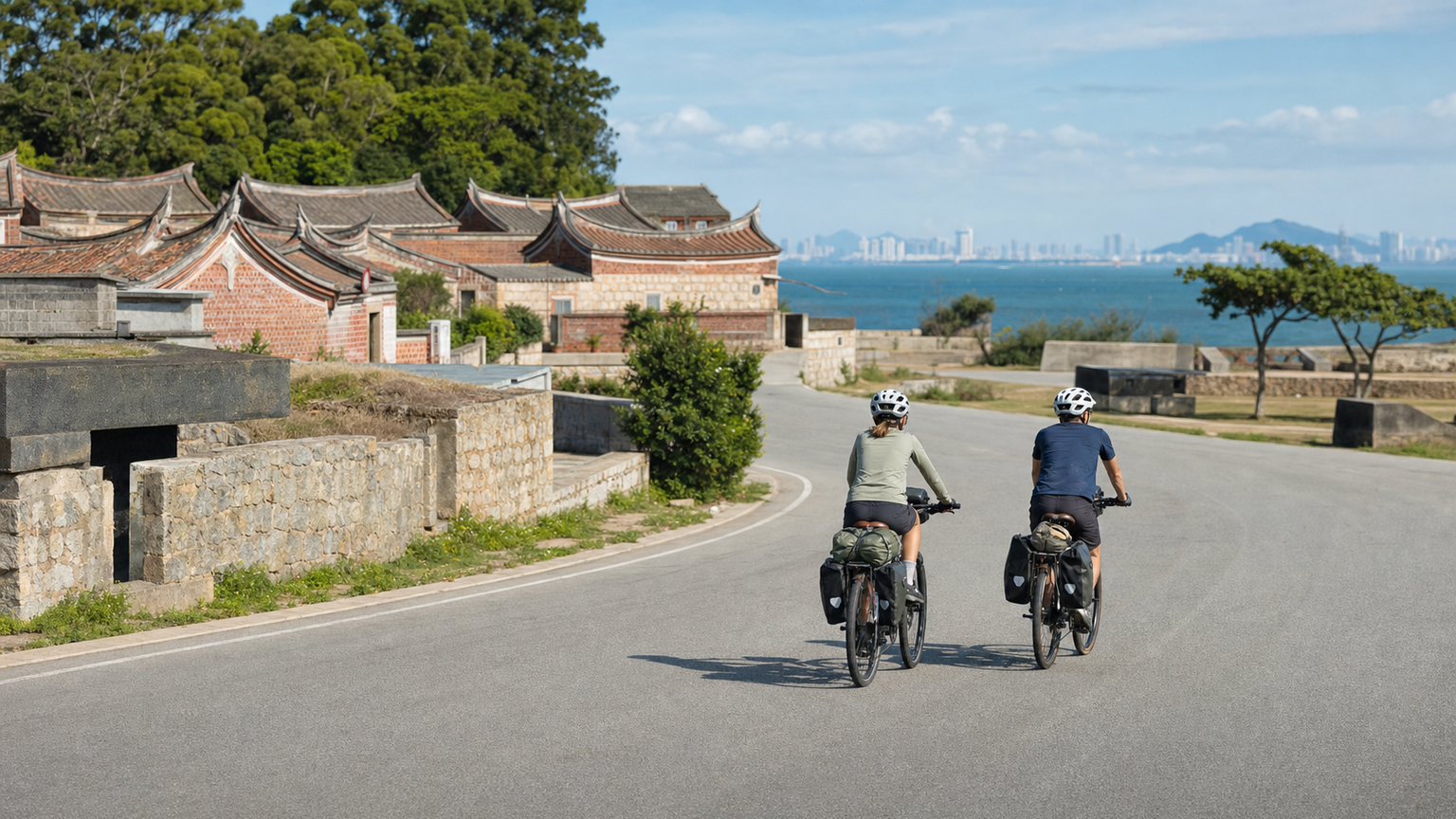
Kinmen Cycling: The Perfect Blend of Battlefield Heritage and Flat Routes
Kinmen, officially known as Kinmen County, consists of Kinmen Island (Greater Kinmen), Lieyu (Lesser Kinmen), and several smaller islets, covering an area of approximately 151 square kilometers. Located off the coast of Xiamen, Fujian, it is Taiwan’s most populated island closest to mainland China.
The appeal of cycling in Kinmen lies in its unique layers of history: ancient Minnan-style courtyard settlements left by immigrants from southern Fujian, defensive fortifications from the Sino-Japanese War, battlefield facilities built after 1949, and the recent transformation into a tourist destination—multiple historical periods coexist on this land. With flat roads and a mild climate, it is the most suitable of all Taiwan’s outlying islands for leisurely cycling and savoring the scenery.
Basic Information
| Item | Details |
|---|---|
| Area | Greater Kinmen approximately 134 square kilometers |
| Transportation | Flights from major Taiwanese cities to Kinmen, approximately 50–60 minutes |
| Bike Rental | Available in Jincheng city center and near Shangyi Airport |
| Cost | Regular bicycles approximately NT$200–300/day |
| Road Characteristics | Almost entirely flat, with occasional gentle slopes |
| Recommended Duration | 2–3 days |
Three-Day Cycling Itinerary
Day 1: Jincheng City Center→Zhaishan Tunnel→Guningtou (approximately 35 km)
Jincheng City Center (Departure)
Jincheng is the seat of Kinmen County Government. The old town district preserves commercial street architecture from the Qing Dynasty and the Japanese colonial era. Starting from Jincheng, take a stroll through the old town and stock up on breakfast.
Zhaishan Tunnel (approximately 12 km)
Zhaishan Tunnel is Kinmen’s most famous battlefield attraction. Excavated in the 1960s, this waterway tunnel, measuring 357 meters in length, was built to accommodate the passage of small boats, and wartime berths for vessels can still be seen inside. Concerts are occasionally held here, with remarkably natural acoustics.
Guningtou (approximately 25 km)
This is the site of the 1949 Battle of Guningtou, where the Republic of China Armed Forces halted the PLA’s landing attempt—regarded as a turning point in Kinmen’s history. The Guningtou War Museum thoroughly documents this battle.
Shuitou Settlement (approximately 35 km)
Kinmen’s most famous traditional Minnan settlement. A row of eighteen traditional courtyard houses (near the so-called “Deyuelou Western-Style Mansion”) showcases the Southern Fujian architectural style. Many Kinmen emigrants who had lived in Southeast Asia brought back Nanyang elements that were incorporated into traditional Minnan architecture, creating Kinmen’s distinctive “Western-style mansion” (yanglou) building type.
Accommodation: Shuitou Settlement has several B&Bs converted from traditional courtyard houses.
Day 2: Taiwu Mountain→Mashan Observation Post→Jinhu (approximately 40 km)
Taiwu Mountain (approximately 8 km)
Taiwu Mountain is Kinmen’s highest point, at 253 meters above sea level. At the summit, the four characters “毋忘在莒” (Never Forget the Past in Ju), written by Chiang Kai-shek, are carved into the rock—a symbol of the Kinmen spirit. From the summit, you can overlook Xiamen and the Kinmen-Xiamen Strait.
Note: A road allows cycling to the mountainside of Taiwu Mountain, but the final section must be done on foot.
Mashan Observation Post (approximately 20 km)
This is the closest point in Kinmen to Xiamen, separated by only about 5.6 kilometers. The observation post is equipped with telescopes, and on clear days, Xiamen’s city buildings can be clearly seen. Loudspeakers stand outside the post, which were once used to broadcast propaganda toward the opposite shore.
Jinhu Township (approximately 40 km)
Kinmen’s second-largest township, with a greater number of convenience stores and restaurants, making it a good spot to rest and resupply.
Accommodation: Jinhu Township offers business hotels and B&Bs.
Day 3: Lesser Kinmen (Lieyu) One-Day Cycling Circuit (approximately 25 km)
Take a ferry from Shuitou Pier to Lieyu (Lesser Kinmen), a ride of about 20 minutes. Lieyu covers approximately 14 square kilometers, with even flatter terrain. A full cycling circuit around the island is about 25 kilometers—very easygoing.
Lieyu’s Featured Attractions:
- Shanglin Granite Mural Village: A painted village converted from a decommissioned military dependents’ village
- Jiugong Tunnel: A waterway tunnel system even larger in scale than Zhaishan Tunnel
- Hujingtou War Museum: Preserves complete historical records of the battles on Lieyu
Kinmen’s Food Culture
| Food | Description |
|---|---|
| Kung Tang (Peanut Brittle) | Kinmen’s most famous souvenir, made from peanuts, crispy and sweet |
| Oyster Vermicelli | Kinmen oysters are sweet and fresh, with a freshness rarely found on the Taiwan mainland |
| Mianxian Hu (Vermicelli Paste) | A common Kinmen breakfast, vermicelli thickened with sweet potato starch |
| Kaoliang Liquor | Kinmen Kaoliang liquor is famous throughout Taiwan; the distillery offers tours by appointment |
| Cantonese Congee | Traditional Cantonese-style porridge found in Jincheng’s old town |
Kinmen’s Minnan Settlement Culture
Kinmen boasts Taiwan’s most complete collection of traditional Minnan settlements. The main reason is that 40 years of military administration after 1949 inadvertently protected these buildings from destruction by urbanization. Major settlements:
- Shuitou Settlement: Western-style mansions and traditional courtyard houses coexist; the richest in architectural variety
- Qionglin Settlement: Maze-like alley design, reportedly intended to confuse enemies
- Zhushan Settlement: A Xue clan settlement with well-preserved ancestral halls and traditional houses
- Oucuo Settlement: Sea-facing traditional houses with a strong sense of weathered erosion from the sea breeze
Best Months to Travel
- March–May: Pleasant weather, spring flowers (kapok, chinaberry) in full bloom
- September–October: Crisp autumn weather, oyster season (Kinmen oysters at their plumpest)
- Avoid: Typhoon season from June–September; strong northeast monsoon from December–February
Conclusion
Kinmen holds a special place in Taiwan’s travel landscape. It is not the most spectacular, nor the most thrilling, but it carries the most concentrated historical sentiment of Taiwan’s modern history. As you cycle through those ancient alleyways of traditional houses and stand at Mashan Observation Post gazing at Xiamen’s high-rises, you will feel a depth of time that can only be experienced in Kinmen.
Let the weight of that history accompany you as you ride every small road in Kinmen.
Related Reading
- Kinmen Cycling: A Bike Journey Through Battlefield Scenery and Minnan Culture
- Kinmen Bike Routes: A Cycling Exploration Guide to Battlefield Heritage and Natural Landscapes
- Kinmen Island Cycling Route: An Outlying Island Riding Experience with Battlefield Charm
- Kinmen Circuit Riding Guide: Planning Bike Routes Through Outlying Island Battlefield Scenery
金門 ! 我騎過最棒的離島了 / 最後可以騎車上金門大橋的機會!?/ 公路車 / CT Yeh
1 年前
太平山單車員工旅遊 | 這樣玩CP值最高!| 公路車
5 年前
公路車 北進武嶺 兩日輕鬆遊 空拍 環山部落極致絕景 Taiwan Cycling Wulin
8 年前
西拉雅五庫單車挑戰 / 曾文水庫 & 南168 二寮 / 500元報名費居然這麼超值/ 公路車 / CT Yeh
10 個月前
高雄綠園道鐵路自行車道 / 外地人能輕鬆駕馭 還是整路崩潰? / 2025 全線開通 春節實地探索一次!(附GPS連結)/ 公路車 / CT Yeh
1 年前
大武山20%魔王陡坡【JJSC南台灣遊騎Day2】!屁股真的要裂開了...凡士林抹滿也沒用?神秘金教堂還有超便宜夜市
3 個月前
微東進 太魯閣 蘇花 單車兩日遊 ! 颱風過後路況超刺激 行程大亂 | 最狂的鹹酥雞訂單 | CT Yeh | 4K 高畫質空拍絕景!
4 年前
南竿 單車 | 老婆公路車首航 | 偽出國體驗 | 4K 高畫質 | 綠色騎跡低碳輕旅遊 | #公路車
5 年前