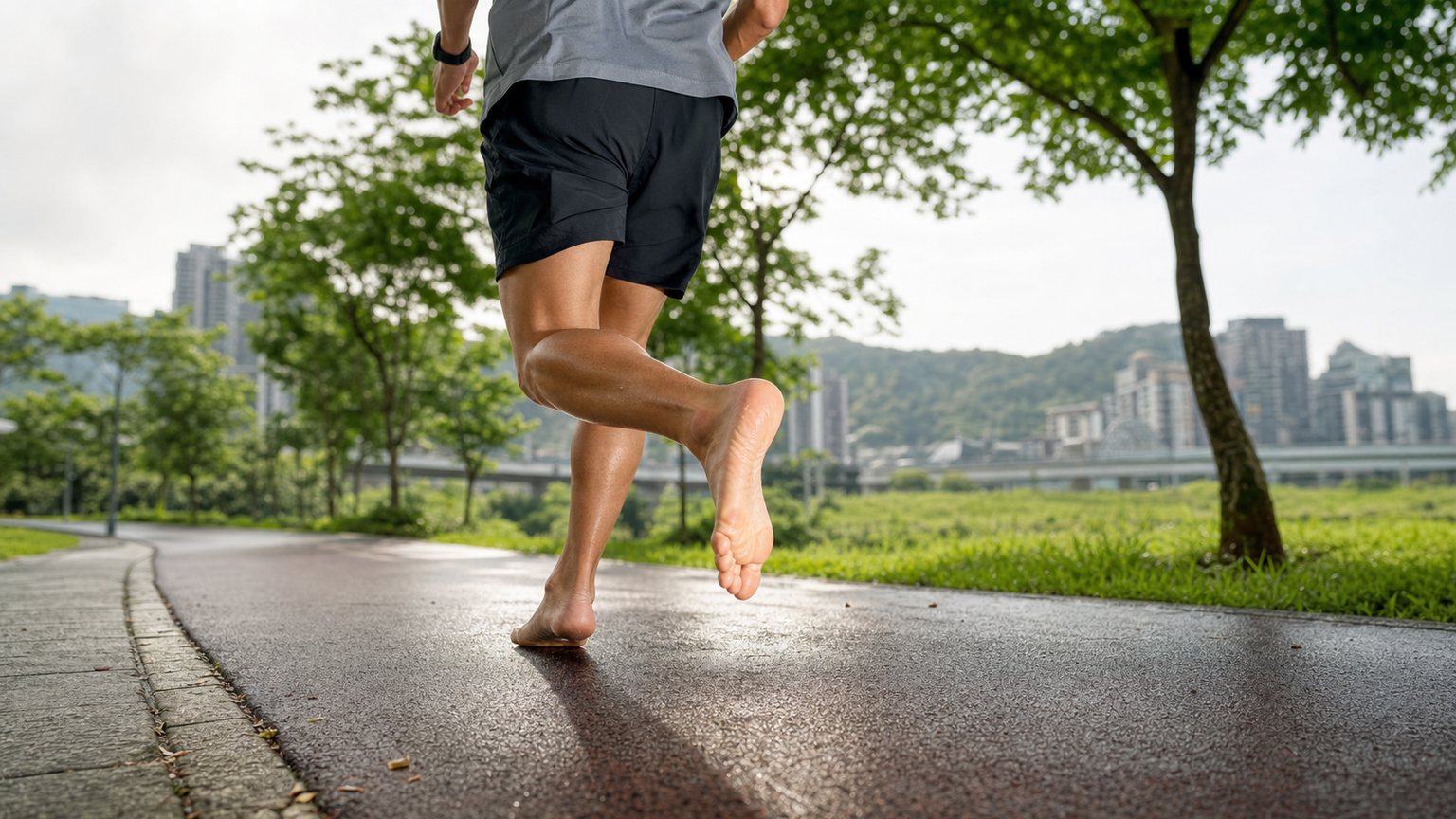
The Rise of Natural Running
In 2009, Christopher McDougall’s Born to Run sparked a global barefoot running craze. The book’s account of Tarahumara Indians running hundreds of kilometers in thin-soled sandals made runners question: Are thickly cushioned running shoes really a good thing?
The Physiological Basis of Barefoot Running
The Foot Is a Natural Shock Absorber
The human foot has 26 bones, 33 joints, and over 100 tendons and ligaments. When running barefoot, this sophisticated system operates automatically:
- Forefoot strike: Barefoot runners naturally favor a forefoot strike, avoiding direct heel impact
- Arch spring: The elastic energy storage of the longitudinal and transverse arches is more efficient than shoe foam
- Proprioception: Ground feedback stimulates the nerves in the soles, allowing the body to adjust running form in real time
Research-Backed Benefits
| Benefit | Research Finding |
|---|---|
| Strengthened foot muscles | After 12 weeks of barefoot running, intrinsic foot muscles thickened by 12% |
| Improved running form | Increased cadence, shortened stride, reduced overstriding |
| Enhanced Achilles tendon | Improved elastic energy storage in the calf tendon |
| Running sensation | Richer ground feedback, heightened running awareness |
Challenges and Solutions Under Taiwan’s Climate
Challenge 1: Hot Ground Burns
In Taiwan’s summer, asphalt road surface temperatures can reach 55–65°C, far exceeding what the feet can tolerate.
Solutions:
- Timing: Before 6 a.m. or after 6 p.m., when ground temperatures drop below 45°C
- Shaded routes: Choose tree-lined trails, such as Taipei’s Daan Forest Park or riverside parks
- Grass training: School field lawns are ideal barefoot training venues
- Tool assistance: Use thin-soled shoes (e.g., Vibram Five Fingers, Xero Shoes) as a transition
Challenge 2: Slippery Ground in the Rainy Season
During Taiwan’s plum rain season (May–June) and typhoon season (July–September), wet ground makes barefoot running less grippy than wearing shoes.
Solutions:
- Switch to barefoot training on indoor treadmills during the rainy season
- Choose gyms with rubber flooring
- Use thin-soled sandals with drainage designs
Challenge 3: Street Hygiene Issues
Taiwan’s urban streets may contain hazards such as glass shards and nails.
Solutions:
- Prioritize public sports fields, tracks, and beaches
- Carefully scan the surface before starting a run
- Use thin-soled shoes as a “hygienic” alternative to barefoot running
A Safe Plan for Transitioning from Traditional Shoes to Barefoot Running
Phase 1: Foot Activation (Weeks 1–4)
No running required, just the following exercises:
- Barefoot standing balance training: 3 sets × 30 seconds daily
- Towel curls: use toes to scrunch up a floor towel, 2 × 20 reps daily
- Plantar rolling: roll the sole with a golf ball, 5 minutes per session
- Barefoot walking: 15–30 minutes of barefoot walking daily
Phase 2: Barefoot Jogging Basics (Weeks 5–8)
- 2 sessions per week, only 5–10 minutes each
- Choose grass or gym wooden floors
- Focus on the feel of a forefoot strike; don’t force it—let the body adjust naturally
Phase 3: Gradual Progression (Weeks 9–16)
- Increase barefoot running time by 5 minutes each week
- May try thin-soled shoes on asphalt
- Total barefoot mileage should not exceed 20% of weekly mileage
Phase 4: Integration (Week 17 onward)
- Barefoot training becomes a supplement to daily running
- Decide whether to fully transition based on personal preference
Recommended Barefoot Running Spots in Taiwan
Northern Taiwan
- Fulong Beach: Fine-sand beach with enough length for training
- Daan Forest Park: Lawn areas, an urban oasis in the city center
- Xindian Bitan Riverside Park: Paved paths with a pleasant environment
Central Taiwan
- Dadutai Plateau: Red-clay trails, ideal for an off-road barefoot feel
- Gaomei Wetlands: Mudflats after low tide, a natural sensory training ground
Southern Taiwan
- Cijin Beach: An accessible beach running spot in Kaohsiung city
- Guanshanli Country Lanes: Pristine rural roads in Taitung
Injury Prevention for Barefoot Running
Most Common Transition-Period Injuries
- Metatarsal stress fractures: Transitioning too quickly, with excessive impact on the forefoot
- Achilles tendinitis: The calf muscles are not yet adapted to the extended load
- Plantar fasciitis: Can actually worsen due to improper transition
Prevention Principles
- The 10% Rule: Increase weekly barefoot mileage by no more than 10% over the previous week
- Listen to your body: Stop at any pain (other than muscle soreness)
- Adequate recovery: Allow 48 hours of recovery after barefoot sessions
Conclusion
Barefoot running and natural running are not a romantic “return to primitivism,” but a training method that allows the body’s natural biomechanics to be fully utilized. Under Taiwan’s climatic conditions, with proper timing and venue planning, barefoot training can be an effective tool for strengthening the feet and improving running form. Remember: gradual progression is the only rule for a successful transition.
Related Reading
- Barefoot Training for Runners: Injury Prevention Benefits and Risks of Natural Running
- The Relationship Between Running Shoes and Injury: A Complete Analysis of Over-Supportive Shoes, Minimalist Shoes, and the Latest Shoe-Selection Science
- Minimalist Shoes vs. Barefoot Running: Who Should Try It and How to Transition Safely
- Heat-Tolerant Runners: The Physiological Mechanisms of Heat Adaptation for Summer Road Running in Taiwan
CT暗黑廚房) 車友必備 宇宙無敵鮮蚵湯 幫助訓練恢復 天然食補 好市多 超肥鮮蚵 破PR
7 年前
小野田真的存在!日本赤城山爬坡公路賽 台灣首發團完全實錄 | 頭文字D真實賽道! | 看完東奧自行車賽後好想再去騎一次啊! | 公路車 | CT Yeh
4 年前
單車 一日北高 ( 雙城 ) 肥宅雙人瘋狂行 紀錄片 REACTO
10 年前
2023自行車展!與環台賽選手一同表演賽 / 全自動AI Fitting?/ TIME新車發表/神秘充電桌等 精華分享 VLOG | CT Yeh | 公路車
3 年前
半日 小台灣 極限單車路線挑戰實錄
7 年前
#公路車 #Fitting 靠人工智慧APP 幫你調整單車
6 年前
白沙屯媽祖進香在家走!UREVO 坡度自調走步機 / 可連接訓練遊戲APP MyWhoosh / 邊看直播邊走起來 / CT Yeh
11 個月前
實景訓練台) 彰化經典百K 高強度喵團 90分鐘 跟著一起練功 2019 Indoor workout Changhua Classic 100 Taiwan
7 年前