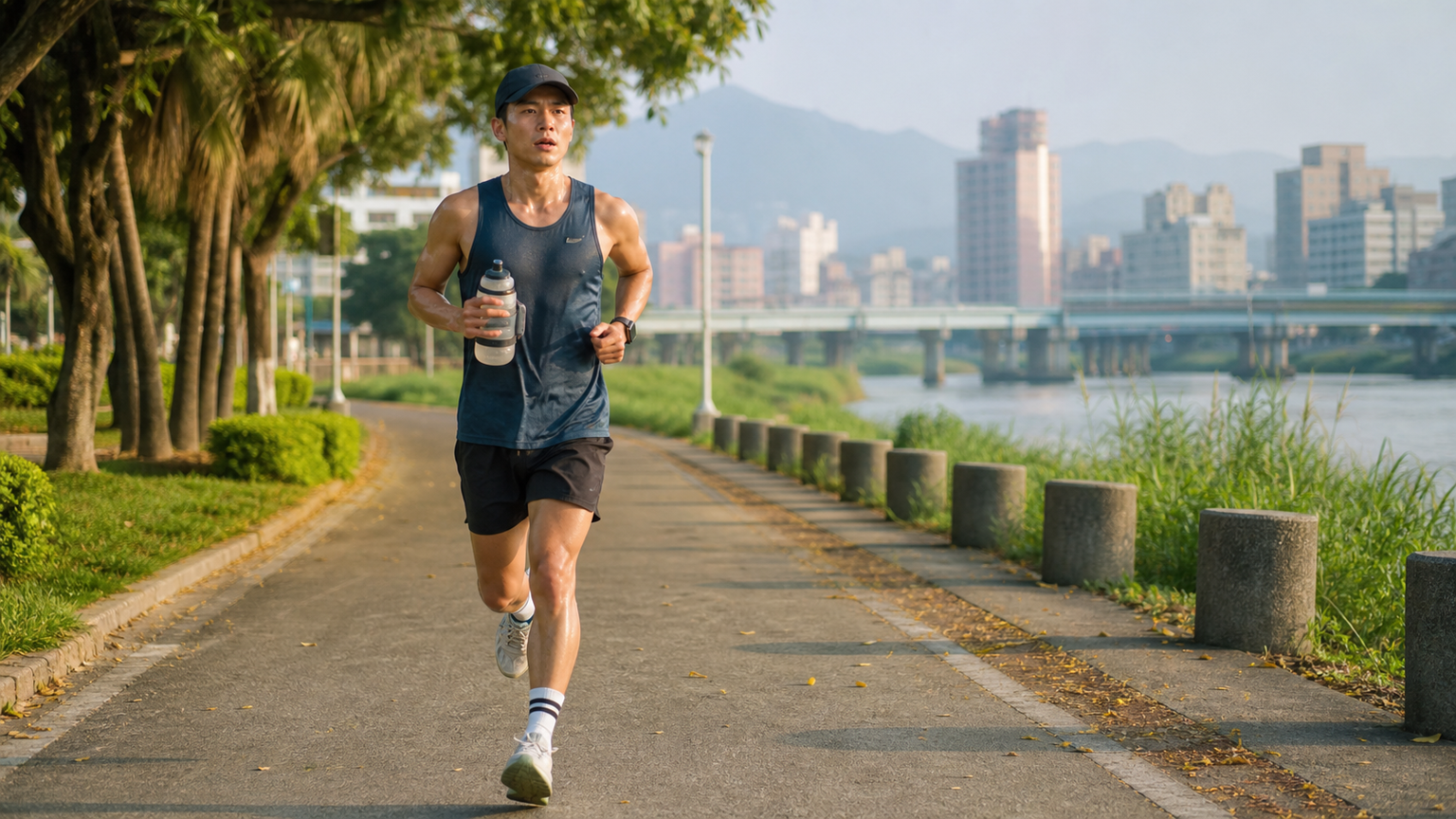
The Running Dilemma of Taiwan’s Summer
From June to September each year, temperatures in Taiwan frequently exceed 33°C, and with relative humidity above 80%, outdoor running becomes a high-risk activity. Many runners drastically reduce their training in the summer and only resume running in the autumn. But in fact, with the right knowledge and strategies, you can still train effectively in the summer—and even achieve better race results in the autumn through heat acclimatization.
The Impact of Heat and Humidity on Running
Body Temperature Regulation Mechanisms
During exercise, core body temperature can rise to 39-40°C. To dissipate heat:
- Skin blood vessels dilate, increasing blood flow
- Sweating dissipates heat; each milliliter of sweat evaporated can carry away approximately 0.58 calories of heat
- Heart rate rises to compensate for the redistribution of blood
The problem is: In high heat and humidity, the air’s capacity to absorb heat decreases, sweat evaporation becomes difficult, and cooling efficiency drops significantly. Running at the same intensity causes heart rate to rise substantially (10-20 bpm higher than in cooler weather).
Pace Adjustment Formula for Hot Conditions
Scientific research provides estimates of how temperature affects running pace:
| Temperature | Pace Decrease Compared to 15°C |
|---|---|
| 15°C (optimal) | Baseline |
| 20°C | -1-2% |
| 25°C | -3-5% |
| 30°C | -5-8% |
| 35°C | -8-12% |
| Above 38°C | -12-15% or more |
If your usual 10K pace is 5:00/km, at 35°C you should adjust it to 5:25-5:36/km to train at the same heart rate intensity.
Summer Running Safety Guidelines
Time Selection (Most Important!)
| Time Slot | Temperature | UV Index | Recommendation |
|---|---|---|---|
| Early morning 5:00-7:00 | Lowest | Low | Best time slot |
| Morning 7:00-9:00 | Warming up | Moderate | Acceptable |
| Morning 9:00-17:00 | Highest | Intense | Avoid |
| Evening 17:00-19:00 | Cooling down | Low | Acceptable |
| After 19:00 at night | Still hot | None | Insect protection and adequate lighting needed |
Hydration Strategy
Sweat rate during running in high heat can reach 1-2 liters per hour, and electrolyte loss also increases significantly.
Hydration principles:
- 2 hours before running: 500 ml of water
- During running: 200-250 ml every 15-20 minutes
- After running: 1.5 liters of water for every 1 kg of body weight lost
Electrolyte supplementation:
Runs exceeding 60 minutes require sodium, potassium, and magnesium supplementation. Options include:
- Sports drinks (Pocari Sweat, Gatorade)
- Salt tablets (Salt Stick brand)
- Electrolyte powder (Precision Hydration)
Warning: Drinking large amounts of plain water without supplementing electrolytes can actually lead to hyponatremia, a dangerous condition for long summer runs.
Clothing Recommendations
| Body Part | Recommendation |
|---|---|
| Top | Light-colored, breathable, moisture-wicking fabric |
| Bottom | Lightweight running pants or shorts, avoid dark colors |
| Hat | Light-colored running cap or visor, essential for sun protection |
| Sunglasses | UV400 protection |
| Sunscreen | SPF 50+, apply 30 minutes before running |
Heat Acclimatization Training: Helping Your Body Embrace Summer
What Is Heat Acclimatization?
After sustained training in hot conditions, the body undergoes a series of adaptations:
- Plasma volume increases (up to 15%)
- The core temperature threshold for starting to sweat lowers
- Sodium concentration in sweat decreases (reducing electrolyte loss)
- Heart rate decreases at the same intensity
- Running efficiency improves
Full heat acclimatization takes approximately 10-14 days, with 60-90 minutes of training in hot conditions each day.
Heat Acclimatization Plan (Suitable Before Important Autumn Races)
| Day | Training Duration | Intensity |
|---|---|---|
| Days 1-3 | 30-45 minutes | Easy |
| Days 4-7 | 60 minutes | Easy to moderate |
| Days 8-14 | 75-90 minutes | Moderate |
The effects of heat acclimatization persist for 1-2 weeks after stopping heat training. You can complete heat training 2-3 weeks before a race, then run in cooler conditions on race day while enjoying the physiological advantages gained from heat acclimatization.
Summer Training Alternatives
Swimming Training
Swimming is the best option for maintaining aerobic capacity in summer. Water resistance is equivalent to 4 times that of air resistance; 60 minutes of swimming provides the same aerobic training effect as 45 minutes of running, with zero impact on the joints.
Treadmill Training
An air-conditioned treadmill lets you run at a comfortable temperature, but note the following:
- Set a 1-2% incline to compensate for the lack of outdoor air resistance
- Pace can be 10-15 seconds/km faster than outdoors
- Lack of outdoor sun exposure means vitamin D supplementation is needed
Cycling Cross-Training
Road cycling or stationary bike training can maintain aerobic capacity, and the muscle recruitment patterns in the legs are similar to running. Replacing running with cycling 1-2 times per week significantly reduces summer injury risk.
Recognizing and Treating Heat Exhaustion and Heat Stroke
Heat Exhaustion
Symptoms: Heavy sweating, dizziness, weakness, nausea, cool and clammy skin
Treatment: Move immediately to a shaded area, replenish fluids and electrolytes, rest
Heat Stroke
Symptoms: Dry and flushed skin (or extreme sweating), confusion, body temperature above 40°C
Treatment: Emergency! Call an ambulance immediately, while cooling the body with ice water (ice bath, ice packs on the neck, armpits, and groin)
Buddy system before running: For long summer runs, it is recommended to run with a partner and monitor each other’s condition.
Conclusion
Summer in Taiwan is not a forbidden season for running—it is a training season that demands more wisdom. By choosing the right time, hydrating adequately, appropriately reducing intensity, and incorporating systematic heat acclimatization training, you can not only get through the summer safely but also build a stronger physiological foundation for autumn races.
Related Reading
- Running Strategies in Hot Conditions: Heat Dissipation and Pace Adjustment for Taiwan Summer Training
- The Impact of Taiwan’s Summer Heat on Pace: Pace Corrections During the Heat Acclimatization Period
- Speed Training Adjustments in Hot Conditions: Practical Interval Strategies for Taiwan Summers
- Compensating for Slower Running Speed in Heat: Pace Adjustment Strategies for Taiwan Summer Training
CT暗黑廚房) 車友必備 宇宙無敵鮮蚵湯 幫助訓練恢復 天然食補 好市多 超肥鮮蚵 破PR
7 年前
實景訓練台) 彰化經典百K 高強度喵團 90分鐘 跟著一起練功 2019 Indoor workout Changhua Classic 100 Taiwan
7 年前
2019 夏季KOM 5小 完賽心得 準備攻略 東進武嶺 夏季登山王之路 Taiwan KOM Challenge
7 年前
單車 一日北高 ( 雙城 ) 肥宅雙人瘋狂行 紀錄片 REACTO
10 年前
一日北高前的高裝檢 | 北高 360 | 挑戰11小時的裝備 | 一日雙塔 | 補給
6 年前
Live) 備戰2019彰化經典百K 賽前攻略 (已完賽請看新影片
7 年前
TBA 北高360 逆風爆熱再送空汙 苦行挑戰賽全記錄 4K沈浸式臨空畫質| 公路車 | CT Yeh
3 年前
#公路車 #Fitting 靠人工智慧APP 幫你調整單車
6 年前