The Origins and Rise of Ice Bathing
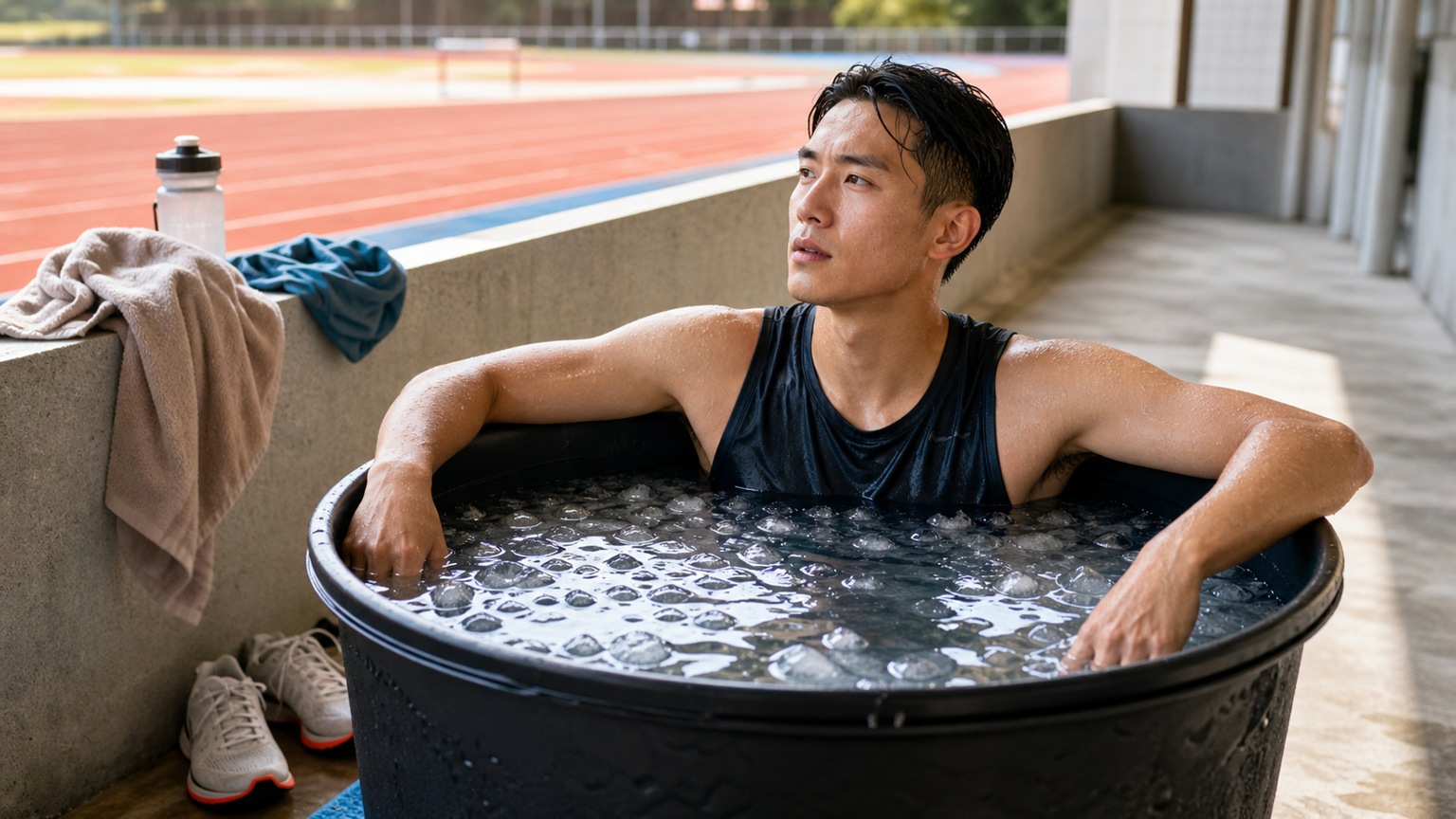
The image of elite athletes plunging into ice-filled tubs after major competitions has become a familiar sight in sports media. Ice baths, or cold water immersion (CWI), are widely used as a post-exercise recovery method among elite athletes in high-intensity sports like track and field, soccer, and rugby. Taiwan’s marathon and trail runners have gradually adopted the practice as well.
But the scientific conclusions are far more nuanced than a simple “ice baths work.”
The Physiological Mechanisms Behind Ice Baths
Theoretical Benefit Mechanisms
- Vasoconstriction: Cold temperatures constrict peripheral blood vessels, reducing blood flow and swelling at inflamed sites
- Lower Metabolic Rate: Cold slows tissue metabolism, theoretically limiting further damage
- Slower Nerve Conduction: Cold reduces the conduction speed of pain nerves, producing an analgesic effect
- Waste Clearance: Vasodilation during rewarming theoretically helps clear metabolic waste products
What the Research Actually Shows
Studies supporting ice baths:
- A 2012 meta-analysis in the British Journal of Sports Medicine found ice baths significantly reduced subjective DOMS (delayed onset muscle soreness) 24-96 hours after training
- A 2015 study found that power output the following day was better after ice baths compared to passive recovery
Studies questioning ice baths:
- A 2021 study in the Journal of Physiology found ice baths suppress muscle protein synthesis, potentially slowing long-term muscle adaptation
- A 2019 study found that while ice baths reduce the perception of DOMS, they don’t actually accelerate the recovery of muscle function
- Mujika et al. (2021) found ice baths may inhibit mitochondrial biogenesis, affecting long-term aerobic capacity gains
The Latest Scientific Consensus: A Contradiction
The current view in exercise science reveals an interesting contradiction:
| Timing | Effect of Ice Bathing |
|---|---|
| 0-48 hours post-training | Reduces pain ✓, may aid recovery |
| 1-4 weeks post-training | May suppress muscle adaptation ✗ |
| During competition season (frequent races) | Likely beneficial (fast recovery is priority) ✓ |
| During training blocks (adaptation is the goal) | Likely counterproductive (suppresses supercompensation) ✗ |
Core takeaway: ice baths are a tool for “reducing suffering,” not a tool for “accelerating progress.”
The Best Times to Use Ice Baths
When Ice Baths Make Sense
-
Frequent racing during competition season
- Multi-day trail running events
- Runners racing multiple times within a week
- Fast recovery matters more than long-term adaptation in these situations
-
Within 24 hours after an ultramarathon or marathon
- Rapid symptom relief after extremely high-intensity training
- Reduces swelling and helps runners “feel” normal sooner
-
Acute injuries with clear inflammation
- Early-stage sprains (paired with the RICE principle: Rest, Ice, Compression, Elevation)
- Note: this refers to localized icing, not necessarily full-body immersion
When to Avoid Ice Baths
-
After routine training sessions
- During periodized training blocks, your body needs the inflammatory response to drive adaptation
- Ice baths suppress inflammation = suppress adaptation
-
After strength training
- Research shows muscle protein synthesis rates are significantly reduced after ice baths
- If your goal is building strength, ice baths work against you
-
In hot environments
- A rapid drop in core body temperature can trigger vasospasm
How to Ice Bath Correctly
Temperature
- Ideal temperature: 10-15°C (colder is not better)
- Danger zone: below 8°C may cause tissue damage or cardiac discomfort
- Safety tip: start at 15°C for your first attempt and gradually acclimate
Duration
- Minimum effective time: 5 minutes
- Ideal range: 10-15 minutes
- Never exceed: 20 minutes
Method
- Immersing the lower body is sufficient (full-body immersion isn’t necessary)
- You can wear shorts to reduce psychological resistance
- If an ice bath isn’t available, a cold shower (15-20°C) offers some benefit
Ice Bath Alternatives in Taiwan
Taiwan’s tap water tends to run warm in summer (25-30°C), making it hard to reach ideal ice bath temperatures. Alternatives include:
| Option | Method | Effectiveness |
|---|---|---|
| Ice tub immersion | Large cooler filled with ice | Good, requires equipment |
| Air-conditioned room immersion | Bathtub with plenty of ice | Good, higher cost |
| Cold shower | Coldest available water (20-25°C) | Partial effect |
| Contrast bath | Alternating cold and hot water | Moderate, subjectively comfortable |
| Localized ice packs | Targeted areas (knees, calves) | Effective locally |
Contrast Water Therapy
Some research supports contrast water therapy (alternating between cold and hot water immersion) as potentially superior to plain ice baths:
- Cold water (12-15°C) for 2 minutes
- Hot water (38-42°C) for 1 minute
- Repeat for 4-5 rounds
- Finish with cold water
The vascular response of contrast bathing (constriction followed by dilation) may help create a “pumping” effect that clears metabolic waste.
Conclusion
Ice baths aren’t a magic recovery tool, nor are they a mandatory ritual of suffering. After frequent racing and extreme training sessions, ice baths can help you “feel better” faster. But during regular training blocks, they may interfere with the adaptations you’ve worked hard to earn. Deciding whether to use an ice bath based on your training goal is the smart runner’s approach.
Related Reading
- Ice Bath vs. Hot Bath After Running: Which Recovery Strategy Fits Your Training Cycle?
- Cold Water Immersion and Recovery: When to Use Post-Race Ice Baths and the Risks of Overuse
- Contrast Therapy: Applying Cold and Hot Showers to Exercise Recovery
- Post-Run Recovery Strategies: The Science of Ice Baths, Massage, and Sleep
滑雪新手們慘摔學習全紀錄(請開字幕),滑雪好好玩 | Snowboard + Ski | 岩原 スキー場 | 滑雪APP使用 | GoPro Max
6 年前
大家都在開箱的...單車用藍芽對講耳機真的有幫助嗎? SENA BiKom 20 長距離旅遊 & 海鷗繞圈賽 實際體驗心得 / 公路車 / CT Yeh
9 個月前
4K 東眼山 x 水蜜桃冰沙 百人單車約騎! 操完再吃冰 多爽快
7 年前
2016/05/13 單車 冷水坑下滑
10 年前
[防寒衣體驗] 鐵人魂 三鐵 防寒衣試穿會 於松運 深水游泳池 鯨魚池
8 年前
松運深水池拍攝 作品 防寒衣品牌
8 年前
靠單車減肥35公斤 心得分享與整理
7 年前
CT暗黑廚房) 車友必備 宇宙無敵鮮蚵湯 幫助訓練恢復 天然食補 好市多 超肥鮮蚵 破PR
7 年前