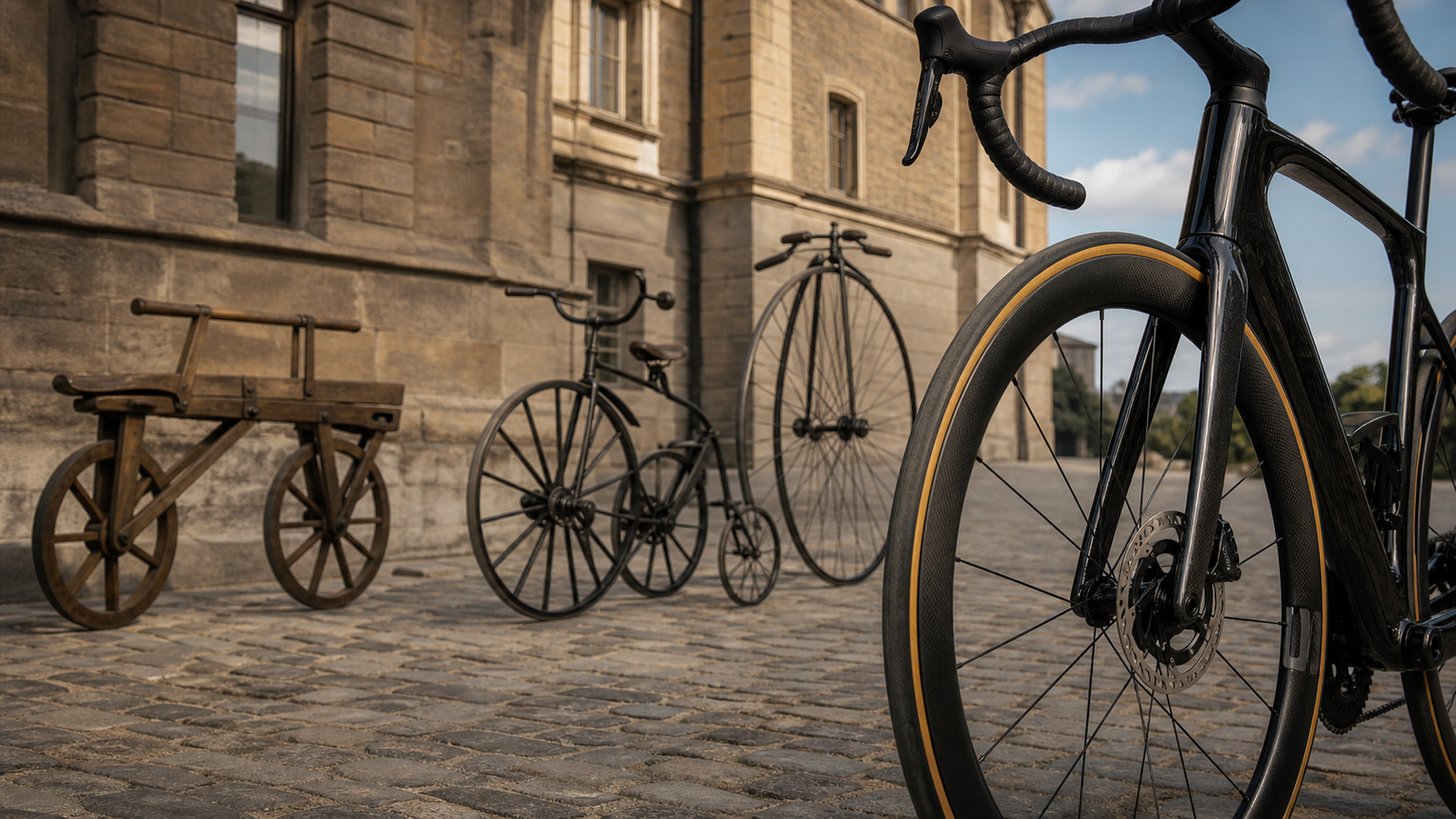
The Origins of Cycling Culture: From the 1800s to the Evolution of the Modern Road Bike
The bicycle, a deceptively simple mechanical device, changed the way humans move, gave rise to modern athletic competition, and even played a key logistical role in two world wars. The road bike we know today is the crystallization of two hundred years of engineering innovation and cultural evolution.
1817: The Birth of the Draisine
The history of the bicycle begins with an environmental crisis. In 1815, the eruption of Mount Tambora in Indonesia triggered the “Year Without a Summer,” causing widespread crop failures and the deaths of many horses due to feed shortages.
Against this backdrop, German Baron Karl Drais invented the “running machine” (Laufmaschine), also known as the “Draisine,” in 1817. It was a device made of a wooden frame and two wheels, propelled by the rider pushing off the ground with alternating feet. It had no pedals, but it already featured steering.
Though the invention looks primitive by today’s standards, it established the core concept of the bicycle: using rolling wheels to reduce friction and make human-powered movement more efficient.
The 1860s: The Emergence of the Pedal Bicycle
The bicycle in the true sense of the word appeared in France in the 1860s. Parisian craftsman Pierre Michaux and his son attached pedals to the front wheel, creating the “Velocipede.” Because its metal wheels caused violent vibration on cobblestone roads, it was nicknamed the “Boneshaker.”
During this period, the bicycle quickly became fashionable among Europe’s upper classes, serving as a symbol of a modern lifestyle. The first bicycle race was held in 1868 in a suburb of Paris, over a distance of 1,200 meters.
The 1870s–1880s: The Penny-farthing
To increase speed, engineers began enlarging the front wheel, since the pedals drove the front wheel directly — the larger the wheel, the farther each pedal revolution would carry the rider. This gave rise to the “Penny-farthing” (also known as the Ordinary Bicycle), with front wheels reaching up to 1.5 meters in diameter.
While fast, these bicycles were extremely dangerous: riders sat high above the ground, and a sudden stop could easily send them flying over the handlebars in what was called a “header.” Combined with the fact that only elite male riders could master it, this limited the bicycle’s spread to the wider public.
1885: The Safety Bicycle Revolution
British engineer John Kemp Starley introduced the “Rover Safety Bicycle” in 1885, establishing the basic form of the modern bicycle:
- Equal-sized front and rear wheels (of smaller diameter)
- A chain-drive system (pedals no longer drove the wheel directly)
- A diamond frame (still the standard today)
- Pneumatic rubber tires (invented and applied by Dunlop in 1888)
The safety bicycle meant that cycling was no longer the privilege of the few. The women’s liberation movement even embraced the bicycle as a symbol of female independence — women no longer needed male chaperones and could ride out freely on their own.
1903: The Birth of the Tour de France
The pinnacle of competitive cycling, the Tour de France, was first held in 1903. Sixty riders set out from Paris, covering a total distance of 2,428 kilometers across six stages that traversed the whole of France.
The birth of the Tour de France elevated the bicycle from a pure means of transportation to a competitive sport, while also driving rapid advances in bicycle technology, as manufacturers eager for their teams to win continuously innovated in materials and geometry.
The 1970s–1990s: The Technology Revolution
After World War II, competitive cycling continued to evolve, bringing about a number of important technological breakthroughs:
| Decade | Technological Innovation |
|---|---|
| 1970s | Early prototypes of indexed shifting |
| 1984 | Shimano launches SIS (Shimano Indexed System) |
| 1985 | The first carbon-fiber road bike competes in a race |
| 1989 | Greg LeMond uses aero bars to stage a comeback victory on the final day of the Tour de France |
| 1990s | Clipless pedals become widespread |
The 1990s to Today: The Rise of Taiwanese Manufacturing
Taiwan’s rise in the bicycle industry is one of the most important chapters in modern cycling culture. Giant and Merida grew from OEM manufacturers into globally recognized brands, and Taiwan became a manufacturing hub for top-tier bicycle components worldwide (Shimano is made in Japan, but many precision components are machined in Taiwan).
The 21st Century: Electronic Shifting and the Digital Revolution
Entering the 21st century, bicycle technology has continued to break new ground:
- Electronic shifting systems: Shimano Di2 (2009) and SRAM eTap (2016) brought shifting precision to an entirely new level
- Power meters: Precisely measuring riding power output, making scientific training widely accessible
- GPS cycling computers: Brands like Garmin and Wahoo transformed how riders train and navigate
- Carbon fiber craftsmanship: Frame weight has dropped from around 12 kilograms in the 1980s to today’s top-tier race bikes at 6.8 kilograms (the UCI’s minimum weight limit)
The Modern Face of Cycling Culture in Taiwan
Taiwan’s cycling culture has its own distinctive character:
- Round-the-island culture: Tens of thousands of people complete a round-the-island bicycle tour of Taiwan each year, forming a unique island cycling culture
- The Wuling pilgrimage: Climbing to Wuling, Taiwan’s highest paved road (at an elevation of 3,275 meters), is the ultimate dream for many riders
- Weekend riding club culture: Hundreds of cycling clubs exist across Taiwan, and groups setting out together on weekend mornings are a common sight
From the wooden hobby horse to the carbon-fiber race bike, two hundred years of bicycle evolution have recorded humanity’s timeless pursuit of speed, efficiency, and freedom. With every push of the pedal, we connect to that two-hundred-year history.
Related Reading
高雄綠園道鐵路自行車道 / 外地人能輕鬆駕馭 還是整路崩潰? / 2025 全線開通 春節實地探索一次!(附GPS連結)/ 公路車 / CT Yeh
1 年前
2023時代騎輪節一分鐘預告💪 #cycling #公路車 #feiyutech
2 年前
2023自行車展!與環台賽選手一同表演賽 / 全自動AI Fitting?/ TIME新車發表/神秘充電桌等 精華分享 VLOG | CT Yeh | 公路車
3 年前
日本公路最高登山賽,台灣首位YT挑戰實錄,乘鞍登山賽40週年,賽前篇完整版,請到我的YT收看 #公路車 #cycling
10 個月前
2025 乘鞍 KOM 登山賽挑戰實錄 / 日本公路最高 ! 賽前探路篇 / 比富士山厲害,無敵絕景!/ 40週年 / 中文YT首發 / 公路車 / CT Yeh #乘鞍ヒルクライム
10 個月前
#Canyon Aeroad 公路車 三年騎乘 #心得 | 出保方式 | 購買價格計算 | 同場加映累積三年大保養慘況
6 年前
超開放的自行車錶!可以玩遊戲裝APP!?/ SRAM合併的 Hammerhead Karoo深入開箱!/ 即時爬坡偵測 / 全球導航地圖 / Garmin Bryton / CT Yeh
1 年前
2025 自行車錶排行榜 兩萬車友大數據 / Garmin Bryton 排名會大洗牌嗎? / 全新的碼表前身分析 /公路車 / CT Yeh
1 年前