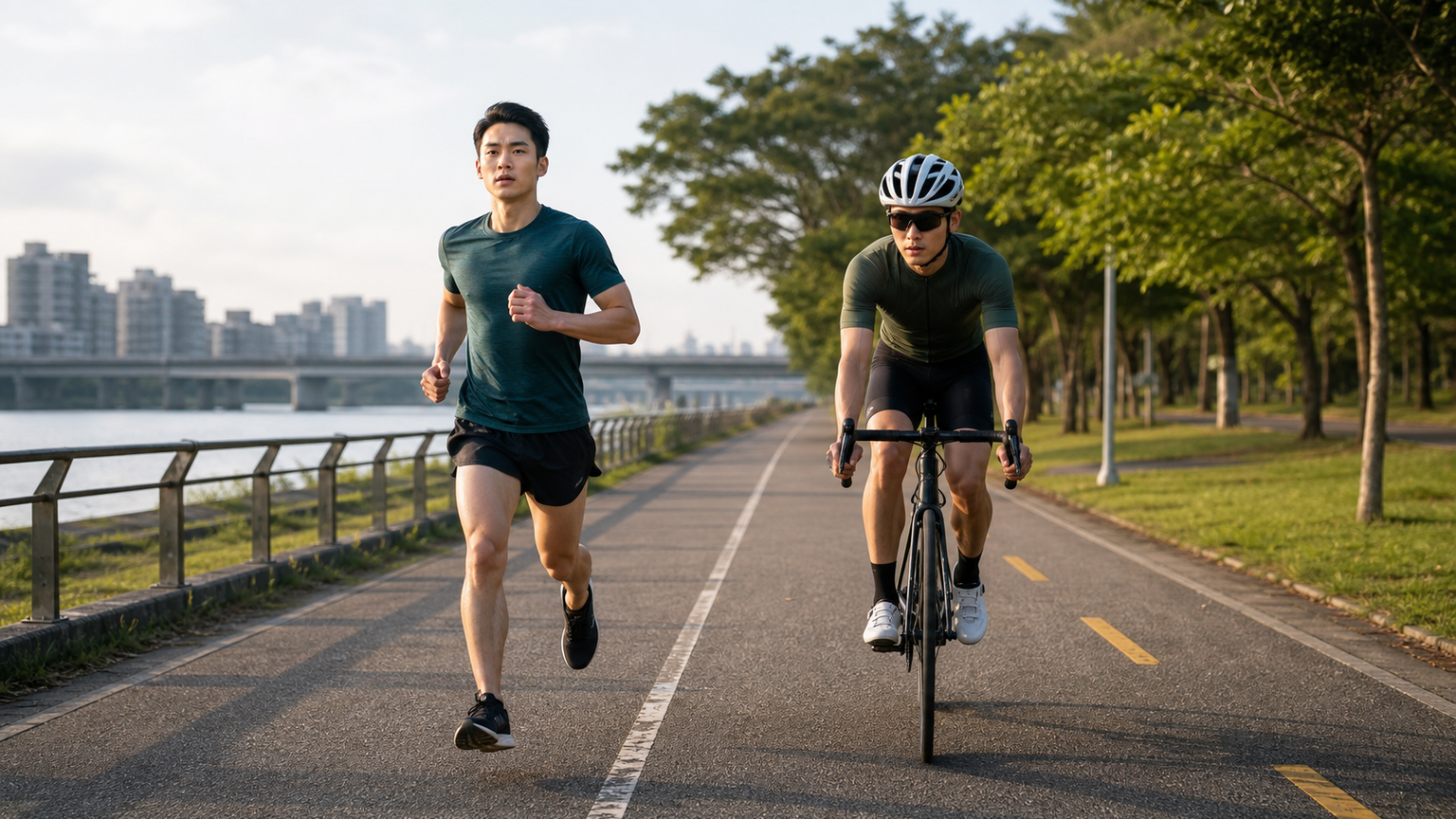
Running vs Cycling: Which Burns Fat More Efficiently
“Should I cycle or run to lose weight?” This question never seems to settle in fitness communities. In truth, the answer isn’t either/or — it depends on your physical condition, goals, and preferences. This article compares the two activities from a scientific perspective.
Calorie Burn: Which Burns More in the Same Time?
Let’s start with the numbers. According to research from Harvard Medical School, for a person weighing 70 kg, the approximate calorie burn for 30 minutes of activity is:
| Activity | Calories Burned in 30 Minutes (70kg) |
|---|---|
| Running (8 km/h) | About 295 kcal |
| Running (11 km/h) | About 372 kcal |
| Cycling (16–19 km/h, easy) | About 260 kcal |
| Cycling (25–30 km/h, moderate) | About 372 kcal |
| Cycling (32+ km/h, vigorous) | About 465 kcal |
Conclusion: At the same intensity level, cycling and running burn a similar number of calories. But when compared at the same speed (km/h), running burns more calories because it requires supporting your own body weight.
Joint Impact: Which Is Harder on the Knees?
This is a key consideration for many people choosing an exercise, especially those who are overweight or have knee issues.
The Impact Force of Running
Running is a classic “high-impact” exercise. With every stride, the knees absorb an impact force of roughly 3 to 5 times body weight. For a 70 kg person, that’s about 210–350 kg of force per step. Running 5 km involves roughly 5,000 steps, meaning the knees absorb millions of kilograms of cumulative impact.
This doesn’t mean running will necessarily damage your knees, but caution is warranted for:
- People with a BMI over 28
- Those with a history of degenerative knee arthritis
- Those with IT Band Syndrome (iliotibial band syndrome)
The Low-Impact Nature of Cycling
Cycling is practically synonymous with “low-impact” exercise. While cycling, body weight is supported jointly by the saddle and pedals, so the knees bear only about 1.3 to 1.5 times body weight — far less than running.
This makes cycling an ideal choice for:
- Beginners who are overweight starting aerobic exercise
- Patients recovering from knee surgery
- Low-intensity exercise for older adults
- Alternative training after a running injury
Muscle Engagement: Which Muscles Does Each Exercise Work?
| Muscle Group | Running Intensity | Cycling Intensity |
|---|---|---|
| Quadriceps (front of thigh) | Moderate | Heavily used |
| Hamstrings (back of thigh) | Heavily used | Moderate |
| Gluteus maximus | Heavily used | Heavily used |
| Calves (gastrocnemius) | Heavily used | Moderate |
| Core muscles | Moderate | Moderate |
| Upper body (shoulders, back) | Low | Moderate (forward-leaning posture) |
Running recruits the glutes and hamstrings more fully, while also working the calves through the push-off. Cycling provides deeper stimulation to the quadriceps, and the repetitive knee flexion-extension motion also helps strengthen the front of the thighs.
Improving Aerobic Fitness (VO₂ max)
Both activities effectively improve VO₂ max, the most important indicator of cardiorespiratory endurance.
Research shows:
- At equal training volume, running tends to improve VO₂ max slightly more efficiently, because it engages a broader range of muscle groups throughout the body
- However, because cycling carries a lower injury risk, it can be sustained for longer training durations and frequency, and the cumulative effect may end up comparable or even better
Practical Considerations for Taiwan’s Climate
Taiwan’s hot, humid summers present a major challenge for outdoor exercise:
- Running: Outdoor running in summer carries a high risk of heatstroke; extra caution is needed when temperatures exceed 32°C
- Cycling: The wind generated by speed provides effective cooling, making cycling more comfortable than running at the same temperature
- Indoor options: Treadmill vs. indoor trainer — both can solve the weather problem
Psychological Factors: Which Is Easier to Stick With?
This may be the most important yet most overlooked factor. An exercise you can stick with long-term is far better than a “superior” exercise you abandon after two weeks.
- Advantages of cycling: Social — you can ride with friends; scenic views; adjustable intensity from very easy to extremely intense; Taiwan has a rich cycling route culture (round-island trips, Wuling)
- Advantages of running: Simple gear with no maintenance required; can be done anytime, anywhere; low barrier to entry
The Best Answer: Cross-Training
For most people, the best strategy is cross-training — combining the benefits of both activities:
- Cycle 2–3 times per week (cardio training, fat burning)
- Run 1–2 times per week (maintain impact adaptation in the legs)
- Reduce injuries caused by overusing a single exercise pattern
Advice for Those with Weight Loss Goals
If your primary goal is weight loss:
- Choose the exercise you’re more likely to stick with
- Cycling 6–8 hours per week or running 4–5 hours per week produce similar results
- The importance of diet control far outweighs which exercise you choose
- Track your data (distance, time, heart rate) — you need a target to stay motivated
There’s no absolute winner between running and cycling. What truly matters is: which one you choose, and whether you actually do it.
Related Reading
- Comparing the Cardio Training Effects of Cycling vs Running
- Cycling and Weight Loss: The Right Mindset and Real Results of Losing Weight by Cycling
- Cross-Training Between Running and Cycling: How to Balance Both Without Getting Injured
- Swimming vs Running vs Cycling: Which Exercise Is Best for Middle-Aged People
靠單車減肥35公斤 心得分享與整理
7 年前
2016/4/20 - 中社路 夜騎 半年甩肉14KG 後測
10 年前
#公路車 #Fitting 靠人工智慧APP 幫你調整單車
6 年前
Fitting訓練兩用功率車 ! Thinkrider ST900 完整實測!/ 坡度升降 / 鄰居測試/ smart bike/公路車/ CT Yeh
2 年前
大家都在開箱的...單車用藍芽對講耳機真的有幫助嗎? SENA BiKom 20 長距離旅遊 & 海鷗繞圈賽 實際體驗心得 / 公路車 / CT Yeh
9 個月前
如果Pogačar騎西進武嶺可以多快?會破2嗎?各種情況深度推估探討 / 公路車 / CT Yeh
2 年前
台北大雁西飛 約騎挑戰 feat. Doris | 公路車 | CT Yeh
3 年前
爬陡坡被爆胎的車友跑步超車 #cycling #里佳部落
9 個月前