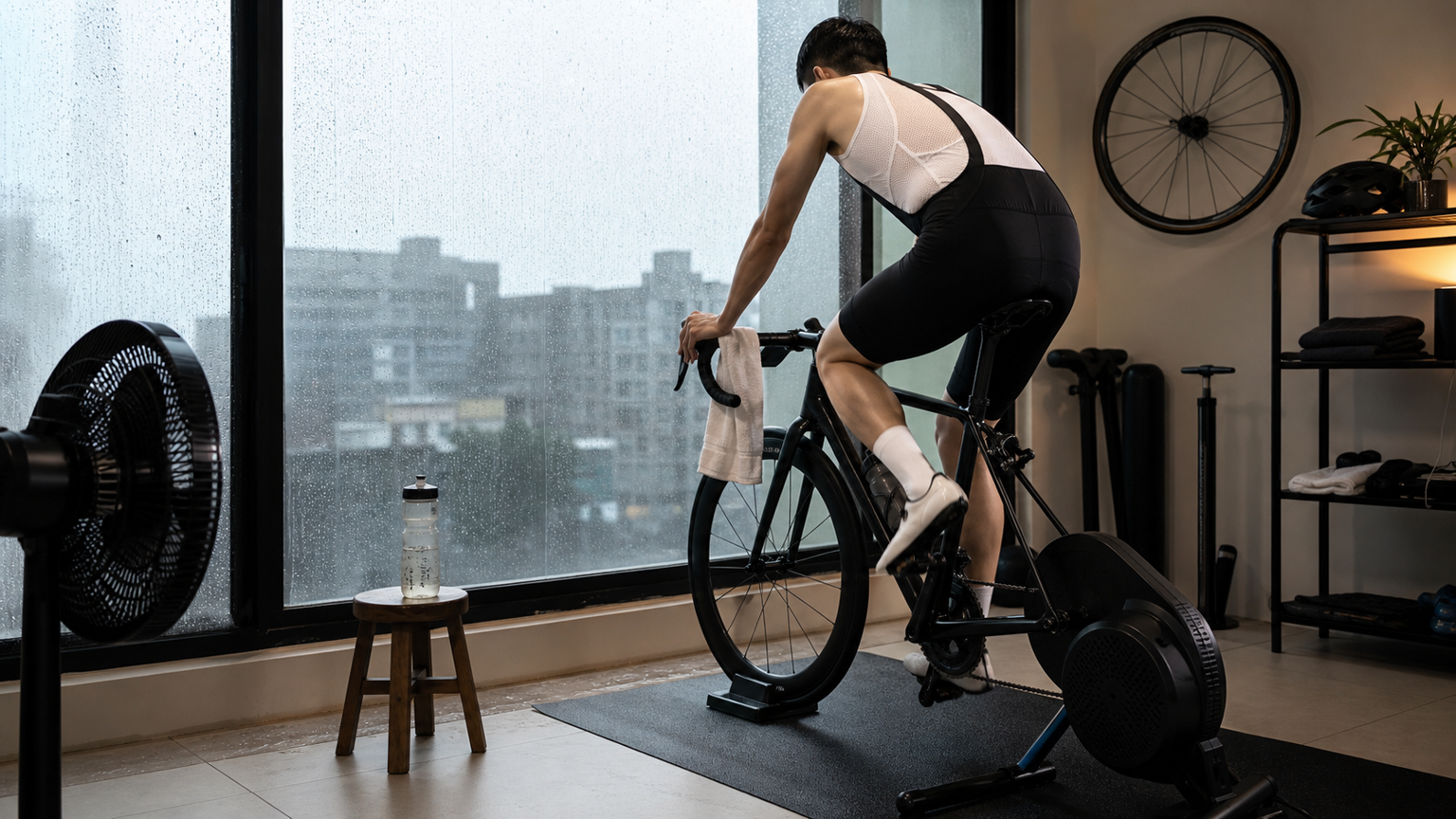
How to Maintain Training During Typhoon Season: Tips for Using Indoor Trainers
Taiwan’s typhoon season (June–October) and plum rain season (May–June) together account for nearly half the year. For cyclists who train regularly, maintaining training quality during bad weather is a very practical concern. Indoor trainers (Indoor Trainer / Smart Trainer) have become indispensable equipment for Taiwanese cyclists.
Types of Indoor Trainers
1. Roller Trainer
Roller trainers are the most traditional type. The bike is placed directly on three rollers and ridden without being fixed in place.
Advantages:
- Trains balance, with a natural and smooth riding posture
- Suitable for recovery rides and technique training
- Protects the wheels, no need to remove the rear wheel
Disadvantages:
- Takes time to get used to at first (easy to drift off)
- Cannot do high-intensity training (too much force causes slipping)
- No smart features (on most models)
Recommended: Elite Arion, Minoura Mag Roller
2. Fixed Rear-Wheel Trainer
The rear wheel is clamped and fixed, with a fork stand supporting the front wheel. This is the most common entry-level option:
Advantages:
- Stable and safe
- Affordable price (NT$3,000–8,000)
Disadvantages:
- Wears out the rear wheel (recommended to switch to a dedicated trainer tire)
- Noisier (magnetic resistance models)
- Not smart, cannot connect to apps
3. Direct Drive Smart Trainer
The rear wheel is removed and the rear axle is connected directly to the trainer’s flywheel. This is the current standard for top-tier indoor training:
Advantages:
- Accurate power measurement (error ±1–2%)
- Can simulate real gradients (ERG mode)
- Low noise
- Seamless connectivity with apps like Zwift, Wahoo, Garmin
Disadvantages:
- Higher price (NT$15,000–45,000)
- Need to confirm thru-axle/skewer compatibility
Recommended: Wahoo KICKR, Tacx Neo, Elite Direto, Saris H3
Smart Trainers and Training Apps
Zwift
Currently the most popular indoor cycling platform, offering a social riding experience in a virtual world:
- Cost: Approximately NT$500–550 per month ($14.99 USD)
- Content: Multiple virtual courses (Watopia, London, New York, etc.)
- Races: Numerous online races daily, allowing you to compete with cyclists worldwide
- Training Plans: Built-in structured training plans
Wahoo RGT / TrainerRoad
- TrainerRoad: Power-based, scientific training plans, suitable for cyclists with clear training goals
- Cost: Approximately NT$500 per month ($19.99 USD)
Garmin Connect / Tacx APP
- Free or lower-cost options
- Basic training logging and guidance
Effective Indoor Training Plans
The biggest advantage of indoor training is that “every minute counts.” Unlike outdoor riding, which has downtime from downhill coasting or waiting at red lights, indoor training can be designed as purely high-quality training time.
A 60-Minute Training Template for Typhoon Days
Prerequisite: Assumes the use of a smart trainer with power data
| Segment | Time | Intensity | Description |
|---|---|---|---|
| Warm-up | 0–10 min | 50–60% FTP | Low-intensity spinning, heart rate rises gradually |
| Main Set A | 10–30 min | 88–93% FTP | Sweet Spot training, steady-state aerobic |
| Main Set B | 30–50 min | 4 × 2 min intervals | 120% FTP, 1 min recovery between intervals |
| Cool-down | 50–60 min | 50% FTP | Recovery spinning |
FTP Note: FTP (Functional Threshold Power) is the maximum power you can sustain for 1 hour, often estimated as 95% of a 20-minute test.
Common Indoor Training Mistakes
- No ventilation: Indoor training causes heavy sweating; you must use a fan (a large industrial fan is recommended)
- Intensity too low: Indoor training cannot be approached with a “casual spin” mindset; you need clear training goals
- No floor protection: Sweat is corrosive to both floors and the bike frame; a trainer-specific mat is needed
- Overtraining: Multiple consecutive days of indoor training during bad weather—intensity is higher than outdoors, so fatigue accumulates faster
Setting Up Your Indoor Training Environment
Essential Equipment
- Large fan: Heat dissipation is the most important thing for indoor training. Outdoor riding relies on the wind from speed; indoors, you can only rely on a fan
- Trainer mat: Protects the floor and absorbs vibration and sweat
- Sweat towel: Hang it on the handlebars to prevent sweat from dripping onto the drivetrain
- Bottle cage: Ensure easy hydration access
- Entertainment: Phone mount or TV, paired with Zwift or YouTube to keep training from getting boring
Ideal Space Dimensions
- Length: at least 2 meters
- Width: at least 1.2 meters
- Height: at least 2.1 meters (accounting for movement when pumping tires)
Recovery Plan After the Typhoon Passes
Things to note when returning to outdoor riding after a typhoon:
- Check road conditions: Roads may have rockslides, standing water, or fallen branches after a typhoon; confirm conditions before heading out
- Body recovery: If indoor training intensity was high during the typhoon, your body may already be fatigued; start with an easy ride
- Bike maintenance: The bike has been sitting during indoor training; check tire pressure and brakes before heading out
Indoor trainers are no longer just a “last resort” for bad weather. Many top cyclists even believe indoor training is more efficient than riding outdoors. Make the most of typhoon season and turn indoor training into your secret weapon for improvement.
Related Reading
- Indoor Alternative Training Plans for Typhoon Season: Don’t Let Bad Weather Be an Excuse
- Bike Trainers: Training Effects of Rollers, Smart Trainers, and Direct Drive Trainers
- Installation and Maintenance of Bike Trainers: Rollers and Direct Drive
- 6-Week Quick Indoor Trainer Plan: Maximizing Time for Office Workers
訓練台體驗) 2019台北自行車展 三大家 訓練台體驗 Tacx Neo Flux 2 Xepdo Apx Wahoo Kickr
7 年前
沉浸室內單車練功房開箱! 100吋大畫面,最便宜的花費? 居然還能K歌!? | 公路車 | CT Yeh
3 年前
ThinkRider 智騎 XXPRO 訓練台,高階機種功能 只要 1/3價格!? 實測功率對比、噪音實測 / 公路車 / CT Yeh
1 年前
實景訓練台) 彰化經典百K 高強度喵團 90分鐘 跟著一起練功 2019 Indoor workout Changhua Classic 100 Taiwan
7 年前
碟煞公路車 銑面器 !? 原來銑完差這麼多! 降低蹭碟機率! | TIME 公路車 保養小記錄 | CT Yeh
3 年前
一日北高前的西濱集訓 | 跟著11小時軍團 | 300W踩不動的大逆風 | 輪車破風差幾瓦?
6 年前
風櫃嘴時間 預測西進武嶺時間?13000名車友統計數據分析告訴你 !
5 年前
Zwift 元宇宙單車世界 如何與全世界同步騎車運動
6 年前