Road Bike Upgrade Order for Beginners: Which Part to Change First for the Biggest Difference
Many riders start thinking about “upgrades” soon after buying their first road bike. But get the priority wrong, and you can spend a lot of money without feeling much improvement. Get it right, and the same budget can bring a noticeable boost to your riding. This article ranks the most cost-effective upgrade order, centered on “value for money.”
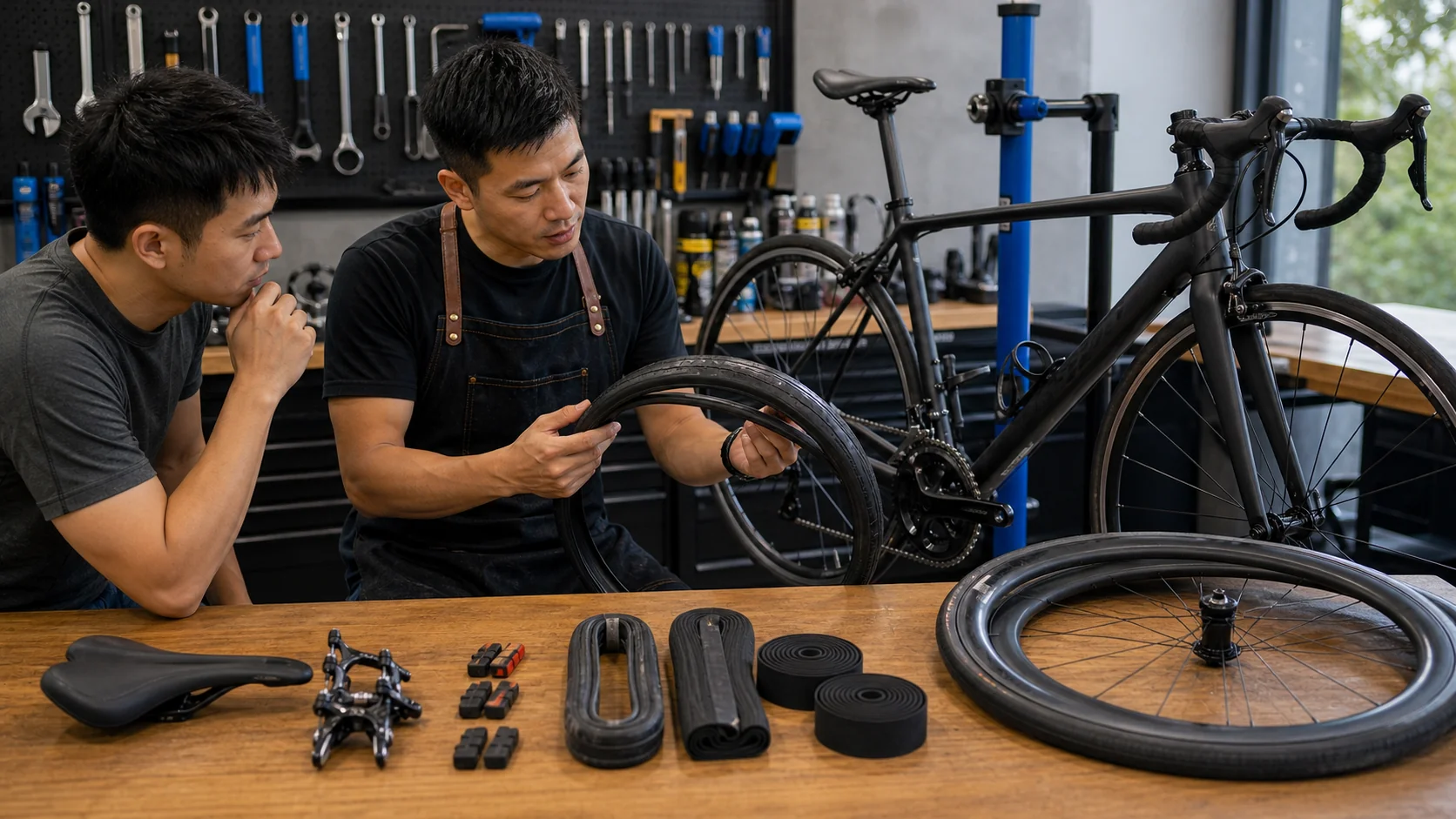
Core Thinking Before You Upgrade
First question: Where is your bottleneck?
Before upgrading any part, ask yourself: is it the bike itself holding you back, or is it your riding technique and fitness? In most cases, time spent training is more effective than money spent upgrading.
Second question: How much are you actually riding?
Riders who cover less than 100 km per week usually don’t need high-end parts. The performance advantage of premium components only shows up once you’re riding enough volume to feel it.
Component Upgrade Ranked by Value for Money
Top Priority: Wheelset (the most noticeable upgrade)
Why should the wheelset come first?
The wheelset carries the most concentrated rotating mass on a bicycle. The effect of rotating mass is far greater than static mass — shaving the same 100g off a wheelset feels 3–5 times more noticeable than shaving it off the frame.
The wheelset also directly affects:
- Acceleration feel on climbs
- Road vibration transmission (comfort)
- Overall rolling efficiency
Recommended upgrade targets:
| Budget | Recommended choice | Characteristics |
|---|---|---|
| NT$8,000–15,000 | Mid-range alloy wheelset | Noticeably lighter and rolls more smoothly than entry-level wheels |
| NT$15,000–30,000 | Entry-level carbon wheelset | Significant weight reduction, increased stiffness |
| NT$30,000–80,000 | Brand-name carbon wheelset (Zipp, Roval) | Aerodynamic performance and ultra-light weight |
Recommended entry-level carbon wheelsets: DT Swiss E 1800, Giant SLR 2 (Giant’s own OEM pairing), Fulcrum Racing 5
Second Priority: Tires (the best value for money)
Why do tires offer the best value for money?
Tires are the only component that directly touches the ground, so their effect on ride feel is immediate. The improvement from a good set of race tires (NT$1,000–3,000) is often surprising.
| Upgrade aspect | Description |
|---|---|
| Rolling resistance | Good tires can have 15–25% lower rolling resistance than entry-level tires |
| Grip | Cornering confidence increases significantly |
| Comfort | Good tires absorb road vibration better through their rebound properties |
| Weight | Entry-level tires: 250–300g; race tires: 180–220g |
Recommended tires: Continental Grand Prix 5000 (the top road pick), Vittoria Corsa, Pirelli P Zero
Tire pressure recommendation: Higher is not always better! Taiwan’s road surfaces vary in quality, so:
- Under 60kg body weight: front 85–90 psi, rear 90–95 psi
- 60–75kg body weight: front 90–95 psi, rear 95–100 psi
- Over 75kg body weight: front 95–100 psi, rear 100–105 psi
Third Priority: Saddle (the key to comfort)
The saddle doesn’t affect speed — it affects whether you can ride comfortably for a long time, which actually matters more than speed.
Everyone’s pelvic shape and soft tissue anatomy differ, so there’s no “best saddle,” only “the saddle that best fits you.”
Selection steps:
- Go to a bike shop and use a sit-bone measuring tool to find your sit-bone width
- Choose a saddle 20–25mm wider than your sit-bone width
- Choose a model with a center cutout (pressure-relief design)
- Test ride for 2–3 weeks — saddles need an adjustment period
Recommended brands: Specialized Power, Fizik Aliante, Selle Italia SLR
Fourth Priority: Handlebar and Stem (riding position adjustment)
If you experience neck, wrist, or back discomfort, adjusting the handlebar and stem can be more effective than any component upgrade.
Common adjustments:
- Stem length: Affects reach to the bars and upper body lean angle — even a 10mm difference is noticeable
- Stem height: Adding spacers raises the position for a more upright (comfortable) posture; lowering it creates a more aggressive (aerodynamic) posture
- Handlebar width: Should be close to shoulder width — too wide hurts aerodynamics, too narrow restricts breathing
Fifth Priority: Brakes (a safety upgrade)
If your bike has entry-level caliper brakes and they’re more than 2–3 years old, upgrading to higher-quality calipers or switching to disc brakes can significantly improve braking feel and safety.
Especially recommended: Shimano 105 or Ultegra-level brakes feel noticeably better than entry-level Claris/Sora.
Upgrades That Are Not Worth Prioritizing
Groupset
Many people first think about upgrading from Shimano 105 → Ultegra → Dura-Ace, but this is one of the lowest value-for-money upgrades:
- The functional difference between entry-level Claris/Sora and Ultegra isn’t obvious for most riders
- Top-tier Dura-Ace is only about 400–600g lighter than 105, but costs 4–6 times more
- That same 400g weight difference can be achieved on the wheelset for far less money
Frame
The frame is the most expensive single component on the whole bike, but the feel of a “lighter frame” is, in most cases, far less noticeable than a wheelset upgrade. Instead of replacing the frame, put the same budget toward wheels and training.
Practical Upgrade Path by Budget
Budget NT$3,000–5,000: Prioritize tires first (a pair of race tires costs NT$2,000–4,000)
Budget NT$10,000–15,000: Tires + saddle replacement
Budget NT$20,000–30,000: Mid-range alloy or entry-level carbon wheelset
Budget NT$50,000+: Consider a brand-name carbon wheelset, or upgrade to a higher-tier bike altogether
The best upgrade is the one that makes you want to go ride more. Find the real bottleneck holding back your riding, then invest with purpose.
Related Reading
- The Most Worthwhile Bicycle Upgrades: Spend Your Money Where It Counts
- The Complete Wheelset Upgrade Strategy: A Roadmap from Entry-Level to Top-Tier
- Bicycle Wheelset Upgrade Value Analysis: Weighing Deep-Section Rims, Weight, and Resistance
- The Complete Road Bike Wheelset Upgrade Guide: Alloy vs. Carbon Fiber Wheelsets
公路車 BB培林大升級! / 備戰海鷗繞圈賽 Canyon Aerod & TIME 一起改 / MIT大廠 CEMA對鎖式陶瓷培林BB & 導輪 / 公路車 / CT Yeh
2 年前
碟煞公路車 優缺點?換車一年半實際經驗分享 / 公路車 / CT Yeh
2 年前
再一組! 全碳幅條 碟煞/無內胎輪組 開箱! 到底好騎嗎? UNAAS X40 | 公路車 | CT Yeh
4 年前
鉅齒紋輪組!? ControlTech MEG-T50 EVO 碳纖維幅條輪組/ 功率對比實驗 / 公路車 / CT Yeh
2 年前
來都來了!改好改滿 / CS大導輪 + BB 可以省幾瓦? / 同場加映 TIME XPRO卡踏 / #公路車 #ceramicspeed / CT Yeh
1 年前
碟煞公路車 銑面器 !? 原來銑完差這麼多! 降低蹭碟機率! | TIME 公路車 保養小記錄 | CT Yeh
3 年前
CT新輪組測試中 #cycling #公路車
2 年前
多到選擇障礙... 換個單車把帶想一個小時 / BTP / 編織&軟木特有材質超吸睛! / 公路車 / CT Yeh
1 年前