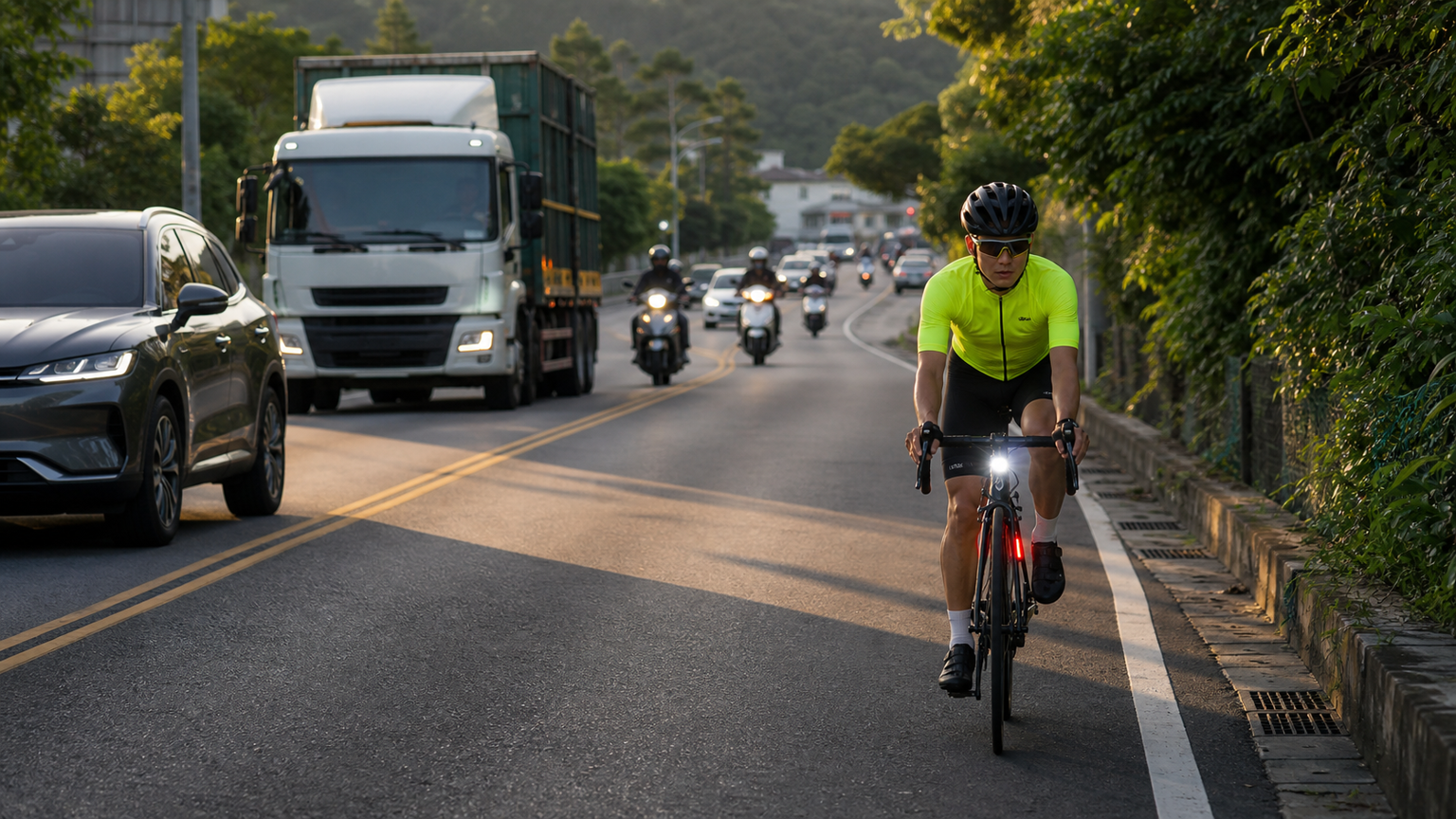
Cycling Traffic Safety: Correct Riding Behavior on Taiwan’s Roads
Taiwan’s road cycling enthusiasts face a unique challenge: sharing the road with scooters, cars, and heavy trucks in one of the highest scooter-density regions in the world. This requires specific knowledge and skills to ensure safety while enjoying the ride.
The Unique Risks of Taiwan’s Roads
Conflict Points with Scooter Culture
Taiwan has over 14 million scooters, and several common conflict scenarios arise with cyclists on the road:
- Scooters cutting right (turning right): Scooters often cut quickly to the roadside to turn right at the last moment, which is dangerous if a cyclist is in their blind spot
- Car door opening (Dooring): A parked vehicle’s door suddenly opening is a major threat to road bikes
- Riding on the shoulder: Many roads in Taiwan lack dedicated space for bicycles, and shoulder conditions vary
- Blind spots of large vehicles: Cement mixers and heavy trucks may not see cyclists beside them when turning
Road Quality Issues
- Gaps in drainage grates can catch narrow road bike tires
- Height differences at transitions between different pavement materials
- Sand and gravel on construction road surfaces
- Debris from rockslides and mudflows after typhoons
The Legal Framework for Taiwan’s Roads
Cyclists’ Rights and Obligations on the Road
According to Taiwan’s Road Traffic Management and Penalty Act:
| Situation | Regulation |
|---|---|
| Cyclist’s position on the road | Must ride on the right; if a bike lane exists, must use it |
| Riding side by side | Riding side by side is prohibited (only allowed with caution) |
| Traffic signals | All traffic signals must be obeyed |
| Headlights | Lights must be turned on when riding at night |
| Riding under the influence | Riding after drinking is prohibited (same standards as scooters) |
Key Insight: Even though cyclists have legal rights on the road, the decisive difference in physical protection in the event of a collision means that being “in the right” does not equal being “safe.”
Core Safety Principles
1. Visibility Management
Making yourself as visible as possible is the most important of all safety measures:
Clothing:
- Avoid all-black or dark-colored cycling kits (especially at dawn, dusk, or in tunnels)
- Choose fluorescent-colored (yellow, orange, bright green) jerseys
- Reflective strips are especially important at night
Lights:
- Front light (white): Recommended to use flashing mode even during the day
- Rear light (red): Must be turned on in any low-light condition
- Tunnels: Lights must be on, both front and rear, and steady mode (rather than flashing) is recommended
2. Predictability
Let other road users anticipate your movements:
- Maintain a steady riding line: Do not weave side to side
- Signal early: Signal 3–5 seconds before turning; do not change lanes suddenly
- Avoid sudden hard braking: Unless in an emergency, give vehicles behind you time to react
- Check behind you before stopping at the roadside: Confirm no vehicles are approaching before getting off your bike
3. Defensive Riding
Defensive riding is not cowardice; it is a professional attitude:
Anticipating danger:
- When seeing a parked vehicle ahead, assume the door may open
- When passing an intersection, assume a scooter may run out without slowing down
- Slow down near supermarket and convenience store entrances
Safe distances:
- Maintain at least a 1–1.5 meter “door zone clearance” from parked vehicles
- Keep sufficient braking distance from the vehicle ahead
- Maintain a greater distance beside oversized vehicles (cement mixers, tractor-trailers), and avoid lingering in their blind spots
4. Intersection Safety
Traffic accidents in Taiwan most often occur at intersections:
- Look before starting on green: Confirm that traffic from other directions has stopped before proceeding
- Yellow and red lights: Obey them strictly; running a red light on a bicycle has no justification, legally or morally
- Right-turning scooters: Pay special attention to the movement of scooters on your right when passing through intersections
Safety Rules for Group Rides
Weekend morning rides with Taiwan cycling clubs are a very common activity, but group riding has its own specific safety considerations:
Formation Management
- General roads: Maximum two abreast; ride single file when vehicle speeds are high
- Mountain roads: Ride single file to ensure oncoming vehicles have enough space
- Front-to-back spacing: Maintain approximately 30–50 cm between wheels (not too close); keep 1–2 meters if riders are unfamiliar with each other
Communication System
Cyclists use a set of hand signals:
| Signal | Meaning |
|---|---|
| Left hand pointing left behind the back | Turn left |
| Right hand pointing right behind the back | Turn right |
| Left hand waving downward | Slow down / hazard |
| Left hand extended outward behind the back | Road obstacle (on the left) |
| Right hand extended outward behind the back | Road obstacle (on the right) |
Handling Taiwan’s Special Road Conditions
Mountain Riding
- Descents: Do not exceed the speed your braking ability can control; Taiwan’s mountain roads have many sharp curves
- Road damage: Rockslides may occur on mountain roads after typhoons; the first riders on the road need to be especially cautious
- Construction vehicles: Construction vehicles are common on mountain roads; check that no oncoming traffic is approaching before overtaking
Coastal Routes
- Crosswinds: Strong crosswinds along the Northeast Coast can affect bike stability; reduce speed
- Sandy surfaces: Coastal sections may have loose sand scattered on the road, reducing traction
Riding safely on Taiwan’s roads requires more than just skill; it requires a sense of responsibility for coexisting with all road users. Getting home safely every time is something both you and your family deserve.
Related Reading
高雄綠園道鐵路自行車道 / 外地人能輕鬆駕馭 還是整路崩潰? / 2025 全線開通 春節實地探索一次!(附GPS連結)/ 公路車 / CT Yeh
1 年前
「悲情男車友」創作單曲 爆笑MV / 公路車 / CT Yeh / 4K劇情版
7 個月前
虎豹潭!日本老師來台一日約騎 台灣車友熱情招待私房路線 / CT Yeh
21 天前
台中大雪山 膏王領騎 震到都沒畫面了 公路車
5 年前
2024 如來神掌 百人約騎挑戰!feat. 秘境單車社團 / 神人們太可怕 / 全程錄影 x 完整坡度解析 / 公路車 / CT Yeh
2 年前
風櫃嘴 | 全台最多大砲的單車路線 | 尋寶網攝影師告訴你怎麼擺拍起來才好看 | 熱門攝影地點巡禮
6 年前
一日北高常見問題大集合 | 攻略 | 路線 | 訓練 | 補給 | 自行車 單車 | 一日雙城 | 雙塔 | TWB北高360 | 屁股痛
6 年前
一日北高/長距離團騎 常見問題補充篇 / 組團或跟團的眉角 / 壯車友容易被瘦車友慢性拉爆 / 原來屁股痛可能是這個原因...? / 風場配速法 / 公路車 / CT Yeh
2 年前