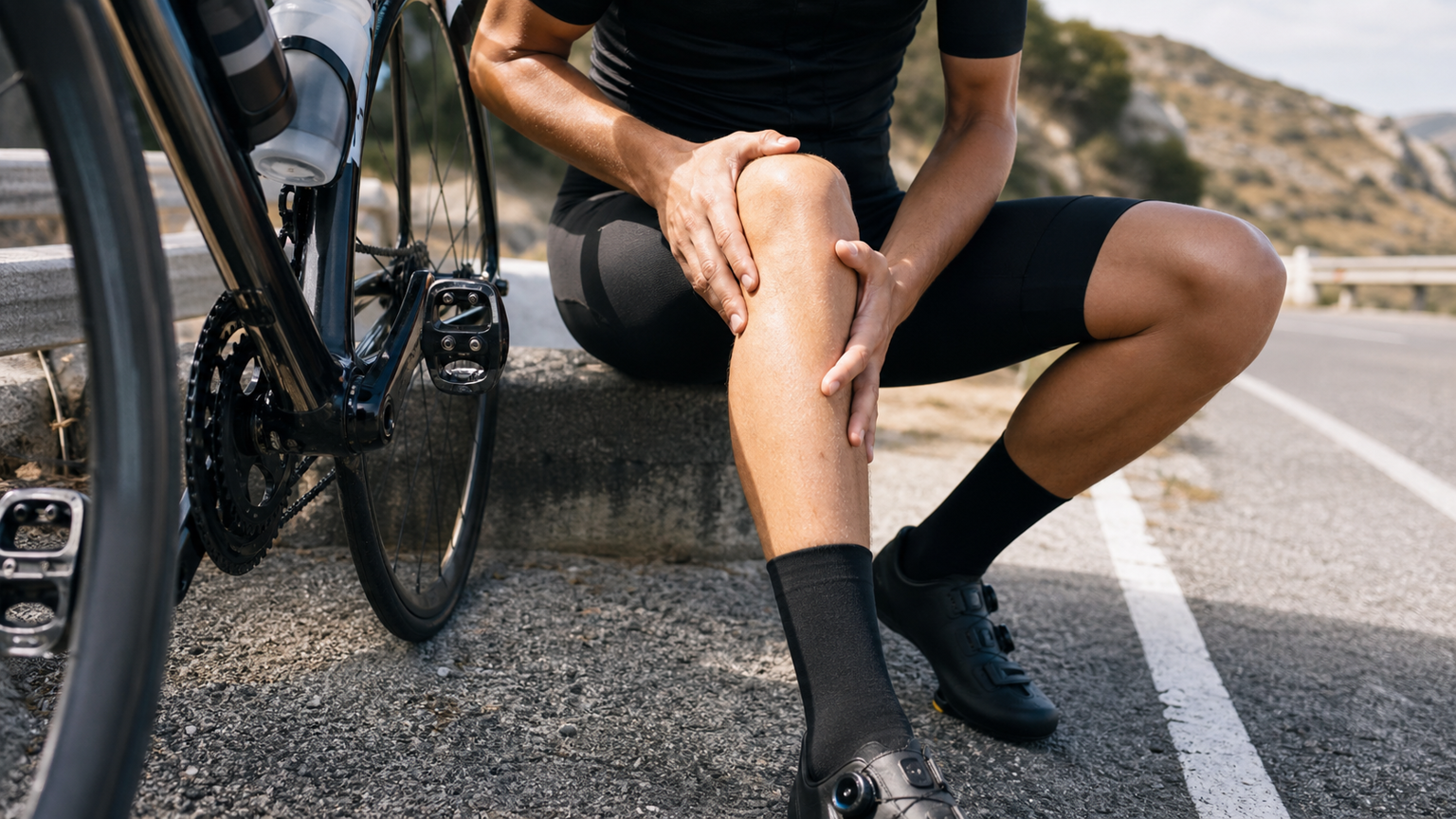
Cyclists’ Knee Protection: Knee Joint Anatomy and Common Injury Mechanisms
Introduction to Knee Joint Anatomy
The knee joint is one of the most complex joints in the human body, composed of the femur (thigh bone), tibia (shin bone), and patella (kneecap). While cycling, the knee joint flexes and extends an average of about 5,000 times per hour, meaning a single 3-hour ride involves as many as 15,000 knee cycles. This is exactly why knee pain is the most common problem among cyclists.
The main structures of the knee joint:
- Meniscus: The cushioning cartilage between the femur and tibia
- Anterior and posterior cruciate ligaments (ACL/PCL): Stabilize the joint
- Medial and lateral collateral ligaments (MCL/LCL): Prevent sideways movement
- Patellar tendon: Connects the quadriceps to the tibia
- IT band (iliotibial band): A thick band of fascia running along the outside of the thigh down to the lateral side of the knee
The Most Common Knee Injuries Among Cyclists
1. Patellofemoral Syndrome
Commonly known as “cyclist’s knee,” this is the most common type of knee pain from cycling.
Symptoms: A dull ache at the front of the knee (behind the kneecap), which worsens when climbing or mashing hard gears.
Main causes:
- Saddle set too low (excessive knee flexion angle)
- Overpronation of the foot, causing patellar tracking misalignment
- Insufficient or imbalanced quadriceps strength (especially the VMO, the medial part of the quadriceps)
- Cadence too low (mashing a big gear)
The golden formula for saddle height to prevent cyclist’s knee:
Saddle height (from bottom bracket to top of saddle) = Leg length (from floor to greater trochanter of the femur) × 0.883
Alternatively, with the heel placed on the pedal at the bottom of the stroke, the knee should fully extend without hyperextending.
2. IT Band Syndrome
Symptoms: A sharp pain on the outside of the knee (at the lateral femoral condyle), most painful at a specific angle during the pedal stroke (around 30-40 degrees of flexion).
Main causes:
- Saddle set too high (excessive leg extension, causing repeated friction of the IT band)
- Knees splaying outward excessively while pedaling
- Insufficient strength in the gluteus medius and gluteus maximus
- Rapidly increasing training volume
3. Patellar Tendinitis
Symptoms: Localized tenderness below the kneecap (at the patellar tendon attachment point), with pain when standing up from a seated position or squatting.
Main causes:
- Cadence too low, using an overly heavy gear
- Too high a proportion of climbing
- Overly tight quadriceps
4. Pes Anserine Bursitis
Symptoms: Tenderness below the inside of the knee, often misdiagnosed as a meniscus problem.
Main causes:
- Knee valgus (knees caving inward) while riding
- Collapsed arches
- Saddle set too low
Quick Diagnosis by Pain Location
| Pain Location | Most Likely Diagnosis | Main Cause |
|---|---|---|
| Front of knee (behind kneecap) | Patellofemoral syndrome | Saddle too low, overpronation |
| Outside of knee | IT band syndrome | Saddle too high, weak glutes |
| Below the knee | Patellar tendinitis | Overly heavy gear, low cadence |
| Inside of knee | Pes anserine bursitis | Knee valgus, collapsed arches |
| Back of knee | Popliteus issues, cysts | Saddle too high |
Bike Fit Is the Key
Research estimates that up to 85% of cycling-related knee pain can be improved or resolved through a proper bike fit. Here are the key setup parameters:
Saddle Height
- The maximum knee flexion angle should be about 25-35 degrees at the bottom of the pedal stroke (6 o’clock position)
- Use a goniometer or an app (such as Bike Fast Fit) to measure
Saddle Fore-Aft Position
- When the pedal is in the horizontal position (3 o’clock position), the front edge of the kneecap should sit directly above the pedal axle (the KOPS principle)
- Saddle too far forward: increased patellar pressure → anterior knee pain
- Saddle too far back: increased load on the popliteus/posterior knee
Cleat Position
- The ball of the foot (first metatarsophalangeal joint) should align with the pedal axle
- A float angle of 4.5-6 degrees is recommended, giving the knee room for natural rotation
Treatment and Recovery Strategies
Acute Phase (First 48-72 Hours)
- The POLICE principle: Protection, Optimal Loading, Ice, Compression, Elevation
- Ice for 15-20 minutes each time, 3-4 times per day
- Avoid heat application and massage
Recovery Phase
- Strengthen the quadriceps (especially the VMO)
- Strengthen the gluteus medius and gluteus maximus (to control knee tracking)
- Stretch the quadriceps, IT band, and hip flexors
- Return to riding progressively (start with a light gear on flat roads)
Prevention Is Better Than Cure
- Re-verify your bike fit every 2,000-3,000 km
- Maintain a cadence of 85-95 RPM, avoiding mashing at too low a cadence
- Warm up thoroughly before climbing
- Perform glute and quadriceps strengthening training twice a week
- Pay attention to insoles: Those with collapsed arches should use corrective insoles
Conclusion
Knee pain from cycling is usually not an unsolvable problem, but rather a “signal” telling you that something needs adjustment. Through proper bike fit, appropriate cadence management, and targeted strength training, the vast majority of cycling-related knee pain can be effectively prevented or treated.
Related Reading
一日北高常見問題大集合 | 攻略 | 路線 | 訓練 | 補給 | 自行車 單車 | 一日雙城 | 雙塔 | TWB北高360 | 屁股痛
6 年前
一日北高/長距離團騎 常見問題補充篇 / 組團或跟團的眉角 / 壯車友容易被瘦車友慢性拉爆 / 原來屁股痛可能是這個原因...? / 風場配速法 / 公路車 / CT Yeh
2 年前
高雄綠園道鐵路自行車道 / 外地人能輕鬆駕馭 還是整路崩潰? / 2025 全線開通 春節實地探索一次!(附GPS連結)/ 公路車 / CT Yeh
1 年前
靠單車減肥35公斤 心得分享與整理
7 年前
Canyon 公路車斷把手 五年老車特規還能修嗎? 維修保養全記錄 feat. 501單車監理站 | 公路車 | CT Yeh
4 年前
超開放的自行車錶!可以玩遊戲裝APP!?/ SRAM合併的 Hammerhead Karoo深入開箱!/ 即時爬坡偵測 / 全球導航地圖 / Garmin Bryton / CT Yeh
1 年前
多到選擇障礙... 換個單車把帶想一個小時 / BTP / 編織&軟木特有材質超吸睛! / 公路車 / CT Yeh
1 年前
碟煞公路車 銑面器 !? 原來銑完差這麼多! 降低蹭碟機率! | TIME 公路車 保養小記錄 | CT Yeh
3 年前