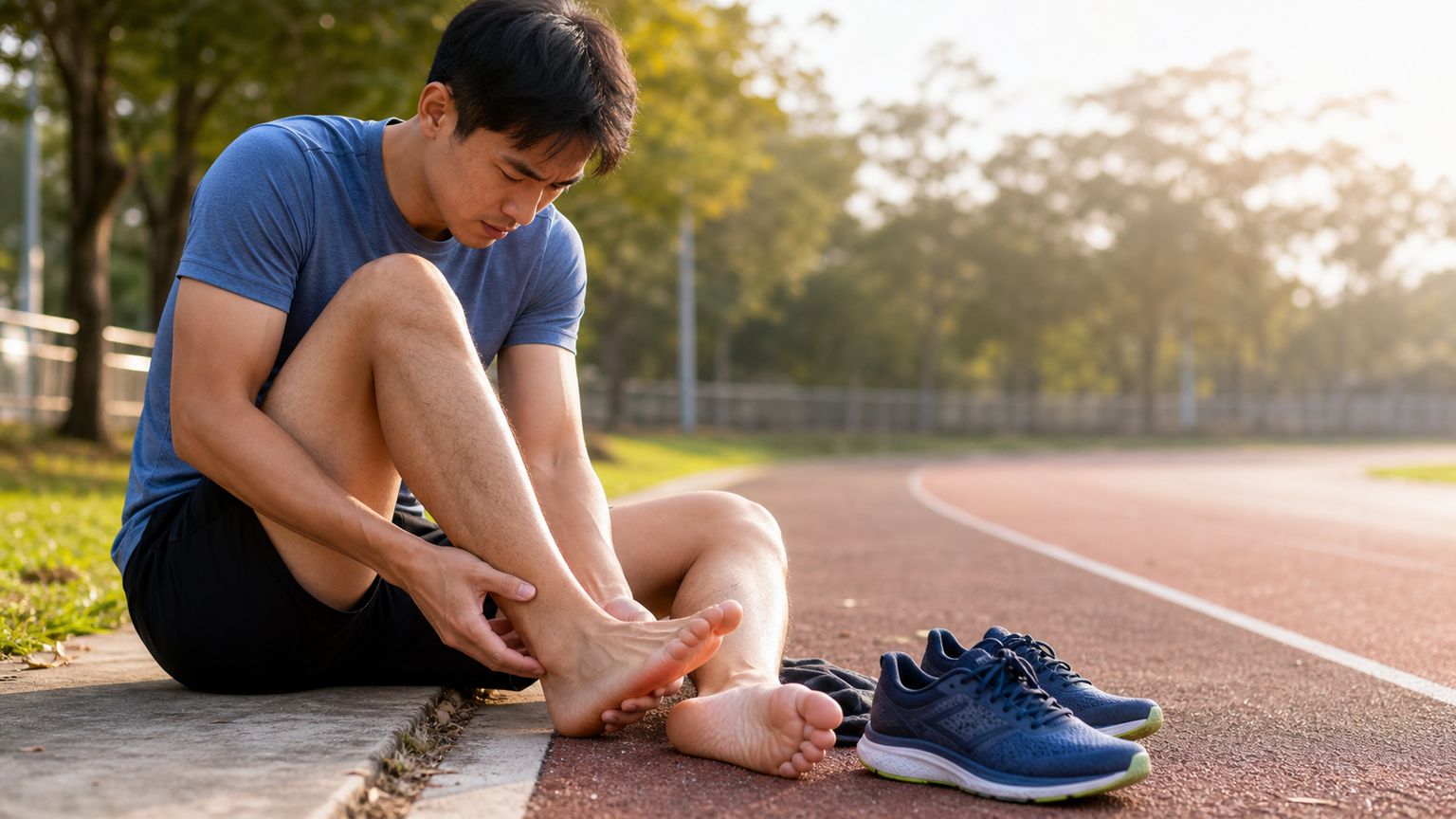
Runner’s Plantar Fasciitis: A Complete Guide to Causes, Treatment, and Prevention
What is Plantar Fasciitis?
Plantar fasciitis is the most common foot injury among runners, accounting for 8-10% of all running injuries. It is a degenerative condition at the heel attachment point of the plantar fascia (the thick band of fibrous tissue connecting the heel to the toes), rather than a simple inflammation.
Typical Symptoms:
- Sharp heel pain when stepping on the ground first thing in the morning (commonly known as “first-step pain”)
- Noticeable pain in the first few steps after prolonged sitting
- Pain worsens after prolonged standing or running
- Pain usually subsides slightly after moving around for a while
- Tenderness on the inner side of the heel (near the arch)
Causes of Plantar Fasciitis
Biomechanical Factors
| Factor | Description |
|---|---|
| Arch problems | Both flat feet (low arches) and high arches increase tension on the fascia |
| Tight Achilles tendon | Restricted ankle dorsiflexion increases fascial load |
| Limited ankle dorsiflexion | Inability to properly absorb impact when running |
| Tight gastrocnemius/soleus muscles | Tightness in the posterior calf muscles affects foot mechanics |
| Weak gluteal and hip muscles | Leads to compensatory loading on the knees and ankles during running |
Training Factors
- Sudden increase in mileage (exceeding the 10% rule)
- Long-term running on hard surfaces (concrete, asphalt)
- Excessively worn or poorly chosen shoes
- Excessive proportion of uphill running
- Weight gain (load on the fascia increases proportionally)
Diagnosis and Severity Grading
Clinical Diagnosis
- Windlass Test: While standing, dorsiflex the big toe upward; if this elicits heel pain, the test is positive
- Heel tenderness point: Localized tenderness at the medial anterior edge of the heel (fascial origin)
- Ultrasound or MRI can be used for confirmation if needed
Severity Grading
| Grade | Symptom Description | Recommended Action |
|---|---|---|
| Mild (Grade 1) | Pain only upon waking in the morning, resolves after activity | Adjust training, increase stretching |
| Moderate (Grade 2) | Pain at the beginning and end of runs | Reduce mileage, pursue active treatment |
| Severe (Grade 3) | Continuous pain throughout the entire run | Stop running, seek medical evaluation |
| Extremely Severe (Grade 4) | Pain even during daily walking | Seek immediate medical attention, stop training |
Treatment Strategies
First-Line Treatment (Conservative Treatment)
90% of plantar fasciitis cases resolve within 6-18 months with conservative treatment.
1. Plantar Fascia Stretching (Most Important!)
Perform the following stretches every morning before getting out of bed and after prolonged sitting:
Plantar Fascia Stretch:
- Sit with the affected foot resting on the opposite knee
- Pull the big toe upward with your hand (toward dorsiflexion)
- Feel the stretch along the arch of the foot
- Hold for 10 seconds, repeat 10 times
- At least 3 times per day
Achilles Tendon Stretch:
- Stand facing a wall, with the affected foot one step back
- Keep the rear heel flat on the ground, feeling the stretch in the back of the calf
- Perform both straight-knee stretch (gastrocnemius) and bent-knee stretch (soleus)
2. Strength Training
- Towel Curls: Place a towel under the foot and use the toes to scrunch it up (trains the intrinsic muscles of the arch)
- Toe Lift: While standing, lift only the big toe (isolation training)
- Single-Leg Calf Raises: Trains eccentric strength of the gastrocnemius and soleus
3. Orthotics
Custom or semi-custom orthotics are particularly effective for those with flat feet, as they redistribute plantar pressure. It is recommended to have an assessment by a podiatrist or physical therapist.
4. Night Splint
Keeping the ankle in 5-10 degrees of dorsiflexion overnight prevents the fascia from shortening during sleep, reducing first-step pain in the morning.
5. Extracorporeal Shock Wave Therapy (ESWT)
For chronic patients who have not responded to conservative treatment for 3-6 months, ESWT has a success rate of approximately 60-80% and is currently one of the most evidence-supported non-surgical treatment options.
Second-Line Treatment
- Corticosteroid Injections: Effective for short-term pain relief, but may weaken the fascia long-term; repeated injections are not recommended (maximum 2-3 times)
- Platelet-Rich Plasma (PRP) Injections: Promotes tissue repair; research results are superior to corticosteroids (on long-term follow-up)
When is Surgery Needed?
Surgery (partial fasciotomy) is only considered if there is no improvement after 9-12 months of conservative treatment. The success rate is approximately 70-80%.
Mileage Adjustment and Return to Training
Mileage recommendations by severity:
| Grade | Mileage Adjustment | Cross-Training |
|---|---|---|
| Mild | Reduce by 30-50%, avoid long distances | Swimming, cycling |
| Moderate | Pause running for 2-4 weeks | Deep-water running, cycling |
| Severe/Extremely Severe | Complete rest from running for at least 4-8 weeks | Swimming, cycling, upper-body training |
Criteria for Returning to Running:
- Pain VAS score ≤ 2/10 during walking or light activity
- Able to perform 25 single-leg calf raises without significant pain
Preventing Plantar Fasciitis Recurrence
- Follow the 10% rule: Do not increase weekly mileage by more than 10%
- Replace running shoes regularly: Every 500-800 km (to avoid excessive midsole compression)
- Stretch the plantar fascia and calves before and after every run
- Avoid walking barefoot on hard surfaces (especially important in the morning)
- Maintain a healthy body weight: For every 1 kg of weight gained, the load on the plantar fascia increases by approximately 3 kg
- Incorporate strength training into your running routine: Particularly gluteal strength and single-leg stability
Conclusion
Although plantar fasciitis can be frustrating, most runners make a full recovery and return to normal training. The key is early diagnosis, proactive conservative treatment, and patience—recovery from this injury typically takes longer than expected. Don’t try to “push through” the pain; instead, rest smartly, treat, and modify your training approach so you can keep running for the long term.
Related Reading
- Prevention and Treatment of Plantar Fasciitis: A Complete Analysis of Runner’s Foot Pain
- The Complete Guide to Plantar Fasciitis: Treatment Strategies and Training Adjustments for the Most Common Foot Injury in Runners
- Plantar Fasciitis: A Complete Guide to Treatment and Prevention for Cyclists and Runners
- Analysis of the Causes of Plantar Fasciitis and a Runner’s Recovery Plan
Never Stop 西進武嶺 前後雙機 完整全程錄影 訓練台 實境
8 年前
一日北高常見問題大集合 | 攻略 | 路線 | 訓練 | 補給 | 自行車 單車 | 一日雙城 | 雙塔 | TWB北高360 | 屁股痛
6 年前
單車 一日北高 ( 雙城 ) 肥宅雙人瘋狂行 紀錄片 REACTO
10 年前
爬陡坡被爆胎的車友跑步超車 #cycling #里佳部落
9 個月前
摔車後補裝備: 好市多新款單車安全帽& Specialized Romin 北高整路屁股都不痛的坐墊 | 一千元居然有MIPS | CT Yeh | 公路車
4 年前
iPhone內建一秒變長腿🤣 車友必備#cycling
2 年前
CT 喇低賽) 武嶺牽車 才是王道 西進牽車四小時內秘訣 攝手位置 如何判斷 防抽筋小秘訣
7 年前
一日北高/長距離團騎 常見問題補充篇 / 組團或跟團的眉角 / 壯車友容易被瘦車友慢性拉爆 / 原來屁股痛可能是這個原因...? / 風場配速法 / 公路車 / CT Yeh
2 年前