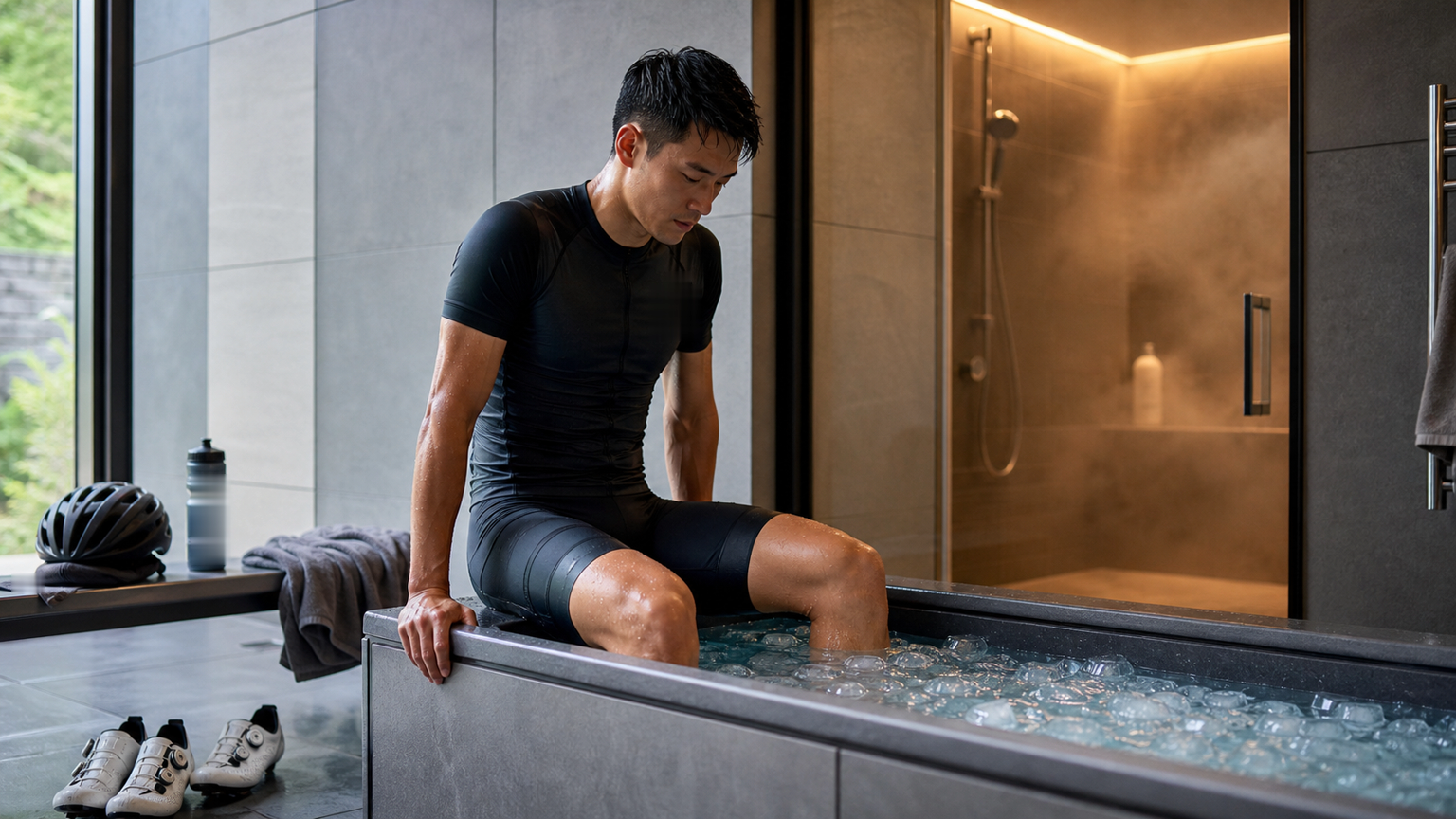
Contrast Water Therapy: Using Ice Baths and Hot Baths for Exercise Recovery
Why Do Athletes Sit in Ice Baths?
You’ve probably seen professional athletes climb into a tub full of ice after competition, wincing in pain but sticking it out until the end. There’s real science behind this. Cold Water Immersion (CWI) is one of the most heavily researched recovery strategies available today, but its effects are more complicated than most people assume.
The Physiology of Cold Water Immersion (CWI)
Acute Physiological Effects
When the body is immersed in cold water (typically 8-15°C), the following changes occur almost immediately:
- Vasoconstriction in the skin and tissue: Peripheral blood vessels constrict rapidly, reducing local blood flow
- Hydrostatic pressure effect: Water pressure (similar to compression garments) helps push tissue fluid back into the veins
- Reduced metabolic rate: Cold slows local cellular metabolism and the speed of inflammatory response
- Slowed nerve conduction: Cold receptors become saturated, “interfering” with pain signal transmission
- Lower core temperature: Speeds the return of core body temperature to normal after heat training
The “Rebound Effect” After Leaving Cold Water
After leaving the cold water, blood vessels dilate again, producing what’s called “reactive hyperemia,” which brings:
- Accelerated clearance of metabolic waste products (lactate, hydrogen ions, cytokines)
- Oxygen and nutrients delivered back to damaged tissue
- Faster circulation of immune cells
Research Evidence on Cold Water Immersion
Well-Supported Benefits
| Benefit | Strength of Evidence | Notes |
|---|---|---|
| Reduced perceived fatigue | Strong | Consistent findings across multiple RCTs |
| Improved perceived muscle soreness (DOMS) | Moderate to strong | Reduces DOMS severity by roughly 20-30% |
| Short-term recovery (24-48 hours) | Moderate | Especially useful for recovery between consecutive competition days |
| Lower core temperature | Strong | Particularly important after heat training |
| Reduced swelling | Moderate | Result of hydrostatic pressure effect |
Debated Benefits
| Question | Research Conclusion |
|---|---|
| Does it accelerate lactate metabolism | Uncertain, research findings are mixed |
| Does it improve objective strength recovery | Effect is limited; subjective improvement outweighs objective measures |
| Is it better than active recovery | Research findings are mixed |
Cold Water Immersion’s Impact on Training Adaptation: The Controversy
This is one of the most important findings in recent years, and also the biggest point of criticism against cold water immersion:
The Problem: Cold water immersion may suppress the long-term adaptations produced by training!
The Mechanism:
- CWI suppresses the post-training inflammatory response
- But this “micro-inflammation” is exactly the signal that triggers training adaptations (muscle hypertrophy, mitochondrial biogenesis, increased oxidative enzymes)
- Excessively suppressing inflammation = reduced adaptive stimulus
Research Evidence:
Multiple studies (including Roberts et al., 2015, published in the Journal of Physiology) have shown that groups performing cold water immersion after every training session had smaller gains in muscle hypertrophy, strength, and aerobic enzyme increases after 12 weeks compared to groups using active recovery.
Practical Conclusions: When to Use It, When Not To
Situations Where Cold Water Immersion Is Appropriate
- Consecutive competition days (such as multi-day races or stage races): Fast recovery within 24-48 hours is needed, and in this case “short-term recovery” takes priority over “long-term adaptation”
- Important competition periods within a season: Fast recovery to prepare for the next event
- After training in hot environments: Effectively lowers core temperature and prevents heat accumulation
- Severe perceived fatigue: Quickly improves how you feel and boosts perceived recovery
Situations Where Cold Water Immersion Is Not Appropriate
- After regular training (outside competition periods): May interfere with long-term training adaptation
- After strength training: Particularly likely to suppress the training adaptations responsible for muscle hypertrophy
- After a new training stimulus: Avoid use when the goal is to maximize training adaptation
Benefits of Hot Water Immersion
Compared to cold therapy, hot water immersion has been studied less, but it still offers unique applications:
Physiological Effects
- Vasodilation, improving local circulation
- Muscle relaxation, reduced tension
- Parasympathetic nervous system activation (helps with relaxation and sleep)
- After a hot bath (40-42°C), core body temperature briefly rises and then falls, which may help initiate sleep
Benefits of a Hot Bath After Training
- Improved flexibility (heat makes connective tissue more pliable)
- Psychological relaxation, reduced anxiety
- A hot bath before bed (15-20 minutes), followed by cooling down, can improve sleep onset quality
Drawback of hot baths: If taken immediately after high-intensity training, the excess blood flow directed to the skin may accelerate dehydration, so rehydration should be a priority.
Contrast Water Therapy (CWT)
Alternating between cold and hot water immersion is thought to combine the benefits of both:
Standard Protocol
| Round | Temperature | Duration |
|---|---|---|
| Hot water | 38-42°C | 2-3 minutes |
| Cold water | 8-15°C | 1 minute |
| Repeat | - | 3-5 rounds |
| Finish | Cold water | End with cold water |
Effectiveness
Research shows that in some studies CWT outperforms CWI alone in terms of subjective recovery, though most objective measures show similar levels of improvement. The advantage of CWT is that it is easier to tolerate and stick with than cold water immersion alone.
Optimal Parameters for Cold Water Immersion
If you decide to use cold water immersion, here are the research-backed optimal parameters:
| Parameter | Recommended Value |
|---|---|
| Water temperature | 10-15°C (going colder is not more effective, and increases risk) |
| Immersion time | 10-15 minutes |
| Immersion depth | Above the waist (ideally up to the chest) |
| Timing after training | Within 30 minutes of finishing training |
| Frequency | No more than 3-4 times per week (to preserve training adaptation) |
Conclusion
Cold water immersion is an effective short-term recovery tool, particularly suited to periods of high competition density. However, using it during general training periods may suppress long-term training adaptations, so timing should be chosen carefully. Hot baths are helpful for relaxation and improving sleep. Contrast water therapy offers a compromise option that’s also relatively easy to implement.
The smartest strategy is: prioritize cold therapy for fast recovery during high-competition periods of the season, let the body’s natural inflammatory adaptation process run its course during general training periods, and rely on active recovery (easy rides/swims) and adequate sleep as your primary everyday recovery tools.
Related Reading
- Contrast Therapy After Swimming: Comparing the Recovery Benefits of Ice Baths and Hot Baths
- Cold Water Immersion vs. Contrast Water Therapy: Comparing the Best Recovery Strategies for Cyclists
- The Science of Contrast Baths for Running Recovery: Optimizing Ice Bath Temperature and Duration
- The Science of Contrast Baths: Low-Cost Recovery Methods You Can Do in a Taiwanese Bathroom
[防寒衣體驗] 鐵人魂 三鐵 防寒衣試穿會 於松運 深水游泳池 鯨魚池
8 年前
西進武嶺 免費訓練分析服務 Intervals | 練不夠還是練過頭?你哪一種類型選手?AI模型告訴你! | 備戰神器 | 公路車 訓練 | CT Yeh
4 年前
2016/05/13 單車 冷水坑下滑
10 年前
CT暗黑廚房) 車友必備 宇宙無敵鮮蚵湯 幫助訓練恢復 天然食補 好市多 超肥鮮蚵 破PR
7 年前
松運深水池拍攝 作品 防寒衣品牌
8 年前
Insta360/DJI做不到的!如何製作「騎士頭頂瓦數特效」單車影片?CycleDash 完整教學 / 超強批次影片數據疊加軟體
12 天前
滑雪新手們慘摔學習全紀錄(請開字幕),滑雪好好玩 | Snowboard + Ski | 岩原 スキー場 | 滑雪APP使用 | GoPro Max
6 年前
白沙屯媽祖進香在家走!UREVO 坡度自調走步機 / 可連接訓練遊戲APP MyWhoosh / 邊看直播邊走起來 / CT Yeh
11 個月前