Quick Field Tests for Running Cardiorespiratory Fitness: Using the Cooper Test and Beep Test
Assessing aerobic capacity (VO2max) is an important topic in exercise science. Laboratory-grade VO2max testing requires expensive equipment and trained professionals, but two simple field tests — the Cooper Test and the Beep Test — allow anyone to quickly assess their own cardiorespiratory fitness level without any special equipment.
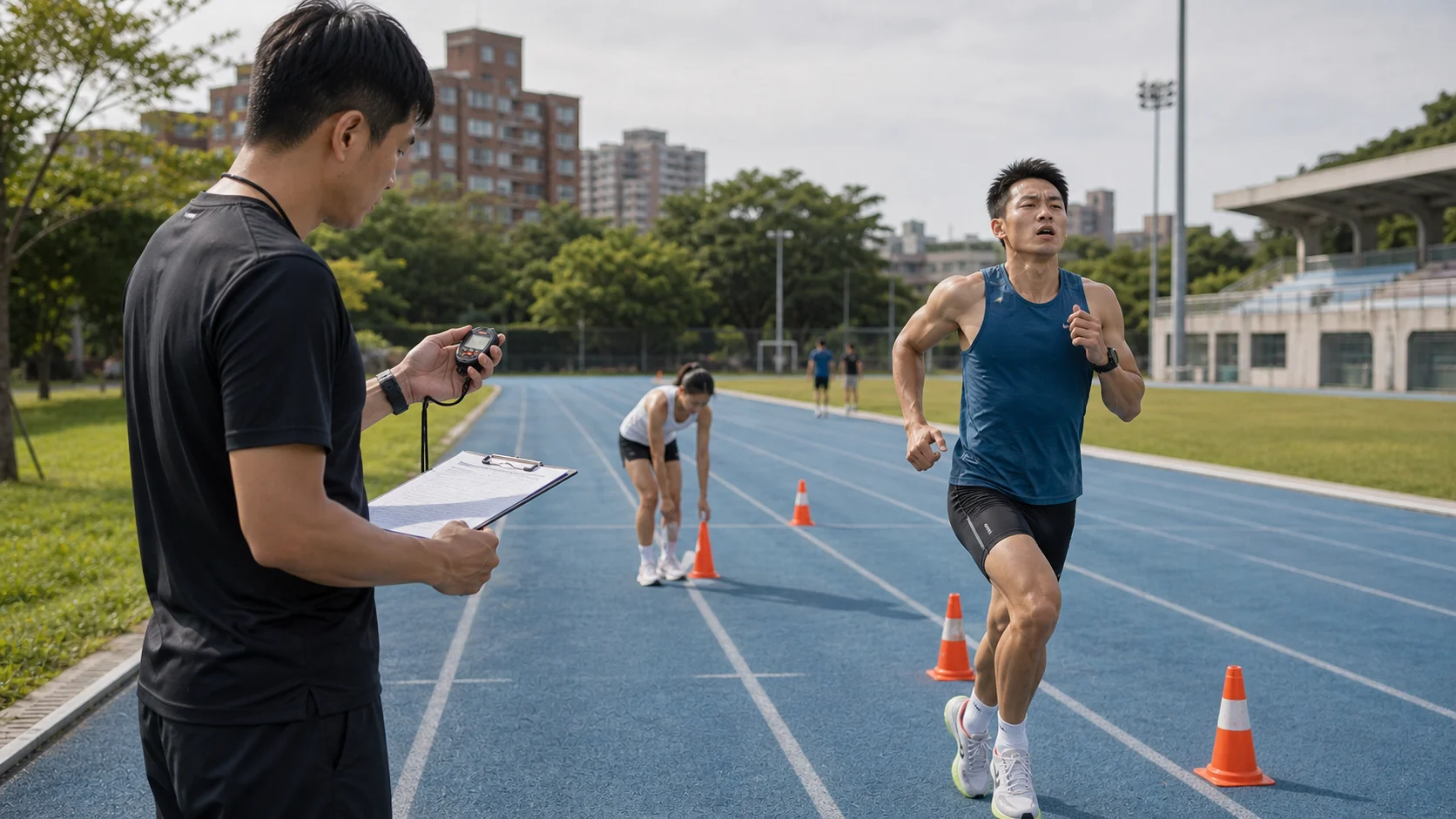
The Cooper Test (12-Minute Run Test)
What Is the Cooper Test
The Cooper Test was designed by Dr. Kenneth Cooper in 1968 for the United States Air Force, and it is one of the most widely used cardiorespiratory fitness field tests in the world.
The test method is extremely simple:
Run as far as possible in 12 minutes and record the total distance in meters.
Execution Guidelines
Preparation:
- Warm up for 5-10 minutes before running
- Choose a track of known length (a standard 400m track is ideal)
- Have a stopwatch ready
- Stay well hydrated, but don’t run right after a full meal
Execution:
- When the signal starts, run at the fastest pace you can sustain for 12 minutes
- Don’t go out too fast at the start (you’ll slow down in the later stages)
- You can sprint all-out in the final 1-2 minutes
- Stop immediately when time is up and record the total distance
Precautions:
- Not recommended after serious illness or when physical condition is extremely poor
- Stop immediately if you feel any discomfort
Cooper Test Score Reference Table
Men (unit: meters):
| Age | Excellent | Good | Average | Needs Improvement | Poor |
|---|---|---|---|---|---|
| 20-29 | >2800 | 2400-2800 | 2200-2399 | 1600-2199 | <1600 |
| 30-39 | >2700 | 2300-2700 | 1900-2299 | 1500-1899 | <1500 |
| 40-49 | >2500 | 2100-2500 | 1700-2099 | 1400-1699 | <1400 |
| 50-59 | >2400 | 2000-2400 | 1600-1999 | 1300-1599 | <1300 |
Women (unit: meters):
| Age | Excellent | Good | Average | Needs Improvement | Poor |
|---|---|---|---|---|---|
| 20-29 | >2700 | 2200-2700 | 1800-2199 | 1500-1799 | <1500 |
| 30-39 | >2500 | 2000-2500 | 1700-1999 | 1400-1699 | <1400 |
| 40-49 | >2300 | 1900-2300 | 1500-1899 | 1200-1499 | <1200 |
| 50-59 | >2200 | 1700-2200 | 1400-1699 | 1100-1399 | <1100 |
Estimating VO2max from the Cooper Test
Cooper proposed the following formula to estimate VO2max:
VO2max (ml/kg/min) = (12-minute run distance (meters) - 504.9) / 44.73
Example calculation:
- Ran 2,400 meters in 12 minutes
- VO2max = (2400 - 504.9) / 44.73 = 1895.1 / 44.73 ≈ 42.4 ml/kg/min
What different VO2max levels represent:
| VO2max (ml/kg/min) | Competitive Level |
|---|---|
| 70+ | World-class endurance athletes |
| 60-70 | Professional / elite amateur |
| 50-60 | Advanced amateur |
| 40-50 | Moderate fitness level |
| 35-40 | Low to moderate |
| <35 | Low (needs improvement) |
The Beep Test (Progressive Shuttle Run Test)
What Is the Beep Test
The Beep Test (also known as the Multi-Stage Fitness Test, MSFT) is another widely used VO2max assessment tool, especially common in Taiwanese junior high school fitness testing and military/police fitness evaluations.
Test principle:
Test-takers run back and forth over a 20-meter distance, keeping pace with an audio signal (the “beep”). The required running speed increases at each level until the runner can no longer reach the end line before the next beep.
How to Perform the Beep Test
Setup:
- Mark out a 20-meter distance on flat ground (usually in a gymnasium)
- Prepare the Beep Test audio track (downloadable online or via a phone app)
- The test-taker gets into position at the starting line
Execution:
- Once the audio starts, the runner must reach or touch the end line each time the beep sounds
- The starting speed is relatively slow (about 8.5km/h), and the speed increases by 0.5km/h at each level
- If the runner fails to reach the end line before the beep, they receive one warning; two consecutive warnings end the test
- Record the final completed Level and Shuttle number
Beep Test Score Reference Table (Men)
| Level-Shuttle | Estimated VO2max | Fitness Level |
|---|---|---|
| 5-1 | 26.8 | Low |
| 7-1 | 34.3 | Below average |
| 9-1 | 41.1 | Average |
| 11-1 | 48.0 | Good |
| 12-10 | 51.4 | Very good |
| 14-1 | 56.0 | Excellent |
| 16-1 | 62.0 | Elite |
Taiwan Police Fitness Standards (Beep Test):
- General police (male): recommended to reach Level 10 or above
- Special forces / detectives (male): recommended to reach Level 12 or above
Comparing the Two Tests
| Comparison | Cooper Test | Beep Test |
|---|---|---|
| Space required | Track (400m ideal) | 20m indoor space is enough |
| Equipment needed | Only a stopwatch | Audio equipment (phone) |
| Number of participants | Individual or small group | Multiple people at once |
| Mental challenge | Self-paced, relatively easier to complete | Constantly chasing the beep, high mental pressure |
| Suitable age range | Adults (16+) | Teenagers through adults |
| VO2max accuracy | Moderate | Moderate |
| Common use cases | Individual fitness assessment | School / military / police fitness testing |
Applying Test Results to Training
Recommended Testing Frequency for Tracking Progress
| Training Goal | Recommended Testing Frequency |
|---|---|
| General fitness | Every 12 weeks |
| Amateur competition | Every 8 weeks |
| Serious race preparation | Every 6 weeks (after a training peak) |
Expected Improvement After Training
For a generally healthy adult following systematic training, here is the expected Cooper Test improvement over 12 weeks:
| Starting Level | Improvement (12 weeks) |
|---|---|
| Low (<1600m) | 200-400m improvement |
| Moderate (1600-2200m) | 100-200m improvement |
| High (>2200m) | 50-100m improvement |
Conclusion
The Cooper Test and Beep Test are the most practical field tools for assessing cardiorespiratory fitness. For runners and cyclists in Taiwan, these two tests provide an objective starting point and a benchmark for tracking progress. Testing regularly not only quantifies your training effect, but also builds confidence throughout race preparation — watching the numbers climb with each round of training is, in itself, one of the most powerful motivations to keep training consistently.
Related Reading
#公路車 #Vo2Max #最大攝氧量 測驗 體驗 | 心肺測試
6 年前
西進武嶺 免費訓練分析服務 Intervals | 練不夠還是練過頭?你哪一種類型選手?AI模型告訴你! | 備戰神器 | 公路車 訓練 | CT Yeh
4 年前
西進武嶺 自製新版AI配速表產生器 x 賽前攻略 抱佛腳! 沒有功率計也可以產生配速表嗎?有什麼其他眉角賽前要注意的呢? | 西進武嶺 / 東進武嶺 KOM 攻略 | 公路車 | CT Yeh
4 年前
一日北高前的高裝檢 | 北高 360 | 挑戰11小時的裝備 | 一日雙塔 | 補給
6 年前
2019 柯P 超越北高 第一集團實錄 (11小時實錄請參考另一部影片) 一日雙城 一日北高 NeverStop Taiwan Long Distance Cycling Challenge
7 年前
單車 重低音 藍芽喇叭 音質實測 SoundBot SB525 Real Sound Test
8 年前
FTL 與 SYB 車隊專訪 西進武嶺 實用攻略分享! 2小時 如何練?!你不知道的眉角!新手準備武嶺必看 EP1 | 實力派女車友 | 精華版 | 公路車 | CTYeh
4 年前
一個測試有沒有認真練車的方法😂 #公路車
10 個月前