Mountain Descent Braking Technique: Protecting Your Brakes and Rims on Long Descents
Taiwan has countless mountain roads, and every climb is followed by the challenge of a long descent. Many riders can conquer the climbs, yet damage their equipment — or even crash — on the way down. This article takes a deep dive into braking technique for mountain descents.
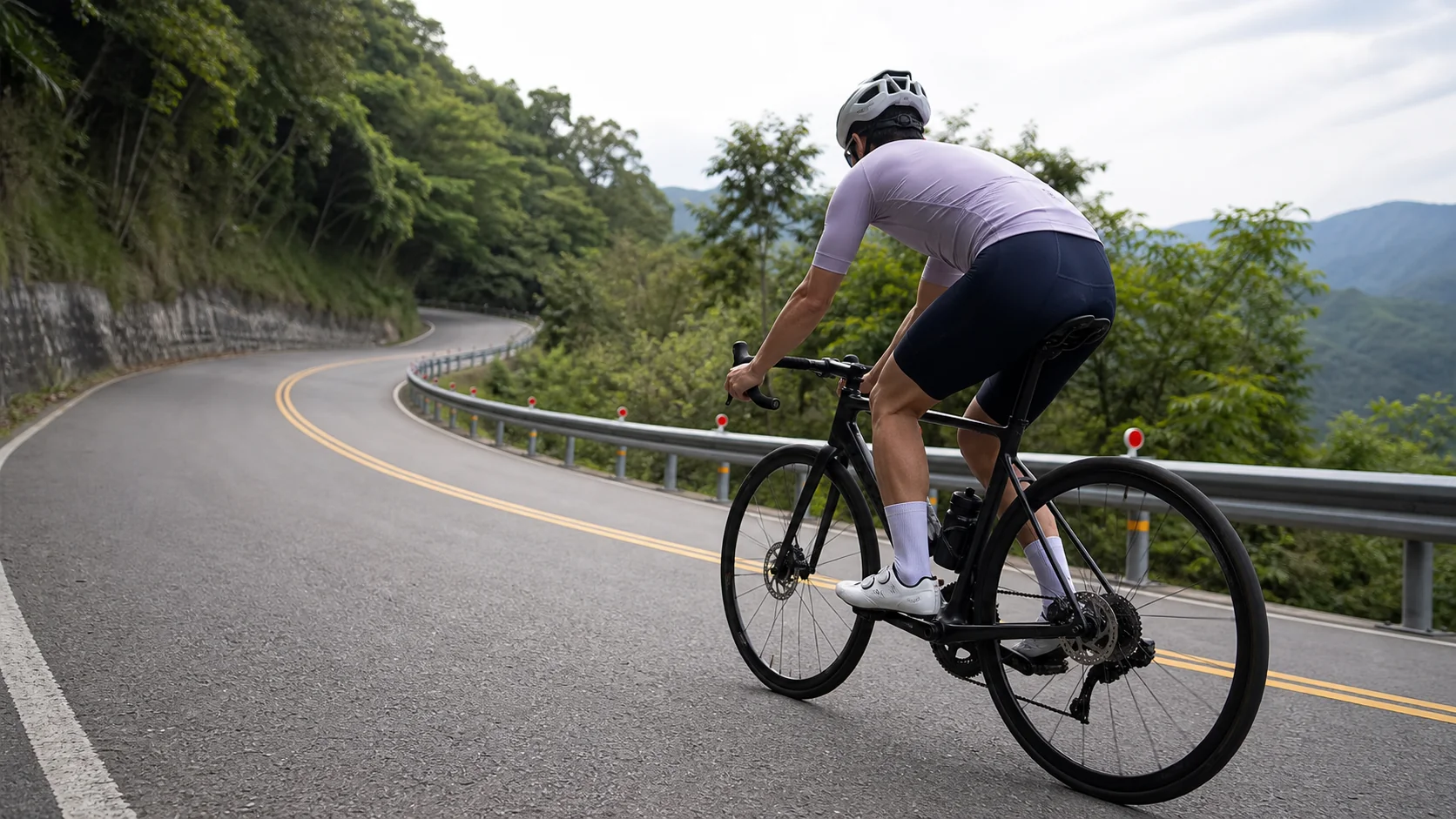
Brake Heat Buildup: The Fatal Weakness of Rim Brakes
The Physics of Heat Accumulation
Braking converts kinetic energy into heat. Continuous braking on a long descent causes heat to build up rapidly in:
- Rim brake pads: Once overheated, the rubber loses friction and braking performance deteriorates sharply
- Aluminum alloy rims: Heat conducts quickly, and temperatures can exceed 100°C
- Carbon fiber rims: Heat conducts slowly and concentrates at the rim edge, potentially exceeding 150°C
The High-Temperature Risk of Carbon Rims
The danger with carbon fiber rims is that high heat can soften the resin structure of the rim, causing deformation or even a blowout. Notable cases include rim failures on Tour de France descents.
Special advice for carbon rim users:
- Avoid continuously gripping the brakes on long descents
- If the rim feels hot after braking, stop immediately and let it cool
- Consider brake pads specifically designed for carbon rims (such as SwissStop yellow pads)
Proper Descent Braking Technique
Feathering / Modulation
The correct technique is intermittent “light touch — release — light touch — release” braking, rather than continuously squeezing the levers.
How to do it:
- Before a section that requires slowing down, apply the brakes gently and early
- Once you feel your speed drop, ease off the brakes slightly to let the rim dissipate heat
- Apply light pressure again to maintain a safe speed
This kind of intermittent braking is 30-50% more effective at cooling than continuous braking.
Front and Rear Brake Balance
| Situation | Front Brake Force | Rear Brake Force | Notes |
|---|---|---|---|
| Normal deceleration | 60-70% | 30-40% | Front brake provides strong stopping power |
| Wet road surface | 40-50% | 50-60% | Reduce the front brake ratio |
| Mid-corner | Avoid braking if possible | Light touch only | Hard braking mid-corner is not advisable |
| Emergency braking | Maximum force | Combine with anti-lock control | Modern disc brakes can include ABS |
Deceleration Strategy Before Corners
“Decelerate on the straights, hold a steady speed through the corner” is the golden rule of mountain descending:
- Read the corner: Judge the curve’s radius and road surface condition from a distance
- Complete most of your braking on the straight: Reach a safe speed before entering the corner
- Release the brakes mid-corner: Let the tires regain full lateral grip
- Accelerate out of the corner: Pedal or coast naturally
Brake Pad Maintenance and Replacement
Judging Wear
Wear indicators for aluminum rim brake pads:
- Wear grooves have disappeared (if the pad has them)
- Thickness below 3mm
- Hardened or glazed surface
Recommended replacement interval: Every 2,000-4,000 km, or whenever you notice a clear drop in braking power
Cleaning the Rim Braking Surface
Metal fragments embedded in brake pads will wear down the rim. Regularly pick out embedded debris with a toothpick or bamboo skewer, and clean the rim braking surface with an alcohol wipe.
Advantages and Precautions of Disc Brakes
Modern disc brakes clearly outperform traditional rim calipers on long descents:
Advantages:
- Heat is dissipated through the rotor rather than the rim (rotors have a large surface area and dissipate heat quickly)
- Less performance degradation in wet conditions
- Strong and consistent braking power
Precautions:
- Rotor temperatures are extremely high after a long descent — never touch the rotor
- Hydraulic disc brakes can experience “brake fade” under extreme heat; pay attention if the brake feedback becomes soft
- Brake hoses and levers need periodic bleeding and fluid replacement
Handling Emergencies
Brake Failure
If your braking performance drops suddenly during a descent (possibly due to overheating):
- Release the brakes immediately (do not keep applying pressure)
- Use the rear brake to try to control your speed (a locked rear wheel is safer than a locked front wheel)
- Look for a safe place to stop along the roadside (sand or grass)
- As a last resort, you may try dragging your foot on the ground to slow down
Mountain descents may look thrilling, but with the right technique, they are actually one of the most exhilarating parts of road cycling. Once you master the skill, you’ll learn to work with gravity instead of fighting it.
Related Reading
碟煞公路車 銑面器 !? 原來銑完差這麼多! 降低蹭碟機率! | TIME 公路車 保養小記錄 | CT Yeh
3 年前
再一組! 全碳幅條 碟煞/無內胎輪組 開箱! 到底好騎嗎? UNAAS X40 | 公路車 | CT Yeh
4 年前
碟煞公路車 優缺點?換車一年半實際經驗分享 / 公路車 / CT Yeh
2 年前
一日北高/長距離團騎 常見問題補充篇 / 組團或跟團的眉角 / 壯車友容易被瘦車友慢性拉爆 / 原來屁股痛可能是這個原因...? / 風場配速法 / 公路車 / CT Yeh
2 年前
大禹嶺 到 武嶺牌樓 全程前後實況錄影 | 北進武嶺 | 東進武嶺 | KOM | 訓練台 | 坡度分析 | Taiwan KOM Last 10 km HARD | 公路車
6 年前
CT 喇低賽) 武嶺牽車 才是王道 西進牽車四小時內秘訣 攝手位置 如何判斷 防抽筋小秘訣
7 年前
公路車 爬坡 破PR 紀錄 小技巧 分享
6 年前
Canyon 公路車斷把手 五年老車特規還能修嗎? 維修保養全記錄 feat. 501單車監理站 | 公路車 | CT Yeh
4 年前