Running Form Analysis: A Self-Assessment Method Using Your Smartphone
Running looks natural, but many people maintain poor running form for years without realizing it — not only hurting efficiency but also becoming the root cause of chronic injury. The high frame-rate video capabilities of modern smartphones make self-analysis of running form something anyone can do.
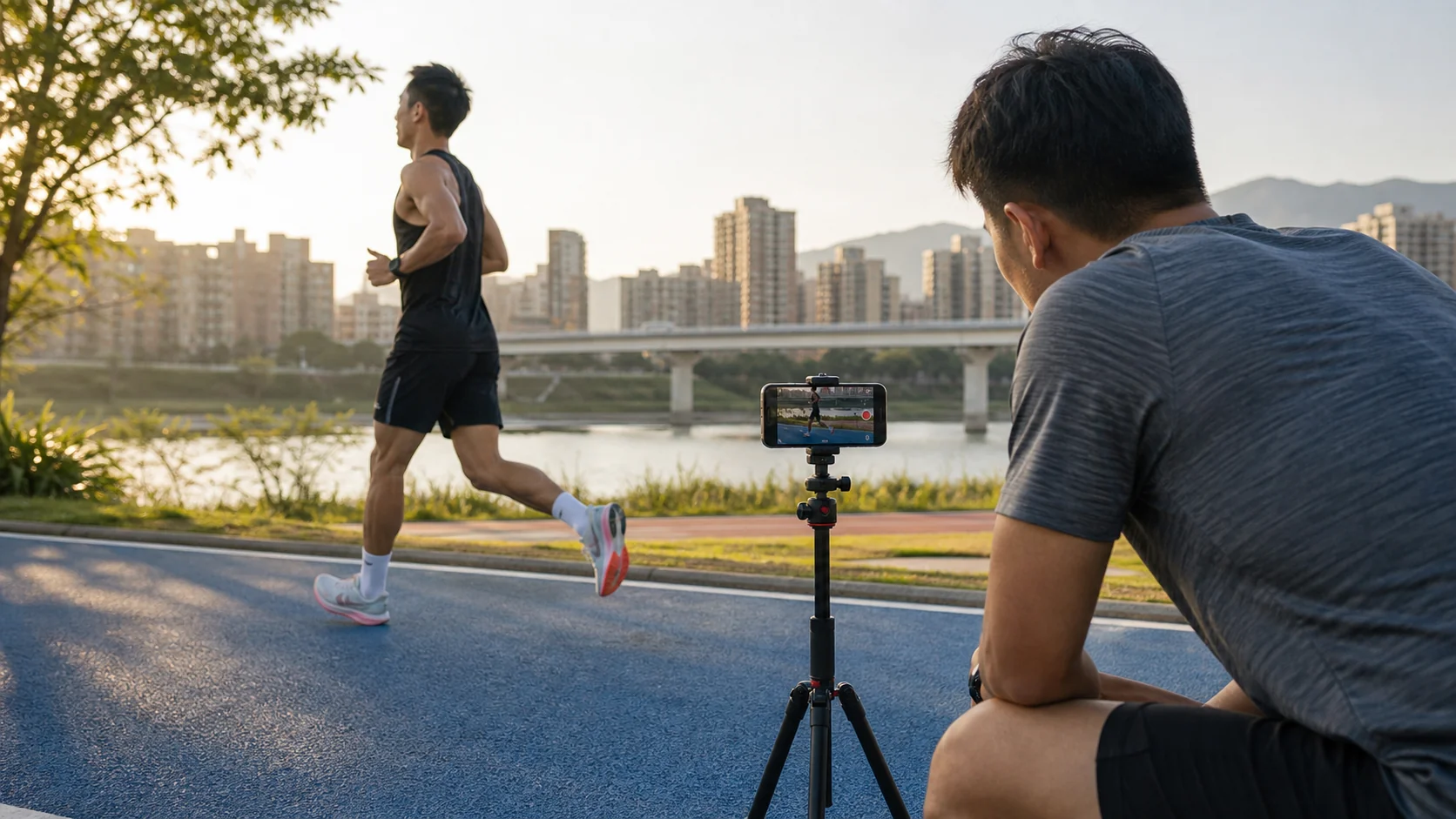
Why Analyze Your Running Form?
Research shows that about 65% of runners get injured at least once a year, and many of these injuries (knee, hip, ankle problems) are directly linked to flaws in running form. Through video analysis, you can:
- Objectively see movement problems you can’t feel on your own
- Track your progress over time
- Make preventive adjustments before an injury occurs
Filming Setup
Equipment Needed
- Smartphone: Any modern smartphone will do. The iPhone’s “Slo-Mo” (240fps) mode is especially well-suited
- Tripod or stand: To keep the camera fixed at the right height (knee height, about 60-80cm, is recommended)
- Lighting: Outdoors with plenty of natural light, or a well-lit track
Filming Angles
Three angles are needed for a comprehensive analysis:
| Angle | Key Things to Observe |
|---|---|
| Direct side view (most important) | Foot strike position, forward lean, knee angle |
| Direct rear view | Ankle eversion, hip drop, stride symmetry |
| Direct front view | Crossover gait, arm swing, head position |
Filming Speed
Slow motion at normal running speed (120-240fps) clearly captures the instant of ground contact and is the most valuable data for analysis.
Key Running Form Indicators
1. Foot Strike Position (Most Important)
Ideal: The foot lands directly beneath the hips, or slightly ahead of them
Problem pattern: Overstriding — the foot lands too far in front of your body’s center of mass
How to tell: Pause the side-view video at the instant of ground contact and check whether the lower leg is nearly vertical. If the lower leg is clearly angled forward (the contact point is far ahead of the knee), that’s overstriding.
Why overstriding hurts: Every ground contact creates a braking impact on the knees and hips, and it’s one of the leading causes of anterior knee pain (“Runner’s Knee”).
2. Cadence
Ideal range: 170-180 steps per minute (85-90 steps per foot)
How to measure: Count steps for one foot over 30 seconds and multiply by 4 to get cadence
Most recreational runners have a cadence that’s too low (150-160 steps/min), and this usually coexists with overstriding. Increasing cadence — rather than deliberately changing other aspects of form — is the most effective way to improve overall running form.
3. Forward Lean Angle
Ideal: A slight forward lean (about 5-10 degrees) along the overall body line from ankle to shoulder
Common problems:
- Standing too upright or even leaning backward (losing the forward propulsion from gravity)
- Bending at the waist instead of leaning as a whole (increasing strain on the lower back)
How to check: Pause the side-view video at the moment of foot strike, draw a line from the ankle to the ear, and observe the angle of forward lean.
4. Arm Swing
Ideal:
- Elbows bent at roughly 90 degrees
- Swinging forward and back, not sideways (not crossing the body’s midline)
- Hands loosely relaxed, not clenched into fists
Problem pattern: Swinging the arms side to side wastes energy through torso rotation and undermines stride stability.
Recommended Analysis Apps
| App | Platform | Cost | Features |
|---|---|---|---|
| Coach’s Eye | iOS/Android | Paid | Frame-by-frame analysis, drawing annotations |
| Hudl Technique | iOS/Android | Free | Slow-motion analysis |
| iPhone Camera Slo-Mo | iOS | Free | 240fps, basic analysis |
| YouTube | Any | Free | Frame-by-frame playback after upload |
Improvement Process
- Film a baseline video: Record your current running form
- Identify the main problem: Start with the most obvious issue
- Set an improvement goal: For example, “raise cadence above 170”
- Do targeted training (e.g., metronome training for cadence)
- Re-film regularly: Reassess every 4-6 weeks
Important Notes
Don’t try to change multiple aspects of your running form at once. Your body needs time to adapt to new movement patterns, and too many changes at once can cause confusion — or even trigger new injuries.
Recommended order of priority for improvement:
- Cadence (easiest to improve, most noticeable effect)
- Foot strike position (key for injury prevention)
- Arm swing (efficiency gains)
- Overall forward lean (an advanced adjustment)
Using your smartphone to analyze your running form is one of the most cost-effective investments you can make in your running training. Start recording your form and let the data speak.
Related Reading
- Slow-Motion Running Analysis: A Complete Self-Filming Method to Diagnose Running Form Problems
- Practical Running Form Assessment: A Self-Gait Analysis Using Smartphone Slow Motion
- Understanding Running Posture: Correct Technique to Reduce Injury Risk
- Running Form Analysis: Assessing and Scientifically Correcting the Injury Risks of Overstriding and Rearfoot Landing
#公路車 #Fitting 靠人工智慧APP 幫你調整單車
6 年前
[教學] Premiere 影片 手震 修正 教學 防抖 單眼 影像 GoPro 穩定 Video Stabilization
8 年前
西進武嶺 免費訓練分析服務 Intervals | 練不夠還是練過頭?你哪一種類型選手?AI模型告訴你! | 備戰神器 | 公路車 訓練 | CT Yeh
4 年前
CT 喇低賽) 單車 比賽總是沒照片? 攝影師的觀點大公開 姿勢就是力量! 請加速1.25倍收看
7 年前
iPhone內建一秒變長腿🤣 車友必備#cycling
2 年前
2018 田中馬拉松 全程健跑 VR 360 環景錄影 體驗現場狂野加油氣氛! Insta 360
7 年前
多機位拍片神器 DJI Action 2 拍出速度張力感 | 類空拍機視角 4陣列麥克風超強降風噪 實測! | 公路車 | CT Yeh
3 年前
教學) 如何做出專業 慢動作 影片 Slow Motion 120fps GoPro 7 ActionCam AX700 A99II
7 年前